| Citation: | Yan Zhao, Kang-Jun Huang, Yuanqiang Guo, Pan Zhang, Yawen Lu, Long Ma. Primary and Secondary Calcite in Chinese Loess Distinguished by Crystallinity and Implications for Illuviation Depth and East Asian Summer Monsoon Intensity. Journal of Earth Science, 2025, 36(6): 2789-2797. doi: 10.1007/s12583-023-1955-7

|
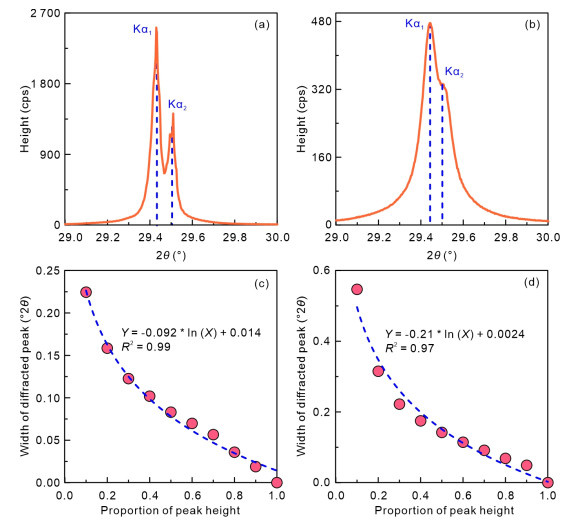
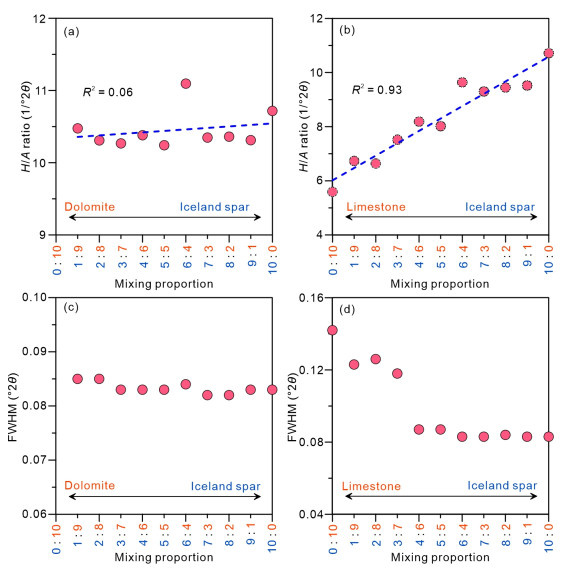
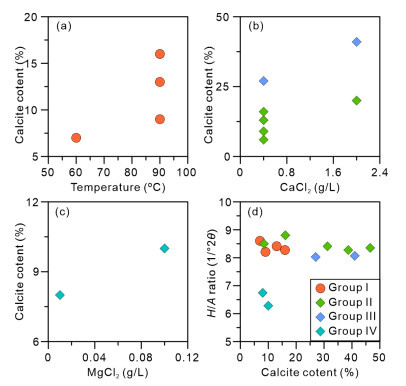
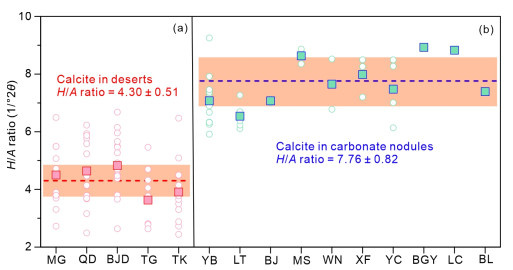
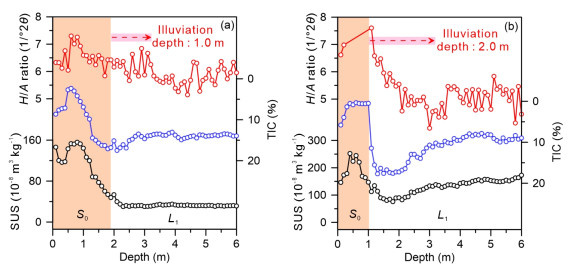
The crystallinity has the potential to distinguish the primary and secondary calcite in Chinese loess, which then provides insights into illuviation depth and variations of the East Asian Summer Monsoon. However, this aspect has been rarely investigated. In this study, we defined the crystallinity of calcite as the height/area (

| An, Z. S., Kukla, G. J., Porter, S. C., et al., 1991. Magnetic Susceptibility Evidence of Monsoon Variation on the Loess Plateau of Central China during the Last 130, 000 Years. Quaternary Research, 36(1): 29–36. https://doi.org/10.1016/0033-5894(91)90015-w |
| An, Z. S., Kutzbach, J. E., Prell, W. L., et al., 2001. Evolution of Asian Monsoons and Phased Uplift of the Himalaya-Tibetan Plateau since Late Miocene Times. Nature, 411(6833): 62–66. https://doi.org/10.1038/35075035 |
| An, Z. S., Huang, Y. S., Liu, W. G., et al., 2005. Multiple Expansions of C4 Plant Biomass in East Asia since 7 Ma Coupled with Strengthened Monsoon Circulation. Geology, 33(9): 705–708. https://doi.org/10.1130/g21423.1 |
| Battaglia, S., Leoni, L., Sartori, F., 2004. The Kübler Index in Late Dia-genetic to Low-Grade Metamorphic Pelites: A Critical Comparison of Data from 10 Å and 5 Å Peaks. Clays and Clay Minerals, 52(1): 85–105. https://doi.org/10.1346/ccmn.2004.0520109 |
|
Buol, S. W., Southard, R. J., Graham, R. C., et al., 2011. Soil-Forming Processes. In: Buol, S. W., Southard, R. J., Graham, R. C., et al., eds., Soil Genesis and Classification. John Wiley & Sons, Inc. 163–179. |
| Bronger, A., Winter, R., Heinkele, T., 1998. Pleistocene Climatic History of East and Central Asia Based on Paleopedological Indicators in Loess-Paleosol Sequences. CATENA, 34(1/2): 1–17. https://doi.org/10.1016/S0341-8162(98)00078-2 |
| Bunaciu, A. A., Udriştioiu, E. G., Aboul-Enein, H. Y., 2015. X-Ray Diffraction: Instrumentation and Applications. Critical Reviews in Analytical Chemistry, 45(4): 289–299. https://doi.org/10.1080/10408347.2014.949616 |
| Chamley, H., 1989. Clay Sedimentology. Springer-Verlag, Berlin |
| Chen, J., Qiu, G., Yang, J. D., 1997. Sr Isotopic Composition of Loess Carbonate and Identification of Primary and Secondary Carbonates. Progress in Natural Science, 7(5): 731–734 |
| Chen, J., An, Z. S., Liu, L. W., et al., 2001. Variations in Chemical Compositions of the Eolian Dust in Chinese Loess Plateau over the Past 2.5 Ma and Chemical Weathering in the Asian Inland. Science in China Series D: Earth Sciences, 44(5): 403–413. https://doi.org/10.1007/bf02909779 |
| Chen, J., Li, G. J., 2011. Geochemical Studies on the Source Region of Asian Dust. Science China Earth Sciences, 54(9): 1279–1301. https://doi.org/10.1007/s11430-011-4269-z |
| Da, J. W., Zhang, Y. G., Li, G., et al., 2020. Aridity-Driven Decoupling of δ13C between Pedogenic Carbonate and Soil Organic Matter. Geology, 48(10): 981–985. https://doi.org/10.1130/g47241.1 |
| Ding, Z. L., Yang, S. L., 2000. C3/C4 Vegetation Evolution over the last 7.0 Myr in the Chinese Loess Plateau: Evidence from Pedogenic Carbonate δ13C. Palaeogeography, Palaeoclimatology, Palaeo-ecology, 160(3/4): 291–299. https://doi.org/10.1016/s0031-0182(00)00076-6 |
| Ehrmann, W., 1998. Implications of Late Eocene to Early Miocene Clay Mineral Assemblages in McMurdo Sound (Ross Sea, Antarctica) on Paleoclimate and Ice Dynamics. Palaeogeo-graphy, Palaeoclimatology, Palaeoecology, 139(3/4): 213–231. https://doi.org/10.1016/s0031-0182(97)00138-7 |
| Feng, Z. D., Wang, H. B., 2006. Geographic Variations in Particle Size Distribution of the Last Interglacial Pedocomplex S1 across the Chinese Loess Plateau: Their Chronological and Pedogenic Implications. CATENA, 65(3): 315–328. https://doi.org/10.1016/j.catena.2006.01.002 |
| Guo, Z. T., Ruddiman, W. F., Hao, Q. Z., et al., 2002. Onset of Asian Desertification by 22 Myr Ago Inferred from Loess Deposits in China. Nature, 416(6877): 159–163. https://doi.org/10.1038/416159a |
| Guo, Z. T., Sun, B., Zhang, Z. S., et al., 2008. A Major Reorganization of Asian Climate by the Early Miocene. Climate of the Past, 4(3): 153–174. https://doi.org/10.5194/cp-4-153-2008 |
| Guo, Y. R., Deng, W. F., Wei, G. J., 2019. Kinetic Effects during the Experimental Transition of Aragonite to Calcite in Aqueous Solution: Insights from Clumped and Oxygen Isotope Signatures. Geochimica et Cosmochimica Acta, 248: 210–230. https://doi.org/10.1016/j.gca.2019.01.012 |
| Huang, Y. M., Fairchild, I. J., 2001. Partitioning of Sr2+ and Mg2+ into Calcite under Karst-Analogue Experimental Conditions. Geochimica et Cosmochimica Acta, 65(1): 47–62. https://doi.org/10.1016/s0016-7037(00)00513-5 |
| Jeong, G. Y., Hillier, S., Kemp, R. A., 2008. Quantitative Bulk and Single-Particle Mineralogy of a Thick Chinese Loess-Paleosol Section: Implications for Loess Provenance and Weathering. Quaternary Science Reviews, 27(11/12): 1271–1287. https://doi.org/10.1016/j.quascirev.2008.02.006 |
| Lee, J., Morse, J. W., 2010. Influences of Alkalinity and pCO2 on CaCO3 Nucleation from Estimated Cretaceous Composition Seawater Representative of "Calcite Seas". Geology, 38(2): 115–118. https://doi.org/10.1130/g30537.1 |
| Li, G. J., Chen, J., Chen, Y., et al., 2007. Dolomite as a Tracer for the Source Regions of Asian Dust. Journal of Geophysical Research: Atmospheres, 112(D17): 2007JD008676. https://doi.org/10.1029/2007jd008676 |
| Li, G. J., Chen, J., Chen, Y., 2013. Primary and Secondary Carbonate in Chinese Loess Discriminated by Trace Element Composition. Geochimica et Cosmochimica Acta, 103: 26–35. https://doi.org/10.1016/j.gca.2012.10.049 |
| Li, T., Liu, F., Abels, H. A., et al., 2017. Continued Obliquity Pacing of East Asian Summer Precipitation after the Mid-Pleistocene Transition. Earth and Planetary Science Letters, 457: 181–190. https://doi.org/10.1016/j.epsl.2016.09.045 |
| Liu, T. S., 1985. Loess and the Environment. China Ocean Press, Beijing. 1–251 (in Chinese) |
| Liu, W. G., Yang, H., Sun, Y. B., et al., 2011. δ13C Values of Loess Total Carbonate: A Sensitive Proxy for Asian Summer Monsoon in Arid Northwestern Margin of the Chinese Loess Plateau. Chemical Geology, 284(3/4): 317–322. https://doi.org/10.1016/j.chemgeo.2011.03.011 |
| Lu, H., Yin, Q. Z., Jia, J., et al., 2020. Possible Link of an exceptionally Strong East Asian Summer Monsoon to a Niña-Like Condition during the Interglacial MIS-13. Quaternary Science Reviews, 227: 106048. https://doi.org/10.1016/j.quascirev.2019.106048 |
| Lu, H. Y., Wang, X. Y., Wang, Y., et al., 2022. Chinese Loess and the Asian Monsoon: What We Know and What Remains Unknown. Quaternary International, 620: 85–97. https://doi.org/10.1016/j.quaint.2021.04.027 |
| Ma, L., Sun, Y. B., Jin, Z. D., et al., 2019. Tracing Changes in Monsoonal Precipitation Using Mg Isotopes in Chinese Loess Deposits. Geochimica et Cosmochimica Acta, 259: 1–16. https://doi.org/10.1016/j.gca.2019.05.036 |
| Ma, L., Sun, Y. B., Jin, Z. D., et al., 2022. Magnesium Isotopic Evidence for Staged Enhancement of the East Asian Summer Monsoon Precipitation since the Miocene. Geochimica et Cosmochimica Acta, 324: 140–155. https://doi.org/10.1016/j.gca.2022.03.005 |
| Meng, X. Q., Liu, L. W., Balsam, W., et al., 2015. Dolomite Abundance in Chinese Loess Deposits: A New Proxy of Monsoon Precipitation Intensity. Geophysical Research Letters, 42(23): 10, 391–10, 398. https://doi.org/10.1002/2015gl066681 |
| Meng, X. Q., Liu, L. W., Wang, X. T., et al., 2018. Mineralogical Evidence of Reduced East Asian Summer Monsoon Rainfall on the Chinese Loess Plateau during the Early Pleistocene Interglacials. Earth and Planetary Science Letters, 486: 61–69. https://doi.org/10.1016/j.epsl.2017.12.048 |
| Meng, X. Q., Liu, L. W., Miao, X. D., et al., 2021. Significant Influence of Northern Hemisphere High Latitude Climate on Appeared Precession Rhythm of East Asian Summer Monsoon after Mid-Brunhes Transition Interglacials Recorded in the Chinese Loess. CATENA, 197: 105002. https://doi.org/10.1016/j.catena.2020.105002 |
| Meng, X. Q., Li, G. K., Liu, L. W., et al., 2022. Decoupled Paleosol-Based Proxies in Chinese Loess Deposits: Role of Leaching and Illuviation Processes. Quaternary Science Reviews, 298: 107847. https://doi.org/10.1016/j.quascirev.2022.107847 |
| Morse, J. W., Mackenzie, F. T., 1990. Geochemistry of Sedimentary Carbonates. Elsevier |
| Murata, K. J., Norman, M. B., 1976. An Index of Crystallinity for Quartz. American Journal of Science, 276(9): 1120–1130. https://doi.org/10.2475/ajs.276.9.1120 |
| Qiang, X. K., An, Z. S., Song, Y. G., et al., 2011. New Eolian Red Clay Sequence on the Western Chinese Loess Plateau Linked to Onset of Asian Desertification about 25 Ma Ago. Science China Earth Sciences, 54(1): 136–144. https://doi.org/10.1007/s11430-010-4126-5 |
| Retallack, G. J., 2005. Pedogenic Carbonate Proxies for Amount and Seasonality of Precipitation in Paleosols. Geology, 33(4): 333–336. https://doi.org/10.1130/g21263.1 |
| Sheng, X. F., Chen, J., Ji, J. F., et al., 2008. Morphological Characters and Multi-Element Isotopic Signatures of Carbonates from Chinese Loess-Paleosol Sequences. Geochimica et Cosmochimica Acta, 72(17): 4323–4337. https://doi.org/10.1016/j.gca.2008.06.024 |
| Sun, J. M., Yin, G. M., Ding, Z. L., et al., 1998. Thermoluminescence Chronology of Sand Profiles in the Mu Us Desert, China. Palaeogeography, Palaeoclimatology, Palaeoecology, 144(1/2): 225–233. https://doi.org/10.1016/S0031-0182(98)00082-0 |
| Sun, Y. B., An, Z. S., 2005. Late Pliocene–Pleistocene Changes in Mass Accumulation Rates of Eolian Deposits on the Central Chinese Loess Plateau. Journal of Geophysical Research: Atmospheres, 110(D23): 2005JD006064. https://doi.org/10.1029/2005jd006064 |
| Sun, Y. B., Clemens, S. C., An, Z. S., et al., 2006. Astronomical Timescale and Palaeoclimatic Implication of Stacked 3.6-Myr Monsoon Records from the Chinese Loess Plateau. Quaternary Science Reviews, 25(1/2): 33–48. https://doi.org/10.1016/j.quascirev.2005.07.005 |
| Sun, Y. B., Tada, R., Chen, J., et al., 2007. Distinguishing the Sources of Asian Dust Based on Electron Spin Resonance Signal Intensity and Crystallinity of Quartz. Atmospheric Environment, 41(38): 8537–8548. https://doi.org/10.1016/j.atmosenv.2007.07.014 |
| Sun, Y. B., An, Z. S., Clemens, S. C., et al., 2010. Seven Million Years of Wind and Precipitation Variability on the Chinese Loess Plateau. Earth and Planetary Science Letters, 297(3/4): 525–535. https://doi.org/10.1016/j.epsl.2010.07.004 |
| Sun, Y. B., Clemens, S. C., Morrill, C., et al., 2012. Influence of Atlantic Meridional Overturning Circulation on the East Asian Winter Monsoon. Nature Geoscience, 5(1): 46–49. https://doi.org/10.1038/ngeo1326 |
| Sun, Y. B., Kutzbach, J., An, Z. S., et al., 2015. Astronomical and Glacial Forcing of East Asian Summer Monsoon Variability. Quaternary Science Reviews, 115: 132–142. https://doi.org/10.1016/j.quascirev.2015.03.009 |
| Sun, Y. B., Yin, Q. Z., Crucifix, M., et al., 2019. Diverse Manifestations of the Mid-Pleistocene Climate Transition. Nature Communications, 10: 352. https://doi.org/10.1038/s41467-018-08257-9 |
| Wen, Q. Z., 1989. Geochemistry of Chinese Loess. Science Press, Beijng. 25–35, 115–169 (in Chinese) |
| Xu, N. C., Shen, J. L., Luo, H. Y., 2014. Analysis for Crystallinity of Kaolinites by X-Ray Diffractometer and Infrared Spectroscopy. Resources Survey & Environment, 35(2): 152–156 (in Chinese with English Abstract) |
| Zamanian, K., Pustovoytov, K., Kuzyakov, Y., 2016. Pedogenic Car-bonates: Forms and Formation Processes. Earth-Science Reviews, 157: 1–17. https://doi.org/10.1016/j.earscirev.2016.03.003 |
| Zhao, J. B., 1995. A Study of the CaCO3 Illuvial Horizons of Paleosols and Permeated Pattern Far Rain Water. Scientia Geographica Sinica, 15(4): 344–350 (in Chinese with English Abstract) |
| Zhao, J. B., 1998. Illuvial CaCO3 Layers of Paleosol in Loess and Its Environmental Significance. Journal of Xi'an Engineering University, 20(3), 46–49 (in Chinese with English Abstract) |
Figures(6)
Copyright © 2013-2020 Journal of Earth Science 鄂ICP备15021562号-2
Tel: +86-27-67885075 Fax: +86-27-67885075 E-mail: xbb@cug.edu.cn
Address: Editorial Office of Journal, China University of Geosciences, Yujiashan, Wuhan, Hubei 430074, P. R. China
Supported by:
Beijing Renhe Information Technology Co. Ltd
E-mail:
info@rhhz.net


 DownLoad: