| Citation: | Liqiang Feng, Ruiwen Shen, Xuexiang Gu, Yongmei Zhang, Zhanlin Ge, Yingshuai Zhang. Genesis of the Shijia Gold Deposit, Jiaodong Peninsula, China: Constraints from Fluid Inclusions and Stable Isotopes. Journal of Earth Science, 2026, 37(5): 2111-2130. doi: 10.1007/s12583-024-0047-7

|
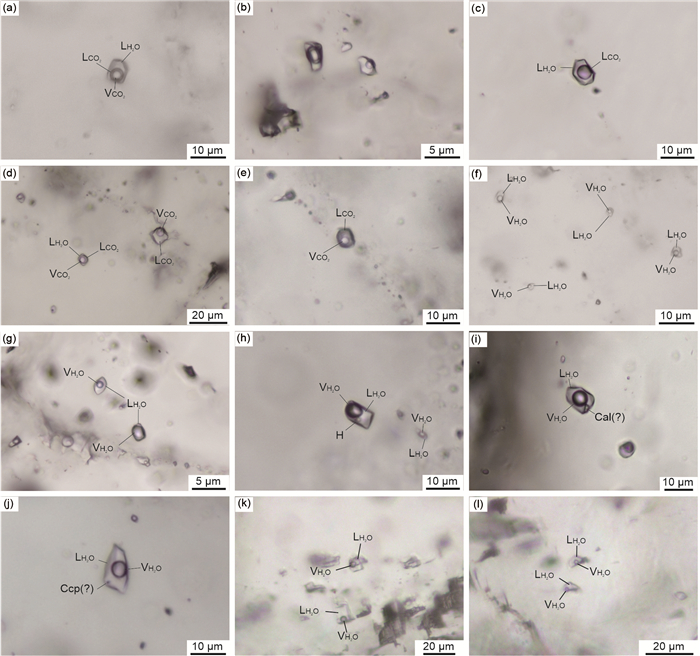
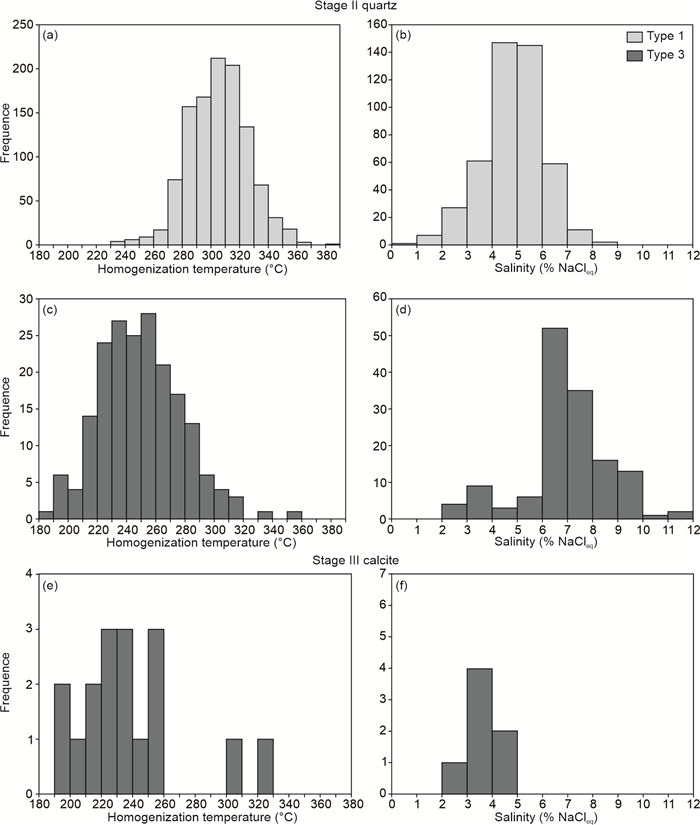
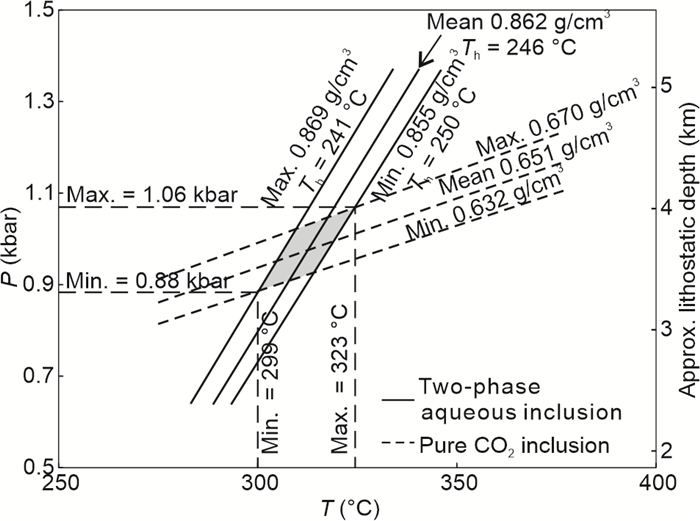
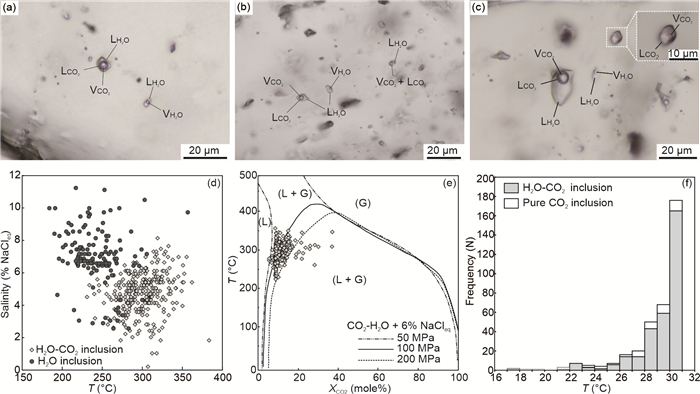
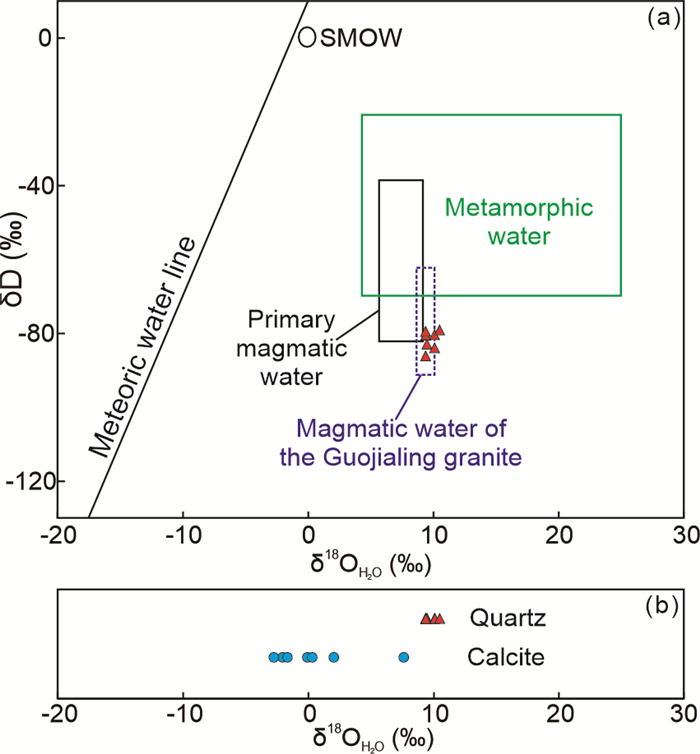
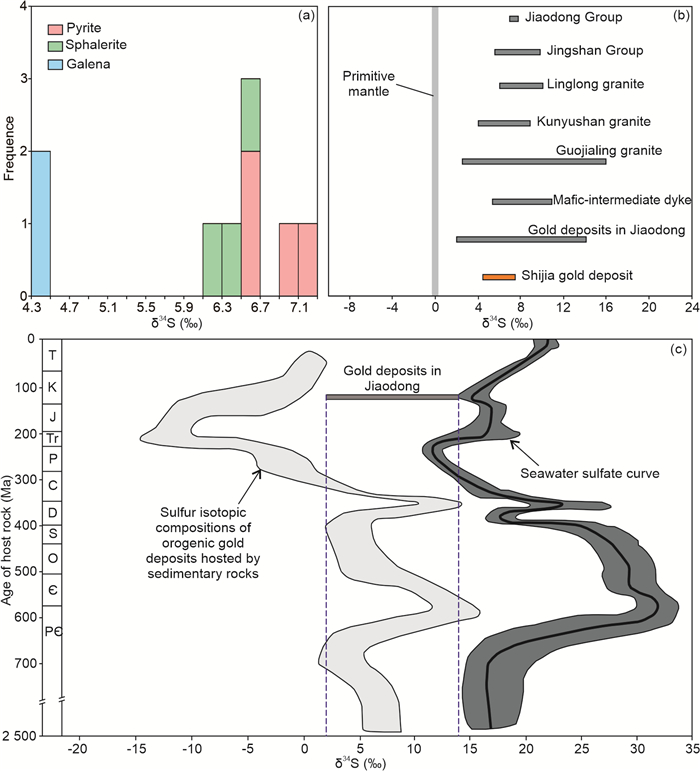
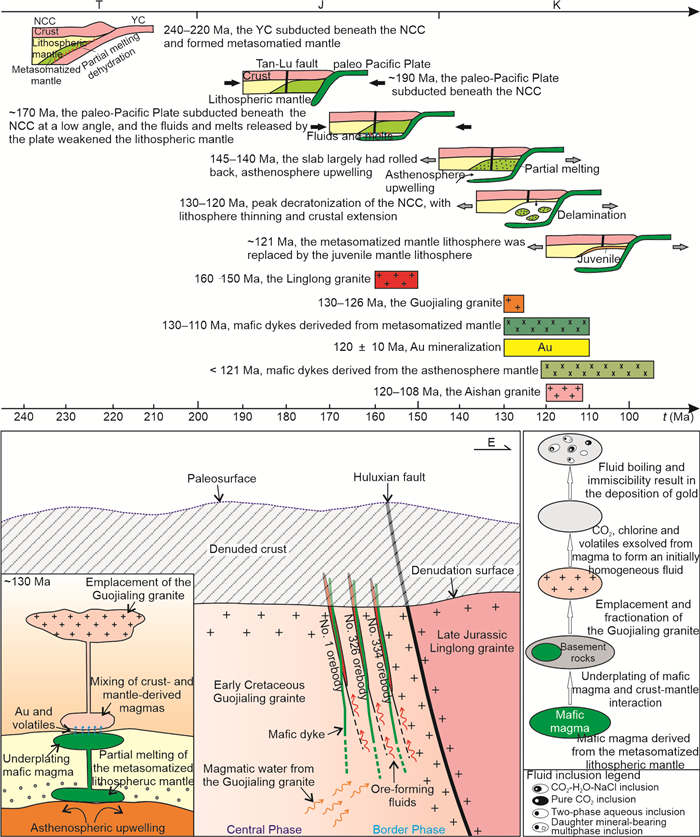
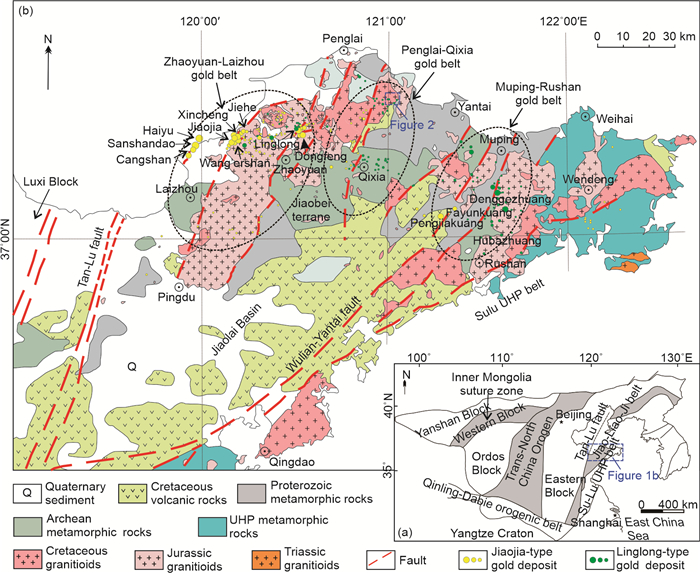
The Shijia gold deposit, situated in Penglai City, Shandong Province, is distinguished by fracture-filling auriferous quartz-sulfide veins. Studies of fluid inclusions and stable isotopes of hydrogen, oxygen, carbon, and sulfur were conducted on this deposit. The results reveal that the auriferous quartz primarily contains four types of fluid inclusions, including CO2-H2O inclusions, pure CO2 inclusions, two-phase aqueous inclusions, and solid mineral-bearing multiphase inclusions. The ore-forming fluids of Shijia belong to a heterogeneous H2O-CO2-NaCl system, characterized by moderate to high temperatures (187-386 ℃), a wide range of salinities (0.2%-41.2% NaCleq), and low densities (0.72-1.07 g/cm3). Evidence suggests that fluid immiscibility and fluid-rock interaction occurred at Shijia, with mineralization depths ranging from 3.3 to 3.9 km. The δD and δ18OH2O values of auriferous quartz vary from -86.1‰ to -79.1‰ and from 9.4‰ to 10.5‰, respectively, suggesting that the ore-forming fluids are of magmatic origin. Carbon isotope compositions of hydrothermal calcite (-3.31‰ to -0.86‰) indicate the carbon might be related to a mantle source that was contaminated by marine carbonates. The positive δ34S values of sulfides (4.3‰-7.3‰) reflect that the ore-forming materials may be sourced from the metasomatized lithospheric mantle beneath the North China Craton, related to the subduction of the Yangtze Craton in the Triassic. Collectively, geology, fluid inclusion and H-O-C-S isotopes evidence indicate that the Shijia gold deposit is of magmatic-hydrothermal origin and related to the Guojialing granite formed by the mixing of crust- and mantle-derived magmas.

| Bischoff, J. L., 1991. Densities of Liquids and Vapors in Boiling NaCl-H2O Solutions: A PVTX Summary from 300 Degrees to 500 Degrees C. American Journal of Science, 291(4): 309–338. https://doi.org/10.2475/ajs.291.4.309 |
| Bodnar, R. J., 1993. Revised Equation and Table for Determining the Freezing Point Depression of H2O-Nacl Solutions. Geochimica et Cosmochimica Acta, 57(3): 683–684. https://doi.org/10.1016/0016-7037(93)90378-a |
| Botcharnikov, R. E., Holtz, F., Mungall, J. E., et al., 2013. Behavior of Gold in a Magma at Sulfide-Sulfate Transition: Revisited. American Mineralogist, 98(8/9): 1459–1464. https://doi.org/10.2 138/am.2013.4502 doi: 10.2138/am.2013.4502 |
| Bowers, T. S., Helgeson, H. C., 1983. Calculation of the Thermodynamic and Geochemical Consequences of Nonideal Mixing in the System H2O-CO2-NaCl on Phase Relations in Geologic Systems: Equation of State for H2O-CO2-NaCl Fluids at High Pressures and Temperatures. Geochimica et Cosmochimica Acta, 47(7): 1247–1275. https://doi.org/10.1016/0016-7037(83)90066-2 |
| Bozzo, A. T., Hsiao-Sheng, C., Kass, J. R., et al., 1975. The Properties of the Hydrates of Chlorine and Carbon Dioxide. Desalination, 16(3): 303–320. https://doi.org/10.1016/s0011-916 4(00)88004-2 doi: 10.1016/s0011-9164(00)88004-2 |
| Brown, P. E., 1989. FLINCOR: A Microcomputer Program for the Reduction and Investigation of Fluid-Inclusion Data. American Mineralogist, 74(11/12): 1390–1393 |
| Cartigny, P., Harris, J. W., Javoy, M., 1998. Eclogitic Diamond Formation at Jwaneng: No Room for a Recycled Component. Science, 280(5368): 1421–1424. https://doi.org/10.1126/scienc e.280.5368.1421 doi: 10.1126/science.280.5368.1421 |
| Chai, P., Hou, Z. Q., Zhang, H. R., et al., 2019. Geology, Fluid Inclusion, and H-O-S-Pb Isotope Constraints on the Mineralization of the Xiejiagou Gold Deposit in the Jiaodong Peninsula. Geofluids, 2019: 3726465. https://doi.org/10.1155/20 19/3726465 doi: 10.1155/2019/3726465 |
| Chang, Z. S., Large, R. R., Maslennikov, V., 2008. Sulfur Isotopes in Sediment-Hosted Orogenic Gold Deposits: Evidence for an Early Timing and a Seawater Sulfur Source. Geology, 36(12): 971. https://doi.org/10.1130/g25001a.1 |
| Chen, B., Jahn, B. M., Suzuki, K., 2013. Petrological and Nd-Sr-Os Isotopic Constraints on the Origin of High-Mg Adakitic Rocks from the North China Craton: Tectonic Implications. Geology, 41(1): 91–94. https://doi.org/10.1130/g33472.1 |
| Chi, G. X., Liu, Y. X., Dubé, B., 2009. Relationship between CO2-Dominated Fluids, Hydrothermal Alterations and Gold Mineralization in the Red Lake Greenstone Belt, Canada. Applied Geochemistry, 24(4): 504–516. https://doi.org/10.1016/j.apgeochem.2008.12.005 |
| Clayton, R. N., O'Neil, J. R., Mayeda, T. K., 1972. Oxygen Isotope Exchange between Quartz and Water. Journal of Geophysical Research, 77(17): 3057–3067. https://doi.org/10.1029/jb077i017 p03057 doi: 10.1029/jb077i017p03057 |
| Dai, L. Q., Zhao, Z. F., Zheng, Y. F., et al., 2012. The Nature of Orogenic Lithospheric Mantle: Geochemical Constraints from Postcollisional Mafic-Ultramafic Rocks in the Dabie Orogen. Chemical Geology, 334: 99–121. https://doi.org/10.1016/j.chemg eo.2012.10.009 doi: 10.1016/j.chemgeo.2012.10.009 |
|
Dai, L. Q., Zheng, Y. F., Zhao, Z. F., 2016. Termination Time of Peak Decratonization in North China: Geochemical Evidence from Mafic Igneous Rocks. Lithos, 240/241/242/243: 327–336. |
| Deines, P., Gold, D. P., 1973. The Isotopic Composition of Carbonatite and Kimberlite Carbonates and Their Bearing on the Isotopic Composition of Deep-Seated Carbon. Geochimica et Cosmochimica Acta, 37(7): 1709–1733. https://doi.org/10.1 016/0016-7037(73)90158-0 doi: 10.1016/0016-7037(73)90158-0 |
| Deng, J., Liu, X. F., Wang, Q. F., et al., 2017. Isotopic Characterization and Petrogenetic Modeling of Early Cretaceous Mafic Diking—Lithospheric Extension in the North China Craton, Eastern Asia. GSA Bulletin, 129(11/12): 1379–1407. https://doi.org/10.1130/b31609.1 |
| Deng, J., Liu, X. F., Wang, Q. F., et al., 2015. Origin of the Jiaodong-Type Xinli Gold Deposit, Jiaodong Peninsula, China: Constraints from Fluid Inclusion and C-D-O-S-Sr Isotope Compositions. Ore Geology Reviews, 65: 674–686. https://doi.org/10.1016/j.oregeo rev.2014.04.018 doi: 10.1016/j.oregeorev.2014.04.018 |
| Deng, J., Yang, L. Q., Groves, D. I., et al., 2020a. An Integrated Mineral System Model for the Gold Deposits of the Giant Jiaodong Province, Eastern China. Earth-Science Reviews, 208: 103274. https://doi.org/10.1016/j.earscirev.2020.103274 |
| Deng, J., Wang, Q. F., Santosh, M., et al., 2020b. Remobilization of Metasomatized Mantle Lithosphere: A New Model for the Jiaodong Gold Province, Eastern China. Mineralium Deposita, 55(2): 257–274. https://doi.org/10.1007/s00126-019-00925-0 |
| Deng, J., Qiu, K. F., Wang, Q. F., et al., 2020c. In situ Dating of Hydrothermal Monazite and Implications for the Geodynamic Controls on Ore Formation in the Jiaodong Gold Province, Eastern China. Economic Geology, 115(3): 671–685. https://doi.org/10.5382/econgeo.4711 |
| Dong, Y. P., Santosh, M., 2016. Tectonic Architecture and Multiple Orogeny of the Qinling Orogenic Belt, Central China. Gondwana Research, 29(1): 1–40. https://doi.org/10.1016/j.gr.2015.06.009 |
| Fan, H. R., Feng, K., Li, X. H., et al., 2016. Mesozioic Gold Mineralization in the Jiaodong and Korean Peninsula. Acta Petrologica Sinca, 32(10): 3225–3228 (in Chinese with English Abstract) |
| Feng, L. Q., Gu, X. X., Zhang, Y. M., et al., 2020. Geology and Geochronology of the Shijia Gold Deposit, Jiaodong Peninsula, China. Ore Geology Reviews, 120: 103432. https://doi.org/10.1 016/j.oregeorev.2020.103432 doi: 10.1016/j.oregeorev.2020.103432 |
| Feng, L. Q., Gu, X. X., Zhang, Y. M., et al., 2023. Trace Element Geochemical Characteristics of Gold-Bearing Pyrite from the Shijia Gold Deposit in Penglai, Shandong Province and Its Constraints on Ore-Forming Fluids. Northwestern Geology, 56(5): 262–277 (in Chinese with English Abstract) |
| Gaboury, D., 2019. Parameters for the Formation of Orogenic Gold Deposits. Applied Earth Science, 128(3): 124–133. https://doi.org/10.1080/25726838.2019.1583310 |
|
Goldfarb, R. J., Santosh, M., 2014. The Dilemma of the Jiaodong Gold Deposits: Are They Unique? Geoscience Frontiers, 5(2): 139–153. |
| Goss, S. C., Wilde, S. A., Wu, F. Y., et al., 2010. The Age, Isotopic Signature and Significance of the Youngest Mesozoic Granitoids in the Jiaodong Terrane, Shandong Province, North China Craton. Lithos, 120(3/4): 309–326. https://doi.org/10.1016/j.lith os.2010.08.019 doi: 10.1016/j.lithos.2010.08.019 |
| Groves, D. I., Santosh, M., Zhang, L., et al., 2021. Subduction: The Recycling Engine Room for Global Metallogeny. Ore Geology Reviews, 134: 104130. https://doi.org/10.1016/j.oregeorev.202 1.104130 doi: 10.1016/j.oregeorev.2021.104130 |
| Gu, X. X., Li, B. H., Zhang, Y. M., et al., 2019. Research Methods of Ore Geology and Their Applications. Geological Publishing House, Beijing (in Chinese) |
| Gu, X. X., Zhang, Y. M., Ge, Z. L., et al., 2023. Mineralization and Genesis of the Orogenic Gold System in the Kalamaili Area, East Junggar, Xinjiang, Northwestern China. GSA Bulletin, 136(1/2): 461–486. https://doi.org/10.1130/b36650.1 |
| Guo, L. N., Deng, J., Yang, L. Q., et al., 2020. Gold Deposition and Resource Potential of the Linglong Gold Deposit, Jiaodong Peninsula: Geochemical Comparison of Ore Fluids. Ore Geology Reviews, 120: 103434. https://doi.org/10.1016/j.oregeo rev.2020.103434 doi: 10.1016/j.oregeorev.2020.103434 |
|
Guo, L. N., Goldfarb, R. J., Wang, Z. L., et al., 2017. A Comparison of Jiaojia- and Linglong-Type Gold Deposit Ore-Forming Fluids: Do they Differ? Ore Geology Reviews, 88: 511–533. |
| Guo, L. N., Zhang, C., Song, Y. Z., et al., 2014. Hydrogen and Oxygen Isotopes Geochemistry of the Wang'ershan Gold Deposit, Jiaodong. Acta Petrologica Sincia, 30(9): 2481–2494 (in Chinese with English Abstract) |
| Guo, P., Santosh, M., Li, S. R., 2013. Geodynamics of Gold Metallogeny in the Shandong Province, NE China: An Integrated Geological, Geophysical and Geochemical Perspective. Gondwana Research, 24(3/4): 1172–1202. https://doi.org/10.1 016/j.gr.2013.02.004 doi: 10.1016/j.gr.2013.02.004 |
|
Hacker, B. R., Ratschbacher, L., Liou, J. G., 2004. Subduction, Collision and Exhumation in the Ultrahigh-Pressure Qinling-Dabie Orogen. Geological Society, London, Special Publications, 226(1): 157–175. |
| Hacker, B. R., Wallis, S. R., McWilliams, M. O., et al., 2009. 40Ar/39Ar Constraints on the Tectonic History and Architecture of the Ultrahigh-Pressure Sulu Orogen. Journal of Metamorphic Geology, 27(9): 827–844. https://doi.org/10.1111/j.1525-1314.2 009.00840.x doi: 10.1111/j.1525-1314.2009.00840.x |
| Hall, D. L., Sterner, S. M., Bodnar, R. J., 1988. Freezing Point Depression of NaCl-KCl-H2O Solutions. Economic Geology, 83(1): 197–202. https://doi.org/10.2113/gsecongeo.83.1.197 |
| Hoefs, J., 1997. Stable Isotope Geochemistry. Springer Verlag, Berlin |
| Hollister, L. S., 1990. Enrichment of CO2 in Fluid Inclusions in Quartz by Removal of H2O during Crystal-Plastic Deformation. Journal of Structural Geology, 12(7): 895–901. https://doi.org/10.1016/0191-8141(90)90062-4 |
| Jiang, P., Yang, K. F., Fan, H. R., et al., 2016. Titanite-Scale Insights into Multi-Stage Magma Mixing in Early Cretaceous of NW Jiaodong Terrane, North China Craton. Lithos, 258/259: 197–214. https://doi.org/10.1016/j.lithos.2016.04.028 |
| Jahn, B. M., Liu, D., Wan, Y., et al., 2008. Archean Crustal Evolution of the Jiaodong Peninsula, China, as Revealed by Zircon SHRIMP Geochronology, Elemental and Nd-Isotope Geochemistry. American Journal of Science, 308(3): 232–269. https://doi.org/10.2475/03.2008.03 |
| Lambert, I. B., Walter, M. R., Zang, W. L., et al., 1987. Palaeoenvironment and Carbon Isotope Stratigraphy of Upper Proterozoic Carbonates of the Yangtze Platform. Nature, 325(6100): 140–142. https://doi.org/10.1038/325140a0 |
| Lang, J. R., Baker, T., 2001. Intrusion-Related Gold Systems: The Present Level of Understanding. Mineralium Deposita, 36(6): 477–489. https://doi.org/10.1007/s001260100184 |
| Li, H., Sun, H. S., Evans, N. J., et al., 2019. Geochemistry and Geochronology of Zircons from Granite-Hosted Gold Mineralization in the Jiaodong Peninsula, North China: Implications for Ore Genesis. Ore Geology Reviews, 115: 103188. https://doi.org/10.1016/j.oregeorev.2019.103188 |
| Li, L., Li, S. R., Santosh, M., et al., 2016. Dyke Swarms and Their Role in the Genesis of World-Class Gold Deposits: Insights from the Jiaodong Peninsula, China. Journal of Asian Earth Sciences, 130: 2–22. https://doi.org/10.1016/j.jseaes.2016.0 6.015 doi: 10.1016/j.jseaes.2016.06.015 |
| Li, L., Santosh, M., Li, S. R., 2015. The 'Jiaodong Type' Gold Deposits: Characteristics, Origin and Prospecting. Ore Geology Reviews, 65: 589–611. https://doi.org/10.1016/j.oregeorev.201 4.06.021 doi: 10.1016/j.oregeorev.2014.06.021 |
| Li, X. H., Chen, F. K., Guo, J. H., et al., 2007. South China Provenance of the Lower-Grade Penglai Group North of the Sulu UHP Orogenic Belt, Eastern China: Evidence from Detrital Zircon Ages and Nd-Hf Isotopic Composition. Geochemical Journal, 41(1): 29–45. https://doi.org/10.2343/geochemj.41.29 |
| Li, X. H., Fan, H. R., Hu, F. F., et al., 2019a. Linking Lithospheric Thinning and Magmatic Evolution of Late Jurassic to Early Cretaceous Granitoids in the Jiaobei Terrane, Southeastern North China Craton. Lithos, 324/325: 280–296. https://doi.org/10.1016/j.lithos.2018.11.022 |
| Li, X. H., Fan, H. R., Santosh, M., et al., 2019b. Mesozoic Felsic Dikes in the Jiaobei Terrane, Southeastern North China Craton: Constraints from Zircon Geochronology and Geochemistry, and Implications for Gold Metallogeny. Journal of Geochemical Exploration, 201: 40–55. https://doi.org/10.1016/j.gexplo.2019. 03.012 doi: 10.1016/j.gexplo.2019.03.012 |
| Li, X. Y., Li, S. Z., Suo, Y. H., et al., 2018. Early Cretaceous Diabases, Lamprophyres and Andesites-Dacites in Western Shandong, North China Craton: Implications for Local Delamination and Paleo-Pacific Slab Rollback. Journal of Asian Earth Sciences, 160: 426–444. https://doi.org/10.1016/j.jseae s.2017.08.005 doi: 10.1016/j.jseaes.2017.08.005 |
| Li, Y. J., He, H. Y., Deng, C. L., et al., 2018. 40Ar/39Ar Dating Results from the Shijiatun Formation, Jiaolai Basin: New Age Constraints on the Cretaceous Terrestrial Volcanic-Sedimentary Sequence of China. Cretaceous Research, 86: 251–260. https://doi.org/10.1016/j.cretres.2018.03.003 |
| Li, Y. J., Li, S. R., Santosh, M., et al., 2015. Zircon Geochronology, Geochemistry and Stable Isotopes of the Wang'ershan Gold Deposit, Jiaodong Peninsula, China. Journal of Asian Earth Sciences, 113: 695–710. https://doi.org/10.1016/j.jseaes.2015. 03.036 doi: 10.1016/j.jseaes.2015.03.036 |
| Ling, W. L., Duan, R. C., Xie, X. J., et al., 2009. Contrasting Geochemistry of the Cretaceous Volcanic Suites in Shandong Province and Its Implications for the Mesozoic Lower Crust Delamination in the Eastern North China Craton. Lithos, 113(3/4): 640–658. https://doi.org/10.1016/j.lithos.2009.07.001 |
| Liu, F. L., Liu, L. S., Liu, P. H., et al., 2017. A Relic Slice of Archean–Early Paleoproterozoic Basement of Jiaobei Terrane Identified within the Sulu UHP Belt: Evidence from Protolith and Metamorphic Ages from Meta-Mafic Rocks, TTG-Granitic Gneisses, and Metasedimentary Rocks in the Haiyangsuo Region. Precambrian Research, 303: 117–152. https://doi.org/10.1016/j.precamres.2017.03.014 |
| Liu, J. G., Cai, R. H., Pearson, D. G., et al., 2019. Thinning and Destruction of the Lithospheric Mantle Root beneath the North China Craton: A Review. Earth-Science Reviews, 196: 102873. https://doi.org/10.1016/j.earscirev.2019.05.017 |
| Liu, Z. K., Hollings, P., Mao, X. C., et al., 2021. Metal Remobilization from Country Rocks into the Jiaodong-Type Orogenic Gold Systems, Eastern China: New Constraints from Scheelite and Galena Isotope Results at the Xiadian and Majiayao Gold Deposits. Ore Geology Reviews, 134: 104126. https://doi.org/10.1016/j.oregeorev.2021.104126 |
|
Ma, L., Jiang, S. Y., Hofmann, A. W., et al., 2014. Lithospheric and Asthenospheric Sources of Lamprophyres in the Jiaodong Peninsula: A Consequence of Rapid Lithospheric Thinning beneath the North China Craton? Geochimica et Cosmochimica Acta, 124: 250–271. |
| Ma, L., Jiang, S. Y., Hofmann, A. W., et al., 2016. Rapid Lithospheric Thinning of the North China Craton: New Evidence from Cretaceous Mafic Dikes in the Jiaodong Peninsula. Chemical Geology, 432: 1–15. https://doi.org/10.1016/j.chemgeo.2016.0 3.027 doi: 10.1016/j.chemgeo.2016.03.027 |
| Melfos, V., Voudouris, P., 2016. Fluid Evolution in Tertiary Magmatic-Hydrothermal Ore Systems at the Rhodope Metallogenic Province, NE Greece. A Review. Geologia Croatica, 69(1): 157–167. https://doi.org/10.4154/gc.2016.12 |
| O'Neil, J. R., Clayton, R. N., Mayeda, T. K., 1969. Oxygen Isotope Fractionation in Divalent Metal Carbonates. The Journal of Chemical Physics, 51(12): 5547–5558. https://doi.org/10.1063/1.1671982 |
| Ohmoto, H., 1986. Stable Isotope Geochemistry of Ore Deposites. Reviews in Mineralogy and Geochemistry, 16(1): 491–559 |
| Ohmoto, H., Rye, R. O., 1979. Isotopes of Sulfur and Carbon. In: Barnes, H. L., ed., Geochemical of Hydrothermal Ore Deposits. John Wiley and Sons, New York |
| Olsen, S. N., 1988. High-Density CO2 Inclusions in the Colorado Front Range. Contributions to Mineralogy and Petrology, 100(2): 226–235. https://doi.org/10.1007/bf00373589 |
| Phillips, G. N., Evans, K. A., 2004. Role of CO2 in the Formation of Gold Deposits. Nature, 429(6994): 860–863. https://doi.org/10. 1038/nature02644 doi: 10.1038/nature02644 |
| Potter, R. W., Clynne, M. A., Brown, D. L., 1978. Freezing Point Depression of Aqueous Sodium Chloride Solutions. Economic Geology, 73(2): 284–285. https://doi.org/10.2113/gsecongeo.7 3.2.284 doi: 10.2113/gsecongeo.73.2.284 |
| Puddephatt, R. J., 1978. The Chemistry of Gold. Elsevier, Amsterdam |
| Qiu, Y. M., Groves, D. I., McNaughton, N. J., et al., 2002. Nature, Age, and Tectonic Setting of Granitoid-Hosted, Orogenic Gold Deposits of the Jiaodong Peninsula, Eastern North China Craton, China. Mineralium Deposita, 37(3): 283–305. https://doi.org/10.1007/s00126-001-0238-3 |
| Ren, Z. H., Lin, W., 2019. Mesozoic Tectonic Evolution of Eastern China: Insights from the Changshan Islands, NE China. Tectonophysics, 763: 46–60. https://doi.org/10.1016/j.tecto.201 9.04.025 doi: 10.1016/j.tecto.2019.04.025 |
| Roedder, E., 1984. Fluid Inclusions: Reviews in Mineralogy. Mineralogical Society of America, Washington |
| Saunders, J. E., Pearson, N. J., O'Reilly, S. Y., et al., 2018. Gold in the Mantle: A Global Assessment of Abundance and Redistribution Processes. Lithos, 322: 376–391. https://doi.org/10.1016/j.lithos.2018.10.022 |
| Schindler, C., Hagemann, S. G., Banks, D., et al., 2016. Magmatic Hydrothermal Fluids at the Sedimentary Rock-Hosted, Intrusion-Related Telfer Gold-Copper Deposit, Paterson Orogen, Western Australia: Pressure-Temperature-Composition Constraints on the Ore-Forming Fluids. Economic Geology, 111(5): 1099–1126. https://doi.org/10.2113/econgeo.111.5.1099 |
| Shan, H. X., Zhai, M. G., Oliveira, E. P., et al., 2015. Convergent Margin Magmatism and Crustal Evolution during Archean-Proterozoic Transition in the Jiaobei Terrane: Zircon U-Pb Ages, Geochemistry, and Nd Isotopes of Amphibolites and Associated Grey Gneisses in the Jiaodong Complex, North China Craton. Precambrian Research, 264: 98–118. https://doi.org/10.1016/j.precamres.2015.04.008 |
| Sillitoe, R. H., 2010. Porphyry Copper Systems. Economic Geology, 105(1): 3–41. https://doi.org/10.2113/gsecongeo.105.1.3 |
| Simon, A. C., Frank, M. R., Pettke, T., et al., 2005. Gold Partitioning in Melt-Vapor-Brine Systems. Geochimica et Cosmochimica Acta, 69(13): 3321–3335. https://doi.org/10.1016/j.gca.2005.0 1.028 doi: 10.1016/j.gca.2005.01.028 |
| Stefánsson, A., Seward, T. M., 2004. Gold(Ⅰ) Complexing in Aqueous Sulphide Solutions to 500 ℃ at 500 Bar. Geochimica et Cosmochimica Acta, 68(20): 4121–4143. https://doi.org/10.1016/j.gca.2004.04.006 |
| Tan, J., Wei, J. H., He, H. Y., et al., 2018. Noble Gases in Pyrites from the Guocheng-Liaoshang Gold Belt in the Jiaodong Province: Evidence for a Mantle Source of Gold. Chemical Geology, 480: 105–115. https://doi.org/10.1016/j.chemgeo.201 7.09.027 doi: 10.1016/j.chemgeo.2017.09.027 |
| Tan, J., Wei, J. H., Li, Y. J., et al., 2015. Origin and Geodynamic Significance of Fault-Hosted Massive Sulfide Gold Deposits from the Guocheng-Liaoshang Metallogenic Belt, Eastern Jiaodong Peninsula: Rb-Sr Dating, and H-O-S-Pb Isotopic Constraints. Ore Geology Reviews, 65: 687–700. https://doi.org/10.1016/j.oregeorev.2014.06.007 |
| Tan, J., Wei, J. H., Audétat, A., et al., 2012. Source of Metals in the Guocheng Gold Deposit, Jiaodong Peninsula, North China Craton: Link to Early Cretaceous Mafic Magmatism Originating from Paleoproterozoic Metasomatized Lithospheric Mantle. Ore Geology Reviews, 48: 70–87. https://doi.org/10.1016/j.oregeor ev.2012.02.008 doi: 10.1016/j.oregeorev.2012.02.008 |
| Tang, J., Zheng, Y. F., Wu, Y. B., et al., 2008. Zircon U-Pb Age and Geochemical Constraints on the Tectonic Affinity of the Jiaodong Terrane in the Sulu Orogen, China. Precambrian Research, 161(3/4): 389–418. https://doi.org/10.1016/j.precamres.2007.09.008 |
| Taylor, H. P., 1997. Oxygen and Hydrogen Isotope Relationships in Hydrothermal Mineral Deposits. In: Barnes, H. L., ed., Geochemistry of Hydrothermal Ore Deposit. John Wiley and Sons, New York. 236–277 |
| Tomkins, A. G., 2010. Windows of Metamorphic Sulfur Liberation in the Crust: Implications for Gold Deposit Genesis. Geochimica et Cosmochimica Acta, 74(11): 3246–3259. https://doi.org/10.1016/j.gca.2010.03.003 |
| Veizer, J., Holser, W. T., Wilgus, C. K., 1980. Correlation of and Secular Variations. Geochimica et Cosmochimica Acta, 44(4): 579–587. https://doi.org/10.1016/0016-7037(80)90250-1 |
| Wan, Y. S., Song, B., Liu, D. Y., et al., 2006. SHRIMP U-Pb Zircon Geochronology of Palaeoproterozoic Metasedimentary Rocks in the North China Craton: Evidence for a Major Late Palaeoproterozoic Tectonothermal Event. Precambrian Research, 149(3/4): 249–271. https://doi.org/10.1016/j.precamr es.2006.06.006 doi: 10.1016/j.precamres.2006.06.006 |
| Wang, J., Chang, S. C., Lu, H. B., et al., 2016. Detrital Zircon Provenance of the Wangshi and Laiyang Groups of the Jiaolai Basin: Evidence for Early Cretaceous Uplift of the Sulu Orogen, Eastern China. International Geology Review, 58(6): 719–736. https://doi.org/10.1080/00206814.2015.1105728 |
| Wang, X., Wang, Z. C., Cheng, H., et al., 2020. Early Cretaceous Lamprophyre Dyke Swarms in Jiaodong Peninsula, Eastern North China Craton, and Implications for Mantle Metasomatism Related to Subduction. Lithos, 368/369: 105593. https://doi.org/10.1016/j.lithos.2020.105593 |
| Wang, Z. C., Cheng, H., Zong, K. Q., et al., 2020. Metasomatized Lithospheric Mantle for Mesozoic Giant Gold Deposits in the North China Craton. Geology, 48(2): 169–173. https://doi.org/10.1130/g46662.1 |
| Wang, Z. C., Xu, Z., Cheng, H., et al., 2021. Precambrian Metamorphic Crustal Basement Cannot Provide much Gold to Form Giant Gold Deposits in the Jiaodong Peninsula, China. Precambrian Research, 354: 106045. https://doi.org/10.1016/j.p recamres.2020.106045 doi: 10.1016/j.precamres.2020.106045 |
| Wang, Z. L., Yang, L. Q., Guo, L. N., et al., 2015. Fluid Immiscibility and Gold Deposition in the Xincheng Deposit, Jiaodong Peninsula, China: A Fluid Inclusion Study. Ore Geology Reviews, 65: 701–717. https://doi.org/10.1016/j.oregeorev.201 4.06.006 doi: 10.1016/j.oregeorev.2014.06.006 |
| Wen, B. J., Fan, H. R., Hu, F. F., et al., 2016. Fluid Evolution and Ore Genesis of the Giant Sanshandao Gold Deposit, Jiaodong Gold Province, China: Constrains from Geology, Fluid Inclusions and H-O-S-He-Ar Isotopic Compositions. Journal of Geochemical Exploration, 171: 96–112. https://doi.org/10.1016/j.gexplo.201 6.01.007 doi: 10.1016/j.gexplo.2016.01.007 |
| Wilkinson, J. J., 2001. Fluid Inclusions in Hydrothermal Ore Deposits. Lithos, 55(1/2/3/4): 229–272. https://doi.org/10.1016/s0024-4937(00)00047-5 |
| Williams-Jones, A. E., Bowell, R. J., Migdisov, A. A., 2009. Gold in Solution. Elements, 5(5): 281–287. https://doi.org/10.2113/gsele ments.5.5.281 doi: 10.2113/gselements.5.5.281 |
| Yan, Y. T., Zhang, N., Li, S. R., et al., 2014. Mineral Chemistry and Isotope Geochemistry of Pyrite from the Heilangou Gold Deposit, Jiaodong Peninsula, Eastern China. Geoscience Frontiers, 5(2): 205–213. https://doi.org/10.1016/j.gsf.2013.0 5.003 doi: 10.1016/j.gsf.2013.05.003 |
|
Yang, D. B., Xu, W. L., Pei, F. P., et al., 2012. Spatial Extent of the Influence of the Deeply Subducted South China Block on the Southeastern North China Block: Constraints from Sr-Nd-Pb Isotopes in Mesozoic Mafic Igneous Rocks. Lithos, 136/137/138/139: 246–260. |
| Yang, J. D., Sun, W. G., Wang, Z. Z., et al., 1999. Variations in Sr and C Isotopes and Ce Anomalies in Successions from China: Evidence for the Oxygenation of Neoproterozoic Seawater? Precambrian Research, 93(2/3): 215–233. https://doi.org/10.10 16/s0301-9268(98)00092-8 |
| Yang, J. H., Chung, S. L., Wilde, S. A., et al., 2005. Petrogenesis of Post-Orogenic Syenites in the Sulu Orogenic Belt, East China: Geochronological, Geochemical and Nd-Sr Isotopic Evidence. Chemical Geology, 214(1/2): 99–125. https://doi.org/10.1016/j.chemgeo.2004.08.053 |
| Yang, K. F., Fan, H. R., Santosh, M., et al., 2012. Reactivation of the Archean Lower Crust: Implications for Zircon Geochronology, Elemental and Sr-Nd-Hf Isotopic Geochemistry of Late Mesozoic Granitoids from Northwestern Jiaodong Terrane, the North China Craton. Lithos, 146/147: 112–127. https://doi.org/10.1016/j.lithos.2012.04.035 |
| Yang, L. Q., Deng, J., Wang, Z. L., et al., 2014. Mesozoic Gold Metallogenic System of the Jiaodong Gold Province, Eastern China. Acta Petrologica Sinica, 30(9): 2447–2467 (in Chinese with English Abstract) |
| Yang, L. Q., Guo, L. N., Wang, Z. L., et al., 2017. Timing and Mechanism of Gold Mineralization at the Wang'ershan Gold Deposit, Jiaodong Peninsula, Eastern China. Ore Geology Reviews, 88: 491–510. https://doi.org/10.1016/j.oregeorev.201 6.06.027 doi: 10.1016/j.oregeorev.2016.06.027 |
| Yang, Y., Wang, X. X., Yu, X. W., et al., 2017. Chemical Composition of Biotite and Amphibole from Mesozoic Granites in Northwestern Jiaodong Peninsula, China, and Their Implications. Acta Petrologica Sinca, 33(10): 3123–3136 (in Chinese with English Abstract) |
| Yuan, Z. Z., Li, Z. K., Zhao, X. F., et al., 2019. New Constraints on the Genesis of the Giant Dayingezhuang Gold (Silver) Deposit in the Jiaodong District, North China Craton. Ore Geology Reviews, 112: 103038. https://doi.org/10.1016/j.oregeorev.201 9.103038 doi: 10.1016/j.oregeorev.2019.103038 |
| Zhang, C., Liu, Y., Liu, X. D., et al., 2014. Characteristics of Sulfur Isotope Geochemistry of the Xincheng Gold Deposit, Northwest Jiaodong, China. Acta Petrologica Sinica, 30: 2495–2506 (in Chinese with English Abstract) |
|
Zhang, J., Zhao, Z. F., Zheng, Y. F., et al., 2012. Zircon Hf-O Isotope and Whole-Rock Geochemical Constraints on Origin of Postcollisional Mafic to Felsic Dykes in the Sulu Orogen. Lithos, 136/137/138/139: 225–245. |
| Zhang, J., Zhao, Z. F., Zheng, Y. F., et al., 2010. Postcollisional Magmatism: Geochemical Constraints on the Petrogenesis of Mesozoic Granitoids in the Sulu Orogen, China. Lithos, 119(3/4): 512–536. https://doi.org/10.1016/j.lithos.2010.08.005 |
| Zhang, T. G., Chu, X. L., Zhang, Q. R., et al., 2004. The Sulfur and Carbon Isotopic Records in Carbonates of the Dengying Formation in the Yangtze Platform, China. Acta Petrologica Sinica, 20(3): 717–724 (in Chinese with English Abstract) |
| Zhao, G. C., Sun, M., Wilde, S. A., et al., 2005. Late Archean to Paleoproterozoic Evolution of the North China Craton: Key Issues Revisited. Precambrian Research, 136(2): 177–202. https://doi.org/10.1016/j.precamres.2004.10.002 |
| Zhao, Z. F., Zheng, Y. F., 2009. Remelting of Subducted Continental Lithosphere: Petrogenesis of Mesozoic Magmatic Rocks in the Dabie-Sulu Orogenic Belt. Science in China Series D: Earth Sciences, 52(9): 1295–1318. https://doi.org/10.1007/s11430-00 9-0134-8 doi: 10.1007/s11430-009-0134-8 |
| Zheng, Y. F., Chen, J. F., 2000. Stable Isotope Geochemistry. Science Press, Beijing (in Chinese) |
| Zhou, G. Y., Song, M. C., Li, L., et al., 2024. Cooling History of Mesozoic Magmatism and Implications for Large-Scale Gold Mineralization in the Jiaodong Peninsula, East China: Constraints from T-t Paths Determined by U-Pb Thermochronology of Zircon and Apatite. Journal of Earth Science, 35(3): 878–889.https://doi.org/10.1007/s12583-023-18 32-4 doi: 10.1007/s12583-023-1832-4 |
| Zhou, J. B., Han, W., Song, M. C., et al., 2020. Zircon U-Pb Ages of the Cetaceous Sedimentary Rocks in the Laiyang Basin, Eastern China and Their Tectonic Implications. Journal of Asian Earth Sciences, 194: 103956.https://doi.org/10.1016/j.jseaes.20 19.103956 doi: 10.1016/j.jseaes.2019.103956 |
| Zhou, J. B., Wilde, S. A., Zhao, G. C., et al., 2008. SHRIMP U-Pb Zircon Dating of the Neoproterozoic Penglai Group and Archean Gneisses from the Jiaobei Terrane, North China, and Their Tectonic Implications. Precambrian Research, 160(3/4): 323–340. https://doi.org/10.1016/j.precamres.2007.08.004 |
| Zhu, R. X., Fan, H. R., Li, J. W., et al., 2015. Decratonic Gold Deposits. Science China Earth Sciences, 58(9): 1523–1537. https://doi.org/10.1007/s11430-015-5139-x |
| Zong, K. Q., Liu, Y. S., 2018. Carbonate Metasomatism in the Lithospheric Mantle: Implications for Cratonic Destruction in North China. Science China Earth Sciences, 61(6): 711–729. https://doi.org/10.1007/s11430-017-9185-2 |
Figures(11) / Tables(2)
Copyright © 2013-2020 Journal of Earth Science 鄂ICP备15021562号-2
Tel: +86-27-67885075 Fax: +86-27-67885075 E-mail: xbb@cug.edu.cn
Address: Editorial Office of Journal, China University of Geosciences, Yujiashan, Wuhan, Hubei 430074, P. R. China
Supported by:
Beijing Renhe Information Technology Co. Ltd
E-mail:
info@rhhz.net


 DownLoad: