| Citation: | Lei Han, Ang Hu, Hellen Lucas Mzuka, Xingting Chen, Ji Shen, Jianjun Wang. Molecular Properties of Dissolved Organic Matter across Earth Systems: A Meta-Analysis. Journal of Earth Science, 2025, 36(6): 2674-2688. doi: 10.1007/s12583-024-0061-9

|
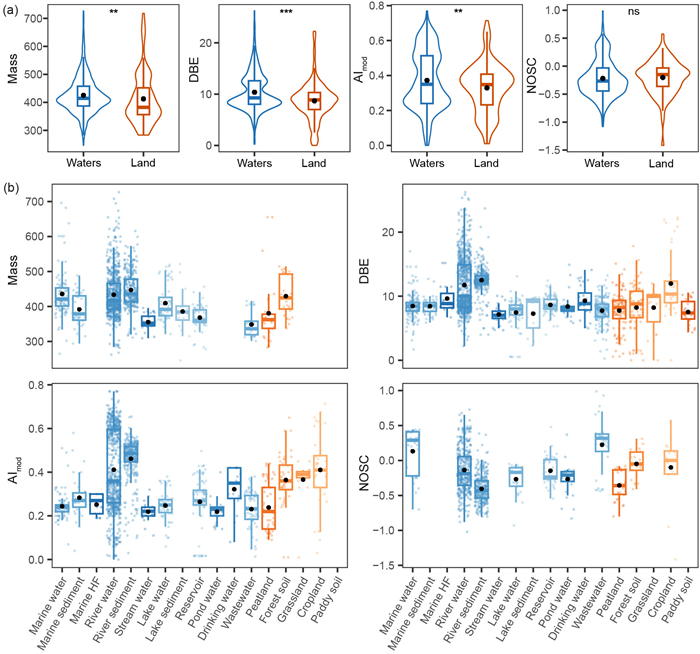
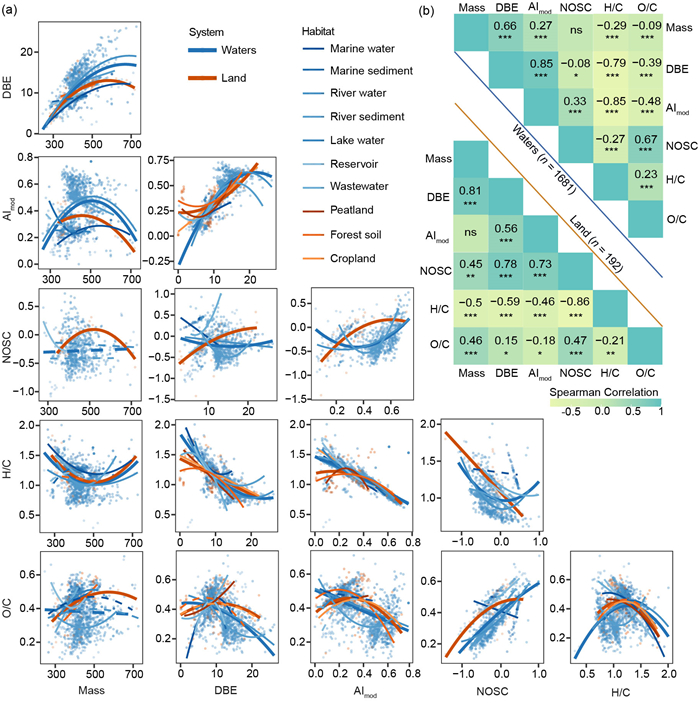
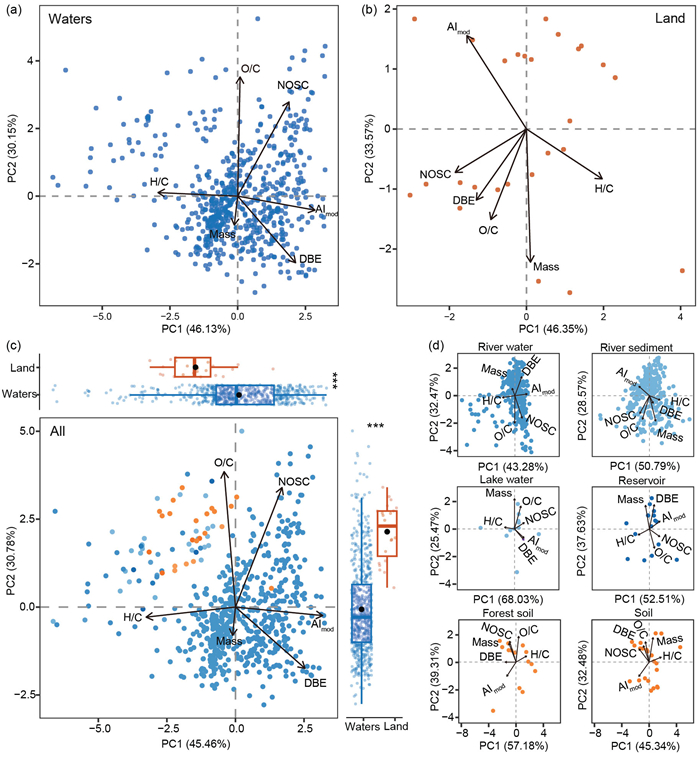
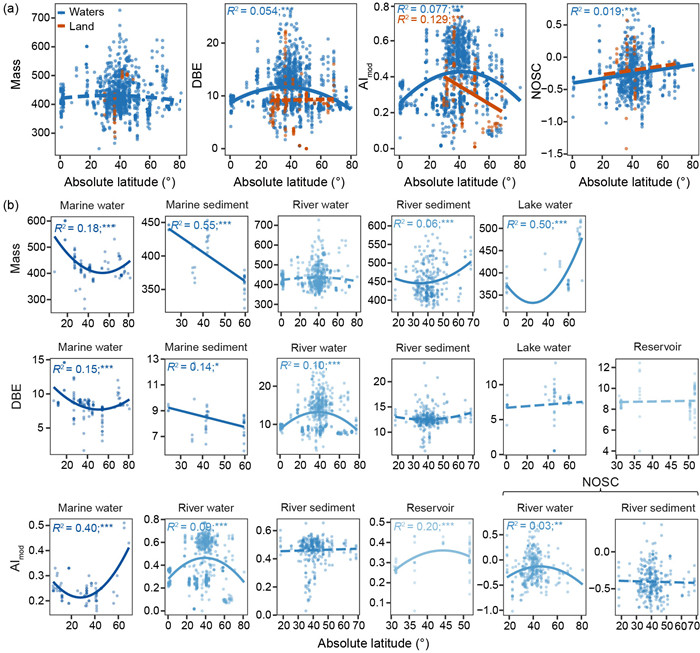
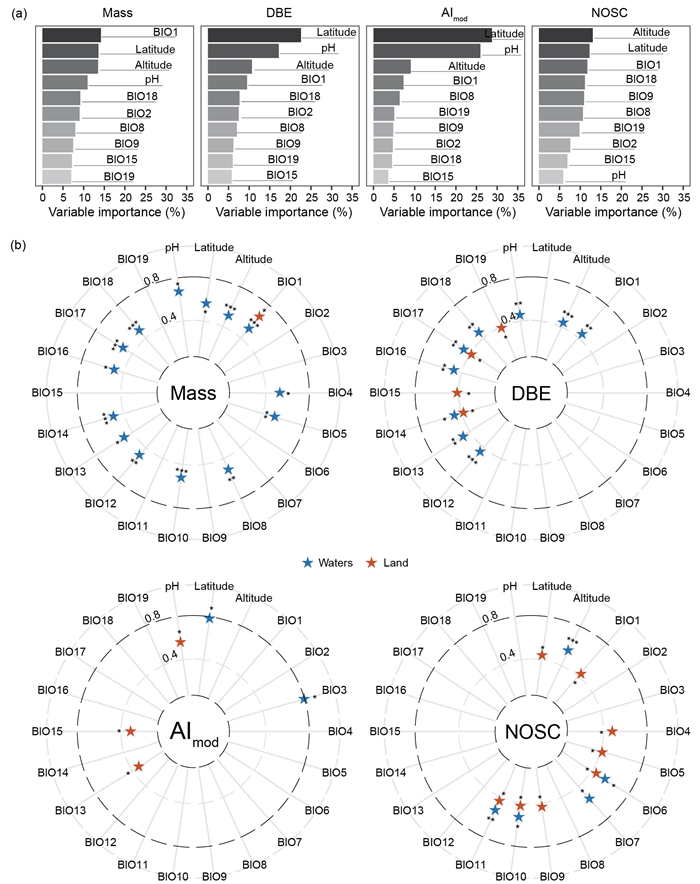
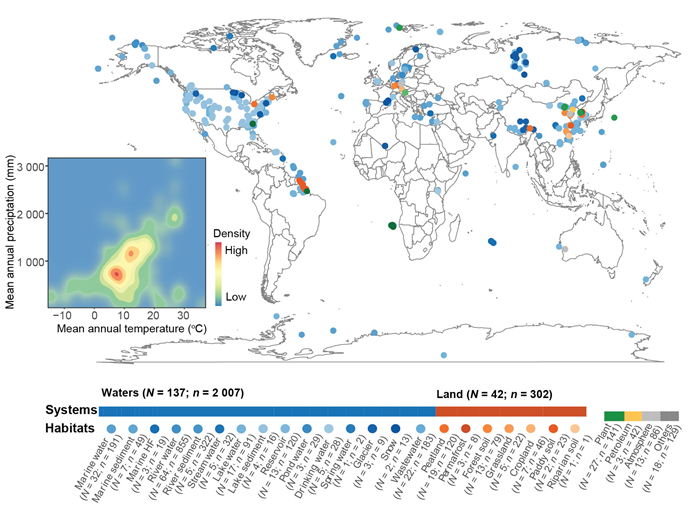
Dissolved organic matter (DOM) represents the largest pool of reactive carbon on the Earth and plays a crucial role in various biogeochemical processes and ecosystem functions. However, it is understudied for a global understanding of DOM molecular properties such as molecular weight, stoichiometry, and oxidation state, and the linkages among them across Earth systems. Here, a meta-analysis of 2 707 sites in 204 literatures was conducted by synthesizing four representative molecular properties of DOM, i.e., mass, double bond equivalent (DBE), modified aromaticity index (AImod), and nominal oxidation state of carbon (NOSC). By exploring H/C and O/C ratios, we examined the relationships among these DOM properties across waters and land systems, and their geographical patterns and environmental drivers. We found that, compared to land system, the mass, DBE, and AImod were all significantly higher in water systems, with river sediments exhibiting the highest values. The DOM oxidation state indicated by NOSC was greater on average in wastewater (NOSC = 0.226 ± 0.06) and marine water (NOSC = 0.133 ± 0.06) than in other habitats. Compared to waters, the mass in land system showed more strongly positive correlations with oxidation states such as NOSC and O/C, and the NOSC showed stronger relations to bioavailability properties such as DBE, AImod, and H/C. Among all the properties, H/C and AImod contributed to the most variations in global DOM properties. In waters, NOSC monotonically increased towards high latitudes, while DBE and AImod showed significant hump-shaped patterns indicating peaked unsaturation and aromaticity at mid-latitudes of approximately absolute 30°–50°. The variations in DOM properties were significantly correlated with environmental factors such as annual mean temperature and pH. Collectively, we revealed the spatial distribution and environmental drivers of DOM molecular properties across Earth ecosystems, which could shed light on our comprehensive understanding of DOM characteristics and its dynamics.

| Ahonen, S. A., Hayden, B., Leppänen, J. J., et al., 2018. Climate and Productivity Affect Total Mercury Concentration and Bioaccumulation Rate of Fish along a Spatial Gradient of Subarctic Lakes. Science of the Total Environment, 637/638: 1586–1596. https://doi.org/10.1016/j.scitotenv.2018.04.436 |
| Bahureksa, W., Tfaily, M. M., Boiteau, R. M., et al., 2021. Soil Organic Matter Characterization by Fourier Transform Ion Cyclotron Resonance Mass Spectrometry (FTICR MS): A Critical Review of Sample Preparation, Analysis, and Data Interpretation. Environmental Science & Technology, 55(14): 9637–9656. https://doi.org/10.1021/acs.est.1c01135 |
| Begum, M. S., Park, J. H., Yang, L. Y., et al., 2023. Optical and Molecular Indices of Dissolved Organic Matter for Estimating Biodegradability and Resulting Carbon Dioxide Production in Inland waters: A Review. Water Research, 228: 119362. https://doi.org/10.1016/j.watres.2022.119362 |
| Benk, S. A., Li, Y., Roth, V. N., et al., 2018. Lignin Dimers as Potential Markers for 14C-Young Terrestrial Dissolved Organic Matter in the Critical Zone. Frontiers in Earth Science, 6: 168. https://doi.org/10.3389/feart.2018.00168 |
| Benner, R., Amon, R. M. W., 2015. The Size-Reactivity Continuum of Major Bioelements in the Ocean. Annual Review of Marine Science, 7: 185–205. https://doi.org/10.1146/annurev-marine-010213-135126 |
| Boye, K., Noël, V., Tfaily, M. M., et al., 2017. Thermodynamically Controlled Preservation of Organic Carbon in Floodplains. Nature Geoscience, 10(6): 415–419. https://doi.org/10.1038/ngeo2940 |
| Breiman, L., 2001. Random Forests. Machine Learning, 45(1): 5–32. https://doi.org/10.1023/a:1010933404324 |
| Brown, V. A., 2021. An Introduction to Linear Mixed-Effects Modeling in R. Advances in Methods and Practices in Psychological Science, 4(1): 2–30. https://doi.org/10.1177/2515245920960351 |
| Butturini, A., Herzsprung, P., Lechtenfeld, O. J., et al., 2022. Origin, Accumulation and Fate of Dissolved Organic Matter in an Extreme Hypersaline Shallow Lake. Water Research, 221: 118727. https://doi.org/10.1016/j.watres.2022.118727 |
| Butturini, A., Herzsprung, P., Lechtenfeld, O. J., et al., 2020. Dissolved Organic Matter in a Tropical Saline-Alkaline Lake of the East African Rift Valley. Water Research, 173: 115532. https://doi.org/10.1016/j.watres.2020.115532 |
| Cai, R. H., Jiao, N. Z., 2023. Recalcitrant Dissolved Organic Matter and Its Major Production and Removal Processes in the Ocean. Deep Sea Research Part Ⅰ: Oceanographic Research Papers, 191: 103922. https://doi.org/10.1016/j.dsr.2022.103922 |
| Cai, R. H., Zhou, W. C., He, C., et al., 2019. Microbial Processing of Sediment-Derived Dissolved Organic Matter: Implications for Its Subsequent Biogeochemical Cycling in Overlying Seawater. Journal of Geophysical Research: Biogeosciences, 124(11): 3479–3490. https://doi.org/10.1029/2019jg005212 |
| Carena, L., García-Gil, Á., Marugán, J., et al., 2023. Global Modeling of Lake-Water Indirect Photochemistry Based on the Equivalent Monochromatic Wavelength Approximation: The Case of the Triplet States of Chromophoric Dissolved Organic Matter. Water Research, 241: 120153. https://doi.org/10.1016/j.watres.2023.120153 |
| Catalán, N., Marcé, R., Kothawala, D. N., et al., 2016. Organic Carbon Decomposition Rates Controlled by Water Retention Time across Inland Waters. Nature Geoscience, 9(7): 501–504. https://doi.org/10.1038/ngeo2720 |
| Chen, Q., Chen, F., Gonsior, M., et al., 2021. Correspondence between DOM Molecules and Microbial Community in a Subtropical Coastal Estuary on a Spatiotemporal Scale. Environment International, 154: 106558. https://doi.org/10.1016/j.envint.2021.106558 |
| Chen, W. M., Gu, Z. P., He, C., et al., 2023. Molecular Characteristics and Formation Mechanisms of Unknown Ozonation Byproducts during the Treatment of Flocculated Nanofiltration Leachate Concentrates Using O3 and UV/O3 Processes. Environmental Science & Technology, 57(48): 20349–20359. https://doi.org/10.1021/acs.est.3c05134 |
| Chen, W., Teng, C. Y., Qian, C., et al., 2019. Characterizing Properties and Environmental Behaviors of Dissolved Organic Matter Using Two-Dimensional Correlation Spectroscopic Analysis. Environmental Science & Technology, 53(9): 4683–4694. https://doi.org/10.1021/acs.est.9b01103 |
| Chen, Z. L., Zhang, H. B., Yi, Y. B., et al., 2024. Dissolved Organic Matter Composition and Characteristics during Extreme Flood Events in the Yangtze River Estuary. Science of the Total Environment, 914: 169827. https://doi.org/10.1016/j.scitotenv.2023.169827 |
| Creed, I. F., Bergström, A. K., Trick, C. G., et al., 2018. Global Change-Driven Effects on Dissolved Organic Matter Composition: Implications for Food Webs of Northern Lakes. Global Change Biology, 24(8): 3692–3714. https://doi.org/10.1111/gcb.14129 |
| D'Andrilli, J., Cooper, W. T., Foreman, C. M., et al., 2015. An Ultrahigh-Resolution Mass Spectrometry Index to Estimate Natural Organic Matter Lability. Rapid Communications in Mass Spectrometry, 29(24): 2385–2401. https://doi.org/10.1002/rcm.7400 |
| D'Andrilli, J., Junker, J. R., Smith, H. J., et al., 2019. DOM Composition Alters Ecosystem Function during Microbial Processing of Isolated Sources. Biogeochemistry, 142(2): 281–298. https://doi.org/10.1007/s10533-018-00534-5 |
| DiDonato, N., Chen, H. M., Waggoner, D., et al., 2016. Potential Origin and Formation for Molecular Components of Humic Acids in Soils. Geochimica et Cosmochimica Acta, 178: 210–222. https://doi.org/10.1016/j.gca.2016.01.013 |
| Dittmar, T., Lennartz, S. T., Buck-Wiese, H., et al., 2021. Enigmatic Persistence of Dissolved Organic Matter in the Ocean. Nature Reviews Earth & Environment, 2(8): 570–583. https://doi.org/10.1038/s43017-021-00183-7 |
| Dittmar, T., Stubbins, A., 2014. Dissolved Organic Matter in Aquatic Systems. Treatise on Geochemistry. Elsevier, Amsterdam. 125–156. https://doi.org/10.1016/b978-0-08-095975-7.01010-x |
| Drake, T. W., Raymond, P. A., Spencer, R. G. M., 2018. Terrestrial Carbon Inputs to Inland Waters: A Current Synthesis of Estimates and Uncertainty. Limnology and Oceanography Letters, 3(3): 132–142. https://doi.org/10.1002/lol2.10055 |
| Ejarque, E., Khan, S., Steniczka, G., et al., 2018. Climate-Induced Hydrological Variation Controls the Transformation of Dissolved Organic Matter in a Subalpine Lake. Limnology and Oceanography, 63(3): 1355–1371. https://doi.org/10.1002/lno.10777 |
| Follstad Shah, J. J., Kominoski, J. S., Ardón, M., et al., 2017. Global Synthesis of the Temperature Sensitivity of Leaf Litter Breakdown in Streams and Rivers. Global Change Biology, 23(8): 3064–3075. https://doi.org/10.1111/gcb.13609 |
| Frey, K. E., Sobczak, W. V., Mann, P. J., et al., 2016. Optical Properties and Bioavailability of Dissolved Organic Matter along a Flow-Path Continuum from Soil Pore Waters to the Kolyma River Mainstem, East Siberia. Biogeosciences, 13(8): 2279–2290. https://doi.org/10.5194/bg-13-2279-2016 |
|
Galecki, A., Burzykowski, T., 2013. Linear Mixed Effects Models Using R: A Step-by-Step Approach. Springer, New York. |
| Gao, Z. Y., Niu, F. J., Luo, D. L., et al., 2024. Role of Suprapermafrost Groundwater Recharge in Dissolved Organic Carbon Dynamics of Thermokarst Lakes. Journal of Earth Science, 35(6): 2175–2179. https://doi.org/10.1007/s12583-024-2017-5 |
| Ge, J. F., Qi, Y. L., Li, C., et al., 2022. Fluorescence and Molecular Signatures of Dissolved Organic Matter to Monitor and Assess Its Multiple Sources from a Polluted River in the Farming-Pastoral Ecotone of Northern China. Science of the Total Environment, 837: 154575. https://doi.org/10.1016/j.scitotenv.2022.154575 |
| Gillman, L. N., Wright, S. D., Cusens, J., et al., 2015. Latitude, Productivity and Species Richness. Global Ecology and Biogeography, 24(1): 107–117. https://doi.org/10.1111/geb.12245 |
| Groeneveld, M., Catalán, N., Einarsdottir, K., et al., 2022. The Influence of pH on Dissolved Organic Matter Fluorescence in Inland Waters. Analytical Methods, 14(13): 1351–1360. https://doi.org/10.1039/d1ay01702k |
| Hansell, D., Carlson, C., Repeta, D., et al., 2009. Dissolved Organic Matter in the Ocean: A Controversy Stimulates New Insights. Oceanography, 22(4): 202–211. https://doi.org/10.5670/oceanog.2009.109 |
| Hawkes, J. A., D'Andrilli, J., Agar, J. N., et al., 2020. An International Laboratory Comparison of Dissolved Organic Matter Composition by High Resolution Mass Spectrometry: Are we Getting the Same Answer? Limnology and Oceanography: Methods, 18(6): 235–258. https://doi.org/10.1002/lom3.10364 |
| He, C., Yi, Y. B., He, D., et al., 2023. Molecular Composition of Dissolved Organic Matter across Diverse Ecosystems: Preliminary Implications for Biogeochemical Cycling. Journal of Environmental Management, 344: 118559. https://doi.org/10.1016/j.jenvman.2023.118559 |
| Hertkorn, N., Benner, R., Frommberger, M., et al., 2006. Characterization of a Major Refractory Component of Marine Dissolved Organic Matter. Geochimica et Cosmochimica Acta, 70(12): 2990–3010. https://doi.org/10.1016/j.gca.2006.03.021 |
| Hildebrand, T., Osterholz, H., Bunse, C., et al., 2022. Transformation of Dissolved Organic Matter by Two Indo-Pacific Sponges. Limnology and Oceanography, 67(11): 2483–2496. https://doi.org/10.1002/lno.12214 |
| Hu, A., Choi, M., Tanentzap, A. J., et al., 2022a. Ecological Networks of Dissolved Organic Matter and Microorganisms under Global Change. Nature Communications, 13: 3600. https://doi.org/10.1038/s41467-022-31251-1 |
| Hu, A., Jang, K. S., Meng, F. F., et al., 2022b. Microbial and Environmental Processes Shape the Link between Organic Matter Functional Traits and Composition. Environmental Science & Technology, 56(14): 10504–10516. https://doi.org/10.1021/acs.est.2c01432 |
| Hu, A., Han, L., Lu, X. C., et al., 2024a. Global Patterns and Drivers of Dissolved Organic Matter across Earth Systems: Insights from H/C and O/C Ratios. Fundamental Research. https://doi.org/10.1016/j.fmre.2023.11.018 |
| Hu, A., Jang, K. S., Tanentzap, A. J., et al., 2024b. Thermal Responses of Dissolved Organic Matter under Global Change. Nature Communications, 15: 576. https://doi.org/10.1038/s41467-024-44813-2 |
| Hu, A., Cui, Y. F., Bercovici, S. K., et al., 2024c. Photochemical Processes Drive Thermal Responses of Dissolved Organic Matter in the Dark Ocean. bioRxiv. https://doi.org/10.1101/2024.09.06.611638 |
| Hugelius, G., Strauss, J., Zubrzycki, S., et al., 2014. Estimated Stocks of Circumpolar Permafrost Carbon with Quantified Uncertainty Ranges and Identified Data Gaps. Biogeosciences, 11(23): 6573–6593. https://doi.org/10.5194/bg-11-6573-2014 |
| Hyung, H., Kim, J. H., 2008. Natural Organic Matter (NOM) Adsorption to Multi-walled Carbon Nanotubes: Effect of NOM Characteristics and Water Quality Parameters. Environmental Science & Technology, 42(12): 4416–4421. https://pubs.acs.org/doi/10.1021/es702916h doi: 10.1021/es702916h |
| Jiao, N. Z., Herndl, G. J., Hansell, D. A., et al., 2010. Microbial Production of Recalcitrant Dissolved Organic Matter: Long-Term Carbon Storage in the Global Ocean. Nature Reviews Microbiology, 8(8): 593–599. https://doi.org/10.1038/nrmicro2386 |
| Johnston, S. E., Carey, J. C., Kellerman, A., et al., 2021. Controls on Riverine Dissolved Organic Matter Composition across an Arctic-Boreal Latitudinal Gradient. Journal of Geophysical Research: Biogeosciences, 126(9): 1–20. https://doi.org/10.1029/2020jg005988 |
| Kellerman, A. M., Dittmar, T., Kothawala, D. N., et al., 2014. Chemodiversity of Dissolved Organic Matter in Lakes Driven by Climate and Hydrology. Nature Communications, 5: 3804. https://doi.org/10.1038/ncomms4804 |
| Kellerman, A. M., Guillemette, F., Podgorski, D. C., et al., 2018. Unifying Concepts Linking Dissolved Organic Matter Composition to Persistence in Aquatic Ecosystems. Environmental Science & Technology, 52(5): 2538–2548. https://doi.org/10.1021/acs.est.7b05513 |
| Kellerman, A. M., Kothawala, D. N., Dittmar, T., et al., 2015. Persistence of Dissolved Organic Matter in Lakes Related to Its Molecular Characteristics. Nature Geoscience, 8(6): 454–457. https://doi.org/10.1038/ngeo2440 |
| Kim, S., Kramer, R. W., Hatcher, P. G., 2003. Graphical Method for Analysis of Ultrahigh-Resolution Broadband Mass Spectra of Natural Organic Matter, the van Krevelen Diagram. Analytical Chemistry, 75(20): 5336–5344. https://doi.org/10.1021/ac034415p |
| Kleber, M., Bourg, I. C., Coward, E. K., et al., 2021. Dynamic Interactions at the Mineral-Organic Matter Interface. Nature Reviews Earth & Environment, 2(6): 402–421. https://doi.org/10.1038/s43017-021-00162-y |
| Koch, B. P., Dittmar, T., 2006. From Mass to Structure: An Aromaticity Index for High-Resolution Mass Data of Natural Organic Matter. Rapid Communications in Mass Spectrometry, 20(5): 926–932. https://doi.org/10.1002/rcm.2386 |
| Krachler, R., Krachler, R. F., 2021. Northern High-Latitude Organic Soils as a Vital Source of River-Borne Dissolved Iron to the Ocean. Environmental Science & Technology, 55(14): 9672–9690. https://doi.org/10.1021/acs.est.1c01439 |
| Kurek, M. R., Garcia-Tigreros, F., Wickland, K. P., et al., 2023. Hydrologic and Landscape Controls on Dissolved Organic Matter Composition across Western North American Arctic Lakes. Global Biogeochemical Cycles, 37(1): e2022GB007495. https://doi.org/10.1029/2022gb007495 |
| LaRowe, D. E., Van Cappellen, P., 2011. Degradation of Natural Organic Matter: A Thermodynamic Analysis. Geochimica et Cosmochimica Acta, 75(8): 2030–2042. https://doi.org/10.1016/j.gca.2011.01.020 |
| Laszakovits, J. R., MacKay, A. A., 2022. Data-Based Chemical Class Regions for van Krevelen Diagrams. Journal of the American Society for Mass Spectrometry, 33(1): 198–202. https://doi.org/10.1021/jasms.1c00230 |
| Li, J. F., Wang, B. L., Yang, M. L., et al., 2022. Geographical Constraints on Chemodiversity of Sediment Dissolved Organic Matter in China's Coastal Wetlands. Applied Geochemistry, 147: 105506. https://doi.org/10.1016/j.apgeochem.2022.105506 |
| Li, P. H., Tao, J. C., Lin, J., et al., 2019. Stratification of Dissolved Organic Matter in the Upper 2 000 m Water Column at the Mariana Trench. Science of the Total Environment, 668: 1222–1231. https://doi.org/10.1016/j.scitotenv.2019.03.094 |
| Li, X. M., Sun, G. X., Chen, S. C., et al., 2018. Molecular Chemodiversity of Dissolved Organic Matter in Paddy Soils. Environmental Science & Technology, 52(3): 963–971. https://doi.org/10.1021/acs.est.7b00377 |
| Lin, Q. L., Tian, Q. X., Liao, C., et al., 2024. Persistence of Soil Microbial Residuals and Lignin Phenols in Forest Ecosystems along the Latitude Gradient. Journal of Soils and Sediments, 24(6): 2425–2436. https://doi.org/10.1007/s11368-024-03794-x |
| Liu, W. W., Chen, X. C., Strong, D. R., et al., 2020. Climate and Geographic Adaptation Drive Latitudinal Clines in Biomass of a Widespread Saltmarsh Plant in Its Native and Introduced Ranges. Limnology and Oceanography, 65(6): 1399–1409. https://doi.org/10.1002/lno.11395 |
| Lu, K. T., Gao, H. J., Yu, H. B., et al., 2022. Insight into Variations of DOM Fractions in Different Latitudinal Rural Black-Odor Waterbodies of Eastern China Using Fluorescence Spectroscopy Coupled with Structure Equation Model. Science of the Total Environment, 816: 151531. https://doi.org/10.1016/j.scitotenv.2021.151531 |
| Luo, D. L., Gao, Z. Y., Chen, F. F., et al., 2025. Revised Understanding of Permafrost Shape: Inclusion of the Transition Zone and Its Climatic and Environmental Significances. Journal of Earth Science, 36(1): 339–346. https://doi.org/10.1007/s12583-024-0111-3 |
| Manning, D. W. P., Rosemond, A. D., Gulis, V., et al., 2018. Nutrients and Temperature Additively Increase Stream Microbial Respiration. Global Change Biology, 24(1): e233–e247. https://doi.org/10.1111/gcb.13906 |
| McDonough, L. K., Santos, I. R., Andersen, M. S., et al., 2020. Changes in Global Groundwater Organic Carbon Driven by Climate Change and Urbanization. Nature Communications, 11: 1279. https://doi.org/10.1038/s41467-020-14946-1 |
| Medeiros, P. M., Seidel, M., Powers, L. C., et al., 2015. Dissolved Organic Matter Composition and Photochemical Transformations in the Northern North Pacific Ocean. Geophysical Research Letters, 42(3): 863–870. https://doi.org/10.1002/2014gl062663 |
| Meng, F. F., Hu, A., Jang, K. S., et al., 2025. iDOM: Statistical Analysis of Dissolved Organic Matter Characterized by High-Resolution Mass Spectrometry. mLife, 4(3): 319–331. https://doi.org/10.1002/mlf2.70002 |
| Mladenov, N., Sommaruga, R., Morales-Baquero, R., et al., 2011. Dust Inputs and Bacteria Influence Dissolved Organic Matter in Clear Alpine Lakes. Nature Communications, 2: 405. https://doi.org/10.1038/ncomms1411 |
| Moody, C. S., 2020. A Comparison of Methods for the Extraction of Dissolved Organic Matter from Freshwaters. Water Research, 184: 116114. https://doi.org/10.1016/j.watres.2020.116114 |
| Nagar, S., Antony, R., Thamban, M., 2021. Extracellular Polymeric Substances in Antarctic Environments: A Review of Their Ecological Roles and Impact on Glacier Biogeochemical Cycles. Polar Science, 30: 100686. https://doi.org/10.1016/j.polar.2021.100686 |
| Nakagawa, S., Schielzeth, H., 2013. A General and Simple Method for Obtaining R2 from Generalized Linear Mixed-Effects Models. Methods in Ecology and Evolution, 4(2): 133–142. https://doi.org/10.1111/j.2041-210x.2012.00261.x |
| O'Donnell, J. A., Aiken, G. R., Butler, K. D., et al., 2016. DOM Composition and Transformation in Boreal Forest Soils: The Effects of Temperature and Organic-Horizon Decomposition State. Journal of Geophysical Research: Biogeosciences, 121(10): 2727–2744. https://doi.org/10.1002/2016jg003431 |
| Pang, Y., Wang, K., Sun, Y. G., et al., 2021. Linking the Unique Molecular Complexity of Dissolved Organic Matter to Flood Period in the Yangtze River Mainstream. Science of the Total Environment, 764: 142803. https://doi.org/10.1016/j.scitotenv.2020.142803 |
| Paz, A., Crowther, T. W., Maynard, D. S., 2024. Functional and Phylogenetic Dimensions of Tree Biodiversity Reveal Unique Geographic Patterns. Global Ecology and Biogeography, 33(9): e13877. https://doi.org/10.1111/geb.13877 |
| Peralta-Maraver, I., Stubbington, R., Arnon, S., et al., 2021. The Riverine Bioreactor: An Integrative Perspective on Biological Decomposition of Organic Matter across Riverine Habitats. Science of the Total Environment, 772: 145494. https://doi.org/10.1016/j.scitotenv.2021.145494 |
| Pracht, L. E., Tfaily, M. M., Ardissono, R. J., et al., 2018. Molecular Characterization of Organic Matter Mobilized from Bangladeshi Aquifer Sediment: Tracking Carbon Compositional Change during Microbial Utilization. Biogeosciences, 15(6): 1733–1747. https://doi.org/10.5194/bg-15-1733-2018 |
| Raymond, P. A., Hartmann, J., Lauerwald, R., et al., 2013. Global Carbon Dioxide Emissions from Inland Waters. Nature, 503(7476): 355–359. https://doi.org/10.1038/nature12760 |
| Ripszam, M., Paczkowska, J., Figueira, J., et al., 2015. Dissolved Organic Carbon Quality and Sorption of Organic Pollutants in the Baltic Sea in Light of Future Climate Change. Environmental Science & Technology, 49(3): 1445–1452. https://doi.org/10.1021/es504437s |
| Rodríguez-Zorro, P. A., Ledru, M. P., Favier, C., et al., 2022. Alternate Atlantic Forest and Climate Phases during the Early Pleistocene 41 Kyr Cycles in Southeastern Brazil. Quaternary Science Reviews, 286: 107560. https://doi.org/10.1016/j.quascirev.2022.107560 |
| Rodríguez-Cardona, B. M., Wymore, A. S., Argerich, A., et al., 2022. Shifting Stoichiometry: Long-Term Trends in Stream-Dissolved Organic Matter Reveal Altered C : N Ratios due to History of Atmospheric Acid Deposition. Global Change Biology, 28(1): 98–114. https://doi.org/10.1111/gcb.15965 |
| Roth, V. N., Dittmar, T., Gaupp, R., et al., 2013. Latitude and pH Driven Trends in the Molecular Composition of DOM across a North South Transect along the Yenisei River. Geochimica et Cosmochimica Acta, 123: 93–105. https://doi.org/10.1016/j.gca.2013.09.002 |
| Roth, V. N., Dittmar, T., Gaupp, R., et al., 2014. Ecosystem-Specific Composition of Dissolved Organic Matter. Vadose Zone Journal, 13(7): 1–10. https://doi.org/10.2136/vzj2013.09.0162 |
| Roth, V. N., Lange, M., Simon, C., et al., 2019. Persistence of Dissolved Organic Matter Explained by Molecular Changes during Its Passage through Soil. Nature Geoscience, 12(9): 755–761. https://doi.org/10.1038/s41561-019-0417-4 |
| Schmidt, M. W. I., Torn, M. S., Abiven, S., et al., 2011. Persistence of Soil Organic Matter as an Ecosystem Property. Nature, 478(7367): 49–56. https://doi.org/10.1038/nature10386 |
| Sheng, M., Chen, S., Liu, C. Q., et al., 2023. Spatial and Molecular Variations in Forest Topsoil Dissolved Organic Matter as Revealed by FT-ICR Mass Spectrometry. Science of the Total Environment, 895: 165099. https://doi.org/10.1016/j.scitotenv.2023.165099 |
| Singer, G. A., Fasching, C., Wilhelm, L., et al., 2012. Biogeochemically Diverse Organic Matter in Alpine Glaciers and Its Downstream Fate. Nature Geoscience, 5(10): 710–714. https://doi.org/10.1038/ngeo1581 |
| Speetjens, N. J., Tanski, G., Martin, V., et al., 2022. Dissolved Organic Matter Characterization in Soils and Streams in a Small Coastal Low-Arctic Catchment. Biogeosciences, 19(12): 3073–3097. https://doi.org/10.5194/bg-19-3073-2022 |
| Stegen, J. C., Johnson, T., Fredrickson, J. K., et al., 2018. Influences of Organic Carbon Speciation on Hyporheic Corridor Biogeo-chemistry and Microbial Ecology. Nature Communications, 9: 585. https://doi.org/10.1038/s41467-018-02922-9 |
| Szkokan-Emilson, E. J., Kielstra, B. W., Arnott, S. E., et al., 2017. Dry Conditions Disrupt Terrestrial-Aquatic Linkages in Northern Catchments. Global Change Biology, 23(1): 117–126. https://doi.org/10.1111/gcb.13361 |
| Valle, J., Harir, M., Gonsior, M., et al., 2020. Molecular Differences between Water Column and Sediment Pore Water SPE-DOM in Ten Swedish Boreal Lakes. Water Research, 170: 115320. https://doi.org/10.1016/j.watres.2019.115320 |
| van Vliet, M. T. H., Thorslund, J., Strokal, M., et al., 2023. Global River Water Quality under Climate Change and Hydroclimatic Extremes. Nature Reviews Earth & Environment, 4(10): 687–702. https://doi.org/10.1038/s43017-023-00472-3 |
| Wadham, J. L., Hawkings, J. R., Tarasov, L., et al., 2019. Ice Sheets Matter for the Global Carbon Cycle. Nature Communications, 10: 3567. https://doi.org/10.1038/s41467-019-11394-4 |
| Wagner, S., Riedel, T., Niggemann, J., et al., 2015. Linking the Molecular Signature of Heteroatomic Dissolved Organic Matter to Watershed Characteristics in World Rivers. Environmental Science & Technology, 49(23): 13798–13806. https://doi.org/10.1021/acs.est.5b00525 |
| Wagner, S., Schubotz, F., Kaiser, K., et al., 2020. Soothsaying DOM: A Current Perspective on the Future of Oceanic Dissolved Organic Carbon. Frontiers in Marine Science, 7: 341. https://doi.org/10.3389/fmars.2020.00341 |
| Wang, W. X., Tao, J. C., Yu, K., et al., 2021. Vertical Stratification of Dissolved Organic Matter Linked to Distinct Microbial Communities in Subtropic Estuarine Sediments. Frontiers in Microbiology, 12: 697860. https://doi.org/10.3389/fmicb.2021.697860 |
| Ward, C. P., Cory, R. M., 2015. Chemical Composition of Dissolved Organic Matter Draining Permafrost Soils. Geochimica et Cosmochimica Acta, 167: 63–79. https://doi.org/10.1016/j.gca.2015.07.001 |
| Ward, C. P., Cory, R. M., 2016. Complete and Partial Photo-Oxidation of Dissolved Organic Matter Draining Permafrost Soils. Environmental Science & Technology, 50(7): 3545–3553. https://doi.org/10.1021/acs.est.5b05354 |
| Ward, C. P., Nalven, S. G., Crump, B. C., et al., 2017. Photochemical Alteration of Organic Carbon Draining Permafrost Soils Shifts Microbial Metabolic Pathways and Stimulates Respiration. Nature Communications, 8: 772. https://doi.org/10.1038/s41467-017-00759-2 |
| Wologo, E., Shakil, S., Zolkos, S., et al., 2021. Stream Dissolved Organic Matter in Permafrost Regions Shows Surprising Compositional Similarities but Negative Priming and Nutrient Effects. Global Biogeochemical Cycles, 35(1): e2020GB006719. https://doi.org/10.1029/2020gb006719 |
| Yamaoka, K., Nakagawa, T., Uno, T., 1978. Application of Akaike's Information Criterion (AIC) in the Evaluation of Linear Pharmacokinetic Equations. Journal of Pharmacokinetics and Biopharmaceutics, 6(2): 165–175. https://doi.org/10.1007/bf01117450 |
| Yang, J., Jiang, H. C., Liu, W., et al., 2020. Potential Utilization of Terrestrially Derived Dissolved Organic Matter by Aquatic Microbial Communities in Saline Lakes. The ISME Journal, 14(9): 2313–2324. https://doi.org/10.1038/s41396-020-0689-0 |
| Yang, X., Rosario-Ortiz, F. L., Lei, Y., et al., 2022. Multiple Roles of Dissolved Organic Matter in Advanced Oxidation Processes. Environmental Science & Technology, 56(16): 11111–11131. https://doi.org/10.1021/acs.est.2c01017 |
| Zark, M., Dittmar, T., 2018. Universal Molecular Structures in Natural Dissolved Organic Matter. Nature Communications, 9: 3178. https://doi.org/10.1038/s41467-018-05665-9 |
| Zheng, Q., Chen, Q., Cai, R. H., et al., 2019. Molecular Characteristics of Microbially Mediated Transformations of Synechococcus-Derived Dissolved Organic Matter as Revealed by Incubation Experiments. Environmental Microbiology, 21(7): 2533–2543. https://doi.org/10.1111/1462-2920.14646 |
| Zherebker, A., Rukhovich, G. D., Sarycheva, A., et al., 2022. Aromaticity Index with Improved Estimation of Carboxyl Group Contribution for Biogeochemical Studies. Environmental Science & Technology, 56(4): 2729–2737. https://doi.org/10.1021/acs.est.1c04575 |
| Zherebker, A., Shirshin, E., Rubekina, A., et al., 2020. Optical Properties of Soil Dissolved Organic Matter are Related to Acidic Functions of Its Components as Revealed by Fractionation, Selective Deuteromethylation, and Ultrahigh Resolution Mass Spectrometry. Environmental Science & Technology, 54(5): 2667–2677. https://doi.org/10.1021/acs.est.9b05298 |
| Zhou, Y. Q., Davidson, T. A., Yao, X. L., et al., 2018. How Autochthonous Dissolved Organic Matter Responds to Eutrophication and Climate Warming: Evidence from a Cross-Continental Data Analysis and Experiments. Earth-Science Reviews, 185: 928–937. https://doi.org/10.1016/j.earscirev.2018.08.013 |
| Zhu, L. J., Zhao, Y., Bai, S. C., et al., 2020. New Insights into the Variation of Dissolved Organic Matter Components in Different Latitudinal Lakes of Northeast China. Limnology and Oceanography, 65(3): 471–481. https://doi.org/10.1002/lno.11316 |
Figures(6)
Copyright © 2013-2020 Journal of Earth Science 鄂ICP备15021562号-2
Tel: +86-27-67885075 Fax: +86-27-67885075 E-mail: xbb@cug.edu.cn
Address: Editorial Office of Journal, China University of Geosciences, Yujiashan, Wuhan, Hubei 430074, P. R. China
Supported by:
Beijing Renhe Information Technology Co. Ltd
E-mail:
info@rhhz.net


 DownLoad: