| Citation: | Mohamed Abd El Monsef, Hassan Z. Harraz. Genetic Model for Beryl/Emerald-Related Schist in Egypt: Clues of Metasomatism. Journal of Earth Science, 2025, 36(6): 2498-2512. doi: 10.1007/s12583-024-0087-z

|
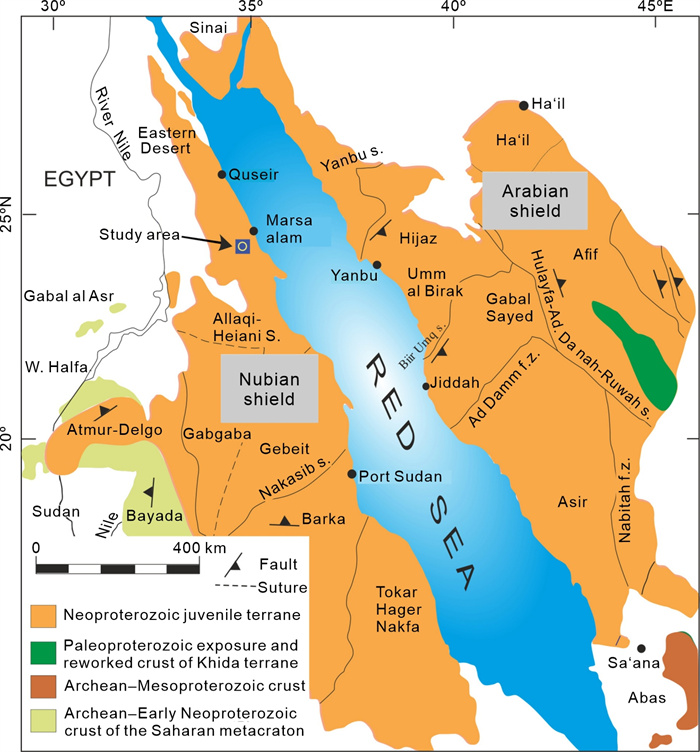
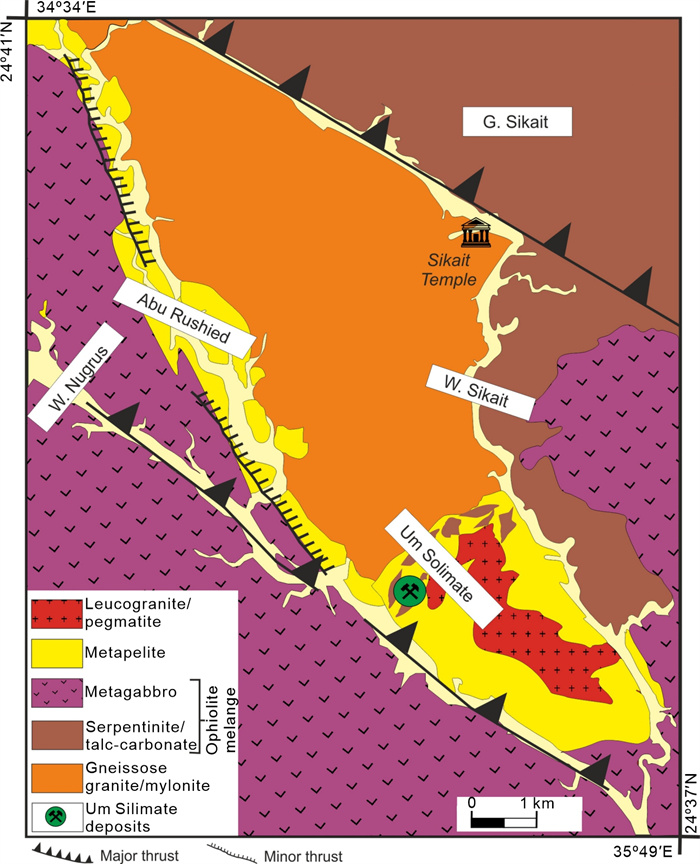
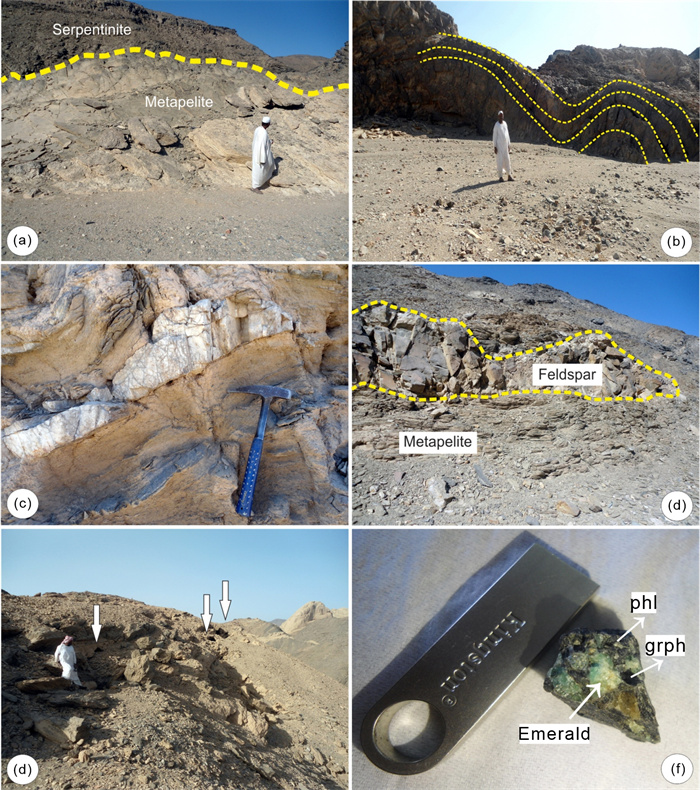
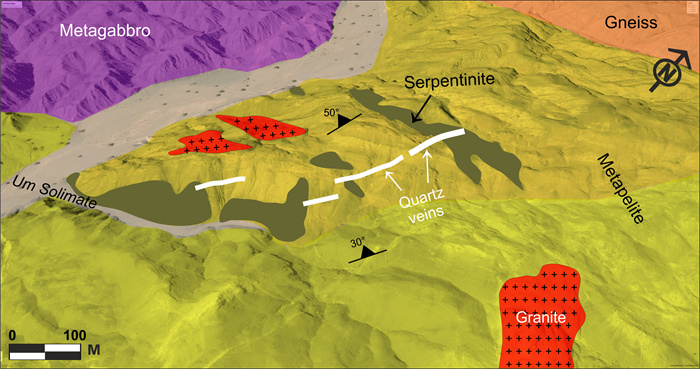
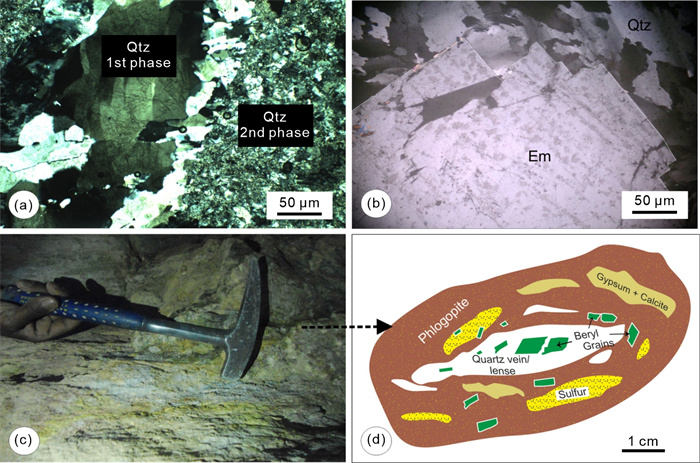
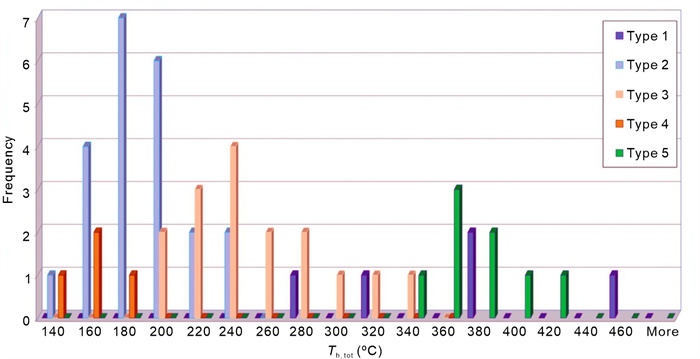
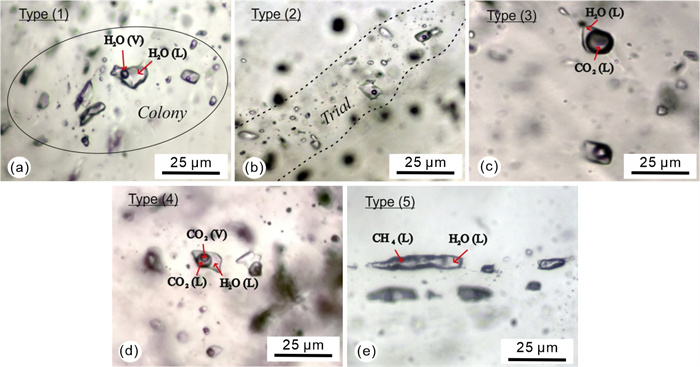
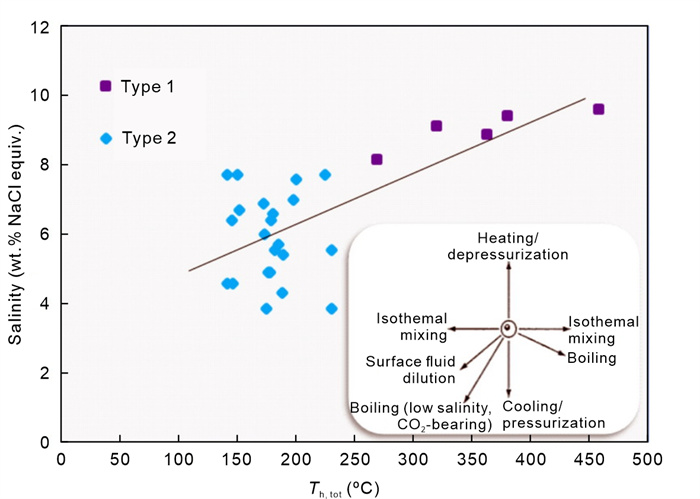
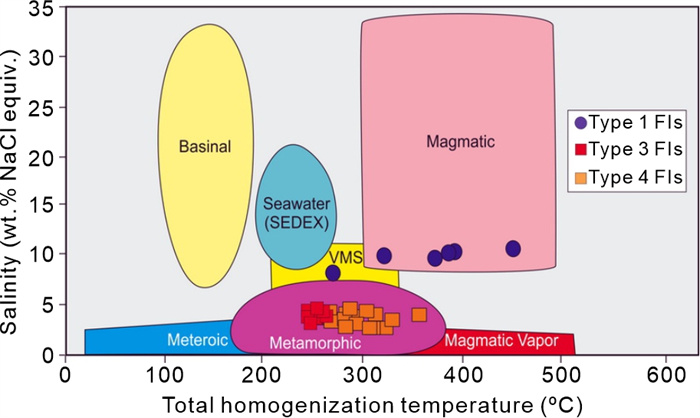
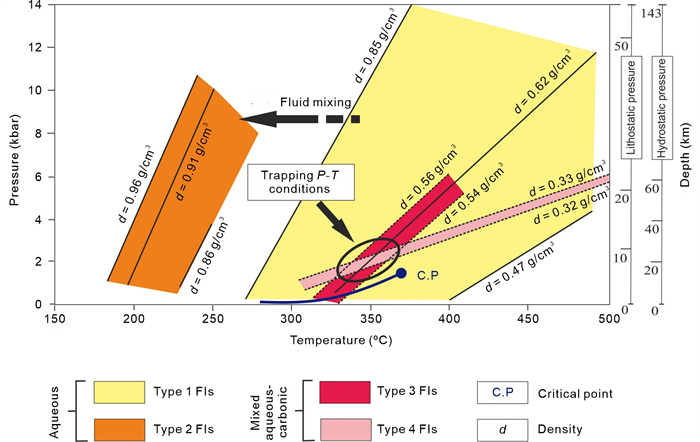
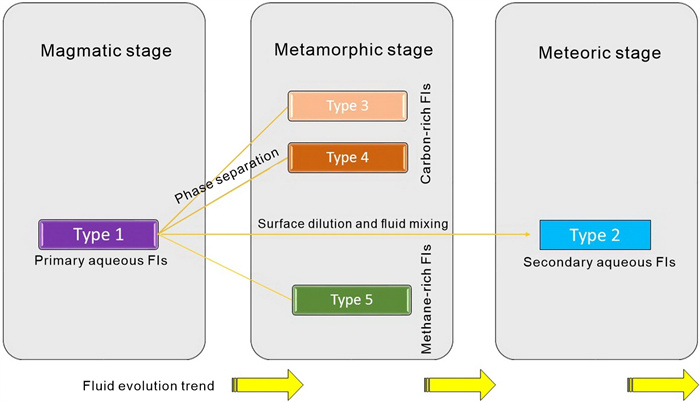
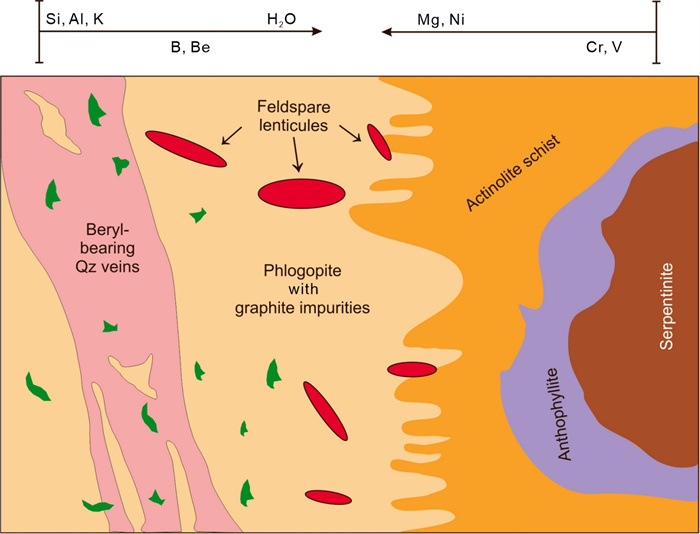
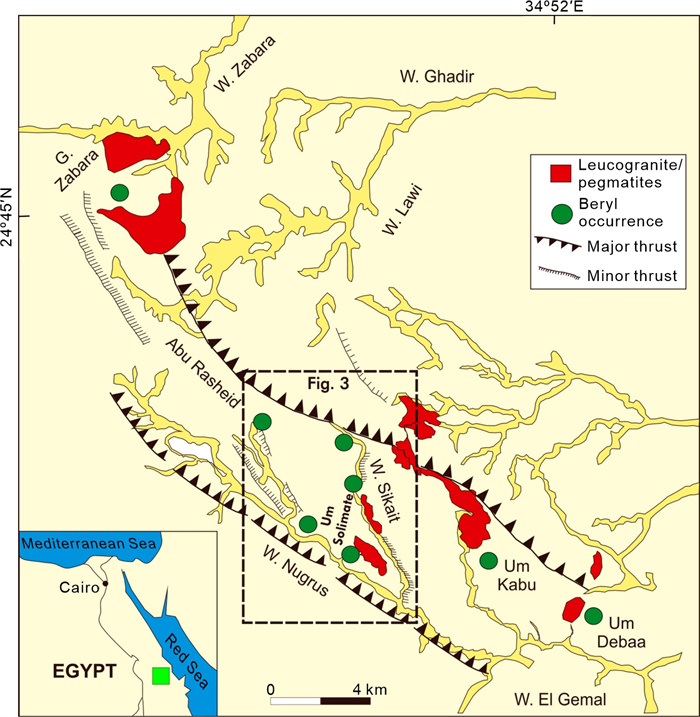
Um Solimate emerald deposit is a unique example for the well-known beryl-related schist type. Where, the Be-mineralization is restricted to NNE-trending quartz veins/lenses and as disseminated emerald grains within the altered-metasomatic zones of phlogopite- and graphite-schists. The study of fluid inclusions for the mineralized quartz vein revealed three major groups: (ⅰ) aqueous (H2O-NaCl), (ⅱ) aqueous-carbonic (H2O-CO2-[CH4]-NaCl), and (ⅲ) aqueous-hydrocarbonic (H2O-CH4) FIs. They have been further classified into five types (namely: types 1, 2, 3, 4 and 5) according to number of phases at the room temperature (20 ℃) as well as microthermometric measurements. Based upon the study of fluid inclusions, the initial-ore forming fluid was supposed to be of magmatic nature, characterized by a relatively high temperature of homogenization (

| Abdalla, H. M., El-Sayet, A., El-Afandy, A. H., 2001. Geochemical and Mineralogical Investigation of Wadi Ghazala Beryl Occurrence, SE Sinai, Egypt an Example of Thiysal Be Pegmatites Egypt. Journal of Geology, 45: 151–168 |
| Abdalla, H. M., Mohamed, F. H., 1999. Mineralogical and Geochemical Investigation of Emerald and Beryl Mineralisation, Pan-African Belt of Egypt: Genetic and Exploration Aspects. Journal of African Earth Sciences, 28(3): 581–598. https://doi.org/10.1016/s0899-5362(99)00033-0 |
| Abdel Gawad, A. E., Ene, A., Skublov, S. G., et al., 2022. Trace Element Geochemistry and Genesis of Beryl from Wadi Nugrus, South Eastern Desert, Egypt. Minerals, 12(2): 206. https://doi.org/10.3390/min12020206 |
| Bakker, R. J., 2003. Package Fluids 1 Computer Programmes for Analysis of Fluid Inclusion Data and for Modelling Bulk Fluid Properties. Chemical Geology, 194: 3–23. https://doi.org/10.1016/s0009-2541(02)00268-1 |
| Basta, E. Z., Zaki M., 1961. Geology and Mineralization of Wadi Sikait Area, South-Eastern Desert, Egypt. Journal of Geology, UAR, 15: 1–38 |
| Beus, A. A., 1966. Geochemistry of Beryllium and Genetic Types of Beryllium Deposits. W. H. Freeman, London. 401 |
| Beyth, M., Stern, R. J., Altherr, R., et al., 1994. The Late Precambrian Timna Igneous Complex, Southern Israel: Evidence for Comagmatic-Type Sanukitoid Monzodiorite and Alkali Granite Magma. Lithos, 31(3/4): 103–124. https://doi.org/10.1016/0024-4937(94)90003-5 |
| Cole, A., Wilkinson, J. J., Halls, C., et al., 2000. Geological Characteristics, Tectonic Setting and Preliminary Interpretations of the Jilau Gold-Quartz Vein Deposit, Tajikistan. Mineralium Deposita, 35(7): 600–618. https://doi.org/10.1007/s001260050266 |
| Collins, P. L. F., 1979. Gas Hydrates in CO2 -Bearing Fluid Inclusions and the Use of Freezing Data for Estimation of Salinity. Economic Geology, 74(6): 1435–1444. https://doi.org/10.2113/gsecongeo.74.6.1435 |
| El-Aassy, I. E., Botros, N. H., Ibrahim, M. E., et al., 1993. A New Beryl Occurrence in Sinai. Egyptian Mineralogy, 5: 1–10 |
| El Dougdoug, A., Takla, M. A., Surour, A. A., et al., 1997. Mineralogy and Origin of Wadi Sikait Emerald, South Eastern Desert, Egypt. The 3rd Conference Geochemistry, Alexandria University. 221–239 |
| El Gaby, S., List, F. X., Tehrani, R., 1988. Geology, Evolution and Metallogenesis of the Pan-African Belt in Egypt. In: El Gaby, S., Greiling, R. O., eds., The Pan African Belt of Northeast Africa and Adjacent Areas. Tectonic Evolution and Economic Aspects of a Late Proterozoic Orogen. Earth Evolution Sciences. Frieder Vieweg and Sohn, Braunschweing/Wiesbaden. 17–68 |
| El-Bayoumi, R. M. A., Greiling, R. O., 1984. Tectonic Evolution of a Pan-African Plate Margin in Southeastern Egypt—A Suture Zone Overprinted by Low Angle Thrusting. In: Klerkx, J., Michot, J., eds., African Geology. Tervuren Belg. 47–56 |
| El-Ramly, M. F., Greiling, R. O., Kroner, A., et al., 1984. On the Tectonic Evolution of the Wadi Hafafit Area and Environs EDE. Bulletin Faculty Earth Science King Abdulaziz University, 6: 113–126 |
| El-Sharkawy, M. F., Harraz, H. Z., 2001. Progressive Boron Metasomatism next a Pegmatite at Wadi Sikait Area, South Eastern Desert, Egypt. The 5th International Conference on Geochemistry, 1: 25–51 |
| Eyal, M., Litvinovsky, B., Jahn, B. M., et al., 2010. Origin and Evolution of Post-Collisional Magmatism: Coeval Neoproterozoic Calc-Alkaline and Alkaline Suites of the Sinai Peninsula. Chemical Geology, 269(3/4): 153–179. https://doi.org/10.1016/j.chemgeo.2009.09.010 |
| Fowler, A. R., El Kalioubi, B., 2002. The Migif-Hafafit Gneissic Complex of the Egyptian Eastern Desert: Fold Interference Patterns Involving Multiply Deformed Sheath Folds. Tectonophysics, 346(3/4): 247–275. https://doi.org/10.1016/s0040-1951(01)00259-1 |
| Fritz, H., Abdelsalam, M., Ali, K. A., et al., 2013. Orogen Styles in the East African Orogen: A Review of the Neoproterozoic to Cambrian Tectonic Evolution. Journal of African Earth Sciences, 86: 65–106. https://doi.org/10.1016/j.jafrearsci.2013.06.004 |
| Giuliani, G., Groat, L. A., Marshall, D., et al., 2019. Emerald Deposits: A Review and Enhanced Classification. Minerals, 9(2): 105. https://doi.org/10.3390/min9020105 |
| Greiling, R. O., Kroner, A., El Ramly, M. F., et al., 1988. Structural Relationships between the Southern and the Central Parts of the Eastern Desert of Egypt: Details of a Fold and Thrust Belt. In: El Gaby, S., Greiling, R., eds., The Pan-African Belt of NE Africa and the Adjacent Areas-Tectonic Evolution and Economic Aspects of a Late Proterozoic Orogen. Wiesbaden. 121–145 |
| Groat, L. A., Giuliani, G., Marshall, D. D., et al., 2008. Emerald Deposits and Occurrences: A Review. Ore Geology Reviews, 34(1/2): 87–112. https://doi.org/10.1016/j.oregeorev.2007.09.003 |
| Groves, D. I., Goldfarb, R. J., Gebre-Mariam, M., et al., 1998. Orogenic Gold Deposits: A Proposed Classification in the Context of Their Crustal Distribution and Relationship to Other Gold Deposit Types. Ore Geology Reviews, 13(1/2/3/4/5): 7–27. https://doi.org/10.1016/s0169-1368(97)00012-7 |
| Grubessi, O., Aurisicchio, C., Castiglioni, A., 1990. The Pharaohs' Forgotten Emerald Mines. The Journal of Gemmology, 22(3): 164–177. https://doi.org/10.15506/jog.1990.22.3.164 |
| Grundmann, G., Morteani, G., 1989. Emerald Mineralization during Regional Metamorphism; The Habachtal (Austria) and Leydsdorp (Transvaal, South Africa) Deposits. Economic Geology, 84(7): 1835–1849. https://doi.org/10.2113/gsecongeo.84.7.1835 |
| Grundmann, G., Morteani, G., 2008. Multi-Stage Emerald Formation during Pan-African Regional Metamorphism: The Zabara, Sikait, Umm Kabo Deposits, South Eastern Desert of Egypt. Journal of African Earth Sciences, 50(2/3/4): 168–187. https://doi.org/10.1016/j.jafrearsci.2007.09.009 |
| Grundmann, G., Morteani, G., 2017. Emerald Formation during Regional Metamorphism: The Zabara, Sikeit and Umm Kabo Deposits (Eastern Desert, Egypt). Geoscientific Research in Northeast Africa. CRC Press, Boca Raton. 495–498. https://doi.org/10.1201/9780203753392-90 doi: 10.1201/9780203753392-90 |
| Hamimi, Z., Abd El-Wahed, M. A., Gahlan, H. A., et al., 2019. Tectonics of the Eastern Desert of Egypt: Key to Understanding the Neoproterozoic Evolution of the Arabian-Nubian Shield (East African Orogen). The Geology of the Arab World—An Overview. Springer International Publishing, Cham. 1–81. https://doi.org/10.1007/978-3-319-96794-3_1 |
| Harraz, H. Z., Hassan, A. M., Furuyama, K., 2005. The Wadi Sikait Complex: A Fertile-Post-Collisional Granite-Pegmatite Suite, Eastern Desert, Egypt. Annals of the Geologic Survey of Egypt, XXVIII: 1–35 |
| Harrell, J. A., 2004. Archeological Geology of the World's First Emerald Mine. Geoscience Canada, 31(2): 69–76 |
| Heyen, G., Ramboz, C., Dubessy, J., 1982. Modelling of Phase Equilibria in the System CO2-CH4 below 50 ºC and 100 bar. Application to Inclusion Fluids. Comptes Rendus Academy of Science, Paris, 294: 203–206 (in French) |
| Ho, S. E., Groves, D. I., Phillips, G. N., 1985. Fluid Inclusions as Indicators of the Nature and Source of Ore Fluids and Ore Depositional Conditions for Archaean Gold Deposits of the Yilgarn Lock, Western Australia. Transactions Geological Society South Africa, 88: 149–158 |
| Holloway, J. R., 1984. Graphite-CH4-CO2-H2O Equilibria in the Earth'S Upper Crust. Geology, 12: 455–458 |
| Johnson, P. R., Andresen, A., Collins, A. S., et al., 2011. Late Cryogenian–Ediacaran History of the Arabian-Nubian Shield: A Review of Depositional, Plutonic, Structural, and Tectonic Events in the Closing Stages of the Northern East African Orogen. Journal of African Earth Sciences, 61(3): 167–232. https://doi.org/10.1016/j.jafrearsci.2011.07.003 |
| Kesler, S. E., 2005. Ore-Forming Fluid. Elements, 1: 13–18 |
| Khedr, M. Z., Saleh, G. M., Abdelfadil, K. M., et al., 2024. The Geology and Mineral Chemistry of Beryl Mineralization, South Eastern Desert, Egypt: A Deeper Insight into Genesis and Distribution. Minerals, 14(5): 465. https://doi.org/10.3390/min14050465 |
| Khaleal, F. M., El Bialy, M. Z., Ibrahim, W. S., et al., 2019. The Geology, Geochemistry and Mineralogy of Beryl Mineralization in Zabara Area, South Eastern Desert, Egypt. International Journal of Mining Science, 5: 18–34 |
| Khaleal, F. M., Lentz, D. R., Hall, D. C., 2022. Mineral Chemistry and Genesis of Emerald and Beryl Mineralization in the South Eastern Desert of Egypt. Egyptian Journal of Chemistry, 65: 601–623. https://doi.org/10.21608/ejchem.2022.113700.5166 |
| MacAlister, D. A., 1900. The Emerald Mines of Northern Etbai. The Geographical Journal, 16(5): 537. https://doi.org/10.2307/1774868 |
| Martin-Izard, A., Paniagua, A., Moreiras, D., et al., 1995. Metasomatism at a Granitic Pegmatite-Dunite Contact in Galicia: The Franqueira Occurrence of Chrysoberyl (Alexandrite), Emerald, and Phenakite. Canadian Mineralogist, 33: 775–792 |
| Marshall, D., Downes, P. J., Ellis, S., et al., 2016. Pressure-Temperature-Fluid Constraints for the Poona Emerald Deposits, Western Australia: Fluid Inclusion and Stable Isotope Studies. Minerals, 6(4): 130. https://doi.org/10.3390/min6040130 |
| Mohamed, F. H., Hassanen, M. A., 1997. Geochemistry and Petrogenesis of Sikait Leucogranite, Egypt: An Example of S-Type Granite in a Metapelitic Sequence. Geologische Rundschau, 86(1): 81–92. https://doi.org/10.1007/s005310050123 |
| Moroz, I., Vapnik, Y., Eliezri, I., et al., 2001. Mineral and Fluid Inclusion Study of Emeralds from the Lake Manyara and Sumbawanga Deposits, Tanzania. Journal of African Earth Sciences, 33(2): 377–390. https://doi.org/10.1016/s0899-5362(01)80070-1 |
| Omar, S. A. M., 2016. Mineralogical and Fluid Inclusions Evidence for the Genesis of Umm Addebbaa-Umm Kabu Beryl Belt, South Eastern Desert. Nuclear Sciences Scientific Journal, 5: 1–14 |
| Potter, R. W., Clynne, M. A., Brown, D. L., 1978. Freezing Point Depression of Aqueous Sodium Chloride Solutions. Economic Geology, 73(2): 284–285. https://doi.org/10.2113/gsecongeo.73.2.284 |
| Roedder, E., 1984. Fluid Inclusions. Reviews Mineralogy, 12: 644 |
| Roedder, E., Bodnar, R. J., 1980. Geologic Pressure Determinations from Fluid Inclusion Studies. Annual Review of Earth and Planetary Sciences, 8: 263–301. https://doi.org/10.1146/annurev.ea.08.050180.001403 |
| Rudnick, R. L., Gao, S., 2003. Composition of the Continental Crust. Treatise on Geochemistry. Elsevier, Amsterdam. 1–64. https://doi.org/10.1016/b0-08-043751-6/03016-4 doi: 10.1016/b0-08-043751-6/03016-4 |
| Santiago, J. S., Souza, V. D. S., Filgueiras, B. D. C., et al., 2018. Emerald from the Fazenda Bonfim Deposit, Northeastern Brazil: Chemical, Fluid Inclusions and Oxygen Isotope Data. Brazilian Journal of Geology, 48(3): 457–472. https://doi.org/10.1590/2317-4889201820170130 |
| Schwarz, D., Giuliani, G., Grundmann, G., et al., 2002. The Origin of Emerald. In: Emeralds of the World. extraLapis English No. 2. 18–23 |
| Shackleton, R. M., Ries, A. C., Graham, R. H., et al., 1980. Late Precambrian Ophiolitic Mélange in the Eastern Desert of Egypt. Nature, 285(5765): 472–474. https://doi.org/10.1038/285472a0 |
| Sharaky, A. M., 2009. Emerald Mineralization in Africa: A Case Study from Marsa Alam District, Egypt. In: Second International Conference of Natural Resources in Africa, Cairo University, Cairo |
| Shepherd, T. J., Rankin, A. H., Alderton, D. H., 1985. A Practical Guide to Fluid Inclusion Studies. Blackie and Sons, Glasgow. 239 |
| Shepherd, T. J., Bottrell, S. H., Miller, M. F., 1991. Fluid Inclusion Volatiles as an Exploration Guide to Black Shale-Hosted Gold Deposits, Dolgellau Gold Belt, North Wales, UK. Journal of Geochemical Exploration, 42(1): 5–24. https://doi.org/10.1016/0375-6742(91)90058-3 |
| Sherif, H. M., Abd El-Aaty, M. A., Lasheen, T. A., et al., 2005. New Beryl Occurrence of Wadi Sedri, South Western Sinai, Egypt. Fourth International Conference Geology of Africa, Assuit, Egypt. 471–477 |
| Sinkankas, J., 1981. Emerald and Other Beryls: Radnor. Chilton Book Co, Pennsylvania. 665 |
| Stern, R., 1994. Arc-Assembly and Continental Collision in the Neoproterozoic African Orogen: Implications for the Consolidation of Gondwanaland. Annual Review of Earth and Planetary Sciences, 22: 319–351. https://doi.org/10.1146/annurev.earth.22.1.319 |
| Stern, R. J., 2002. Crustal Evolution in the East African Orogen: A Neodymium Isotopic Perspective. Journal of African Earth Sciences, 34(3/4): 109–117. https://doi.org/10.1016/s0899-5362(02)00012-x |
| Surour, A. A., Omar, S. A. M., 2020. Historiography and FTIR Spectral Signatures of Beryl Crystals from Some Ancient Roman Sites in the Eastern Desert of Egypt. Environmental Earth Sciences, 79(23): 520. https://doi.org/10.1007/s12665-020-09260-4 |
| Surour, A. A., Takla, M. A., Omar, S. A. M., 2002. EPR Spectra and Age Determination of Beryl from the Eastern Desert of Egypt. Annals of the Geologic Survey of Egypt, 25: 389–400 |
| Takla, M. A., Surour, A. A., Omar, S. A. M., 2003. Mapping Source of Beryllium and Genesis of Some Beryl Occurrences in the Eastern Desert of Egypt. Annals of the Geologic Survey of Egypt, 76: 153–182 |
| Uher, P. A. V. E. L., Bacík, P., Fridrichova, F., 2019. Beryllium Silicate Minerals in Granite-Pegmatite Suites: Tracers of Magmatic to Hydrothermal and Tectonic Evolution (Examples from Western Carpathians). Geologica Carpathica, 70: 9–11 |
| Vityk, M. O., Bodnar, R. J., 1995. Do Fluid Inclusions in High-Grade Metamorphic Terranes Preserve Peak Metamorphic Density during Retrograde Decompression? American Mineralogist, 80(5/6): 641–644 |
| Wilkinson, J. J., 2001. Fluid Inclusions in Hydrothermal Ore Deposits. Lithos, 55(1/2/3/4): 229–272. https://doi.org/10.1016/s0024-4937(00)00047-5 |
| Wilkinson, J. J., Johnston, J. D., 1996. Pressure Fluctuations, Phase Separation, and Gold Precipitation during Seismic Fracture Propagation. Geology, 24(5): 395. https://doi.org/10.1130/0091-7613(1996)0240395:pfpsag>2.3.co;2 doi: 10.1130/0091-7613(1996)0240395:pfpsag>2.3.co;2 |
| Zachariáš, J., Žáček, V., Pudilová, M., et al., 2005. Fluid Inclusions and Stable Isotope Study of Quartz-Tourmaline Veins Associated with Beryl and Emerald Mineralization, Kafubu Area, Zambia. Chemical Geology, 223(1/2/3): 136–152. https://doi.org/10.1016/j.chemgeo.2004.12.023 |
| Zhang, Y. G., Frantz, J. D., 1987. Determination of the Homogenization Temperatures and Densities of Supercritical Fluids in the System NaClKClCaCl2H2O Using Synthetic Fluid Inclusions. Chemical Geology, 64(3/4): 335–350. https://doi.org/10.1016/0009-2541(87)90012-x |
Figures(13) / Tables(1)
Copyright © 2013-2020 Journal of Earth Science 鄂ICP备15021562号-2
Tel: +86-27-67885075 Fax: +86-27-67885075 E-mail: xbb@cug.edu.cn
Address: Editorial Office of Journal, China University of Geosciences, Yujiashan, Wuhan, Hubei 430074, P. R. China
Supported by:
Beijing Renhe Information Technology Co. Ltd
E-mail:
info@rhhz.net


 DownLoad: