| Citation: | Shi-Heng Bai, Ru-Xiong Lei, Matthew J. Brzozowski, Zhen-Hua Wang, Wei Wang, Chang-Zhi Wu. Permian Ridge Subduction-Related Magmatism in the Chinese Altai: Insights from Geochronology and Geochemistry of the Jiangjunshan Pluton. Journal of Earth Science, 2025, 36(6): 2479-2497. doi: 10.1007/s12583-024-0088-y

|
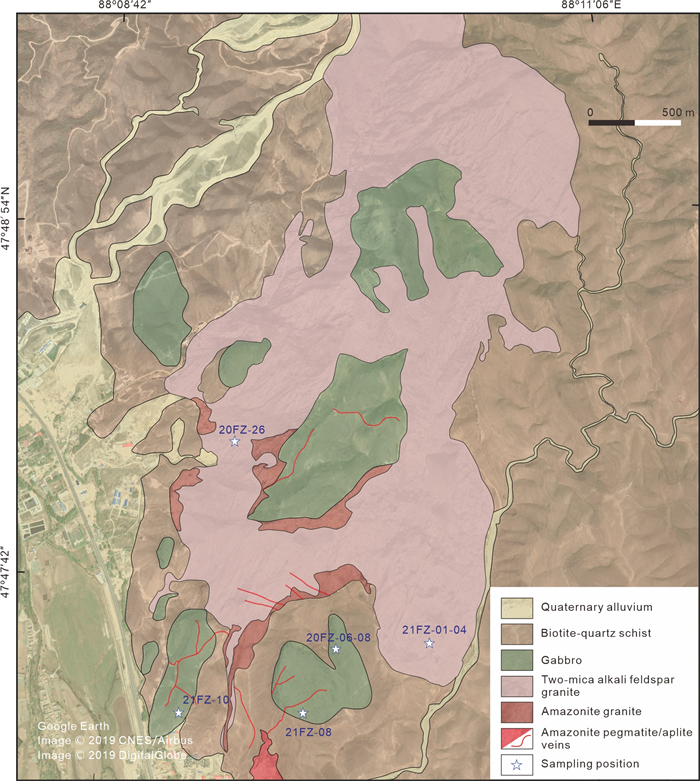
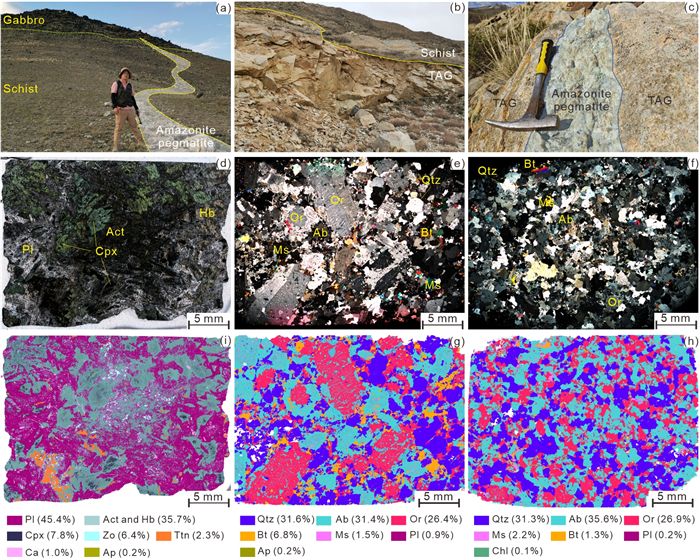
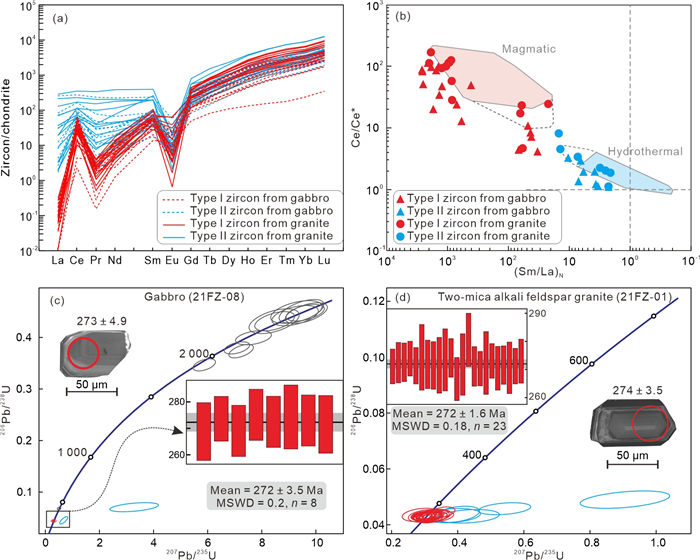
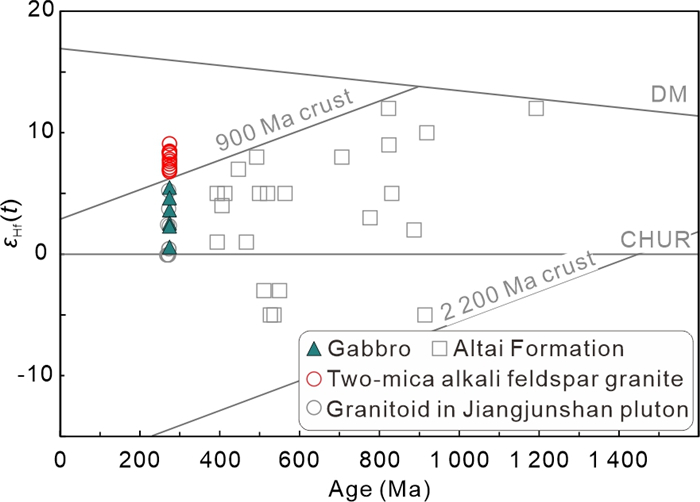
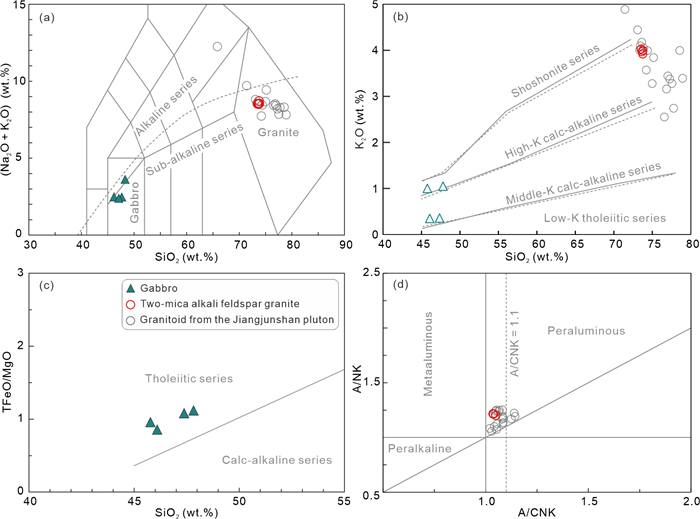
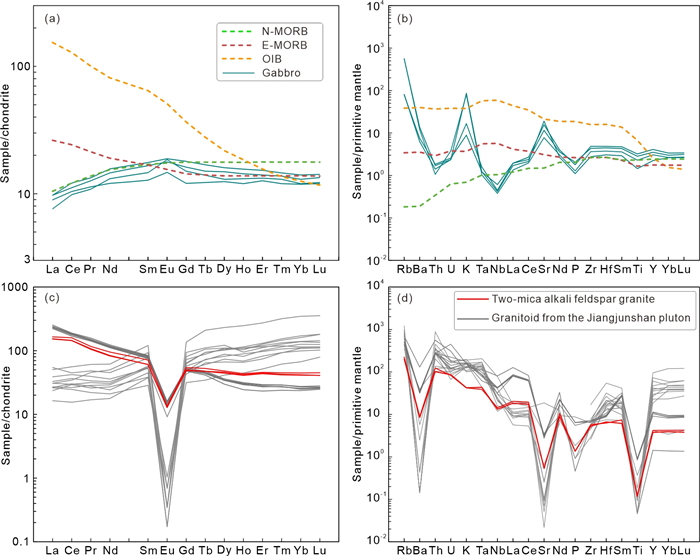
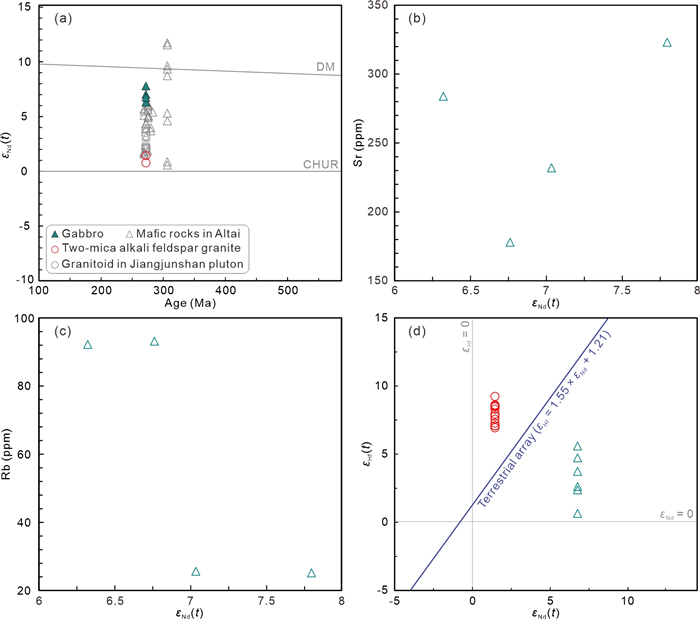
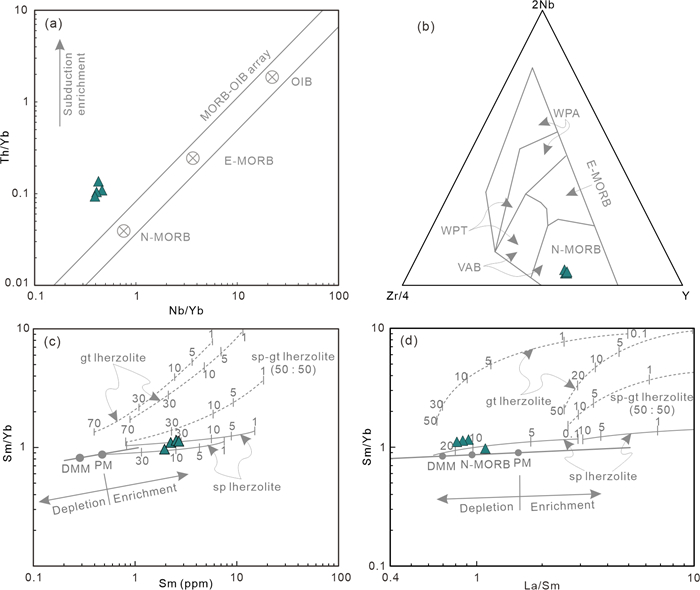
The Chinese Altai, a key component of the Central Asian Orogenic Belt (CAOB), represents a significant Phanerozoic accretionary orogenic belt. The oceanic-continental subduction processes spanning the Cambrian to Carboniferous and subsequent intracontinental extension since the Triassic have been well documented in the Chinese Altai, the southwestern segment of the CAOB. Deciphering the petrogenetic evolution of this region during the Permian is thus crucial for advancing our understanding of its tectonic transitions. However, the Permian tectonic setting of the Chinese Altai remains contentious. To address this knowledge gap, this study presents new geochronological and geochemical data for the Jiangjunshan pluton in the southern Chinese Altai. Zircon U-Pb geochronology reveals that the gabbro and two-mica alkali feldspar granite—which collectively constitute the primary lithology of the Jiangjunshan pluton—were emplaced at ~272 ± 3.5 and ~272 ± 1.6 Ma, respectively. Geochemically, the gabbro exhibits pronounced light rare-earth element (LREE) depletion, low Nb/Yb (0.39–0.46) and Ti/V (23.7–25.3) ratios, and trace-element signatures akin to normal mid-ocean ridge basalts (N-MORB). However, its conspicuous Nb-Ta depletion parallels that of island arc basalts. Depleted Hf-Nd isotopic compositions (

| Aldanmaz, E., Pearce, J. A., Thirlwall, M. F., et al., 2000. Petrogenetic Evolution of Late Cenozoic, Post-Collision Volcanism in Western Anatolia, Turkey. Journal of Volcanology and Geothermal Research, 102(1/2): 67–95. https://doi.org/10.1016/s0377-0273(00)00182-7 |
| Bai, S. H., Lei, R. X., Brzozowski, M. J., et al., 2023. Constraints on the Timing of Magmatism and Rare-Metal Mineralization in the Fangzheng Rb Deposit, Altai, NW China: Implications for the Spatiotemporal Controls on Rare-Metal Mineralization. Ore Geology Reviews, 157: 105427. https://doi.org/10.1016/j.oregeorev.2023.105427 |
| Baillard, C., Crawford, W. C., Ballu, V., et al., 2018. Tracking Subducted Ridges through Intermediate-Depth Seismicity in the Vanuatu Subduction Zone. Geology, 46(9): 767–770. https://doi.org/10.1130/g45010.1 |
| Bau, M., 1996. Controls on the Fractionation of Isovalent Trace Elements in Magmatic and Aqueous Systems: Evidence from Y/Ho, Zr/Hf, and Lanthanide Tetrad Effect. Contributions to Mineralogy and Petrology, 123(3): 323–333. https://doi.org/10.1007/s004100050159 |
| Boehnke, P., Watson, E. B., Trail, D., et al., 2013. Zircon Saturation Re-revisited. Chemical Geology, 351: 324–334. https://doi.org/10.1016/j.chemgeo.2013.05.028 |
| Bonin, B., 2007. A-Type Granites and Related rocks: Evolution of a Concept, Problems and Prospects. Lithos, 97(1/2): 1–29. https://doi.org/10.1016/j.lithos.2006.12.007 |
| Broussolle, A., Aguilar, C., Sun, M., et al., 2018. Polycyclic Palaeozoic Evolution of Accretionary Orogenic Wedge in the Southern Chinese Altai: Evidence from Structural Relationships and U-Pb Geochronology. Lithos, 314: 400–424. https://doi.org/10.1016/j.lithos.2018.06.005 |
| Cai, K. D., Sun, M., Yuan, C., et al., 2010. Geochronological and Geochemical Study of Mafic Dykes from the Northwest Chinese Altai: Implications for Petrogenesis and Tectonic Evolution. Gondwana Research, 18(4): 638–652. https://doi.org/10.1016/j.gr.2010.02.010 |
| Cai, K. D., Sun, M., Yuan, C., et al., 2012. Carboniferous Mantle-Derived Felsic Intrusion in the Chinese Altai, NW China: Implications for Geodynamic Change of the Accretionary Orogenic Belt. Gondwana Research, 22(2): 681–698. https://doi.org/10.1016/j.gr.2011.11.008 |
| Cai, K. D., Sun, M., Jahn, B. M., et al., 2016. Petrogenesis of the Permian Intermediate-Mafic Dikes in the Chinese Altai, Northwest China: Implication for a Postaccretion Extensional Scenario. The Journal of Geology, 124(4): 481–500. https://doi.org/10.1086/686464 |
|
Castro, A., 2020. The Dual Origin of Ⅰ-type Granites: The Contribution from Experiments. In: Janoušek, V., Bonin, B., Collins, W. J., et al., eds., Post-Archean Granitic Rocks: Petrogenetic Processes and Tectonic Environments. Geological Society, London, Special Publications, 491. |
| Champion, D. C., Bultitude, R. J., 2013. The Geochemical and SRND Isotopic Characteristics of Paleozoic Fractionated S-Types Granites of North Queensland: Implications for S-Type Granite Petrogenesis. Lithos, 162: 37–56. https://doi.org/10.1016/j.lithos.2012.11.022 |
| Chappell, B. W., 1999. Aluminium Saturation in I- and S-Type Granites and the Characterization of Fractionated Haplogranites. Lithos, 46(3): 535–551. https://doi.org/10.1016/s0024-4937(98)00086-3 |
| Chappell, B. W., Bryant, C. J., Wyborn, D., 2012. Peraluminous Ⅰ-type Granites. Lithos, 153: 142–153. https://doi.org/10.1016/j.lithos.2012.07.008 |
| Chauvel, C., Lewin, E., Carpentier, M., et al., 2008. Role of Recycled Oceanic Basalt and Sediment in Generating the Hf-Nd Mantle Array. Nature Geoscience, 1(1): 64–67. https://doi.org/10.1038/ngeo.2007.51 |
| Chen, B., Jahn, B. M., 2002. Geochemical and Isotopic Studies of the Sedimentary and Granitic Rocks of the Altai Orogen of Northwest China and Their Tectonic Implications. Geological Magazine, 139: 1. https://doi.org/10.1017/s0016756801006100 |
| Chen, M., Sun, M., Li, P. F., et al., 2019. Late Paleozoic Accretionary and Collisional Processes along the Southern Peri-Siberian Orogenic System: New Constraints from Amphibolites within the Irtysh Complex of Chinese Altai. The Journal of Geology, 127(2): 241–262. https://doi.org/10.1086/701253 |
| Chen, L., Yakymchuk, C., Zhao, K., et al., 2023. The Garnet Effect on Hafnium Isotope Compositions of Granitoids during Crustal Anatexis. Geology, 51(5): 439–443. https://doi.org/10.1130/g50914.1 |
| Chiaradia, M., Schaltegger, U., Spikings, R., et al., 2013. How Accurately Can we Date the Duration of Magmatic-Hydrothermal Events in Porphyry Systems?—An Invited Paper. Economic Geology, 108(4): 565–584. https://doi.org/10.2113/econgeo.108.4.565 |
| Corfu, F., Hanchar, J. M., Hoskin, P. W. O., et al., 2003. Atlas of Zircon Textures. Reviews in Mineralogy and Geochemistry, 53(1): 469–500. https://doi.org/10.2113/0530469 |
| Cross, T. A., Pilger, R. H., 1982. Controls of Subduction Geometry, Location of Magmatic Arcs, and Tectonics of Arc and Back-Arc Regions. GSA Bulletin, 93(6): 545–562. https://doi.org/10.1130/0016-7606(1982)93545:cosglo>2.0.co;2 doi: 10.1130/0016-7606(1982)93545:cosglo>2.0.co;2 |
| Cui, X., Sun, M., Zhao, G. C., et al., 2021. Origin of Permian Mafic Intrusions in Southern Chinese Altai, Central Asian Orogenic Belt: A Post-Collisional Extension System Triggered by Slab Break-off. Lithos, 390: 106112. https://doi.org/10.1016/j.lithos.2021.106112 |
| Duan, J., Qian, Z., Feng, Y., et al., 2017. Compositional Variations of Several Early Permian Magmatic Sulfide Deposits in the Kalatongke District, Southern Altai, Western China: With Genetic and Exploration Implications. Ore Geology Reviews, 90: 576–590. https://doi.org/10.1016/j.oregeorev.2017.04.031 |
| Duan, Z. P., Jiang, S. Y., Su, H. M., et al., 2021. Geochronological and Geochemical Investigations of the Granites from the Giant Shihuiyao Rb-(Nb-Ta-Be-Li) Deposit, Inner Mongolia: Implications for Magma Source, Magmatic Evolution, and Rare Metal Mineralization. Lithos, 400: 106415. https://doi.org/10.1016/j.lithos.2021.106415 |
| Fan, J. J., Li, C., Sun, Z. M., et al., 2018. Early Cretaceous MORB-Type Basalt and A-Type Rhyolite in Northern Tibet: Evidence for Ridge Subduction in the Bangong-Nujiang Tethyan Ocean. Journal of Asian Earth Sciences, 154: 187–201. https://doi.org/10.1016/j.jseaes.2017.12.020 |
| Ferry, J. M., Watson, E. B., 2007. New Thermodynamic Models and Revised Calibrations for the Ti-in-Zircon and Zr-in-Rutile Thermo-meters. Contributions to Mineralogy and Petrology, 154(4): 429–437. https://doi.org/10.1007/s00410-007-0201-0 |
| Frost, B. R., Barnes, C. G., Collins, W. J., et al., 2001. A Geochemical Classification for Granitic Rocks. Journal of Petrology, 42(11): 2033–2048. https://doi.org/10.1093/petrology/42.11.2033 |
| Gan, J. M., Xiao, W. J., Mao, Q. G., et al., 2023. A newly Defined Latest Carboniferous–Permian Ridge Subduction in the Southern Altaids: Insights from Adakitic, S-Type, and Ⅰ-type Granitoids in the Northern East Junggar (NW China). International Geology Review, 66(9): 1634–1662. https://doi.org/10.1080/00206814.2023.2246072 |
| Gan, J. M., Xiao W. J., Mao Q. G., et al., 2024. A Newly Defined Latest Carboniferous-Permian Ridge Subduction in the Southern Altaids: Insights from Adakitic, S-Type, and Ⅰ-type Granitoids in the Northern East Junggar (NW China). International Geology Review, 66(9): 1634–1662. https://doi.org/10.1080/00206814.2023.2246072 |
| Gao, J. F., Zhou, M. F., 2013. Magma Mixing in the Genesis of the Kalatongke Dioritic intrusion: Implications for the Tectonic Switch from Subduction to Post-Collision, Chinese Altay, NW China. Lithos, 162/163: 236–250. https://doi.org/10.1016/j.lithos.2013.01.007 |
| Glazner, A. F., Coleman, D. S., Bartley, J. M., 2008. The Tenuous Connection between High-Silica Rhyolites and Granodiorite Plutons. Geology, 36(2): 183–186. https://doi.org/10.1130/g24496a.1 |
| Guy, A., Schulmann, K., Soejono, I., et al., 2020. Revision of the Chinese Altai-East Junggar Terrane Accretion Model Based on Geophysical and Geological Constraints. Tectonics, 39(4): e2019TC006026. https://doi.org/10.1029/2019tc006026 |
| Haeussler, P. J., Bradley, D. C., Wells, R. E., et al., 2003. Life and Death of the Resurrection Plate: Evidence for Its Existence and Subduction in the Northeastern Pacific in Paleocene–Eocene Time. GSA Bulletin, 115(7): 867–880. https://doi.org/10.1130/0016-7606(2003)1150867:ladotr>2.0.co;2 doi: 10.1130/0016-7606(2003)1150867:ladotr>2.0.co;2 |
| Hames, W. E., Bowring, S. A., 1994. An Empirical Evaluation of the Argon Diffusion Geometry in Muscovite. Earth and Planetary Science Letters, 124(1/2/3/4): 161–169. https://doi.org/10.1016/0012-821x(94)00079-4 |
| Han, J. S., Chen, H. Y., Hollings, P., et al., 2019. The Formation of Modified Zircons in F-Rich Highly-Evolved granites: An Example from the Shuangji Granites in Eastern Tianshan, China. Lithos, 324: 776–788. https://doi.org/10.1016/j.lithos.2018.12.009 |
| Han, J. S., Hanchar, J. M., Pan, Y. M., et al., 2023. Hydrothermal Alteration, Not Metamictization, Is the Main Trigger for Modifying Zircon in Highly Evolved Granites. GSA Bulletin, 136(5/6): 1878–1888. https://doi.org/10.1130/b36996.1 |
| Han, Y. G., Zhao, G. C., 2018. Final Amalgamation of the Tianshan and Junggar Orogenic Collage in the Southwestern Central Asian Orogenic Belt: Constraints on the Closure of the Paleo-Asian Ocean. Earth-Science Reviews, 186: 129–152. https://doi.org/10.1016/j.earscirev.2017.09.012 |
| Hirose, K., Kushiro, I., 1993. Partial Melting of Dry Peridotites at High Pressures: Determination of Compositions of Melts Segregated from Peridotite Using Aggregates of Diamond. Earth and Planetary Science Letters, 114(4): 477–489. https://doi.org/10.1016/0012-821x(93)90077-m |
| Hoskin, P. W. O., 2005. Trace-Element Composition of Hydrothermal Zircon and the Alteration of Hadean Zircon from the Jack Hills, Australia. Geochimica et Cosmochimica Acta, 69(3): 637–648. https://doi.org/10.1016/j.gca.2004.07.006 |
| Huang, H., Niu, Y. L., Zhao, Z. D., et al., 2011. On the Enigma of Nb-Ta and Zr-Hf Fractionation—A Critical Review. Journal of Earth Science, 22(1): 52–66. https://doi.org/10.1007/s12583-011-0157-x |
| Huang, Y. Q., Jiang, Y. D., Yu, Y., et al., 2020. Nd-Hf Isotopic Decoupling of the Silurian—Devonian Granitoids in the Chinese Altai: A Consequence of Crustal Recycling of the Ordovician Accretionary Wedge? Journal of Earth Science, 31(1): 102–114. https://doi.org/10.1007/s12583-019-1217-x |
| Irvine, T. N., Baragar, W. R. A., 1971. A Guide to the Chemical Classification of the Common Volcanic Rocks. Canadian Journal of Earth Sciences, 8(5): 523–548. https://doi.org/10.1139/e71-055 |
| Jahn, B. -M., Wu, F. Y., Chen, B., 2000. Granitoids of the Central Asian Orogenic Belt and Continental Growth in the Phanerozoic. Earth and Environmental Science Transactions of the Royal Society of Edinburgh, 91(1/2): 181–193. https://doi.org/10.1017/s0263593300007367 |
|
Jahn B. -M., 2004. The Central Asian Orogenic Belt and Growth of the Continental Crust in the Phanerozoic. In: Malpas, J., Fletcher, C. J. N., Ali, J. R., et al., eds., Aspects of the Tectonic Evolution of China. Geological Society, London, Special Publications, 226: 73–100. |
| Jiang, S. -Y., Wang, R. C., Xu, X. S., et al., 2005. Mobility of High Field Strength Elements (HFSE) in Magmatic-, Metamorphic-, and Submarine-Hydrothermal Systems. Physics and Chemistry of the Earth, Parts A/B/C, 30(17/18): 1020–1029. https://doi.org/10.1016/j.pce.2004.11.004 |
| Jiang, Y. D., Shu, T., Soejono, I., et al., 2024. Late Paleozoic Sedimentation Recording Back-Arc Basin Evolution in Response to Chinese Altai—East Junggar Convergence in Central Asia. GSA Bulletin, 136(9/10): 3939–3964. https://doi.org/10.1130/B37247.1 |
| King, P. L., White, A. J. R., Chappell, B. W., et al., 1997. Chara-cterization and Origin of Aluminous A-Type Granites from the Lachlan Fold Belt, Southeastern Australia. Journal of Petrology, 38(3): 371–391. https://doi.org/10.1093/petroj/38.3.371 |
| Kinzler, R. J., 1997. Melting of Mantle Peridotite at Pressures Approaching the Spinel to Garnet transition: Application to Mid-Ocean Ridge Basalt Petrogenesis. Journal of Geophysical Research: Solid Earth, 102(B1): 853–874. https://doi.org/10.1029/96jb00988 |
| Lee, C. A., Morton, D. M., 2015. High Silica Granites: Terminal Porosity and Crystal Settling in Shallow Magma Chambers. Earth and Planetary Science Letters, 409: 23–31. https://doi.org/10.1016/j.epsl.2014.10.040 |
| Li, J. L., Liu, J. G., Zhu, D. C., et al., 2022. Ridge Subduction and Episodes of Crustal Growth in Accretionary belts: Evidence from Late Paleozoic Felsic Igneous Rocks in the Southeastern Central Asian Orogenic Belt, Inner Mongolia, China. GSA Bulletin, 134(11/12): 3189–3204. https://doi.org/10.1130/b35986.1 |
| Li, J. L., Liu, J. G., Wang, Y. J., et al., 2021. Late Carboniferous to Early Permian Ridge Subduction Identified in the Southeastern Central Asian Orogenic Belt: Implications for the Architecture and Growth of Continental Crust in Accretionary Orogens. Lithos, 384: 105969. https://doi.org/10.1016/j.lithos.2021.105969 |
| Li, P. F., Sun, M., Rosenbaum, G., et al., 2017. Late Paleozoic Closure of the Ob-Zaisan Ocean along the Irtysh Shear Zone (NW China): Implications for Arc Amalgamation and Oroclinal Bending in the Central Asian Orogenic Belt. GSA Bulletin, 129(5/6): 547–569. https://doi.org/10.1130/b31541.1 |
| Liégeois, J. P., Navez, J., Hertogen, J., et al., 1998. Contrasting Origin of Post-Collisional High-K Calc-Alkaline and Shoshonitic versus Alkaline and Peralkaline Granitoids. The Use of Sliding Normalization. Lithos, 45(1/2/3/4): 1–28. https://doi.org/10.1016/s0024-4937(98)00023-1 |
| Liu, P. D., Liu, X. J., Xiao, W. J., et al., 2023. Multiple Ridge Subduction Processes in the Southern Altaids: Implications from Clinopyroxene Chemistry and Sr-Nd-Hf Isotopes of Late Carboniferous Nb-Enriched, Magnesian Diorite-Andesites in West Junggar, NW China. Chemical Geology, 635: 121600. https://doi.org/10.1016/j.chemgeo.2023.121600 |
| Liu, X. J., Xiao, W. J., Xu, J. F., et al., 2017. Geochemical Signature and Rock Associations of Ocean Ridge-subduction: Evidence from the Karamaili Paleo-Asian Ophiolite in East Junggar, NW China. Gondwana Research, 48: 34–49. https://doi.org/10.1016/j.gr.2017.03.010 |
| Liu, Y. L., Zhang, H., Tang, Y., et al., 2018. Petrogenesis and Tectonic Setting of the Middle Permian A-Type Granites in Altay, Northwestern China: Evidences from Geochronological, Geochemical, and Hf Isotopic Studies. Geological Journal, 53(2): 527–546. https://doi.org/10.1002/gj.2910 |
| Liu, Z., Bartoli, O., Tong, L. X., et al., 2020a. Anatexis and Metamorphic History of Permian Pelitic Granulites from the Southern Chinese Altai: Constraints from Petrology, Melt Inclusions and Phase Equilibria Modelling. Lithos, 360: 105432. https://doi.org/10.1016/j.lithos.2020.105432 |
| Liu, Z., Bartoli, O., Tong, L. X., et al., 2020b. Anatexis and Metamorphic History of Permian Pelitic Granulites from the Southern Chinese Altai: Constraints from Petrology, Melt Inclusions and Phase Equilibria Modelling. Lithos, 360/361: 105432. https://doi.org/10.1016/j.lithos.2020.105432 |
| Long, X. P., Sun, M., Yuan, C., et al., 2007. Detrital Zircon Age and Hf Isotopic Studies for Metasedimentary Rocks from the Chinese Altai: Implications for the Early Paleozoic Tectonic Evolution of the Central Asian Orogenic Belt. Tectonics, 26(5): 1–20. https://doi.org/10.1029/2007tc002128 |
| Lv, Z. H., Zhang, H., Tang, Y., 2021. Anatexis Origin of Rare Metal/Earth pegmatites: Evidences from the Permian Pegmatites in the Chinese Altai. Lithos, 380/381: 105865. https://doi.org/10.1016/j.lithos.2020.105865 |
| Ma, J. F., Wang, X. L., Yang, A. Y., et al., 2023. Tracking Crystal-Melt Segregation and Accumulation in the Intermediate Magma Reservoir. Geophysical Research Letters, 50(10): e2022GL102540. https://doi.org/10.1029/2022gl102540 |
| McKay, G., Wagstaff, J., Yang, S. R., 1986. Clinopyroxene REE Distribution Coefficients for shergottites: The REE Content of the Shergotty Melt. Geochimica et Cosmochimica Acta, 50(6): 927–937. https://doi.org/10.1016/0016-7037(86)90374-1 |
| Maniar, P. D., Piccoli, P. M., 1989. Tectonic Discrimination of Granitoids. Geological Society of America Bulletin, 101(5): 635–643. https://doi.org/10.1130/0016-7606(1989)101<0635:tdog>2.3.co;2 doi: 10.1130/0016-7606(1989)101<0635:tdog>2.3.co;2 |
| McDonough, W. F., Sun, S. S., 1995. The Composition of the Earth. Chemical Geology, 120(3/4): 223–253. https://doi.org/10.1016/0009-2541(94)00140-4 |
| Meschede, M., 1986. A Method of Discriminating between Different Types of Mid-Ocean Ridge Basalts and Continental Tholeiites with the Nb-Zr-Y Diagram. Chemical Geology, 56(3/4): 207–218. https://doi.org/10.1016/0009-2541(86)90004-5 |
| Middlemost, E. A. K., 1994. Naming Materials in the Magma/Igneous Rock System. Earth-Science Reviews, 37(3/4): 215–224. https://doi.org/10.1016/0012-8252(94)90029-9 |
| Miyashiro, A., 1974. Volcanic Rock Series in Island Arcs and Active Continental Margins. American Journal of Science, 274(4): 321–355. https://doi.org/10.2475/ajs.274.4.321 |
| Morgavi, D., Laumonier, M., Petrelli, M., et al., 2022. Decrypting Magma Mixing in Igneous Systems. Reviews in Mineralogy and Geochemistry, 87(1): 607–638. https://doi.org/10.2138/rmg.2022.87.13 |
| Muhtar, M. N., Wu, C. Z., Santosh, M., et al., 2020. Late Paleozoic Tectonic Transition from Subduction to Post-Collisional Extension in Eastern Tianshan, Central Asian Orogenic Belt. GSA Bulletin, 132(7/8): 1756–1774. https://doi.org/10.1130/b35432.1 |
| Muhtar, M. N., Xiao, W. J., Brzozowski, M. J., et al., 2023. Permian–Triassic Magmatism above a Slab Window in the Eastern Tianshan: Implications for the Evolution of the Southern Altaids. GSA Bulletin, 136(7/8): 2999–3017. https://doi.org/10.1130/b37133.1 |
| Norman, M. D., Taylor, L. A., Shih, C. Y., et al., 2016. Crystal Accumulation in a 4.2 Ga Lunar Impact Melt. Geochimica et Cosmochimica Acta, 172: 410–429. https://doi.org/10.1016/j.gca.2015.09.021 |
| Pearce, J. A., 2008. Geochemical Fingerprinting of Oceanic Basalts with Applications to Ophiolite Classification and the Search for Archean Oceanic Crust. Lithos, 100(1/2/3/4): 14–48. https://doi.org/10.1016/j.lithos.2007.06.016 |
| Peng, H., Wang, J. Q., Liu, C. Y., et al., 2023. Mesozoic Tectonothermal Evolution of the Southern Central Asian Orogenic Belt: Evidence from Apatite Fission-Track Thermochronology in Shalazha Mountain, Inner Mongolia. Journal of Earth Science, 34(1): 37–53. https://doi.org/10.1007/s12583-020-1053-z |
| Pe-Piper, G., 2020. Mineralogy of an Appinitic Hornblende Gabbro and Its Significance for the Evolution of Rising Calc-Alkaline Magmas. Minerals, 10(12): 1088. https://doi.org/10.3390/min10121088 |
| Presnall, D. C., Gudfinnsson, G. H., Walter, M. J., 2002. Generation of Mid-Ocean Ridge Basalts at Pressures from 1 to 7 GPa. Geochimica et Cosmochimica Acta, 66(12): 2073–2090. https://doi.org/10.1016/s0016-7037(02)00890-6 |
| Rickwood, P. C., 1989. Boundary Lines within Petrologic Diagrams which Use Oxides of Major and Minor Elements. Lithos, 22(4): 247–263. https://doi.org/10.1016/0024-4937(89)90028-5 |
| Riley, T. R., Leat, P. T., Kelley, S. P., et al., 2003. Thinning of the Antarctic Peninsula Lithosphere through the Mesozoic: evidence from Middle Jurassic Basaltic Lavas. Lithos, 67(3/4): 163–179. https://doi.org/10.1016/S0024-4937(02)00266-9 |
| Roberts, M. P., Clemens, J. D., 1993. Origin of High-Potassium, Calc-Alkaline, Ⅰ-type Granitoids. Geology, 21(9): 825–828. https://doi.org/10.1130/0091-7613(1993)021<0825:oohpta>2.3.co;2 doi: 10.1130/0091-7613(1993)021<0825:oohpta>2.3.co;2 |
| Rosenbaum, G., Giles, D., Saxon, M., et al., 2005. Subduction of the Nazca Ridge and the Inca Plateau: Insights into the Formation of Ore Deposits in Peru. Earth and Planetary Science Letters, 239(1/2): 18–32. https://doi.org/10.1016/j.epsl.2005.08.003 |
|
Rudnick, R. L., Gao, S., 2003. Composition of the Continental Crust. Treatise on Geochemistry. Elsevier, Amsterdam. 3: 1–64. |
| Safonova, I., 2014. The Russian-Kazakh Altai Orogen: An Overview and Main Debatable Issues. Geoscience Frontiers, 5(4): 537–552. https://doi.org/10.1016/j.gsf.2013.12.003 |
| Şengör, A. M. C., Natal'in, B. A., Burtman, V. S., 1993. Evolution of the Altaid Tectonic Collage and Palaeozoic Crustal Growth in Eurasia. Nature, 364(6435): 299–307. https://doi.org/10.1038/364299a0 |
| She, G. M., Liu, K., Zhou, J. J., et al., 2024. Petrogenesis of Amazonite Granite and Its Constraints on Rubidium Mineralization in Jiangjunshan, Xinjiang Altai. Acta Petrologica Sinica, 40(3): 907–926. https://doi.org/10.18654/1000-0569/2024.03.13 (in Chinese with English Abstract) |
| Shervais, J. W., 2001. Birth, Death, and resurrection: The Life Cycle of Suprasubduction Zone Ophiolites. Geochemistry, Geophysics, Geosystems, 2(1). https://doi.org/10.1029/2000gc000080 |
| Shu, T., Jiang, Y. D., Schulmann, K., et al., 2022. Structure, Geochronology, and Petrogenesis of Permian Peraluminous Granite Dykes in the Southern Chinese Altai as Indicators of Altai-East Junggar Convergence. GSA Bulletin, 135(5/6): 1243–1264. https://doi.org/10.1130/b36408.1 |
| Sun, S. S., McDonough, W. F., 1989. Chemical and Isotopic Systematics of Oceanic Basalts: implications for Mantle Composition and Processes. Geological Society of London Special Publications, 42(1): 313–345. https://doi.org/10.1144/gsl.sp.1989.042.01.19 |
| Sun, M., Long, X. P., Cai, K. D., et al., 2009. Early Paleozoic Ridge Subduction in the Chinese Altai: Insight from the Abrupt Change in Zircon Hf Isotopic Compositions. Science in China Series D: Earth Sciences, 52(9): 1345–1358. https://doi.org/10.1007/s11430-009-0110-3 |
| Taylor, S. R., McLennan, S. M., 1985. The Continental Crust: Its Composition and Evolution. An Examination of the Geochemical Record Preserved in Sedimentary Rocks. Blackwell Scientific Publications, Oxford. 312 |
| Thorkelson, D. J., Madsen, J. K., Sluggett, C. L., 2011. Mantle Flow through the Northern Cordilleran Slab Window Revealed by Volcanic Geochemistry. Geology, 39(3): 267–270. https://doi.org/10.1130/g31522.1 |
| Tong, Y., Wang, T., Jahn, B. M., et al., 2014. Post-Accretionary Permian Granitoids in the Chinese Altai Orogen: Geochronology, Petrogenesis and Tectonic Implications. American Journal of Science, 314(1): 80–109. https://doi.org/10.2475/01.2014.03 |
| Trail, D., Bruce Watson, E., Tailby, N. D., 2012. Ce and Eu Anomalies in Zircon as Proxies for the Oxidation State of Magmas. Geochimica et Cosmochimica Acta, 97: 70–87. https://doi.org/10.1016/j.gca.2012.08.032 |
| Uehara, S. I., Aoya, M., 2005. Thermal Model for Approach of a Spreading Ridge to Subduction Zones and Its Implications for High-P/High-T metamorphism: Importance of Subduction versus Ridge Approach Ratio. Tectonics, 24(4). https://doi.org/10.1029/2004tc001715 |
| Vervoort, J. D., Plank, T., Prytulak, J., 2011. The Hf-Nd Isotopic Composition of Marine Sediments. Geochimica et Cosmochimica Acta, 75(20): 5903–5926. https://doi.org/10.1016/j.gca.2011.07.046 |
| Walter, M. J., 1998. Melting of Garnet Peridotite and the Origin of Komatiite and Depleted Lithosphere. Journal of Petrology, 39(1): 29–60. https://doi.org/10.1093/petroj/39.1.29 |
| Wan, B., Xiao, W. J., Windley, B. F., et al., 2013. Permian Hornblende Gabbros in the Chinese Altai from a Subduction-Related Hydrous Parent Magma, not from the Tarim Mantle Plume. Lithosphere, 5(3): 290–299. https://doi.org/10.1130/l261.1 |
| Wang, F., Xing, K. C., Xu, W. L., et al., 2021. Permian Ridge Subduction in the Easternmost Central Asian Orogenic Belt: Magmatic Record Using Sr-Nd-Pb-Hf-Mg Isotopes. Lithos, 384/385: 105966. https://doi.org/10.1016/j.lithos.2021.105966 |
| Wang, Q., Tang, G. J., Hao, L. L., et al., 2020. Ridge Subduction, Magmatism, and Metallogenesis. Science China Earth Sciences, 63(10): 1499–1518. https://doi.org/10.1007/s11430-019-9619-9 |
| Wang, T., Hong, D., Tong, Y., et al., 2005. Zircon U-Pb SHRIMP Age and Origin of Post-Orogenic Lamazhao Granitic Pluton from Altai Orogen: Its Implications for Vertical Continental Growth. Acta Petrologica Sinica, 21: 640–650 (in Chinese with English Abstract) |
| Wang, T., Jahn, B. M., Kovach, V. P., et al., 2009. Nd-Sr Isotopic Mapping of the Chinese Altai and Implications for Continental Growth in the Central Asian Orogenic Belt. Lithos, 110(1/2/3/4): 359–372. https://doi.org/10.1016/j.lithos.2009.02.001 |
| Wang, T., Jahn, B. M., Kovach, V. P., et al., 2014. Mesozoic Intraplate Granitic Magmatism in the Altai Accretionary Orogen, NW China: Implications for the Orogenic Architecture and Crustal Growth. American Journal of Science, 314(1): 1–42. https://doi.org/10.2475/01.2014.01 |
| Wang, Z. G., Zhao, Z. H., Zou, T. R., 1998. Geochemistry of Altai Granitoids. Science Press, Beijing. 152 (in Chinese) |
| Wedepohl, K. H., 1995. The Composition of the Continental Crust. Geochimica et Cosmochimica Acta, 59(7): 1217–1232. https://doi.org/10.1016/0016-7037(95)00038-2 |
| Wendlandt, R. F., Altherr, R., Neumann, E. R., et al., 2006. Chapter 3A Petrology, Geochemistry, Isotopes. Developments in Geotectonics, 25: 47–60. https://doi.org/10.1016/S0419-0254(06)80007-8 |
| Weng, K., Dong, Y. P., Jiang, L. Q., et al., 2023. Geochemistry, Geochronology and Sr-Nd-Hf Isotopes of Paleozoic Granitoids in the Chinese Altai, NW China: Constraints on the Conversion from Subduction-Accretion to Syn-/Post-Collision. Journal of the Geological Society, 180(3): jgs2022–jgs2150. https://doi.org/10.1144/jgs2022-150 |
| Whalen, J. B., Currie, K. L., Chappell, B. W., 1987. A-Type Granites: geochemical Characteristics, Discrimination and Petrogenesis. Contributions to Mineralogy and Petrology, 95(4): 407–419. https://doi.org/10.1007/bf00402202 |
| Windley, B. F., Alexeiev, D., Xiao, W. J., et al., 2007. Tectonic Models for Accretion of the Central Asian Orogenic Belt. Journal of the Geological Society, 164(1): 31–47. https://doi.org/10.1144/0016-76492006-022 |
| Windley, B. F., Xiao, W. J., 2018. Ridge Subduction and Slab Windows in the Central Asian Orogenic Belt: Tectonic Implications for the Evolution of an Accretionary Orogen. Gondwana Research, 61: 73–87. https://doi.org/10.1016/j.gr.2018.05.003 |
| Wu, F. Y., Liu, X. C., Ji, W. Q., et al., 2017. Highly Fractionated granites: Recognition and Research. Science China Earth Sciences, 60(7): 1201–1219. https://doi.org/10.1007/s11430-016-5139-1 |
| Wu, F. Y., Guo, C. L., Hu, F. Y., et al., 2023. Petrogenesis of the highly Fractionated Granites and Their Mineralizations in Nanling Range, South China. Acta Petrologica Sinica, 39(1): 1–36. https://doi.org/10.18654/1000-0569/2023.01.01 (in Chinese with English Abstract) |
| Xiao, W. J., Windley, B. F., Sun, S., et al., 2015. A Tale of Amalgamation of Three Permo-Triassic Collage Systems in Central Asia: Oroclines, Sutures, and Terminal Accretion. Annual Review of Earth and Planetary Sciences, 43: 477–507. https://doi.org/10.1146/annurev-earth-060614-105254 |
| Xiao, W. J., Windley, B. F., Han, C. M., et al., 2018. Late Paleozoic to Early Triassic Multiple Roll-back and Oroclinal Bending of the Mongolia Collage in Central Asia. Earth-Science Reviews, 186: 94–128. https://doi.org/10.1016/j.earscirev.2017.09.020 |
| Xu, J. H., Jiang, Y. P., Hu, S. L., et al., 2024. Petrogenesis and Tectonic Implications of the Paleoproterozoic A-Type Granites in the Xiong'ershan Area along the Southern Margin of the North China Craton. Journal of Earth Science, 35(2): 416–429. https://doi.org/10.1007/s12583-021-1424-0 |
| Xu, Y., Han, B. F., Liu, Y. Y., et al., 2024. Permian Post-Orogenic Terrestrial Successions in the Western and Northern Peripheral Orogens of the Junggar Basin: Records of Sedimentary Provenance, Paleogeographic and Tectonic Changes. Palaeogeography, Palaeoclimatology, Palaeoecology, 634: 111930. https://doi.org/10.1016/j.palaeo.2023.111930 |
| Xu, Y. G., Lan, J. B., Yang, Q. J., et al., 2008. Eocene Break-off of the Neo-Tethyan Slab as Inferred from Intraplate-Type Mafic Dykes in the Gaoligong Orogenic Belt, Eastern Tibet. Chemical Geology, 255(3/4): 439–453. https://doi.org/10.1016/j.chemgeo.2008.07.016 |
| Yang, A. Y., Wang, C. G., Liang, Y., et al., 2019. Reaction between Mid-Ocean Ridge Basalt and Lower Oceanic Crust: An Experimental Study. Geochemistry, Geophysics, Geosystems, 20(9): 4390–4407. https://doi.org/10.1029/2019gc008368 |
| Yu, Y., Sun, M., Long, X. P., et al., 2017. Whole-Rock Nd-Hf Isotopic Study of Ⅰ-type and Peraluminous Granitic Rocks from the Chinese Altai: Constraints on the Nature of the Lower Crust and Tectonic Setting. Gondwana Research, 47: 131–141. https://doi.org/10.1016/j.gr.2016.07.003 |
| Yuan, C., Sun, M., Xiao, W. J., et al., 2007. Accretionary Orogenesis of the Chinese Altai: Insights from Paleozoic Granitoids. Chemical Geology, 242(1/2): 22–39. https://doi.org/10.1016/j.chemgeo.2007.02.013 |
| Yuan, F., Liu, H. N., Zhao, S. J., et al., 2024. Zircon Hf Isotope Mapping for Understanding Crustal Architecture and Its Controls on Mineralization during Early Cretaceous in the Southern Great Xing'an Range, NE China. Journal of Earth Science, 35(1): 41–50. https://doi.org/10.1007/s12583-020-1100-9 |
| Zhang, Q. F., Hu, A. Q., Zhang, G. X., et al., 1994. Evidence from Isotopic Age for Presence of Mesozoic–Cenozoic Magmatic Activities in Altai Region, Xinjiang. Geochimica, (3): 269–280. https://doi.org/10.19700/j.0379-1726.1994.03.007 (in Chinese with English Abstract) |
| Zhang, Z. C., Chai, F. M., Yan, S. H., et al., 2007. Sr, Nd and O Isotope Geochemistry of the Mafic-Ultramafic Complexes in the Southern Margin of the Altay Orogenic Belt and Discussion of Their Sources. Frontiers of Earth Science in China, 1(1): 44–48. https://doi.org/10.1007/s11707-007-0007-4 |
| Zhang, C. L., Li, Z. X., Li, X. H., et al., 2010. A Permian Large Igneous Province in Tarim and Central Asian Orogenic Belt, NW China: Results of a ca. 275 Ma Mantle Plume? GSA Bulletin, 122(11/12): 2020–2040. https://doi.org/10.1130/b30007.1 |
| Zhang, C. L., Zou, H. B., Yao, C. Y., et al., 2014. Origin of Permian Gabbroic Intrusions in the Southern Margin of the Altai Orogenic Belt: A Possible Link to the Permian Tarim Mantle Plume? Lithos, 204: 112–124. https://doi.org/10.1016/j.lithos.2014.05.019 |
| Zhang, L., Zhao, L. F., Zhao, L., et al., 2024. Intraplate Thrust Orogeny of the Altai Mountains Revealed by Deep Seismic Reflection. Science Bulletin, 69(11): 1757–1766. https://doi.org/10.1016/j.scib.2024.03.011 |
| Zhang, H. L., Lv, Z. H., Tang, Y., 2019. Metallogeny and Prospecting Model as well as Prospecting Direction of Pegmatite-Type Rare Metal Ore Deposits in Altay Orogenic Belt, Xinjiang. Mineral Deposits, 38(4): 792–814. https://doi.org/10.16111/j.0258-7106.2019.04.008 (in Chinese with English Abstract) |
| Zhang, X. N., Zeng, Q. D., Nie, F. J., 2022. Geochemical Variations of the Late Paleozoic Granitoids from the Baolidao Arc-Accrection Belt in Southeastern Segment of Central Asia Orogenic Belt: Implications for Tectonic Transition from Early Carboniferous to Early Permian. Journal of Earth Science, 33(3): 719–735. https://doi.org/10.1007/s12583-021-1638-9 |
| Zheng, F. S., Song, G. X., 2023. Application of Eu Anomaly in Geology. Acta Petrologica Sinica, 39(9): 2832–2856. https://doi.org/10.18654/1000-0569/2023.09.17 (in Chinese with English Abstract) |
| Zheng, Y. F., 2022. Does the Mantle Contribute to Granite Petrogenesis? Journal of Earth Science, 33(5): 1320. https://doi.org/10.1007/s12583-022-1747-5 |
Figures(11)
Copyright © 2013-2020 Journal of Earth Science 鄂ICP备15021562号-2
Tel: +86-27-67885075 Fax: +86-27-67885075 E-mail: xbb@cug.edu.cn
Address: Editorial Office of Journal, China University of Geosciences, Yujiashan, Wuhan, Hubei 430074, P. R. China
Supported by:
Beijing Renhe Information Technology Co. Ltd
E-mail:
info@rhhz.net


 DownLoad: