| Citation: | Rui Gao, Tao Wu, Andrew C. Kerr, Han Liu, Long Xiao, Wan Huang. Zircon U-Pb Ages and Sr-Nd-Hf Isotopes Geochemistry of I-Type Granites in the Jiangda-Weixi Region, Eastern Tibet: Implications for the Tectonic Evolution of the Paleo-Tethyan Orogen. Journal of Earth Science, 2025, 36(6): 2387-2410. doi: 10.1007/s12583-024-0144-7

|
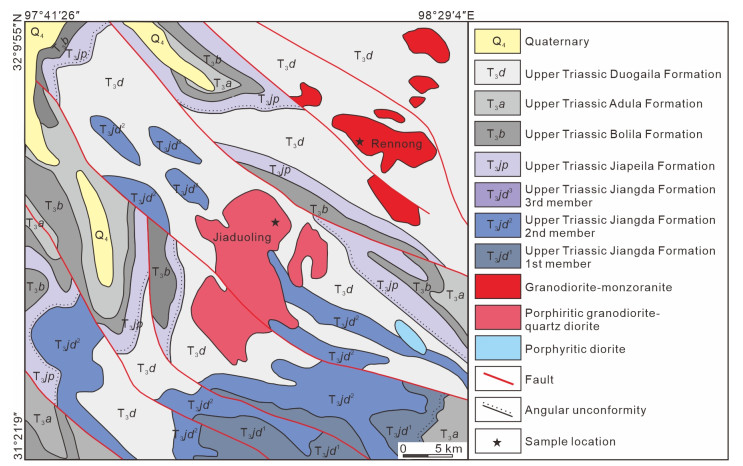
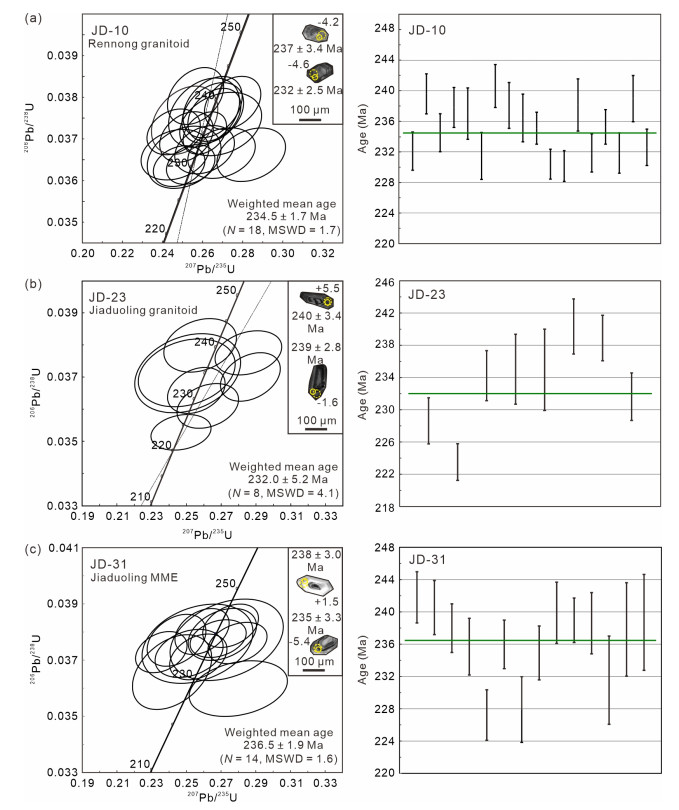
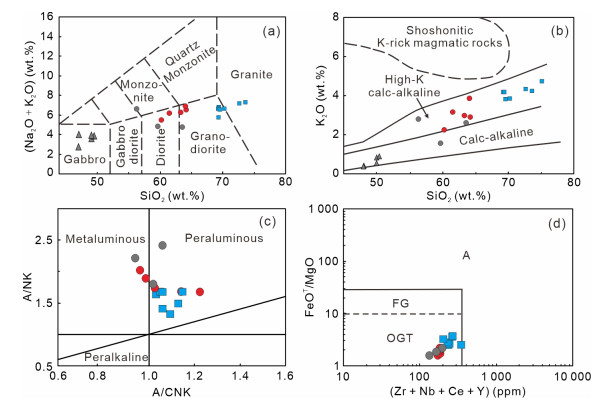
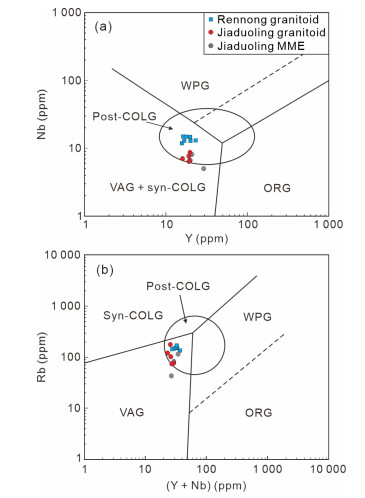
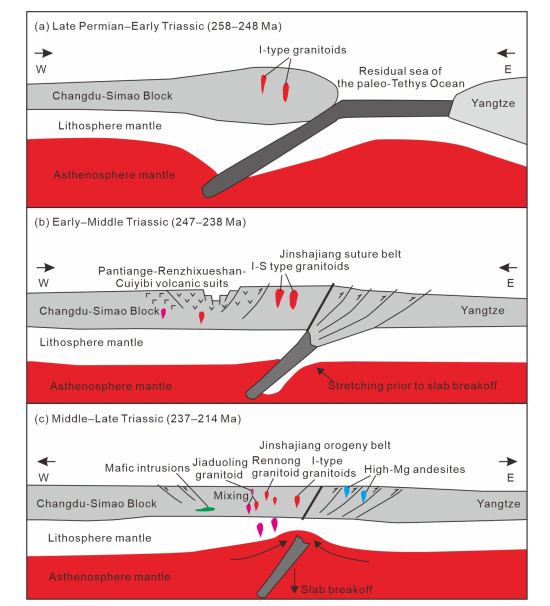
Permian–Triassic granitoids are widely distributed along the Jinshajiang suture belt, eastern Tibet, and are regarded as the result of the tectonic-magmatic activity associated with the evolution of Paleo-Tethys Ocean. This paper focuses on the high-K calc-alkaline I-type Rennong (~235 Ma) and Jiaduoling (~232 Ma) granitoid plutons, eastern Tibet, which are enriched in light rare earth elements (LREEs) and large ion lithophile elements (LILEs), but depleted in high field strength elements (HFSEs) with moderate-weak negative Eu anomalies (0.61–0.90). The Rennong granites are characterized by uniform zircon

| Barbarin, B., 2005. Mafic Magmatic Enclaves and Mafic Rocks Associated with Some Granitoids of the Central Sierra Nevada Batholith, California: Nature, Origin, and Relations with the Hosts. Lithos, 80(1/2/3/4): 155–177. https://doi.org/10.1016/j.lithos.2004.05.010 |
| Bureau of Geology and Mineral Resources of Yunnan Province (BGMRY), 1990. Regional Geology of Yunnan Province. Geological Publishing House, Beijing (in Chinese) |
| Blichert-Toft, J., Albarède, F., 1997. The Lu-Hf Isotope Geochemistry of Chondrites and the Evolution of the Mantle-Crust System. Earth and Planetary Science Letters, 148(1/2): 243–258. https://doi.org/10.1016/s0012-821x(97)00040-x |
| Bolhar, R., Weaver, S. D., Whitehouse, M. J., et al., 2008. Sources and Evolution of Arc Magmas Inferred from Coupled O and Hf Isotope Systematics of Plutonic Zircons from the Cretaceous Separation Point Suite (New Zealand). Earth and Planetary Science Letters, 268(3/4): 312–324. https://doi.org/10.1016/j.epsl.2008.01.022 |
| Bonin, B., 2007. A-Type Granites and Related Rocks: Evolution of a Concept, Problems and Prospects. Lithos, 97(1/2): 1–29. https://doi.org/10.1016/j.lithos.2006.12.007 |
| Browne, B. L., Eichelberger, J. C., Patino, L. C., et al., 2006. Magma Mingling as Indicated by Texture and Sr/Ba Ratios of Plagioclase Phenocrysts from Unzen Volcano, SW Japan. Journal of Volcanology and Geothermal Research, 154(1/2): 103–116. https://doi.org/10.1016/j.jvolgeores.2005.09.022 |
| Cao, W. T., Yan, D. P., Qiu, L., et al., 2015. Structural Style and Metamorphic Conditions of the Jinshajiang Metamorphic Belt: Nature of the Paleo-Jinshajiang Orogenic Belt in the Eastern Tibetan Plateau. Journal of Asian Earth Sciences, 113: 748–765. https://doi.org/10.1016/j.jseaes.2015.09.003 |
| Castro, A., 2013. Tonalite-Granodiorite Suites as Cotectic Systems: A Review of Experimental Studies with Applications to Granitoid Petrogenesis. Earth-Science Reviews, 124: 68–95. https://doi.org/10.1016/j.earscirev.2013.05.006 |
| Champion, D. C., Huston, D. L., 2016. Radiogenic Isotopes, Ore Deposits and Metallogenic terranes: Novel Approaches Based on Regional Isotopic Maps and the Mineral Systems Concept. Ore Geology Reviews, 76: 229–256. https://doi.org/10.1016/j.oregeorev.2015.09.025 |
| Chappell, B. W., 1999. Aluminium Saturation in I- and S-Type Granites and the Characterization of Fractionated Haplogranites. Lithos, 46(3): 535–551. https://doi.org/10.1016/s0024-4937(98)00086-3 |
| Chappell, B. W., Simpson, P. R., 1984. Source Rocks of I- and S-Type Granites in the Lachlan Fold Belt, Southeastern Australia. Philosophical Transactions of the Royal Society of London, 310: 693–707. https://doi.org/10.1098/rsta.1984.0015 |
|
Chappell, B. W., White, A. J. R., 1992. I- and S-Type Granites in the Lachlan Fold Belt. In: Brown, P. E., Chappell, B. W., eds., The Second Hutton Symposium on the Origin of Granites and Related Rocks. Geological Society of America. |
| Chappell, B. W., White, A. J. R., Wyborn, D., 1987. The Importance of Residual Source Material (Restite) in Granite Petrogenesis. Journal of Petrology, 28(6): 1111–1138. https://doi.org/10.1093/petrology/28.6.1111 |
| Chappell, B. W., Wyborn, D., 2012. Origin of Enclaves in S-Type Granites of the Lachlan Fold Belt. Lithos, 154: 235–247. https://doi.org/10.1016/j.lithos.2012.07.012 |
| Chauvel, C., Lewin, E., Carpentier, M., et al., 2007. Role of Recycled Oceanic Basalt and Sediment in Generating the Hf-Nd Mantle Array. Nature Geoscience, 1(1): 64–67. https://doi.org/10.1038/ngeo.2007.51 |
| Chen, Q., Wang, C. M., He, Z. C., et al., 2024. Fragmentary Records from the Breakup of Rodinia to the Closure of the Paleo-Tethys Ocean: New Evidence from the Gicha Complex in the Middle Sanjiang Tethyan Orogen, SW China. International Journal of Earth Sciences, 113(2): 477–499. https://doi.org/10.1007/s00531-024-02386-x |
| Chen, S., Niu, Y. L., Li, J. Y., et al., 2016. Syn-Collisional Adakitic Granodiorites Formed by Fractional Crystallization: Insights from Their Enclosed Mafic Magmatic Enclaves (MMEs) in the Qumushan Pluton, North Qilian Orogen at the Northern Margin of the Tibetan Plateau. Lithos, 248: 455–468. https://doi.org/10.1016/j.lithos.2016.01.033 |
| Chen, Y. L., Luo, Z. H., Liu, C., 2001. New Recognition of Kangding-Mianning Metamorphic Complexes from Sichuan, Western Yangtze Craton: Evidence from Nd Isotopic Composition. Earth Science, 26(3): 279–285 (in Chinese with English Abstract) |
| Cong, F., Wu, F. Y., Li, W. C., et al., 2022. Petrogenesis of the Late Triassic Mengsong Strongly Peraluminous Granites in the Southeastern Tibetan Plateau: Highly Fractionated from Crystal Mush. International Geology Review, 64(2): 164–181. https://doi.org/10.1080/00206814.2020.1839975 |
| Deng, J., Qiu, K. F., Wang, Q. F., et al., 2020. In situ Dating of Hydrothermal Monazite and Implications for the Geodynamic Controls on Ore Formation in the Jiaodong Gold Province, Eastern China. Economic Geology, 115(3): 671–685. https://doi.org/10.5382/econgeo.4711 |
| Deng, J., Wang, Q. F., Li, G. J., et al., 2014. Tethys Tectonic Evolution and Its Bearing on the Distribution of Important Mineral Deposits in the Sanjiang Region, SW China. Gondwana Research, 26(2): 419–437. https://doi.org/10.1016/j.gr.2013.08.002 |
| Didier, J., Barbarin, B., 1991. Enclaves and Granite Petrology. Elsevier, Amsterdam |
| Dong, G. C., Mo, X. X., Zhao, Z. D., et al., 2013. Zircon U-Pb Dating and the Petrological and Geochemical Constraints on Lincang Granite in Western Yunnan, China: Implications for the Closure of the Paleo-Tethys Ocean. Journal of Asian Earth Sciences, 62: 282–294. https://doi.org/10.1016/j.jseaes.2012.10.003 |
| Dong, P. S., Dong, G. C., Santosh, M., et al., 2021. Multiple Sources and Magmatic Evolution of the Late Triassic Daocheng Batholith in the Yidun Terrane: Implications for Evolution of the Paleo-Tethys Ocean in the Eastern Tibetan Plateau. GSA Bulletin, 134(7/8): 1660–1680. https://doi.org/10.1130/b35970.1 |
| Du, B., Wang, C. M., He, X. Y., et al., 2016. Advances in Research of Bulk-Rock Nd and Zircon Hf Isotopic Mappings: Case Study of the Sanjiang Tethyan Orogen. Acta Petrologica Sinica, 32(8): 2555–2570 (in Chinese with English Abstract) |
| Eby, G. N., 1992. Chemical Subdivision of the A-Type Granitoids: Petrogenetic and Tectonic Implications. Geology, 20(7): 641–644. https://doi.org/10.1130/0091-7613(1992)0200641:csotat>2.3.co;2 doi: 10.1130/0091-7613(1992)0200641:csotat>2.3.co;2 |
| Fan, H. P., Li, B., Zhou, J. X., et al., 2020. Subduction-Modified Mantle-Derived Triassic High-Mg Andesites in the Sanjiang Tethys, Eastern Tibet. Journal of Asian Earth Sciences, 191: 104216. https://doi.org/10.1016/j.jseaes.2019.104216 |
| Ferry, J. M., Watson, E. B., 2007. New Thermodynamic Models and Revised Calibrations for the Ti-in-Zircon and Zr-in-Rutile Ther-mometers. Contributions to Mineralogy and Petrology, 154(4): 429–437. https://doi.org/10.1007/s00410-007-0201-0 |
| Gan, Z. Q., Feng, Q. L., Wei, Y. H., et al., 2024. Detrital Zircon of Devonian Sandstones in Changning-Menglian Suture Zone, Yunnan, SW China: Implications for the Early Evolution of Paleo-Tethys. Journal of Earth Science, 35(3): 786–796. https://doi.org/10.1007/s12583-021-1470-7 |
| Gao, R., Xiao, L., He, Q., et al., 2010. Geochronology, Geochemistry and Petrogenesis of Granites in Weixi-Deqin, West Yunnan. Earth Science, 35(2): 186–200 (in Chinese with English Abstract) |
| Gao, R., Wu, T., Kerr, A. C., et al., 2024. Origin of Mafic Microgranular Enclaves from the Late Triassic Cuojiaoma Granitic Pluton: Implications for the Tectonic Evolution of the Yidun Arc Belt, Eastern Tibetan Plateau. Journal of Asian Earth Sciences, 266: 106131. https://doi.org/10.1016/j.jseaes.2024.106131 |
| Gerdes, A., Kemp, A. I. S., Hanchar, J. M., et al., 2009. Accessory Minerals as Tracers of Crustal Processes. Chemical Geology, 261(3/4): 197–198. https://doi.org/10.1016/j.chemgeo.2009.03.001 |
| Green, T. H., 1994. Experimental Studies of Trace-Element Partitioning Applicable to Igneous Petrogenesis—Sedona 16 Years Later. Chemical Geology, 117(1/2/3/4): 1–36. https://doi.org/10.1016/0009-2541(94)90119-8 |
| Green, T. H., Pearson, N. J., 1986. Rare-Earth Element Partitioning between Sphene and Coexisting Silicate Liquid at High Pressure and Temperature. Chemical Geology, 55(1/2): 105–119. https://doi.org/10.1016/0009-2541(86)90131-2 |
| Guan, C., Yan, M. D., Zhang, W. L., et al., 2021. Paleomagnetic and Chronologic Data Bearing on the Permian/Triassic Boundary Position of Qamdo in the Eastern Qiantang Terrane: Implications for the Closure of the Paleo-Tethys. Geophysical Research Letters, 48(6): e2020GL092059. https://doi.org/10.1029/2020gl092059 |
| Guo, Z. F., Wilson, M., 2012. The Himalayan Leucogranites: Constraints on the Nature of Their Crustal Source Region and Geodynamic Setting. Gondwana Research, 22(2): 360–376. https://doi.org/10.1016/j.gr.2011.07.027 |
| Hao, T. P., 1993. Sm-Nd Isotopic Ages of Proterozoic Metamorphic Rocks from the Middle Sector of the Jinsha River. Geological Review, 39(1): 52–56. https://doi.org/10.16509/j.georeview. 1993.01.008 (in Chinese with English Abstract) doi: 10.16509/j.georeview.1993.01.008 |
| Harrison, T. M., Watson, E. B., Aikman, A. B., 2007. Temperature Spectra of Zircon Crystallization in Plutonic Rocks. Geology, 35(7): 635–638. https://doi.org/10.1130/g23505a.1 |
| He, J., Wang, B. D., Wang, Q. Y., 2020. Subduction and Collision of the Jinsha River Paleo-Tethys: Constraints from Zircon U-Pb Dating and Geochemistry of the Ludian Batholith in the Jiangda-Deqen-Weixi Continental Margin Arc. Acta Geologica Sinica—English Edition, 94(4): 972–987. https://doi.org/10.1111/1755-6724.14554 |
| He, S. P., Li, R. S., Wang, C., et al., 2013. Research on the Formation Age of Ningduo Rock Group in Changdu Block: Evidence for the Existence of Basement in the North Qiangtang. Earth Science Frontiers, 20(5): 15–24 (in Chinese with English Abstract) |
| He, W. Y., Yang, L. Q., Lu, Y. J., et al., 2018. Zircon U-Pb Dating, Geochemistry and Sr-Nd-Hf-O Isotopes for the Baimaxueshan Granodiorites and Mafic Microgranulars Enclaves in the Sanjiang Orogen: Evidence for Westward Subduction of Paleo-Tethys. Gondwana Research, 62: 112–126. https://doi.org/10.1016/j.gr.2018.03.011 |
| Hermann, J., Rubatto, D., 2009. Accessory Phase Control on the Trace Element Signature of Sediment Melts in Subduction Zones. Chemical Geology, 265(3/4): 512–526. https://doi.org/10.1016/j.chemgeo.2009.05.018 |
| Hoskin, P. W. O., Schaltegger, U., 2003. The Composition of Zircon and Igneous and Metamorphic Petrogenesis. Reviews in Mineralogy and Geochemistry, 53(1): 27–62. https://doi.org/10.2113/0530027 |
| Hou, Z. Q., Zaw, K., Pan, G. T., et al., 2007. Sanjiang Tethyan Metallogenesis in S. W. China: Tectonic Setting, Metallogenic Epochs and Deposit Types. Ore Geology Reviews, 31(1/2/3/4): 48–87. https://doi.org/10.1016/j.oregeorev.2004.12.007 |
| Huang, H., Niu, Y. L., Mo, X. X., 2017. Garnet Effect on Nd-Hf Isotope Decoupling: Evidence from the Jinfosi Batholith, Northern Tibetan Plateau. Lithos, 274: 31–38. https://doi.org/10.1016/j.lithos.2016.12.025 |
| Huang, X. G., Dou, J. Z., Wu, G. H., et al., 2021. Source Rocks Control the Geochemical Diversity of Granite: The Lincang Pluton in the Western Yunnan Tethyan Belt, SW China. Lithos, 382: 105950. https://doi.org/10.1016/j.lithos.2020.105950 |
| Jagoutz, O., Schmidt, M. W., Enggist, A., et al., 2013. TTG-Type Plutonic Rocks Formed in a Modern Arc Batholith by Hydrous Fractionation in the Lower Arc Crust. Contributions to Mineralogy and Petrology, 166(4): 1099–1118. https://doi.org/10.1007/s00410-013-0911-4 |
| Jian, P., Liu, D. Y., Sun, X. M., 2003. SHRIMP Dating of Baimaxueshan and Ludian Granitoid Batholiths, Northwestern Yunnan Province, and Its Geological Implications. Acta Geosicientia Sinica, 24(4): 337–342 (in Chinese with English Abstract) |
| Kemp, A. S., Hawkesworth, C. J., Foster, G. L., et al., 2007. Magmatic and Crustal Differentiation History of Granitic Rocks from Hf-O Isotopes in Zircon. Science, 315(5814): 980–983. https://doi.org/10.1126/science.1136154 |
| Kirkland, C. L., Smithies, R. H., Taylor, R. J. M., et al., 2015. Zircon Th/U Ratios in Magmatic Environs. Lithos, 212: 397–414. https://doi.org/10.1016/j.lithos.2014.11.021 |
| Lai, C. K., Meffre, S., Crawford, A. J., et al., 2014. The Western Ailaoshan Volcanic Belts and Their SE Asia Connection: A New Tectonic Model for the Eastern Indochina Block. Gondwana Research, 26(1): 52–74. https://doi.org/10.1016/j.gr.2013.03.003 |
| Li, G. M., Li, J. X., Zhao, J. X., et al., 2015. Petrogenesis and Tectonic Setting of Triassic Granitoids in the Qiangtang Terrane, Central Tibet: Evidence from U-Pb Ages, Petrochemistry and Sr-Nd-Hf Isotopes. Journal of Asian Earth Sciences, 105: 443–455. https://doi.org/10.1016/j.jseaes.2015.02.017 |
| Li, H. L., Yang, D. X., Tian, Y., et al., 2023. Genesis and Its Geodynamic Significance of Late Cretaceous Granites in North Lancang River Suture. Earth Science, 48(4): 1330–1350. https://doi.org/10.3799/dqkx.2022.466 (in Chinese with English Abstract) |
| Li, X., Jiang, X., Sun, Z., et al., 2002. The Collision Orogenic Processes of the Nujiang-Lancangjiang-Jinshajiang Area, SW China. Geological Publishing House, Beijing. 213 (in Chinese) |
| Li, X. H., Li, Z. X., Li, W. X., et al., 2007. U-Pb Zircon, Geochemical and Sr-Nd-Hf Isotopic Constraints on Age and Origin of Jurassic I- and A-Type Granites from Central Guangdong, SE China: A Major Igneous Event in Response to Foundering of a Subducted Flat-Slab? Lithos, 96(1/2): 186–204. https://doi.org/10.1016/j.lithos.2006.09.018 |
| Lin, X. W., Zhang, Y. F., Chen, G. C., et al., 2023. LA-ICP-MS U-Pb Geochronology, Geochemistry and Petrography of Akebulake Pluton in Southern Altay Orogenic Belt: An Example for Magma Mixing. Earth Science, 48(10): 3597–3612. https://doi.org/10.3799/dqkx.2021.215 (in Chinese with English Abstract) |
| Liu, C., Deng, J. F., Liu, J. L., et al., 2011. Characteristics of Volcanic Rocks from Late Permian to Early Traissic in Ailaoshan Tectono-Magmatic Belt and Implications for Tectonic Settings. Acta Petrologica Sinica, 27(12): 3590–3602 (in Chinese with English Abstract) |
| Liu, F. T., Liu, J. H., Zhong, D. L., et al., 2000. The Subducted Slab of Yangtze Continental Block beneath the Tethyan Orogen in Western Yunnan. Chinese Science Bulletin, 45(5): 466–472. https://doi.org/10.1007/bf02884953 |
| Liu, G. C., Zi, J. W., Nie, X. M., et al., 2024. Late Cambrian Magmatic Events in SW Yunnan and Implications for the Tectonic Reconstruction of Northern Gondwana. Journal of Earth Science, 35(5): 1407–1425. https://doi.org/10.1007/s12583-022-1613-5 |
| Liu, H. C., Wang, Y. J., Cawood, P. A., et al., 2015. Record of Tethyan Ocean Closure and Indosinian Collision along the Ailaoshan Suture Zone (SW China). Gondwana Research, 27(3): 1292–1306. https://doi.org/10.1016/j.gr.2013.12.013 |
| Liu, H. C., Wang, Y. J., Guo, X. F., et al., 2017. Late Triassic Post-Collisional Slab Break-off along the Ailaoshan Suture: Insights from OIB-Like Amphibolites and Associated Felsic Rocks. International Journal of Earth Sciences, 106(4): 1359–1373. https://doi.org/10.1007/s00531-016-1373-5 |
| Ma, C. Q., Ehlers, C., Xu, C. H., et al., 2000. The Roots of the Dabieshan Ultrahigh-Pressure Metamorphic Terrane: Constraints from Geochemistry and Nd-Sr Isotope Systematics. Precambrian Research, 102(3/4): 279–301. https://doi.org/10.1016/s0301-9268(00)00069-3 |
| Mahood, G., Hildreth, W., 1983. Large Partition Coefficients for Trace Elements in High-Silica Rhyolites. Geochimica et Cosmochimica Acta, 47(1): 11–30. https://doi.org/10.1016/0016-7037(83)90087-x |
| Maniar, P. D., Piccoli, P. M., 1989. Tectonic Discrimination of Granitoids. Geological Society of America Bulletin, 101(5): 635–643. https://doi.org/10.1130/0016-7606(1989)101<0635:tdog>2.3.co;2 doi: 10.1130/0016-7606(1989)101<0635:tdog>2.3.co;2 |
| Metcalfe, I., 1996. Gondwanaland Dispersion, Asian Accretion and Evolution of Eastern Tethys. Australian Journal of Earth Sciences, 43(6): 605–623. https://doi.org/10.1080/08120099608728282 |
| Metcalfe, I., 2011. Tectonic Framework and Phanerozoic Evolution of Sundaland. Gondwana Research, 19(1): 3–21. https://doi.org/10.1016/j.gr.2010.02.016 |
| Metcalfe, I., 2002. Permian Tectonic Framework and Palaeogeography of SE Asia. Journal of Asian Earth Sciences, 20(6): 551–566. https://doi.org/10.1016/s1367-9120(02)00022-6 |
| Middlemost, E. A. K., 1994. Naming Materials in the Magma/Igneous Rock System. Earth-Science Reviews, 37(3/4): 215–224. https://doi.org/10.1016/0012-8252(94)90029-9 |
| Miller, C. F., McDowell, S. M., Mapes, R. W., 2003. Hot and Cold Granites? Implications of Zircon Saturation Temperatures and Preservation of Inheritance. Geology, 31(6): 529. https://doi.org/10.1130/0091-7613(2003)0310529:hacgio>2.0.co;2 doi: 10.1130/0091-7613(2003)0310529:hacgio>2.0.co;2 |
| Patiño Douce, A. E., Johnston, A. D., 1991. Phase Equilibria and Melt Productivity in the Pelitic System: Implications for the Origin of Peraluminous Granitoids and Aluminous Granulites. Contributions to Mineralogy and Petrology, 107(2): 202–218. https://doi.org/10.1007/bf00310707 |
| Pearce, J. A., Harris, N. B. W., Tindle, A. G., 1984. Trace Element Discrimination Diagrams for the Tectonic Interpretation of Granitic Rocks. Journal of Petrology, 25(4): 956–983. https://doi.org/10.1093/petrology/25.4.956 |
| Peccerillo, A., Taylor, S. R., 1976. Geochemistry of Eocene Calc-Alkaline Volcanic Rocks from the Kastamonu Area, Northern Turkey. Contributions to Mineralogy and Petrology, 58(1): 63–81. https://doi.org/10.1007/bf00384745 |
| Plank, T., Langmuir, C. H., 1998. The Chemical Composition of Subducting Sediment and Its Consequences for the Crust and Mantle. Chemical Geology, 145(3/4): 325–394. https://doi.org/10.1016/s0009-2541(97)00150-2 |
| Polat, A., Münker, C., 2004. Hf-Nd Isotope Evidence for Contemporaneous Subduction Processes in the Source of Late Archean Arc Lavas from the Superior Province, Canada. Chemical Geology, 213(4): 403–429. https://doi.org/10.1016/j.chemgeo.2004.08.016 |
| Pullen, A., Kapp, P., Gehrels, G. E., et al., 2008. Triassic Continental Subduction in Central Tibet and Mediterranean-Style Closure of the Paleo-Tethys Ocean. Geology, 36(5): 351. https://doi.org/10.1130/g24435a.1 |
| Rapp, R. P., Watson, E. B., 1995. Dehydration Melting of Metabasalt at 8–32 kbar: Implications for Continental Growth and Crust-Mantle Recycling. Journal of Petrology, 36(4): 891–931. https://doi.org/10.1093/petrology/36.4.891 |
| Roberts, N. M. W., Slagstad, T., Parrish, R. R., et al., 2013. Sedimentary Recycling in Arc Magmas: Geochemical and U-Pb-Hf-O Constraints on the Mesoproterozoic Suldal Arc, SW Norway. Contributions to Mineralogy and Petrology, 165(3): 507–523. https://doi.org/10.1007/s00410-012-0820-y |
| Roger, F., Jolivet, M., Malavieille, J., 2010. The Tectonic Evolution of the Songpan-Garzê (North Tibet) and Adjacent Areas from Pro-terozoic to Present: A Synthesis. Journal of Asian Earth Sciences, 39(4): 254–269. https://doi.org/10.1016/j.jseaes.2010.03.008 |
| Rollinson, H. R., 1993. Using Geochemical Data: Evaluation, Presentation, Interpretation. Longman Scientific & Technical, London. 1–352 |
| Rudnick, R. L., Fountain, D. M., 1995. Nature and Composition of the Continental Crust: A Lower Crustal Perspective. Reviews of Geophysics, 33(3): 267–309. https://doi.org/10.1029/95rg01302 |
| Schiano, P., Monzier, M., Eissen, J. P., et al., 2010. Simple Mixing as the Major Control of the Evolution of Volcanic Suites in the Ecuadorian Andes. Contributions to Mineralogy and Petrology, 160(2): 297–312. https://doi.org/10.1007/s00410-009-0478-2 |
| Schmitz, M. D., Vervoort, J. D., Bowring, S. A., et al., 2004. Decoupling of the Lu-Hf and Sm-Nd Isotope Systems during the Evolution of Granulitic Lower Crust beneath Southern Africa. Geology, 32(5): 405–408. https://doi.org/10.1130/g20241.1 |
| Searle, M. P., Yeh, M. W., Lin, T. H., et al., 2010. Structural Constraints on the Timing of Left-Lateral Shear along the Red River Shear Zone in the Ailao Shan and Diancang Shan Ranges, Yunnan, SW China. Geosphere, 6(4): 316–338. https://doi.org/10.1130/ges00580.1 |
| Sengor, A. M. C., 1981. The Evolution of the Paleo-Tethys in the Tibetan Segment of Alpides: Geological and Ecological Studies of Qinghai-Xizang Plateau, I. Science Press, Beijing. 51–56 |
| Sha, J. G., Fürsich, F. T., 1999. Palaeotethys Ocean Closed before Capitanian Times in Hohxil Area (W China): New Data on the Temporal Extent of the Palaeotethys. Neues Jahrbuch für Geologie und Paläontologie—Monatshefte, 1999(7): 440–448. https://doi.org/10.1127/njgpm/1999/1999/440 |
| Sisson, T. W., Ratajeski, K., Hankins, W. B., et al., 2005. Voluminous Granitic Magmas from Common Basaltic Sources. Contributions to Mineralogy and Petrology, 148(6): 635–661. https://doi.org/10.1007/s00410-004-0632-9 |
| Smithies, R. H., Howard, H. M., Evins, P. M., et al., 2011. High-Temperature Granite Magmatism, Crust-Mantle Interaction and the Mesoproterozoic Intracontinental Evolution of the Musgrave Province, Central Australia. Journal of Petrology, 52(5): 931–958. https://doi.org/10.1093/petrology/egr010 |
| Sun, S. S., McDonough, W. F., 1989. Chemical and Isotopic Systematics of Oceanic Basalts: Implications for Mantle Composition and Processes. Geological Society, London, Special Publications, 42(1): 313–345. https://doi.org/10.1144/gsl.sp.1989.042.01.19 doi: 10.1144/GSL.SP.1989.042.01.19 |
| Sun, X. M., Jian, P., 2004. The Wilson Cycle of the Jinshajiang Paleo-Tethys Ocean, in Western Yunnan and Western Sichuan Provinces. Geological Review, 50(4): 343–350 (in Chinese with English Abstract) |
| Sylvester, P. J., 1998. Post-Collisional Strongly Peraluminous Granites. Lithos, 45(1/2/3/4): 29–44. https://doi.org/10.1016/s0024-4937(98)00024-3 |
| Wang, B. D., Wang, L. Q., Chen, J. L., et al., 2014. Triassic Three-Stage Collision in the Paleo-Tethys: Constraints from Magmatism in the Jiangda-Deqen-Weixi Continental Margin Arc, SW China. Gondwana Research, 26(2): 475–491. https://doi.org/10.1016/j.gr.2013.07.023 |
| Wang, B. D., Wang, L. Q., Wang, D. B., et al., 2011. Zircons U-Pb Dating of Volcanic Rocks from Renzhixueshan Formation in Shangdie Rift Basin of Sanjiang Area and Its Geological Implications. Acta Petrologica et Mineralogica, 30(1): 25–33 (in Chinese with English Abstract) |
| Wang, C. M., Bagas, L., Lu, Y. J., et al., 2016. Terrane Boundary and Spatio-Temporal Distribution of Ore Deposits in the Sanjiang Tethyan Orogen: Insights from Zircon Hf-Isotopic Mapping. Earth-Science Reviews, 156: 39–65. https://doi.org/10.1016/j.earscirev.2016.02.008 |
| Wang, C. M., Deng, J., Lu, Y. J., et al., 2015. Age, Nature, and Origin of Ordovician Zhibenshan Granite from the Baoshan Terrane in the Sanjiang Region and Its Significance for Understanding Proto-Tethys Evolution. International Geology Review, 57(15): 1922–1939. https://doi.org/10.1080/00206814.2015.104335 |
| Wang, C. S., Li, X. H., Hu, X. M., 2003. Age of Initial Collision of India with Asia: Review and Constraints from Sediments in Southern Tibet. Acta Geologica Sinica, 77(1): 16–24 (in Chinese with English Abstract) |
| Wang, L. Q., Pan, G. T., Ding, J., et al., 2013. The Geological Map and Instruction of the Qinghai-Tibet Plateau and Its Adjacent Areas. Geological Publishing House, Beijing (in Chinese) |
| Wang, S. F., Yao, X., Jiang, W., 2019. Geochronological, Geochemical, and Sr-Nd-Hf Isotopic Characteristics of Granitoids in Eastern Tibet and Implications for Tectonic Correlation with Southeastern Asia. Lithosphere, 11(3): 333–347. https://doi.org/10.1130/l1019.1 |
| Wang, X. F., Metcalfe, I., Jian, P., et al., 2000. The Jinshajiang-Ailaoshan Suture Zone, China: Tectonostratigraphy, Age and Evolution. Journal of Asian Earth Sciences, 18(6): 675–690. https://doi.org/10.1016/s1367-9120(00)00039-0 |
| Wang, Y. J., Qian, X., Cawood, P. A., et al., 2018. Closure of the East Paleotethyan Ocean and Amalgamation of the Eastern Cimmerian and Southeast Asia Continental Fragments. Earth-Science Reviews, 186: 195–230. https://doi.org/10.1016/j.earscirev.2017.09.013 |
| Wang, Y. J., Wu, C. M., Zhang, A. M., et al., 2012. Kwangsian and Indosinian Reworking of the Eastern South China Block: Constraints on Zircon U-Pb Geochronology and Metamorphism of Amphibolites and Granulites. Lithos, 150: 227–242. https://doi.org/10.1016/j.lithos.2012.04.022 |
| Watson, E. B., Harrison, T. M., 1983. Zircon Saturation Revisited: Temperature and Composition Effects in a Variety of Crustal Magma Types. Earth and Planetary Science Letters, 64(2): 295–304. https://doi.org/10.1016/0012-821x(83)90211-x |
| Watson, E. B., Harrison, T. M., 2005. Zircon Thermometer Reveals Minimum Melting Conditions on Earliest Earth. Science, 308(5723): 841–844. https://doi.org/10.1126/science.1110873 |
| Watson, E. B., Wark, D. A., Thomas, J. B., 2006. Crystallization Thermometers for Zircon and Rutile. Contributions to Mineralogy and Petrology, 151(4): 413–433. https://doi.org/10.1007/s00410-006-0068-5 |
| Whalen, J. B., Currie, K. L., Chappell, B. W., 1987. A-Type Granites: Geochemical Characteristics, Discrimination and Petrogenesis. Contributions to Mineralogy and Petrology, 95(4): 407–419. https://doi.org/10.1007/bf00402202 |
| White, A. J. R., Chappell, B. W., Wyborn, D., 1999. Application of the Restite Model to the Deddick Granodiorite and Its Enclaves—A Reinterpretation of the Observations and Data of Maas et al. (1997). Journal of Petrology, 40(3): 413–421. https://doi.org/10.1093/petroj/40.3.413 |
| Woodhead, J. D., Hergt, J. M., Davidson, J. P., et al., 2001. Hafnium Isotope Evidence for 'Conservative' Element Mobility during Subduction Zone Processes. Earth and Planetary Science Letters, 192(3): 331–346. https://doi.org/10.1016/s0012-821x(01)00453-8 |
| Woodland, A. B., Bulatov, V. K., Brey, G. P., et al., 2018. Subduction Factory in an Ampoule: Experiments on Sediment-Peridotite Interaction under Temperature Gradient Conditions. Geochimica et Cosmochimica Acta, 223: 319–349. https://doi.org/10.1016/j.gca.2017.12.012 |
| Wu, G. Y., Wang, X. P., Zhong, D., et al., 2000. Two Arc Volcanics Suites of Permian–Early Triassic Bordering Sichuan, Yunnan and Xizang, China. Chinese Journal of Geology, 35(3): 350–362 (in Chinese with English Abstract) |
| Wu, T., Xiao, L., Ma, C. Q., et al., 2013. The Geochronological, Geochemical and Sr-Nd Isotopic Characteristics of Tongpu Intrusive Complex and Its Implications. Acta Petrologica Sinica, 29(10): 3567–3580 (in Chinese with English Abstract) |
| Wu, T., Xiao, L., Wilde, S. A., et al., 2016. Zircon U-Pb Age and Sr-Nd-Hf Isotope Geochemistry of the Ganluogou Dioritic Complex in the Northern Triassic Yidun Arc Belt, Eastern Tibetan Plateau: Implications for the Closure of the Garzê-Litang Ocean. Lithos, 248: 94–108. https://doi.org/10.1016/j.lithos.2015.12.029 |
| Wu, T., Xiao, L., Wilde, S. A., et al., 2017. A Mixed Source for the Late Triassic Garzê-Daocheng Granitic Belt and Its Implications for the Tectonic Evolution of the Yidun Arc Belt, Eastern Tibetan Plateau. Lithos, 288: 214–230. https://doi.org/10.1016/j.lithos.2017.07.002 |
| Wu, T., Zhang, W., Wilde, S. A., 2020. The Origin of Mafic Microgranular Enclaves in Granitoids: Insights from in situ Sr Isotope of Plagioclases and Zr-Hf Isotopes of Zircons. Chemical Geology, 551: 119776. https://doi.org/10.1016/j.chemgeo.2020.119776 |
| Xiao, L., He, Q., Pirajno, F., et al., 2008. Possible Correlation between a Mantle Plume and the Evolution of Paleo-Tethys Jinshajiang Ocean: Evidence from a Volcanic Rifted Margin in the Xiaru-Tuoding Area, Yunnan, SW China. Lithos, 100(1/2/3/4): 112–126. https://doi.org/10.1016/j.lithos.2007.06.020 |
| Xin, D., Yang, T. N., Liang, M. J., et al., 2018. Syn-Subduction Crustal Shortening Produced a Magmatic Flare-up in Middle Sanjiang Orogenic Belt, Southeastern Tibet Plateau: Evidence from Geochronology, Geochemistry, and Structural Geology. Gondwana Research, 62: 93–111. https://doi.org/10.1016/j.gr.2018.03.009 |
| Xiong, F. H., Ma, C. Q., Jiang, H. A., et al., 2016. Geochronology and Petrogenesis of Triassic High-K Calc-Alkaline Granodiorites in the East Kunlun Orogen, West China: Juvenile Lower Crustal Melting during Post-Collisional Extension. Journal of Earth Science, 27(3): 474–490. https://doi.org/10.1007/s12583-016-0674-6 |
| Xu, J. F., Castillo, P. R., 2004. Geochemical and Nd-Pb Isotopic Characteristics of the Tethyan Asthenosphere: Implications for the Origin of the Indian Ocean Mantle Domain. Tectonophysics, 393(1/2/3/4): 9–27. https://doi.org/10.1016/j.tecto.2004.07.028 |
| Xu, J. H., Jiang, Y. P., Hu, S. L., et al., 2024a. Petrogenesis and Tectonic Implications of the Paleoproterozoic A-Type Granites in the Xiong'ershan Area along the Southern Margin of the North China Craton. Journal of Earth Science, 35(2): 416–429. https://doi.org/10.1007/s12583-021-1424-0 |
| Xu, J. H., Zhang, Z. W., Wu, C. Q., et al., 2024b. Early Ordovician–Middle Silurian Subduction-Closure of the Proto-Tethys Ocean: Evidence from the Qiaerlong Pluton at the Northwestern Margin of the West Kunlun Orogenic Belt, NW China. Journal of Earth Science, 35(2): 430–448. https://doi.org/10.1007/s12583-021-1453-8 |
| Yan, M. D., Zhang, D. W., Fang, X. M., et al., 2016. Paleomagnetic Data Bearing on the Mesozoic Deformation of the Qiangtang Block: Implications for the Evolution of the Paleo- and Meso-Tethys. Gondwana Research, 39: 292–316. https://doi.org/10.1016/j.gr.2016.01.012 |
| Yang, J. H., Wu, F. Y., Wilde, S. A., et al., 2007. Tracing Magma Mixing in Granite Genesis: In situ U-Pb Dating and Hf-Isotope Analysis of Zircons. Contributions to Mineralogy and Petrology, 153(2): 177–190. https://doi.org/10.1007/s00410-006-0139-7 |
| Yang, L. F., Wang, C. M., Du, B., et al., 2020. Sequence and Petrogenesis of the Volcanic Rocks from the Middle Sanjiang Tethys Orogen, SW China: Implications for the Sanjiang Paleo-Tethyan Evolution. Geological Journal, 55(9): 6235–6254. https://doi.org/10.1002/gj.3806 |
| Yang, L. Q., Deng, J., Qiu, K. F., et al., 2015. Magma Mixing and Crust-Mantle Interaction in the Triassic Monzogranites of Bikou Terrane, Central China: Constraints from Petrology, Geoche-mistry, and Zircon U-Pb-Hf Isotopic Systematics. Journal of Asian Earth Sciences, 98: 320–341. https://doi.org/10.1016/j.jseaes. 2014.11.023 doi: 10.1016/j.jseaes.2014.11.023 |
| Yang, T. N., Ding, Y., Zhang, H. R., et al., 2014. Two-Phase Subduction and Subsequent Collision Defines the Paleotethyan Tectonics of the Southeastern Tibetan Plateau: Evidence from Zircon U-Pb Dating, Geochemistry, and Structural Geology of the Sanjiang Orogenic Belt, Southwest China. GSA Bulletin, 126(11/12): 1654–1682. https://doi.org/10.1130/b30921.1 |
| Yang, T. N., Hou, Z. Q., Wang, Y., et al., 2012. Late Paleozoic to Early Mesozoic Tectonic Evolution of Northeast Tibet: Evidence from the Triassic Composite Western Jinsha-Garzê-Litang Suture. Tectonics, 31(4): 1–20. https://doi.org/10.1029/2011tc003044 |
| Yang, T. N., Xue, C. D., Xin, D., et al., 2019. Paleotethyan Tectonic Evolution of the Sanjiang Orogenic Belt, SW China: Temporal and Spatial Distribution Pattern of Arc-Like Igneous Rocks. Acta Petrologica Sinica, 35(5): 1324–1340 (in Chinese with English Abstract) doi: 10.18654/1000-0569/2019.05.02 |
| Yang, T. N., Zhang, H. R., Liu, Y. X., et al., 2011. Permo-Triassic Arc Magmatism in Central Tibet: Evidence from Zircon U-Pb Geochronology, Hf Isotopes, Rare Earth Elements, and Bulk Geochemistry. Chemical Geology, 284(3/4): 270–282. https://doi.org/10.1016/j.chemgeo.2011.03.006 |
| Yin, S. P., Zhang, H. R., Bian, Y. K., 2023. Petrogenesis of Middle Triassic Andesitic Rocks in the Weixi Area, Southwest China: Implications for the Tectonic Evolution of the Paleo-Tethys. Lithos, 450: 107194. https://doi.org/10.1016/j.lithos.2023.107194 |
| Yurimoto, H., Duke, E. F., Papike, J. J., et al., 1990. Are Discontinuous Chondrite-Normalized REE Patterns in Pegmatitic Granite Systems the Results of Monazite Fractionation? Geochimica et Cosmochimica Acta, 54(7): 2141–2145. https://doi.org/10.1016/0016-7037(90)90277-r |
| Zhai, Q. G., Jahn, B. M., Wang, J., et al., 2016. Oldest Paleo-Tethyan Ophiolitic Melange in the Tibetan Plateau. GSA Bulletin, 128(3/4): 355–373. https://doi.org/10.1130/b31296.1 |
| Zhan, Q. Y., Zhu, D. C., Wang, Q., et al., 2021. Imaging the Late Triassic Lithospheric Architecture of the Yidun Terrane, Eastern Tibetan Plateau: Observations and Interpretations. GSA Bulletin, 33: 2279–2290. https://doi.org/10.1130/b35778.1 |
| Zhang, H. R., Yang, L. Q., He, W. Y., et al., 2021. Geochronology and Geochemistry of the Tongjige Granodiorites in the Jinshajiang Suture Zone, SW China: Constraints on Petrogenesis and Tectonic Evolution of the Palaeo-Tethys Ocean. Geological Journal, 56(3): 1445–1463. https://doi.org/10.1002/gj.3988 |
| Zhang, J. B., Ding, X. Z., Liu, Y. X., 2023. Zircon SHRIMP U-Pb Ages, Geochemistry and Nd-Hf Isotopes of ~1.0 Ga A-Type Felsic Rocks in the Southwestern Yangtze Block, South China: Petrogenesis and Tectonic Implications. Journal of Earth Science, 34(2): 504–517. https://doi.org/10.1007/s12583-020-1090-7 |
| Zhang, L. Y., Ding, L., Pullen, A., et al., 2014. Age and Geochemistry of Western Hoh-Xil-Songpan-Ganzi Granitoids, Northern Tibet: Implications for the Mesozoic Closure of the Paleo-Tethys Ocean. Lithos, 190: 328–348. https://doi.org/10.1016/j.lithos.2013.12.019 |
| Zhang, W. P., Wang, L. Q., Wang, B. D., et al., 2011. Chronology, Geochemistry and Petrogenesis of Deqin Granodiorite Body in the Middle Section of Jiangda-Weixi Arc. Acta Petrologica Sinica, 27(9): 2577–2590 (in Chinese with English Abstract) |
| Zhong, D. L., 1998. The Paleo-Tethys Orogenic Belt in West of Sichuan and Yunnan. Science Press, Beijing. 1–230 (in Chinese) |
| Zhong, D. L., 2000. The Changning-Menglian Tectonic Belt: Paleotethysides in West Yunnan and Sichuan, China. Science Press, Beijing. 112–123 (in Chinese) |
| Zhou, Y., Zhao, Y. S., Cai, Y. F., et al., 2023. Permian–Triassic Magmatism in the Qin-Fang Tectonic Belt, SW China: New Insights into Tectonic Evolution of the Eastern Paleo-Tethys. Journal of Earth Science, 34(6): 1704–1716. https://doi.org/10.1007/s12583-020-1111-6 |
| Zhu, J. J., Hu, R. Z., Bi, X. W., et al., 2011. Zircon U-Pb Ages, Hf-O Isotopes and Whole-Rock Sr-Nd-Pb Isotopic Geochemistry of Granitoids in the Jinshajiang Suture Zone, SW China: Constraints on Petrogenesis and Tectonic Evolution of the Paleo-Tethys Ocean. Lithos, 126(3/4): 248–264. https://doi.org/10.1016/j.lithos.2011.07.003 |
| Zi, J. W., Cawood, P. A., Fan, W. M., et al., 2012a. Generation of Early Indosinian Enriched Mantle-Derived Granitoid Pluton in the Sanjiang Orogen (SW China) in Response to Closure of the Paleo-Tethys. Lithos, 140: 166–182. https://doi.org/10.1016/j.lithos.2012.02.006 |
| Zi, J. W., Cawood, P. A., Fan, W. M., et al., 2012b. Triassic Collision in the Paleo-Tethys Ocean Constrained by Volcanic Activity in SW China. Lithos, 144: 145–160. https://doi.org/10.1016/j.lithos.2012.04.020 |
| Zi, J. W., Cawood, P. A., Fan, W. M., et al., 2013. Late Permian-Triassic Magmatic Evolution in the Jinshajiang Orogenic Belt, SW China and Implications for Orogenic Processes Following Closure of the Paleo-Tethys. American Journal of Science, 313(2): 81–112. https://doi.org/10.2475/02.2013.02 |
| Zindler, A., Hart, S., 1986. Chemical Geodynamics. Annual Review of Earth and Planetary Sciences, 14: 493–571. https://doi.org/10.1146/annurev.earth.14.1.493 |
Figures(15)
Copyright © 2013-2020 Journal of Earth Science 鄂ICP备15021562号-2
Tel: +86-27-67885075 Fax: +86-27-67885075 E-mail: xbb@cug.edu.cn
Address: Editorial Office of Journal, China University of Geosciences, Yujiashan, Wuhan, Hubei 430074, P. R. China
Supported by:
Beijing Renhe Information Technology Co. Ltd
E-mail:
info@rhhz.net


 DownLoad: