| Citation: | Min Zhang, Yan Liu, Huafeng Qin, Jinhua Li, Yifei Hou, Bitian Wei, Wei Liu, Linhao Cui, Xingliang Zhang, Chenglong Deng, Yongxin Pan. Early Paleozoic Affiliation between South China Block and Gondwana Revealed by Early Silurian Remagnetization. Journal of Earth Science, 2026, 37(3): 1166-1178. doi: 10.1007/s12583-025-0394-z

|
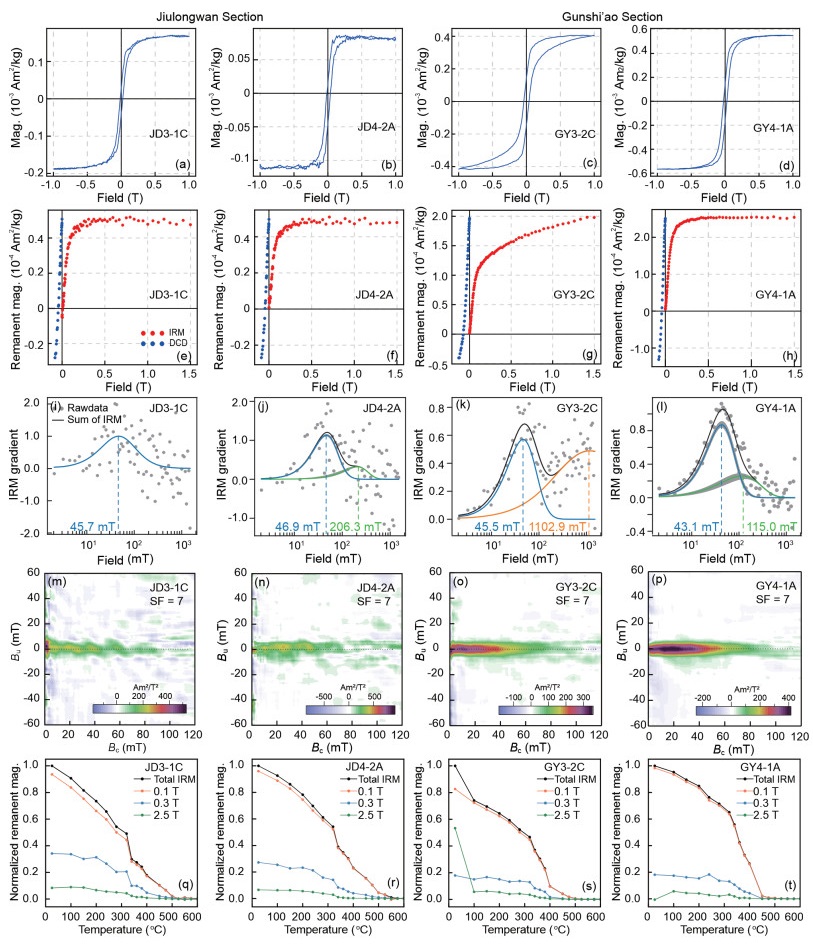
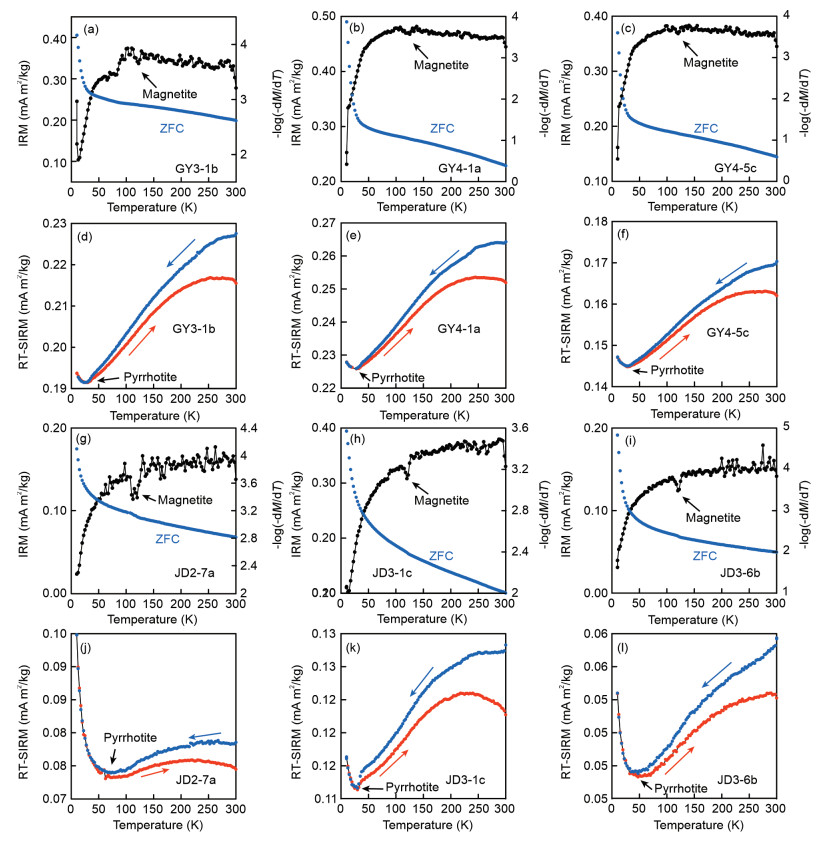
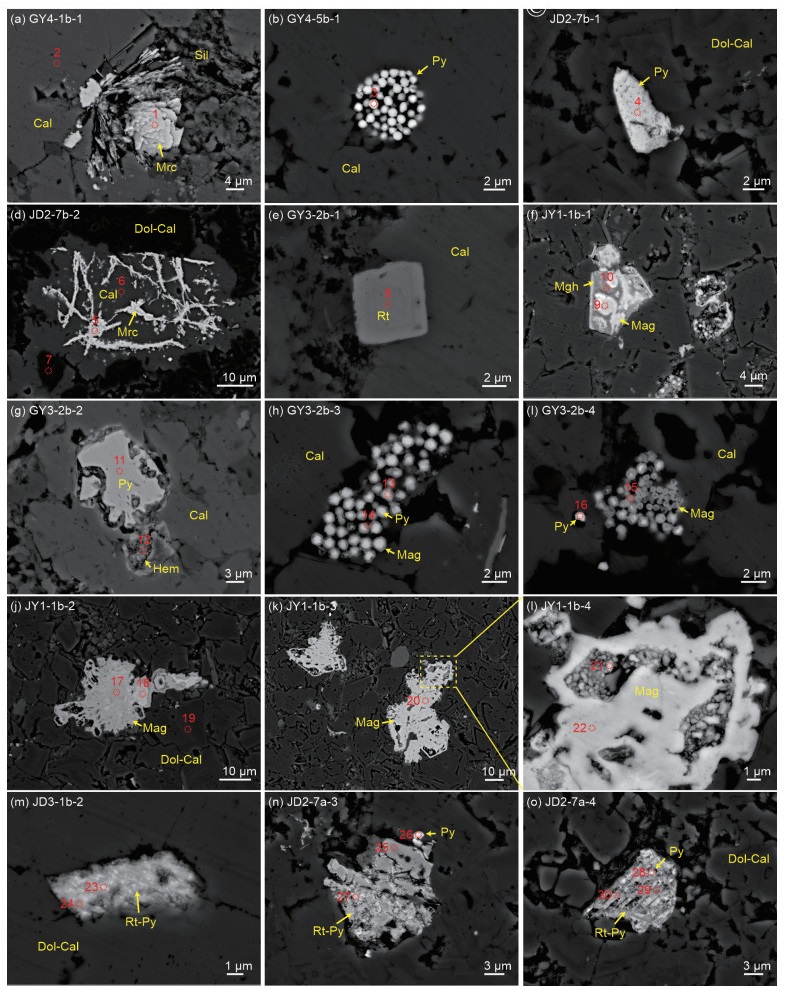
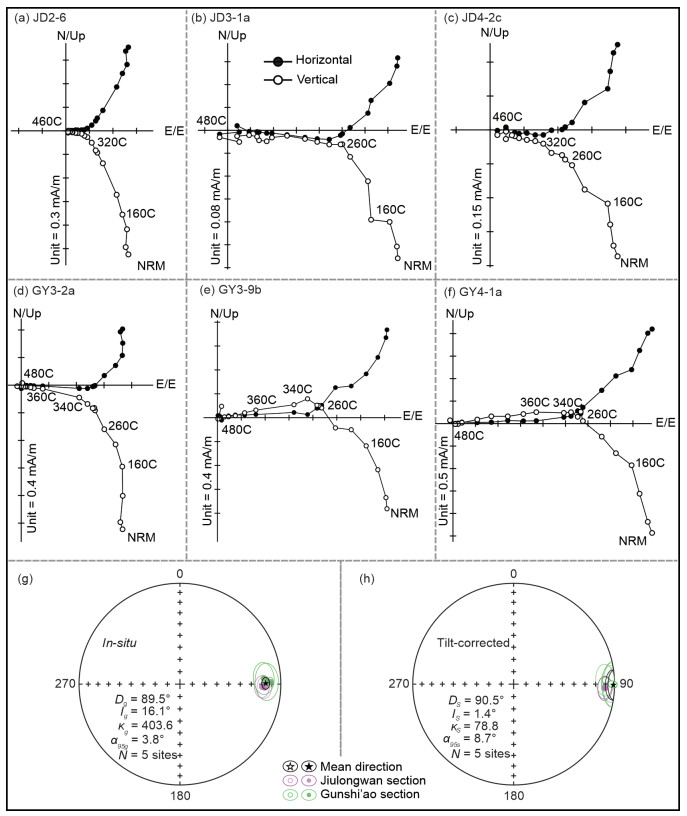
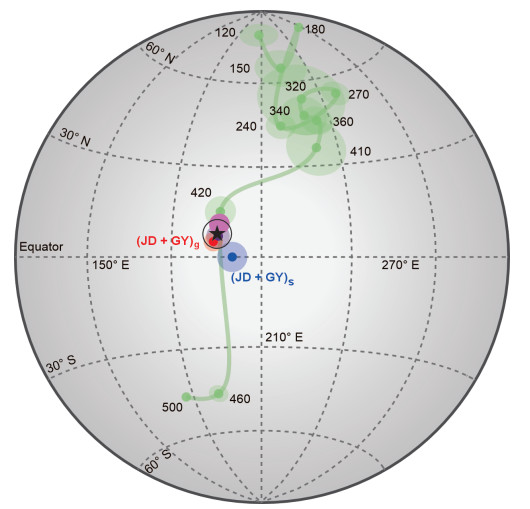
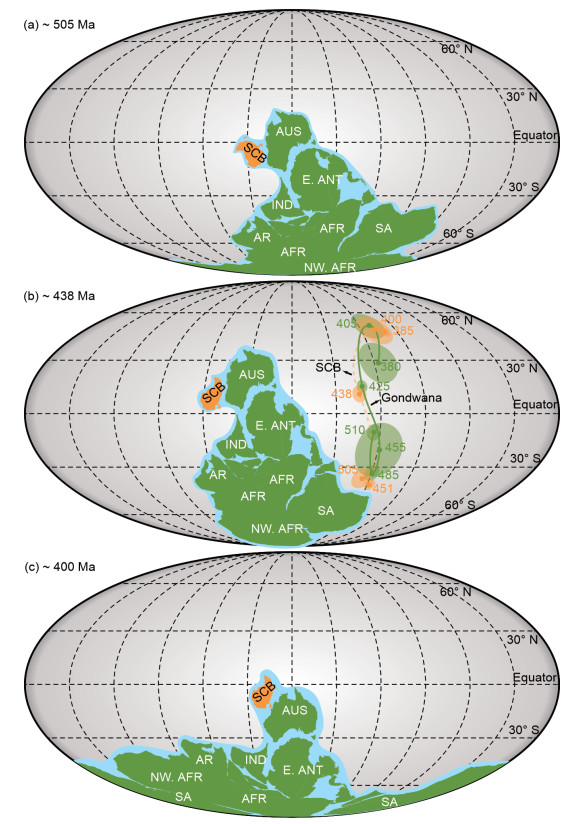
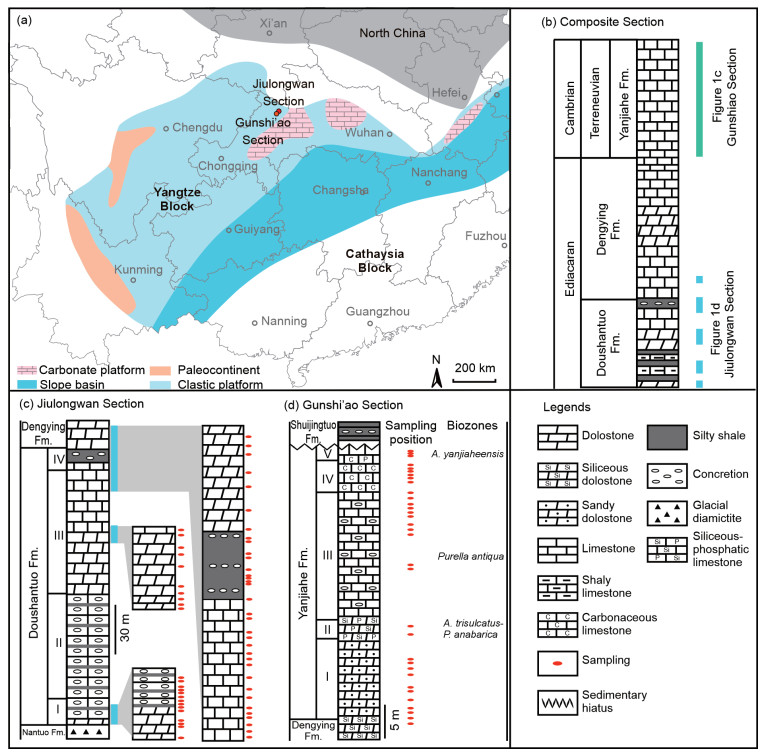
Paleogeographic reconstruction provides a key surface boundary condition for the study of many first-order Earth systems and geodynamic processes. However, scarcity of robust Early Paleozoic paleomagnetic data leads to a controversial reconstruction between the South China Block (SCB) and Gondwana. Here, we performed rock-magnetic, mineralogical and paleomagnetic analyses on the Ediacaran and Cambrian strata in the Jiulongwan and Gunshi’ao sections in the Three Gorges area, Hubei province in South China. Rock-magnetic and mineralogical analyses suggested that the secondary magnetite—formed via pyrite oxidation—is the main remanence carrier, recording a post-tilting remagnetization event associated with fluid alterations. Paleomagnetic measurements showed a new Early Silurian paleopole (5.0°N, 194.1°E,

| Bai, L. X., Zhu, R. X., Harming, W., et al., 1998. New Cambrian Paleomagnetic Pole for Yangtze Block. Science in China Series D: Earth Sciences, 41(2): 66–71.https://doi.org/10.1007/bf029 84514 doi: 10.1007/bf02984514 |
| Bian, W. W., Jiao, X. W., Wang, S., et al., 2024. Remagnetization of the Upper Permian–Lower Triassic Limestones in the Western Lhasa Terrane and Its Tectonic Implications. Geophysical Journal International, 237(1): 465–484. https://doi.org/10.1093/gji/ggae052 |
| Burrett, C., Long, J., Stait, B., 1990. Early-Middle Palaeozoic Biogeography of Asian Terranes Derived from Gondwana. Geological Society, London, Memoirs, 12(1): 163–174. https://doi.org/10.1144/gsl.mem.1990.012.01.14 |
| Burrett, C., Zaw, K., Meffre, S., et al., 2014. The Configuration of Greater Gondwana—Evidence from LA ICPMS, U-Pb Geochronology of Detrital Zircons from the Palaeozoic and Mesozoic of Southeast Asia and China. Gondwana Research, 26(1): 31–51. https://doi.org/10.1016/j.gr.2013.05.020 |
| Cawood, P. A., Zhao, G. C., Yao, J. L., et al., 2018. Reconstructing South China in Phanerozoic and Precambrian Supercontinents. Earth-Science Reviews, 186: 173–194. https://doi.org/10.1016/j.earscirev.2017.06.001 |
| Condon, D., Zhu, M. Y., Bowring, S., et al., 2005. U-Pb Ages from the Neoproterozoic Doushantuo Formation, China. Science, 308(5718): 95–98. https://doi.org/10.1126/science.1107765 |
| Derkowski, A., Bristow, T. F., Wampler, J. M., et al., 2013. Hydrothermal Alteration of the Ediacaran Doushantuo Formation in the Yangtze Gorges Area (South China). Geochimica et Cosmochimica Acta, 107: 279–298.https://doi.org/10.1016/j.gc a.2013.01.015 doi: 10.1016/j.gca.2013.01.015 |
| Domeier, M., 2018. Early Paleozoic Tectonics of Asia: Towards a Full-Plate Model. Geoscience Frontiers, 9(3): 789–862. https://doi.org/10.1016/j.gsf.2017.11.012 |
| Domeier, M., Robert, B., Meert, J. G., et al., 2023. The Enduring Ediacaran Paleomagnetic Enigma. Earth-Science Reviews, 242: 104444. https://doi.org/10.1016/j.earscirev.2023.104444 |
| Domeier, M., Torsvik, T. H., 2014. Plate Tectonics in the Late Paleozoic. Geoscience Frontiers, 5(3): 303–350. https://doi.org/10.1016/j.gsf.2014.01.002 |
| Fisher, R., 1953. Dispersion on a Sphere. Proceedings of the Royal Society A: Mathematical, Physical and Engineering Sciences, 217(1130): 295–305. https://doi.org/10.1098/rspa.1953.0064 |
| Fu, D. J., Tong, G. H., Dai, T., et al., 2019. The Qingjiang Biota—A Burgess Shale-Type Fossil Lagerstätte from the Early Cambrian of South China. Science, 363(6433): 1338–1342. https://doi.org/10.1126/science.aau8800 |
| Guo, J. F., Li, Y., Li, G. X., 2014. Small Shelly Fossils from the Early Cambrian Yanjiahe Formation, Yichang, Hubei, China. Gondwana Research, 25(3): 999–1007. https://doi.org/10.1016/j.gr.2013.03.007 |
| Han, Z. R., Yang, Z. Y., Tong, Y. B., et al., 2015. New Paleomagnetic Results from Late Ordovician Rocks of the Yangtze Block, South China, and Their Paleogeographic Implications. Journal of Geophysical Research: Solid Earth, 120(7): 4759–4772. https://doi.org/10.1002/2015jb012005 |
| Harrison, R. J., Feinberg, J. M., 2008. FORCinel: An Improved Algorithm for Calculating First-Order Reversal Curve Distributions Using Locally Weighted Regression Smoothing. Geochemistry, Geophysics, Geosystems, 9(5): 2008GC001987. https://doi.org/10.1029/2008gc001987 |
| Heslop, D., Roberts, A. P., 2019. Quantifying the Similarity of Paleomagnetic Poles. Journal of Geophysical Research: Solid Earth, 124(12): 12388–12403.https://doi.org/10.1029/2019jb01 8342 doi: 10.1029/2019jb018342 |
| Huang, B. C., Yan, Y. G., Piper, J. D. A., et al., 2018. Paleomagnetic Constraints on the Paleogeography of the East Asian Blocks during Late Paleozoic and Early Mesozoic Times. Earth-Science Reviews, 186: 8–36.https://doi.org/10.1016/j.earscirev.2018.0 2.004 doi: 10.1016/j.earscirev.2018.02.004 |
| Huang, K. N., Opdyke, N. D., Zhu, R. X., 2000. Further Paleomagnetic Results from the Silurian of the Yangtze Block and Their Implications. Earth and Planetary Science Letters, 175(3/4): 191–202. https://doi.org/10.1016/s0012-821x(99)00302-7 |
| Huang, W. T., Lippert, P. C., Zhang, Y., et al., 2017. Remagnetization of Carbonate Rocks in Southern Tibet: Perspectives from Rock Magnetic and Petrographic Investigations. Journal of Geophysical Research: Solid Earth, 122(4): 2434–2456. https://doi.org/10.1002/2017jb013987 |
| Jiang, G. Q., Sohl, L. E., Christie-Blick, N., 2003. Neoproterozoic Stratigraphic Comparison of the Lesser Himalaya (India) and Yangtze Block (South China): Paleogeographic Implications. Geology, 31(10): 917. https://doi.org/10.1130/g19790.1 |
| Jing, X. Q., Yang, Z. Y., Mitchell, R. N., et al., 2022. Ordovician–Silurian True Polar Wander as a Mechanism for Severe Glaciation and Mass Extinction. Nature Communications, 13: 7941. https://doi.org/10.1038/s41467-022-35609-3 |
| Jing, X. Q., Yang, Z. Y., Tong, Y. B., et al., 2015. A Revised Paleomagnetic Pole from the Mid-Neoproterozoic Liantuo Formation in the Yangtze Block and Its Paleogeographic Implications. Precambrian Research, 268: 194–211. https://doi.org/10.1016/j.precamres.2015.07.007 |
| Jing, X. Q., Yang, Z. Y., Tong, Y. B., et al., 2018. Identification of Multiple Magnetizations of the Ediacaran Strata in South China. Geophysical Journal International, 212(1): 54–75. https://doi.org/10.1093/gji/ggx396 |
| Jones, C. H., 2002. User-Driven Integrated Software Lives: “Paleomag” Paleomagnetics Analysis on the Macintosh. Computers Geosciences, 28(10): 1145–1151. https://doi.org/10.1016/s0098-3004(02)00032-8 |
| Kirschvink, J. L., 1980. The Least-Squares Line and Plane and the Analysis of Palaeomagnetic Data. Geophysical Journal International, 62(3): 699–718.https://doi.org/10.1111/j.1365-246 x.1980.tb02601.x doi: 10.1111/j.1365-246x.1980.tb02601.x |
| Kirschvink, J. L., Isozaki, Y., Shibuya, H., et al., 2015. Challenging the Sensitivity Limits of Paleomagnetism: Magnetostratigraphy of Weakly Magnetized Guadalupian–Lopingian (Permian) Limestone from Kyushu, Japan. Palaeogeography, Palaeoclimatology, Palaeoecology, 418: 75–89. https://doi.org/10.1016/j.palaeo.2014.10.037 |
| Kirschvink, J. L., Kopp, R. E., Raub, T. D., et al., 2008. Rapid, Precise, and High-Sensitivity Acquisition of Paleomagnetic and Rock-Magnetic Data: Development of a Low-Noise Automatic Sample Changing System for Superconducting Rock Magnetometers. Geochemistry, Geophysics, Geosystems, 9(5): 2007GC001856. https://doi.org/10.1029/2007gc001856 |
| Kullback, S., Leibler, R. A., 1951. On Information and Sufficiency. The Annals of Mathematical Statistics, 22(1): 79–86. https://doi.org/10.1214/aoms/1177729694 |
| Li, Z. X., Li, X. H., Wartho, J. A., et al., 2010. Magmatic and Metamorphic Events during the Early Paleozoic Wuyi-Yunkai Orogeny, Southeastern South China: New Age Constraints and Pressure-Temperature Conditions. Geological Society of America Bulletin, 122(5/6): 772–793.https://doi.org/10.1130/b3 0021.1 doi: 10.1130/b30021.1 |
| Lowrie, W., 1990. Identification of Ferromagnetic Minerals in a Rock by Coercivity and Unblocking Temperature Properties. Geophysical Research Letters, 17(2): 159–162. https://doi.org/10.1029/gl017i002p00159 |
| Macouin, M., Besse, J., Ader, M., et al., 2004. Combined Paleomagnetic and Isotopic Data from the Doushantuo Carbonates, South China: Implications for the “Snowball Earth” Hypothesis. Earth and Planetary Science Letters, 224(3/4): 387–398. https://doi.org/10.1016/j.epsl.2004.05.015 |
| McElhinny, M. W., Powell, C. M., Pisarevsky, S. A., 2003. Paleozoic Terranes of Eastern Australia and the Drift History of Gondwana. Tectonophysics, 362(1/2/3/4): 41–65. https://doi.org/10.1016/s0040-1951(02)00630-3 |
|
Metcalfe, I., 2011. Palaeozoic–Mesozoic History of SE Asia. In: Hall, R., Cottam, M. A., Wilson, M. E. J., eds. The SE Asian Gateway: History and Tectonics of the Australia-Asia Collision, Geological Society of London, London. |
| Metcalfe, I., 2013. Gondwana Dispersion and Asian Accretion: Tectonic and Palaeogeographic Evolution of Eastern Tethys. Journal of Asian Earth Sciences, 66: 1–33.https://doi.org/10. 1016/j.jseaes.2012.12.020 doi: 10.1016/j.jseaes.2012.12.020 |
| Morin, F. J., 1950. Magnetic Susceptibility of αFe2O3 and αFe2O3 with Added Titanium. Physical Review, 78(6): 819–820. https://doi.org/10.1103/physrev.78.819.2 |
| Murowchick, J. B., Barnes, H. L., 1986. Marcasite Precipitation from Hydrothermal Solutions. Geochimica et Cosmochimica Acta, 50(12): 2615–2629. https://doi.org/10.1016/0016-7037(86)90214-0 |
| Opdyke, N. D., Huang, K., Xu, G., et al., 1987. Paleomagnetic Results from the Silurian of the Yangtze Paraplatform. Tectonophysics, 139(1/2): 123–132.https://doi.org/10.1016/004 0-1951(87)90201-0 doi: 10.1016/0040-1951(87)90201-0 |
| Peng, B., Li, Z. X., Li, G. R., et al., 2018. Multiple Dolomitization and Fluid Flow Events in the Precambrian Dengying Formation of Sichuan Basin, Southwestern China. Acta Geologica Sinica (English Edition), 92(1): 311–332. https://doi.org/10.1111/1755-6724.13507 |
| Qin, H. F., Zhao, X., Liu, S. C., et al., 2020. An Ultra-Low Magnetic Field Thermal Demagnetizer for High-Precision Paleo-magnetism. Earth, Planets and Space, 72(1): 170. https://doi.org/10.1186/s40623-020-01304-0 |
| Qiu, H., Feng, L. J., Chu, X. L., et al., 2022. Genesis of Silica-Phosphatic Nodules with Small Shelly Fossils Preserved in the Lowermost Cambrian of South China. Acta Geologica Sinica (English Edition), 96(4): 1294–1307.https://doi.org/10.1111/17 55-6724.14924 doi: 10.1111/1755-6724.14924 |
| Roberts, A. P., 1995. Magnetic Properties of Sedimentary Greigite (Fe3S4). Earth and Planetary Science Letters, 134(3/4): 227–236. https://doi.org/10.1016/0012-821x(95)00131-u |
| Roberts, A. P., Cui, Y. L., Verosub, K. L., 1995. Wasp-Waisted Hysteresis Loops: Mineral Magnetic Characteristics and Discrimination of Components in Mixed Magnetic Systems. Journal of Geophysical Research: Solid Earth, 100(B9): 17909–17924. https://doi.org/10.1029/95jb00672 |
| Rochette, P., Fillion, G., Mattéi, J. L., et al., 1990. Magnetic Transition at 30–34 Kelvin in Pyrrhotite: Insight into a Widespread Occurrence of this Mineral in Rocks. Earth and Planetary Science Letters, 98(3/4): 319–328.https://doi.org/10. 1016/0012-821x(90)90034-u doi: 10.1016/0012-821x(90)90034-u |
| Suk, D., Peacor, D. R., Van der Voo, R., 1990. Replacement of Pyrite Framboids by Magnetite in Limestone and Implications for Palaeomagnetism. Nature, 345(6276): 611–613. https://doi.org/10.1038/345611a0 |
| Torsvik, T. H., Cocks, L. R. M., 2009. The Lower Palaeozoic Palaeogeographical Evolution of the Northeastern and Eastern Peri-Gondwanan Margin from Turkey to New Zealand. In: Bassett, M. G., ed., Early Palaeozoic Peri-Gondwana Terranes: New Insights from Tectonics and Biogeography, Geological Society of London, London |
| Torsvik, T. H., Cocks, L. R. M., 2017. Earth History and Palaeogeography. Cambridge University Press, Cambridge. https://doi.org/10.1017/9781316225523 |
| Verwey, E. J. W., 1939. Electronic Conduction of Magnetite (Fe3O4) and Its Transition Point at Low Temperatures. Nature, 144(3642): 327–328. https://doi.org/10.1038/144327b0 |
| Wu, L., Pisarevsky, S., Li, Z. X., et al., 2024. A New Reconstruction of Phanerozoic Earth Evolution: Toward a Big-Data Approach to Global Paleogeography. Tectonophysics, 874: 230198. https://doi.org/10.1016/j.tecto.2023.230198 |
| Xian, H. B., Zhang, S. H., Li, H. Y., et al., 2019. How Did South China Connect to and Separate from Gondwana? New Paleomagnetic Constraints from the Middle Devonian Red Beds in South China. Geophysical Research Letters, 46(13): 7371–7378. https://doi.org/10.1029/2019gl083123 |
| Yang, C., Bowyer, F. T., Condon, D. J., et al., 2023. New U-Pb Age from the Shuijingtuo Formation (Yangtze Gorges Area) and Its Implications for the Cambrian Timescale. Palaeogeography, Palaeoclimatology, Palaeoecology, 616: 111477. https://doi.org/10.1016/j.palaeo.2023.111477 |
| Yang, C., Li, X. H., Li, Z. X., et al., 2020. Provenance Evolution of Age-Calibrated Strata Reveals when and how South China Block Collided with Gondwana. Geophysical Research Letters, 47(19): e2020GL090282. https://doi.org/10.1029/2020gl090282 |
| Yang, C., Rooney, A. D., Condon, D. J., et al., 2021. The Tempo of Ediacaran Evolution. Science Advances, 7(45): eabi9643. https://doi.org/10.1126/sciadv.abi9643 |
| Yang, Z. Y., Sun, Z. M., Yang, T., et al., 2004. A Long Connection (750–380 Ma) between South China and Australia: Paleomagnetic Constraints. Earth and Planetary Science Letters, 220(3/4): 423–434. https://doi.org/10.1016/s0012-821x(04)00053-6 |
| Zhang, S. H., Li, H. Y., Jiang, G. Q., et al., 2015. New Paleomagnetic Results from the Ediacaran Doushantuo Formation in South China and Their Paleogeographic Implications. Precambrian Research, 259: 130–142.https://doi.org/10.1016/j.precamres.20 14.09.018 doi: 10.1016/j.precamres.2014.09.018 |
| Zhang, S., Zhu, H., Meng, X., 2001. New Paleomagnetic Results from the Devonian–Carboniferous Successions in the Southern Yangtze Block and Their Paleogeographic Implications. Acta Geologica Sinica, 75(3): 303–313 (in Chinese with English Abstract) |
| Zhang, Y., Jia, D., Muxworthy, A. R., et al., 2020. Fluid Migration and Widespread Remagnetization in the Dabashan Fold and Thrust Belt, China. Journal of Geophysical Research: Solid Earth, 125(11): e2020JB019989. https://doi.org/10.1029/2020jb019989 |
| Zhao, G. C., Wang, Y. J., Huang, B. C., et al., 2018. Geological Reconstructions of the East Asian Blocks: From the Breakup of Rodinia to the Assembly of Pangea. Earth-Science Reviews, 186: 262–286. https://doi.org/10.1016/j.earscirev.2018.10.003 |
| Zhao, X. Y., Fujii, M., Suganuma, Y., et al., 2018. Applying the Burr Type XII Distribution to Decompose Remanent Magnetization Curves. Journal of Geophysical Research: Solid Earth, 123(10): 8298–8311. https://doi.org/10.1029/2018jb016082 |
| Zhou, C. M., Xiao, S. H., 2007. Ediacaran δ13C Chemostratigraphy of South China. Chemical Geology, 237(1/2): 89–108. https://doi.org/10.1016/j.chemgeo.2006.06.021 |
Figures(7)
Copyright © 2013-2020 Journal of Earth Science 鄂ICP备15021562号-2
Tel: +86-27-67885075 Fax: +86-27-67885075 E-mail: xbb@cug.edu.cn
Address: Editorial Office of Journal, China University of Geosciences, Yujiashan, Wuhan, Hubei 430074, P. R. China
Supported by:
Beijing Renhe Information Technology Co. Ltd
E-mail:
info@rhhz.net


 DownLoad: