| Citation: | Wang Chen, Tao Ni. Quantitative Constraints on the Exhumation and Preservation of the Giant Jinchuan Cu-Ni Sulfide Deposit. Journal of Earth Science, 2026, 37(4): 1540-1551. doi: 10.1007/s12583-025-0362-7

|
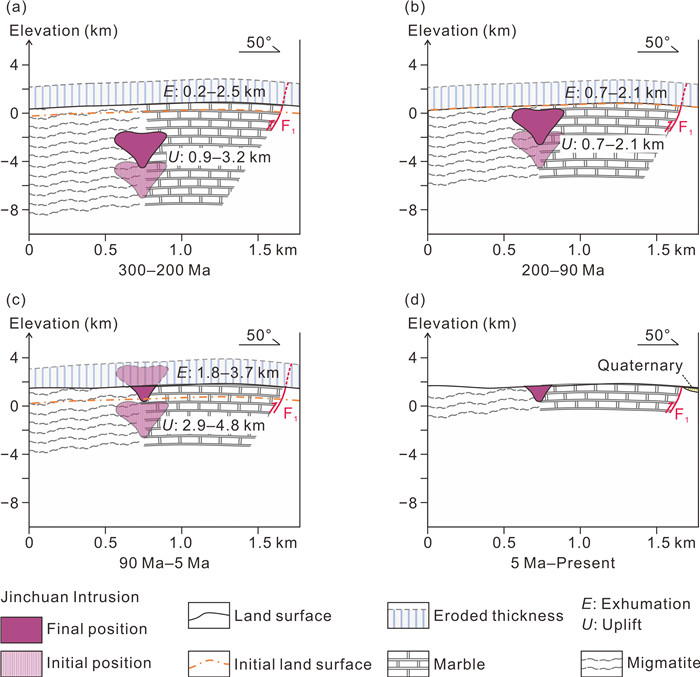
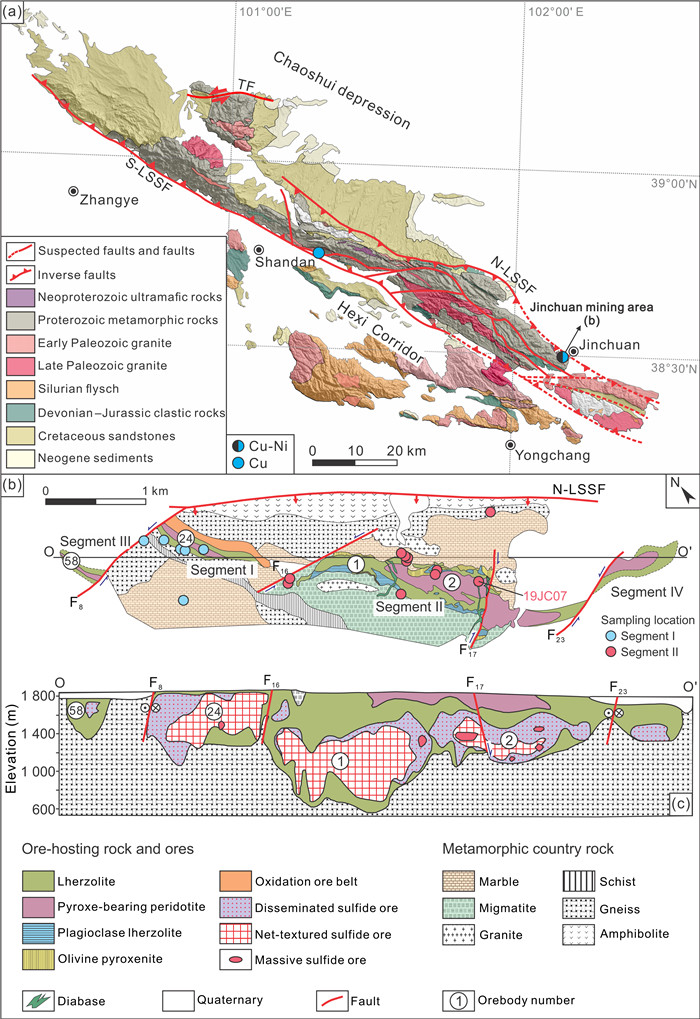
Jinchuan deposit, the world's 3rd largest Cu-Ni sulfide magmatic deposit formed in the Neoproterozoic, has been developed as an open pit mine, indicating the impact of exhumation and erosion on the deposit. To evaluate the preservation of the Jinchuan deposit, this study compiles published thermochronological data (zircon (U-Th)/He, apatite (U-Th)/He, apatite fission track) and Monte Carlo inverse thermal modeling results, with the aim to reconstruct < 300 Ma time-temperature of the Jinchuan deposit when the deposit was exhumed to zircon (U-Th)/He temperature range. Furthermore, we conduct 2D explicit finite difference inverse thermal modeling and the results suggest that near-surface exposure of the Jinchuan deposit most likely occurred during the Mid-Cretaceous (ca. 90 Ma), which is corresponding to the timing when the Jinchuan deposit entered the apatite (U-Th)/He closure temperature range and is much earlier than a previously suspected Miocene exposure. A total cumulative exhumation thickness of 2.7–6.2 and 1.8–3.7 km is calculated for time periods since initial exhumation (ca. 300 Ma) and surface exposure (ca. 90 Ma). It is noted that post-exposure erosion thickness is thicker than the current maximum thickness of the residual ore-bearing intrusion (1.2 km). Prolonged post-mineralization exhumation facilitates the shallow exhumation and ultimately leads to exposure, partly erosion and a degree of preservation with appreciable economic value for the ancient Pre-Cambrian Cu-Ni sulfide Jinchuan deposit.

| Cai, Q. S., Fan, Y. X., Yan, X. Y., et al., 2023. Paleozoic Rapid Denudation of the Proterozoic Jinchuan Ni-Cu-PGE Sulfide Deposit, NW China: Insights from Single-Grain Zircon (U-Th)/He Thermochronology. Journal of Asian Earth Sciences, 255: 105762. https://doi.org/10.1016/j.jseaes.2023.105762 |
| Cai, Q. S., Yan, X. Y., Fan, Y. X., et al., 2024. Mesozoic–Cenozoic Exhumation of the Giant Jinchuan Ni-Cu Sulfide Deposit, China: Evidence from Single-Grain Apatite (U-Th)/He Ages. Journal of Asian Earth Sciences, 271: 106231. https://doi.org/10.1016/j.jseaes.2024.106231 |
| Cassata, W. S., Renne, P. R., Shuster, D. L., 2009. Argon Diffusion in Plagioclase and Implications for Thermochronometry: A Case Study from the Bushveld Complex, South Africa. Geochimica et Cosmochimica Acta, 73(21): 6600–6612. https://doi.org/10.1016/j.gca.2009.07.017 |
| Chai, G., Naldrett, A. J., 1992. The Jinchuan Ultramafic Intrusion: Cumulate of a High-Mg Basaltic Magma. Journal of Petrology, 33(2): 277–303. https://doi.org/10.1093/petrology/33.2.277 |
| Chen, L. M., Song, X. Y., Danyushevsky, L. V., et al., 2009. Parental Magma Compositions of the Jinchuan Intrusion, Gansu Province and MELTS Thermodynamic Modelling of Fractional Crystallization. Acta Geologica Sinica, 83(9): 1302–1315. https://doi.org/10.3321/j.issn:0001-5717.2009.09.009 (in Chinese with English Abstract) |
| Chen, Y. L., Li, H., Zheng, C. Y., et al., 2023. Exhumation History and Exploration Potential of Gold Deposits in the NE Jiaodong Peninsula, North China: Evidence from Apatite and Zircon Fission Track Thermochronology. Journal of Earth Science, 34(3): 776–789. https://doi.org/10.1007/s12583-021-1558-0 |
| Dai, J. F., Gong, L., Fan, L. F., et al., 2015. A Comparison of Geology Geochemical Characteristics between the Kalatongke and the Jinchuan Cu-Ni Sulfide Deposit and Its Significance. Engineering Sciences, 17(2): 85–96 (in Chinese with English Abstract) |
| De Waal, S. A., Xu, Z. H., Li, C., et al., 2004. Emplacement of Viscous Mushes in the Jinchuan Ultramafic Intrusion, Western China. The Canadian Mineralogist, 42(2): 371–392. https://doi.org/10.2113/gscanmin.42.2.371 |
| Ding, R. X., Yu, P. P., Hu, G. M., et al., 2018. Thermochronology of Pangxidong Fault Zone in Southern Section of Qin-Hang Metallogenic Belt. Earth Science, 43(6): 1830–1838. https://doi.org/10.3799/dqkx.2018.609 (in Chinese with English Abstract) |
| Dong, Y. P., Sun, S. S., Santosh, M., et al., 2021. Central China Orogenic Belt and Amalgamation of East Asian Continents. Gondwana Research, 100: 131–194. https://doi.org/10.1016/j.gr.2021.03.006 |
| Duan, J., 2015. The Genesis and Metallogenic Model of Jinchuan Cu-Ni (PGE) Magmatic Sulfide Deposit: [Dissertation]. Chang'an University, Xi'an (in Chinese with English Abstract) |
| Duan, J., Li, C., Qian, Z. Z., et al., 2015. Geochronological and Geochemical Constraints on the Petrogenesis and Tectonic Significance of Paleozoic Dolerite Dykes in the Southern Margin of Alxa Block, North China Craton. Journal of Asian Earth Sciences, 111: 244–253. https://doi.org/10.1016/j.jseaes.2015.07.012 |
| England, P., Molnar, P., 1990. Surface Uplift, Uplift of Rocks, and Exhumation of Rocks. Geology, 18(12): 1173–1177. https://doi.org/10.1130/0091-7613(1990)018<1173:suuora>2.3.co;2 doi: 10.1130/0091-7613(1990)018<1173:suuora>2.3.co;2 |
| Fleischer, R. L., Price, P. B., 1964. Techniques for Geological Dating of Minerals by Chemical Etching of Fission Fragment Tracks. Geochimica et Cosmochimica Acta, 28(10/11): 1705–1714. https://doi.org/10.1016/0016-7037(64)90017-1 |
| Flowers, R. M., Ketcham, R. A., Shuster, D. L., et al., 2009. Apatite (U-Th)/He Thermochronometry Using a Radiation Damage Accumulation and Annealing Model. Geochimica et Cosmochimica Acta, 73(8): 2347–2365. https://doi.org/10.1016/j.gca.2009.01.015 |
| Fu, F. Q., McInnes, B. I. A., Evans, N. J., et al., 2010. Numerical Modeling of Magmatic-Hydrothermal Systems Constrained by U-Th-Pb-He Time-Temperature Histories. Journal of Geochemical Exploration, 106(1/2/3): 90–109. https://doi.org/10.1016/j.gexplo.2009.09.001 |
| Fu, Q. P., McInnes, B. I. A., Davies, P. J., 2004. Numerical Modelling of Thermal and Exhumation Histories of Magmatic Ore Deposits. Earth Science—Journal of China University of Geosciences, 29(5): 555–562 (in Chinese with English Abstract) |
| Gallagher, K., 2012. Transdimensional Inverse Thermal History Modeling for Quantitative Thermochronology. Journal of Geophysical Research: Solid Earth, 117(B2): B02408. https://doi.org/10.1029/2011jb008825 |
| Gao, Y. L., 2009. Study on Geological Characteristics, Temporal and Spatial Evolution, Prospecting in the Depth and Border of Jinchuan Deposit: [Dissertation]. Lanzhou University, Lanzhou (in Chinese with English Abstract) |
| Gao, Y. L., Tang, Z. L., Song, X. Y., et al., 2009. Study on Genesis of the Concealed Cu-Rich Ore Body in the Jinchuan Cu-Ni Deposit and Its Prospecting in Depth. Acta Petrologica Sinica, 25(12): 3379–3395. (in Chinese with English Abstract) |
| Gao, Y. L., Wang, M., Ruan, J. H., 2020. Discussion on Geological Prospecting Target in the Deep and Edge Areas of Jinchuan Deposit. Copper Engineering, (1): 31–34, 60 (in Chinese with English Abstract) |
| Ge, X., Shen, C. B., Yang, Z., et al., 2013. Low-Temperature Thermochronology Constraints on the Mesozoic–Cenozoic Exhumation of the Huangling Massif in the Middle Yangtze Block, Central China. Journal of Earth Science, 24(4): 541–552. https://doi.org/10.1007/s12583-013-0348-8 |
|
Gleadow, A. J. W., Seiler, C., 2015. Fission Track Dating and Thermochronology. In: Rink, W. J., Thompson, J. W., eds., Encyclopedia of Scientific Dating Methods. Springer Dordrecht, Heidelberg, New York, London. 285–296. |
| Gong, J. H., Zhang, J. X., Yu, S. Y., 2011. The Origin of Longshoushan Group and Associated Rocks in the Southern Part of the Alxa Block: Constraint from LA-ICP-MS U-Pb Zircon Dating. Acta Petrologica et Mineralogica, 30(5): 795–818. https://doi.org/10.3969/j.issn.1000-6524.2011.05.005 (in Chinese with English Abstract) |
| Gong, J. H., Zhang, J. X., Yu, S. Y., et al., 2012. Ca. 2.5 Ga TTG Rocks in the Western Alxa Block and Their Implications. Chinese Science Bulletin, 57(31): 4064–4076. https://doi.org/10.1007/s11434-012-5315-8 |
| GSBGMR (Gansu Bureau of Geology and Mineral Resources) 1973. 1 : 200 000 Regional Geological Survey Memoir of Zhangye. Lanzhou (in Chinese) |
| GSBGMR (Gansu Bureau of Geology and Mineral Resources), 1995. 1 : 50 000 Regional Geological Survey Memoir of Xipo, Hexipu, Dongzhaixiang. Lanzhou (in Chinese) |
| Guenthner, W. R., Reiners, P. W., Ketcham, R. A., et al., 2013. Helium Diffusion in Natural Zircon: Radiation Damage, Anisotropy, and the Interpretation of Zircon (U-Th)/He Thermochronology. American Journal of Science, 313(3): 145–198. https://doi.org/10.2475/03.2013.01 |
| Harrison, T. M., 1982. Diffusion of 40Ar in Hornblende. Contributions to Mineralogy and Petrology, 78(3): 324–331. https://doi.org/10.1007/bf00398927 |
| Harrison, T. M., Duncan, I., McDougall, I., 1985. Diffusion of 40Ar in Biotite: Temperature, Pressure and Compositional Effects. Geochimica et Cosmochimica Acta, 49(11): 2461–2468. https://doi.org/10.1016/0016-7037(85)90246-7 |
| Ju, D. L., Yang, Z., Shi, X. H., et al., 2023. Research Advances in River and Geomorphology Evolution. Chinese Journal of Geology (Scientia Geologica Sinica), 58(3): 1063–1090. https://doi.org/10.12017/dzkx.2023.058 (in Chinese with English Abstract) |
| Ketcham, R. A., 2005. Forward and Inverse Modeling of Low-Temperature Thermochronometry Data. Reviews in Mineralogy and Geochemistry, 58(1): 275–314. https://doi.org/10.2138/rmg.2005.58.11 |
| Lehmann, J., Arndt, N., Windley, B., et al., 2007. Field Relationships and Geochemical Constraints on the Emplacement of the Jinchuan Intrusion and Its Ni-Cu-PGE Sulfide Deposit, Gansu, China. Economic Geology, 102(1): 75–94. https://doi.org/10.2113/gsecongeo.102.1.75 |
| Lei, X. H., Yu, Q., Jiao, J. G., et al., 2023. Exhumation and Preservation of the Jinchuan Ni-Cu-PGE Deposit under the East Longshou Mountain Thermal Evolution, Revealed by Apatite Fission Track Thermochronology. Acta Geologica Sinica (English Edition), 97(2): 486–500. https://doi.org/10.1111/1755-6724.15036 |
| Leng, C. B., Cooke, D. R., Hou, Z. Q., et al., 2018. Quantifying Exhumation at the Giant Pulang Porphyry Cu-Au Deposit Using U-Pb-He Dating. Economic Geology, 113(5): 1077–1092. https://doi.org/10.5382/econgeo.2018.4582 |
|
Li, C. S., Ripley, E. M., 2011. The Giant Jinchuan Ni-Cu-(PGE) Deposit: Tectonic Setting, Magma Evolution, Ore Genesis, and Exploration Implications. In: Magmatic Ni-Cu and PGE Deposits: Geology, Geochemistry, and Genesis. Society of Economic Geologists. |
| Li, S. D., Yang, Y. C., Ai, Q. X., et al., 2022. Evolution of F1 Fracture System in Jinchuan Cu-Ni Sulfide Deposit and Its Significance. Geotectonica et Metallogenia, 46(1): 63–76. https://doi.org/10.16539/j.ddgzyckx.2021.05.015 (in Chinese with English Abstract) |
| Li, W. Y., 2022. Study of Ore-Forming Theoretical Innovation and Prospecting Breakthrough of Magmatic Copper-Nickel-Cobalt Sulfide Deposits in China. Journal of Geomechanics, 28(5): 793–820. https://doi.org/10.12090/j.issn.1006-6616.20222810 (in Chinese with English Abstract) |
|
Li, X. H., Su, L., Chung, S. L., et al., 2005. Formation of the Jinchuan Ultramafic Intrusion and the World's Third Largest Ni-Cu Sulfide Deposit: Associated with the ~825 Ma South China Mantle Plume? Geochemistry, Geophysics, Geosystems, 6(11): Q11004. |
| Liu, J., Yu, Q., Wang, M., et al., 2023. Apitite Fission Track Constraints on the Late Mesozoic Uplift and Cooling Events of the Jinchuan Cu-Ni Sulfide Deposit. Geotectonica et Metallogenia, 47(3): 618–630. https://doi.org/10.16539/j.ddgzyckx.2023.03.007 (in Chinese with English Abstract) |
|
Liu, W. B., Tao, N., Sun, J. B., et al., 2025. A Review on the Zircon Laser in-situ Microanalytical U-Th-Pb-He Double Dating. Bulletin of Mineralogy, Petrology and Geochemistry, 44(1): 162–177. |
| Liu, X., Fan, H. R., Evans, N. J., et al., 2017. Exhumation History of the Sanshandao Au Deposit, Jiaodong: Constraints from Structural Analysis and (U-Th)/He Thermochronology. Scientific Reports, 7: 7787. https://doi.org/10.1038/s41598-017-08103-w |
| Lovera, O. M., Richter, F. M., Harrison, T. M., 1989. The 40Ar/39Ar Thermochronometry for Slowly Cooled Samples Having a Distribution of Diffusion Domain Sizes. Journal of Geophysical Research: Solid Earth, 94(B12): 17917–17935. https://doi.org/10.1029/jb094ib12p17917 |
| McInnes, B. I. A., Evans, N. J., Fu, F. Q., et al., 2005. Thermal History Analysis of Selected Chilean, Indonesian, and Iranian Porphyry Cu-Mo-Au Deposits. In: Porter, T. M., ed., Super Porphyry Copper and Gold Deposits: A Global Perspective. Porter Geoconsultancy Publishing, Adelaide. 27–42 |
| Peng, H., Wang, J. Q., Zattin, M., et al., 2018. Late Triassic–Early Jurassic Uplifting in Eastern Qilian Mountain and Its Geological Significance: Evidence from Apatite Fission Track Thermochronology. Earth Science, 43(6): 1983–1996 (in Chinese with English Abstract) |
| Reiners, P. W., Spell, T. L., Nicolescu, S., et al., 2004. Zircon (U-Th)/He Thermochronometry: He Diffusion and Comparisons with 40Ar/39Ar Dating. Geochimica et Cosmochimica Acta, 68(8): 1857–1887. https://doi.org/10.1016/j.gca.2003.10.021 |
| Ren, Z. L., 1998. Comparative Research on Tectonical Thermal History of Sedimentary Basins in the North China: [Dissertation]. Northwest University, Xi'an (in Chinese with English Abstract) |
| Ren, Z. L., Zhao, Z. Y., 2001. Recovery and Comparison of Geo-Thermal Gradient for Late Mesozoic Sedimentary Basins in the Northern Part of China. Petroleum Exploration and Development, 28(6): 1–4 (in Chinese with English Abstract) |
| Sauter, D., Cannat, M., Rouméjon, S., et al., 2013. Continuous Exhumation of Mantle-Derived Rocks at the Southwest Indian Ridge for 11 Million Years. Nature Geoscience, 6(4): 314–320. https://doi.org/10.1038/ngeo1771 |
| Scibiorski, E., Tohver, E., Jourdan, F., 2015. Rapid Cooling and Exhumation in the Western Part of the Mesoproterozoic Albany-Fraser Orogen, Western Australia. Precambrian Research, 265: 232–248. https://doi.org/10.1016/j.precamres.2015.02.005 |
| Shen, C. B., Mei, L. F., Liu, Z. Q., et al., 2009. Apatite and Zircon Fission Track Data, Evidences for the Mesozoic–Cenozoic Uplift of Huangling Dome, Central China. Journal of Mineralogy and Petrology, 29(2): 54–60. https://doi.org/10.19719/j.cnki.1001-6872.2009.02.009 (in Chinese with English Abstract) |
| Shuster, D. L., Cuffey, K. M., Sanders, J. W., et al., 2011. Thermochronometry Reveals Headward Propagation of Erosion in an Alpine Landscape. Science, 332(6025): 84–88. https://doi.org/10.1126/science.1198401 |
| Song, C., Su, S. G., Wu, Y., et al., 2014. Discovery and Significance of High-Mg Dolerite in Jinchuan Copper-Nickel (Pt) Sulfide Deposits. Acta Petrologica Sinica, 30(11): 3375–3382 (in Chinese with English Abstract) |
| Song, S. G., Niu, Y. L., Su, L., et al., 2013. Tectonics of the North Qilian Orogen, NW China. Gondwana Research, 23(4): 1378–1401. https://doi.org/10.1016/j.gr.2012.02.004 |
| Song, X. Y., Danyushevsky, L. V., Keays, R. R., et al., 2012. Structural, Lithological, and Geochemical Constraints on the Dynamic Magma Plumbing System of the Jinchuan Ni-Cu Sulfide Deposit, NW China. Mineralium Deposita, 47(3): 277–297. https://doi.org/10.1007/s00126-011-0370-7 |
| Song, X. Y., Keays, R. R., Zhou, M. F., et al., 2009. Siderophile and Chalcophile Elemental Constraints on the Origin of the Jinchuan Ni-Cu-(PGE) Sulfide Deposit, NW China. Geochimica et Cosmochimica Acta, 73(2): 404–424. https://doi.org/10.1016/j.gca.2008.10.029 |
| Sun, H. S., Li, H., Liu, L., et al., 2017. Exhumation History of the Jiaodong and Its Adjacent Areas since the Late Cretaceous: Constraints from Low Temperature Thermochronology. Science China Earth Sciences, 60(3): 531–545. https://doi.org/10.1007/s11430-016-0021-1 |
| Tagami, T., O'Sullivan, P. B., 2005. Fundamentals of Fission-Track Thermochronology. Reviews in Mineralogy and Geochemistry, 58(1): 19–47. https://doi.org/10.2138/rmg.2005.58.2 |
| Tang, Z. L., Duan, J., Xu, G., et al., 2023. Theory and Practice of Small Intrusive Mineralization. Journal of Earth Sciences and Environment, 45(5): 1015–1025. https://doi.org/10.19814/j.jese.2023.09001 (in Chinese with English Abstract) |
| Tang, Z. L., Li, W. Y., 1995. The Metallogenetic Model and Geological Characteristics of the Jinchuan Pt-Bearing Ni-Cu Sulfide Deposit. Geological Publishing House, Beijing (in Chinese with English Abstract) |
| Tang, Z. L., Ren, D. J., 1988. Types and Metallogenic Models of Nickel Sulfide Deposits of China. Acta Geologica Sinica (English Edition), 1(2): 193–206. https://doi.org/10.1111/j.1755-6724.1988.mp1002006.x |
| Tang, Z. L., Song, X. Y., Su, S. G., 2009. Ni-Cu Deposits Related to High-Mg Basaltic Magma, Jinchuan, Western China. In: New Developments in Magmatic Ni-Cu and PGE Deposits. Geological Publishing House, Beijing. 121–140 (in Chinese) |
| Tao, N., Duan, J., Danišík, M., et al., 2023. Paleozoic Tectonothermal Evolution of the Jinchuan Ni-Cu Sulfide Deposit, NW China: New Constraints from 40Ar/39Ar and (U-Th)/He Thermochronology. Journal of Asian Earth Sciences, 250: 105622. https://doi.org/10.1016/j.jseaes.2023.105622 |
| Tao, N., Jiao, R. H., Liu, Y. D., et al., 2025. Thermotectonic History of the Longshou Shan: From Paleozoic Tethys Subduction to Cenozoic Tibetan Plateau Growth. Tectonophysics, 895: 230560. https://doi.org/10.1016/j.tecto.2024.230560 |
| Wang, H. T., Yang, J., Du, J., et al., 2019. Comparison of the Ultrabasic Rocks Associated with Cu-Ni Deposits in Beishan and Jinchuan, Gansu Province and those Associated with Within-Plate Environment: Preliminary Results of Big Data Research. Earth Science Frontiers, 26(4): 94–108. https://doi.org/10.13745/j.esf.sf.2019.5.9 (in Chinese with English Abstract) |
|
Willett, S. D., Brandon, M. T., 2013. Some Analytical Methods for Converting Thermochronometric Age to Erosion Rate. Geochemistry, Geophysics, Geosystems, 14(1): 209–222. |
| Xia, W. H., Yin, J. Y., He, Z. Y., et al., 2025. Meso-Cenozoic Tectonic and Thermal History of the Kuqa Depression, Tarim Basin: Insights from Low-Temperature Thermochronology and Vitrinite Reflectance. Journal of Earth Science, 36(3): 1290–1296. https://doi.org/10.1007/s12583-025-2027-y |
| Xiu, Q. Y., Yu, H. F., Li, Q., et al., 2004. Discussion on the Petrogenic Time of Longshoushan Group, Gansu Province. Acta Geologica Sinica, 78(3): 366–373 (in Chinese with English Abstract) |
| Yang, F., Jepson, G., Bagas, L., et al., 2025. Temporal Evolution, Tectonic Exhumation and Preservation Potential of the Giant Zaozigou Au Deposit in West Qinling Orogen, China. Science China Earth Sciences, 68(4): 1158–1179. https://doi.org/10.1007/s11430-024-1508-2 |
| Yang, X. Z., Ishihara, S., Matsueda, H., 1998. Multiphase Melt Inclusions in the Jinchuan Complex, China: Implications for Petrogenic and Metallogenic Physico-Chemical Conditions. International Geology Review, 40(4): 335–349. https://doi.org/10.1080/00206819809465213 |
| Yang, X. Z., Ishihara, S., Zhao, D. H., 2006. Genesis of the Jinchuan PGE Deposit, China: Evidence from Fluid Inclusions, Mineralogy and Geochemistry of Precious Elements. Mineralogy and Petrology, 86(1/2): 109–128. https://doi.org/10.1007/s00710-005-0094-4 |
| Yang, X. Z., Peng, L. G., Dong, X. Y., et al., 1991. The Characteristics and Geological Significance Magmatic Inclusions in the Jinchuan Copper-Nickel-Bearing Ultrabasic Intrusion, Gansu Province. Geological Review, 37(1): 70–79, 98. https://doi.org/10.16509/j.georeview.1991.01.008 (in Chinese with English Abstract) |
| Yu, H. C., Qiu, K. F., Deng, J., et al., 2022. Exhuming and Preserving Epizonal Orogenic Au-Sb Deposits in Rapidly Uplifting Orogenic Settings. Tectonics, 41(8): e2021TC007165. https://doi.org/10.1029/2021tc007165 |
| Yuan, W. M., 2016. Thermochronological Method of Revealing Conservation and Changes of Mineral Deposits. Acta Petrologica Sinica, 32(8): 2571–2578 (in Chinese with English Abstract) |
| Yuan, W. M., Yang, Z. Q., Zhang, Z. C., et al., 2011. The Uplifting and Denudation of Main Huangshan Mountains, Anhui Province, China. Science China Earth Sciences, 54(8): 1168–1176. https://doi.org/10.1007/s11430-011-4187-0 |
| Zeitler, P. K., Herczeg, A. L., McDougall, I., et al., 1987. U-Th-He Dating of Apatite: A Potential Thermochronometer. Geochimica et Cosmochimica Acta, 51(10): 2865–2868. https://doi.org/10.1016/0016-7037(87)90164-5 |
| Zeng, R. Y., Lai, J. Q., Mao, X. C., et al., 2013. Evolution of Fault System and Its Controlling on Jinchuan Cu-Ni (PGE) Sulfide Deposit. The Chinese Journal of Nonferrous Metals, 23(9): 2574–2583. https://doi.org/10.19476/j.ysxb.1004.0609.2013.09.029 (in Chinese with English Abstract) |
| Zhang, B. H., Zhang, J., Wang, Y. N., et al., 2017. Late Mesozoic–Cenozoic Exhumation of the Northern Hexi Corridor: Constrained by Apatite Fission Track Ages of the Longshoushan. Acta Geologica Sinica (English Edition), 91(5): 1624–1643. https://doi.org/10.1111/1755-6724.13402 |
| Zhang, L., Yang, L. Q., Wang, Y., et al., 2017. Thermochronologic Constrains on the Processes of Formation and Exhumation of the Xinli Orogenic Gold Deposit, Jiaodong Peninsula, Eastern China. Ore Geology Reviews, 81: 140–153. https://doi.org/10.1016/j.oregeorev.2016.09.026 |
| Zhang, M. J., Kamo, S. L., Li, C., et al., 2010. Precise U-Pb Zircon-Baddeleyite Age of the Jinchuan Sulfide Ore-Bearing Ultramafic Intrusion, Western China. Mineralium Deposita, 45(1): 3–9. https://doi.org/10.1007/s00126-009-0259-x |
| Zhang, Q. B., Song, M. C., Ding, Z. J., et al., 2022. Exhumation History and Preservation of the Jiaojia Giant Gold Deposit, Jiaodong Peninsula. Science China Earth Sciences, 65(6): 1161–1177. https://doi.org/10.1007/s11430-021-9887-1 |
| Zhao, D., Chen, P., Li, R. X., et al., 2023. Basin Response of Muti-Stage Tectonic Uplift of the Longshoushan Area since the Late Cenozoic in Northeastern Margin of the Qinghai-Tibet Plateau. Acta Petrologica Sinica, 39(12): 3759–3774. https://doi.org/10.18654/1000-0569/2023.12.14 (in Chinese with English Abstract) |
| Zhao, Y. F., Shi, W., Zhang, Y., 2023. Study on the Reconstruction of the Paleo-Tectonic Stress Field and Its Evolution in the Jinchuan Mining District, Gansu Province, China. Journal of Geomechanics, 29(6): 770–785. https://doi.org/10.12090/j.issn.1006-6616.2023161 (in Chinese with English Abstract) |
Figures(5) / Tables(1)
Copyright © 2013-2020 Journal of Earth Science 鄂ICP备15021562号-2
Tel: +86-27-67885075 Fax: +86-27-67885075 E-mail: xbb@cug.edu.cn
Address: Editorial Office of Journal, China University of Geosciences, Yujiashan, Wuhan, Hubei 430074, P. R. China
Supported by:
Beijing Renhe Information Technology Co. Ltd
E-mail:
info@rhhz.net


 DownLoad: