| Citation: | Peiwen Chen, Tiancheng Zhou, Yong Fu, Qingdong Zeng. Multi-Stage Magmatic and Hydrothermal Events Formed Giant Caosiyao Porphyry Mo Deposit in the Northern Margin of North China Craton. Journal of Earth Science, 2026, 37(1): 92-113. doi: 10.1007/s12583-023-1827-1

|
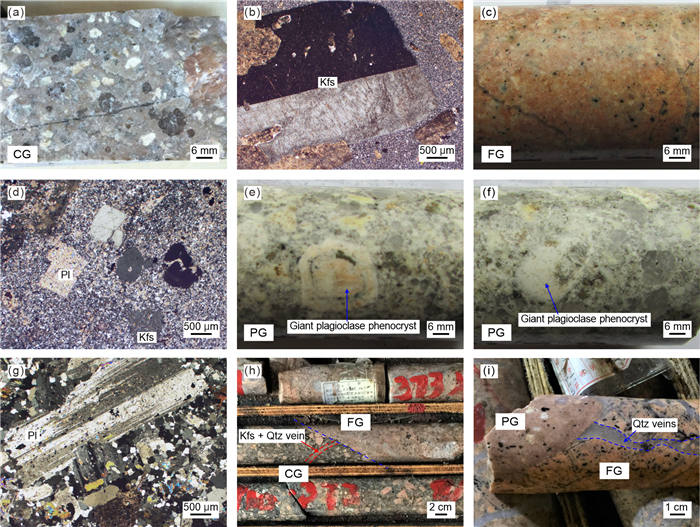
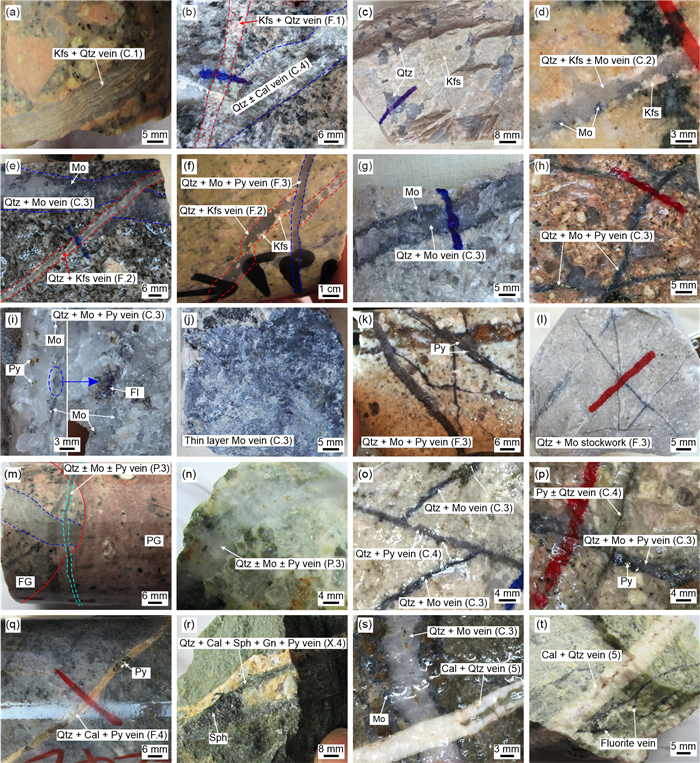
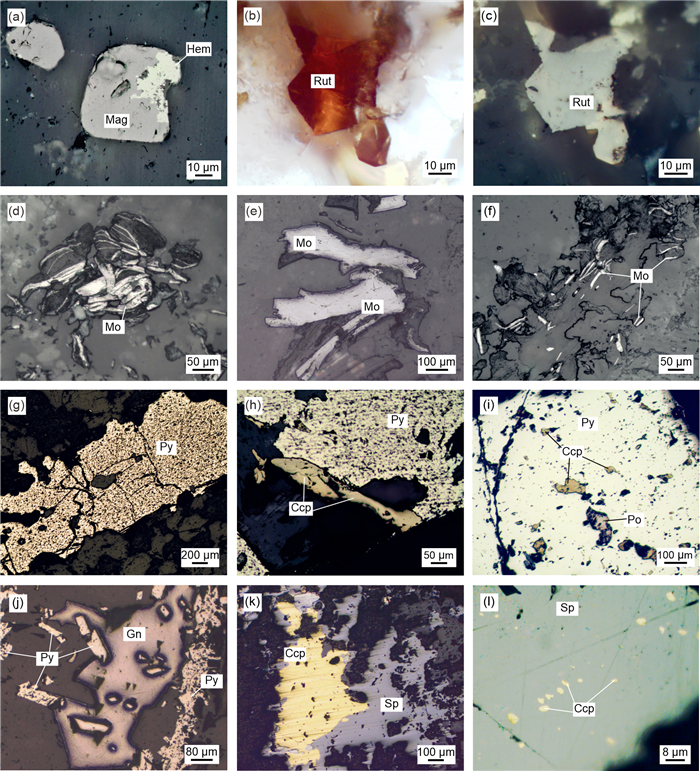
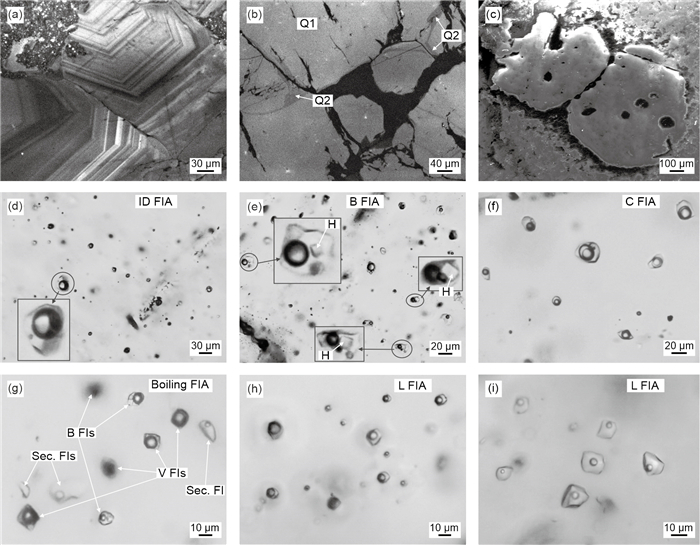
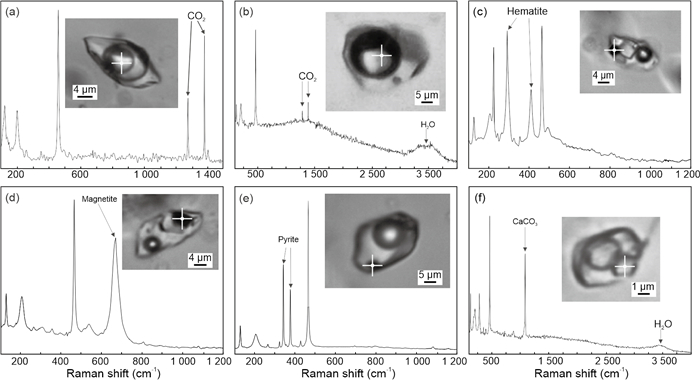
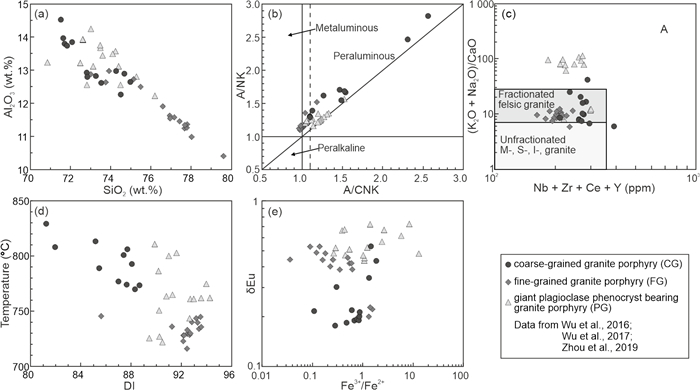
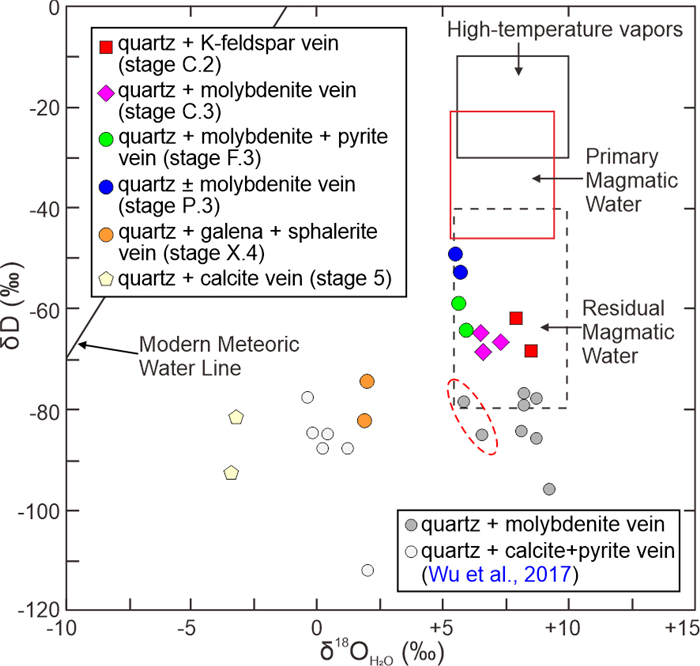
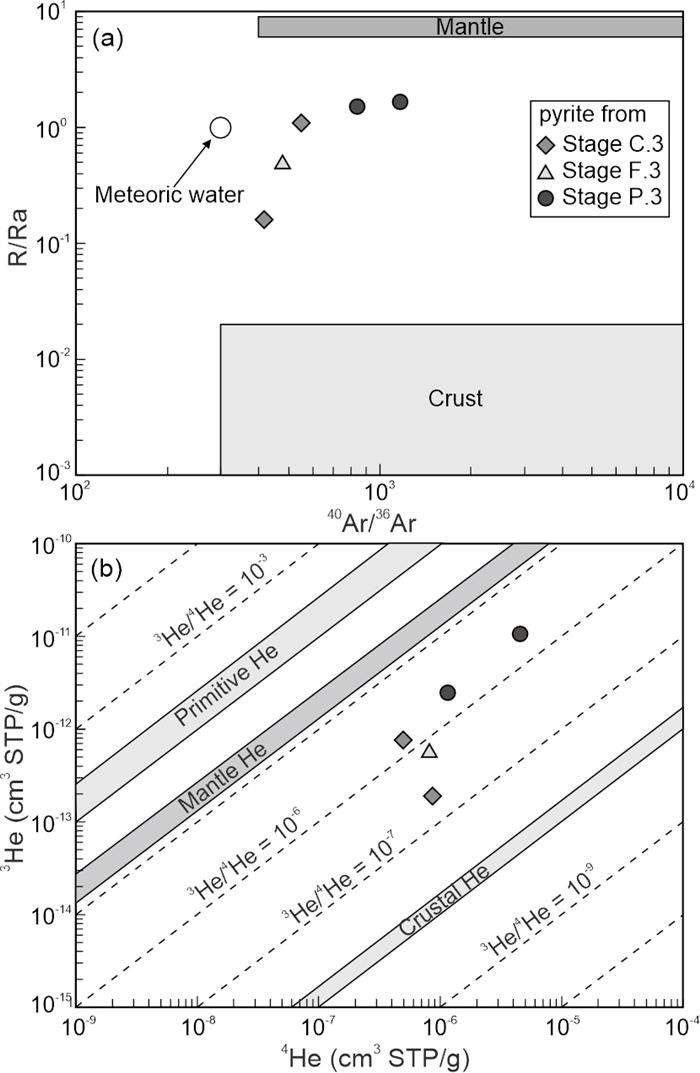
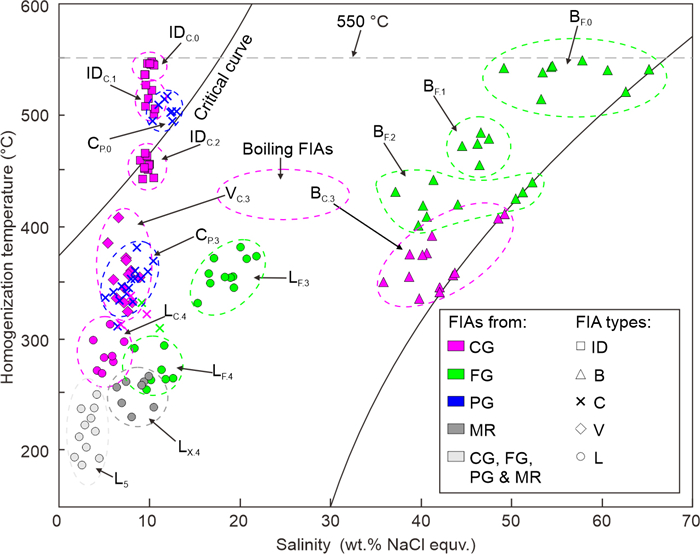
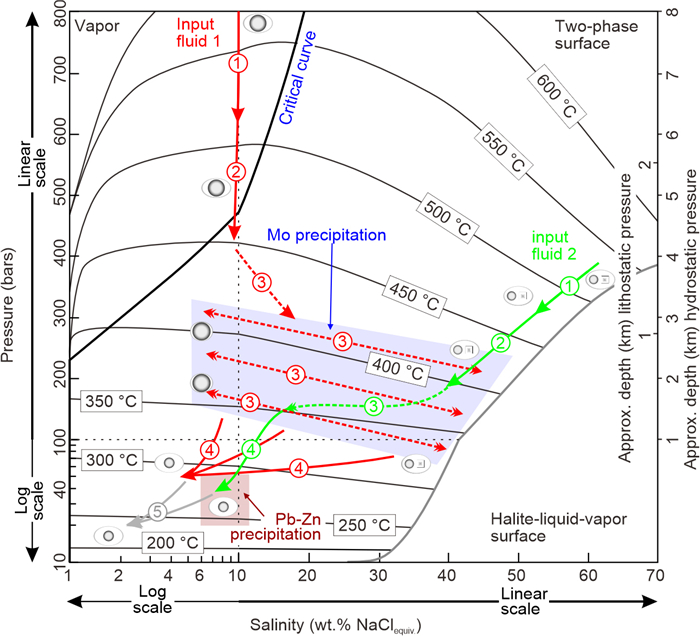
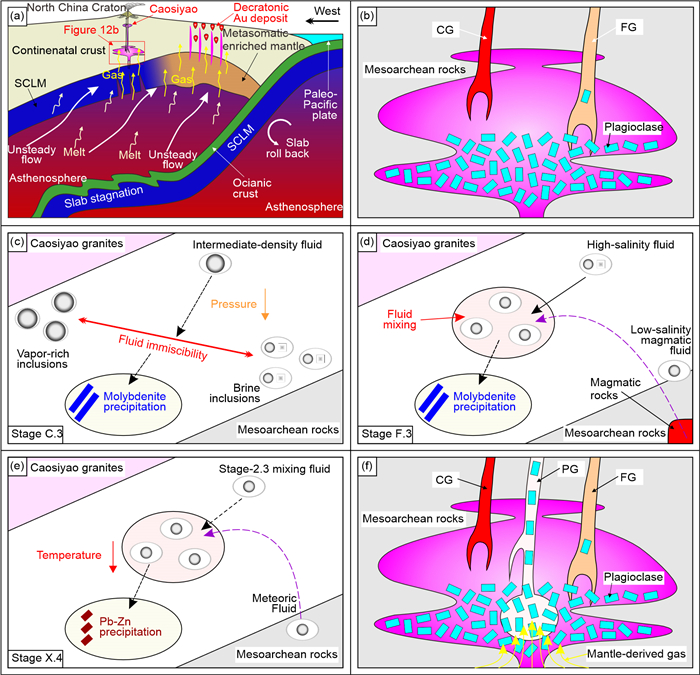
The formation of Caosiyao giant porphyry Mo deposit is related to three granitic porphyries: coarse-grained granite porphyry (CG), fine-grained granite porphyry (FG), and giant plagioclase phenocryst bearing granite porphyry (PG). To investigate the mineralization significance of three porphyries, Microthermometry, Laser micro-Raman Spectra, and H-O-He-Ar isotope analyses of fluid inclusions were conducted. Intermediate density with high temperatures (> 550 ℃) and moderate-low salinities (~10 wt.%) characterizes CG-related initial exsolved fluids. Vapor-rich and brine phases separated from the initial fluid following a continuous decrease in pressure and temperature, inducing molybdenite precipitation. FG-related initial fluids are characterized by high temperatures (> 550 ℃) and salinities (> 65 wt.%). The mixing of low-salinity fluids led to a rapid decrease in the salinity of FG-related fluid, promoting the deposit of the Mo element. The lead-zinc mineralization is closely related to the FG-related fluid, and the addition of meteoric fluid induced the formation of galena and sphalerite. The ore-forming fluid related to the PG is CO2-rich and accompanied by the addition of mantle-derived He-Ar. The presence of CO2 did not contribute to the solubility of Mo, resulting in the absence of a considerable amount of molybdenite.

| Anderson, D. L., 2000. The Statistics and Distribution of Helium in the Mantle. International Geology Review, 42(4): 289–311. https://doi.org/10.1080/00206810009465084 |
| Audétat, A., 2010. Source and Evolution of Molybdenum in the Porphyry Mo(-Nb) Deposit at Cave Peak, Texas. Journal of Petrology, 51(8): 1739–1760. https://doi.org/10.1093/petrology/egq037 |
| Audétat, A., 2019. The Metal Content of Magmatic-Hydrothermal Fluids and Its Relationship to Mineralization Potential. Economic Geology, 114(6): 1033–1056. https://doi.org/10.5382/econgeo.4673 |
| Audétat, A., Günther, D., 1999. Mobility and H2O Loss from Fluid Inclusions in Natural Quartz Crystals. Contributions to Mineralogy and Petrology, 137(1): 1–14. https://doi.org/10.1007/s004100050578 |
| Audétat, A., Günther, D., Heinrich, C., 1998. Formation of a Magmatic-Hydrothermal Ore Deposit: Insights with LA-ICP-MS Analysis of Fluid Inclusions. Science, 279(5359): 2091–2094. https://doi.org/10.1126/science.279.5359.2091 |
| Audétat, A., Pettke, T., 2003. The Magmatic-Hydrothermal Evolution of Two Barren Granites: A Melt and Fluid Inclusion Study of the Rito Del Medio and Cañada Pinabete Plutons in Northern New Mexico (USA). Geochimica et Cosmochimica Acta, 67(1): 97–121. https://doi.org/10.1016/S0016-7037(02)01049-9 |
| Bakker, R. J., Ben H Jansen, J., 1994. A Mechanism for Preferential H2O Leakage from Fluid Inclusions in Quartz, Based on TEM Observations. Contributions to Mineralogy and Petrology, 116(1): 7–20. https://doi.org/10.1007/BF00310686 |
| Bodnar, R. J., Vityk, M. O., 1994. Interpretation of Microthermometric Data for H2O-NaCl Fluid Inclusions. In: De Vivo, B., Frezzotti, M. L., eds., Fluid Inclusions in Minerals: Methods and Applications. Virginia Tech., Blacksburg. 117–130 |
| Brown, P. E., Lamb, W. M., 1989. P-V-T Properties of Fluids in the System H2O ± CO2 ± NaCl: New Graphical Presentations and Implications for Fluid Inclusion Studies. Geochimica et Cosmochimica Acta, 53(6): 1209–1221. https://doi.org/10.1016/0016-7037(89)90057-4 |
| Bureau of Geology and Mineral Exploration and Development of Henan Province (BGMEDHP), 2014. Detailed Geological Survey Report of the Caosiyao Deposit in Xinghe County, Inner Mongolia. 1–146 (in Chinese) |
| Burnard, P. G., Hu, R., Turner, G., et al., 1999. Mantle, Crustal and Atmospheric Noble Gases in Ailaoshan Gold Deposits, Yunnan Province, China. Geochimica et Cosmochimica Acta, 63(10): 1595–1604. https://doi.org/10.1016/S0016-7037(99)00108-8 |
|
Chappell, B. W., White, A. J. R., 1992. I- and S-Type Granites in the Lachlan Fold Belt. In: Brown, P. E., Chappell, B. W., eds., The Second Hutton Symposium on the Origin of Granites and Related Rocks. Geological Society of America. 1–26. |
| Chen, H. Y., Wu, C., 2020. Metallogenesis and Major Challenges of Porphyry Copper Systems above Subduction Zones. Science China Earth Sciences, 63(7): 899–918. https://doi.org/10.1007/s11430-019-9595-8 |
| Chen, P. W., Liu, B., Long, Z., et al., 2022. Ore Genesis of the Sadaigoumen Porphyry Mo Deposit, North China Craton: Constraints from Pyrite Trace Element and Lead Isotope Analyses. Ore Geology Reviews, 142: 104698. https://doi.org/10.1016/j.oregeorev.2022.104698 |
| Chen, P. W., Zeng, Q. D., Guo, W. K., et al., 2021a. The Source, Enrichment and Precipitation of Ore-Forming Elements for Porphyry Mo Deposit: Evidences from Melt Inclusions, Biotite and Fluorite in Dasuji Deposit, China. Ore Geology Reviews, 135: 104205. https://doi.org/10.1016/j.oregeorev.2021.104205 |
| Chen, P. W., Zeng, Q. D., Wang, Y. B., et al., 2018. Petrogenesis of the Dasuji Porphyry Mo Deposit at the Northern Margin of North China Craton: Constrains from Geochronology, Geochemistry and Isotopes Characteristics. Lithos, 322: 87–103. https://doi.org/10.1016/j.lithos.2018.10.009 |
| Chen, P. W., Zeng, Q. D., Zhou, L. L., et al., 2021b. Fluid Inclusion Evidence for Hydrothermal Evolution of the Sadaigoumen Porphyry Mo Deposit on the Northern Margin of the North China Craton. Ore Geology Reviews, 134: 104145. https://doi.org/10.1016/j.oregeorev.2021.104145 |
| Chen, P. W., Zeng, Q. D., Zhou, T. C., et al., 2019. Evolution of Fluids in the Dasuji Porphyry Mo Deposit on the Northern Margin of the North China Craton: Constraints from Microthermometric and LA-ICP-MS Analyses of Fluid Inclusions. Ore Geology Reviews, 104: 26–45. https://doi.org/10.1016/j.oregeorev.2018.10.012 |
| Chen, P. W., Zeng, Q. D., Zhou, T. C., et al., 2021c. He, Ar, and S Isotopic Constraints on the Origin of the Dasuji Porphyry Mo Deposit, China. Arabian Journal of Geosciences, 14(6): 437. https://doi.org/10.1007/s12517-021-06738-8 |
| Chen, Y. J., Li, C., Zhang, J., et al., 2000. Sr and O Isotopic Characteristics of Porphyries in the Qinling Molybdenum Deposit Belt and Their Implication to Genetic Mechanism and Type. Science in China Series D: Earth Sciences, 43: 82–94. https://doi.org/10.1007/BF02911935 |
| Chen, Y. Q., Mo, X. X., 2021. Metallogenic Background, Process and Exploration as One: A Trinity Concept for Prospecting for Super-Large Ore Deposits. Earth Science Frontiers, 28 (3): 26–48. https://doi.org/10.13745/j.esf.sf.2021.1.11 (in Chinese with English Abstract) |
| Clayton, R. N., O'Neil, J. R., Mayeda, T. K., 1972. Oxygen Isotope Exchange between Quartz and Water. Journal of Geophysical Research (1896–1977), 77(17): 3057–3067. https://doi.org/10.1029/JB077i017p03057 |
| Deng, X. D., Li, J. W., 2024. Quantitatively Evaluating the Erosion and Preservation of Supergene Oxide Zones: Evidence from the Yulong Porphyry Cu Deposit, Eastern Tibetan Plateau. Journal of Earth Science, 35(1): 280–282. https://doi.org/10.1007/s12583-023-1952-x |
| Diamond, L. W., 1992. Stability of CO2 Clathrate Hydrate + CO2 Liquid + CO2 Vapour + Aqueous KCL-NaCl Solutions: Experimental Determination and Application to Salinity Estimates of Fluid Inclusions. Geochimica et Cosmochimica Acta, 56(1): 273–280. https://doi.org/10.1016/0016-7037(92)90132-3 |
| Duan, Z. H., Møller, N., Weare, J. H., 1992a. An Equation of State for the CH4-CO2-H2O System: Ⅰ. Pure Systems from 0 to 1000 ºC and 0 to 8000 Bar. Geochimica et Cosmochimica Acta, 56(7): 2605–2617. https://doi.org/10.1016/0016-7037(92)90347-L |
| Duan, Z. H., Møller, N., Weare, J. H., 1992b. An Equation of State for the CH4-CO2-H2O System: Ⅱ. Mixtures from 50 to 1000 ºC and 0 to 1000 Bar. Geochimica et Cosmochimica Acta, 56(7): 2619–2631. https://doi.org/10.1016/0016-7037(92)90348-M |
| Fu, B., Touret, J. L. R., Zheng, Y. F., et al., 2003. Fluid Inclusions in Granulites, Granulitized Eclogites and Garnet Clinopyroxenites from the Dabie-Sulu Terranes, Eastern China. Lithos, 70(3/4): 293–319. https://doi.org/10.1016/S0024-4937(03)00103-8 |
| Giggenbach, W. F., 1992. Isotopic Shifts in Waters from Geothermal and Volcanic Systems along Convergent Plate Boundaries and Their Origin. Earth and Planetary Science Letters, 113(4): 495–510. https://doi.org/10.1016/0012-821X(92)90127-H |
| Grondahl, C., Zajacz, Z., 2017. Magmatic Controls on the Genesis of Porphyry Cu-Mo-Au Deposits: The Bingham Canyon Example. Earth and Planetary Science Letters, 480: 53–65. https://doi.org/10.1016/j.epsl.2017.09.036 |
| He, H. Y., Zhu, R. X., Saxton, J., 2011. Noble Gas Isotopes in Corundum and Peridotite Xenoliths from the Eastern North China Craton: Implication for Comprehensive Refertilization of Lithospheric Mantle. Physics of the Earth and Planetary Interiors, 189(3/4): 185–191. https://doi.org/10.1016/j.pepi.2011.09.001 |
| Hu, R. Z., Bi, X. W., Jiang, G. H., et al., 2012. Mantle-Derived Noble Gases in Ore-Forming Fluids of the Granite-Related Yaogangxian Tungsten Deposit, Southeastern China. Mineralium Deposita, 47(6): 623–632. https://doi.org/10.1007/s00126-011-0396-x |
| Kendrick, M. A., Burgess, R., Pattrick, R. A. D., et al., 2001. Fluid Inclusion Noble Gas and Halogen Evidence on the Origin of Cu-Porphyry Mineralising Fluids. Geochimica et Cosmochimica Acta, 65(16): 2651–2668. https://doi.org/10.1016/S0016-7037(01)00618-4 |
| Klemm, L. M., Pettke, T., Heinrich, C. A., 2008. Fluid and Source Magma Evolution of the Questa Porphyry Mo Deposit, New Mexico, USA. Mineralium Deposita, 43(5): 533–552. https://doi.org/10.1007/s00126-008-0181-7 |
| Klemm, L. M., Pettke, T., Heinrich, C. A., et al., 2007. Hydrothermal Evolution of the El Teniente Deposit, Chile: Porphyry Cu-Mo Ore Deposition from Low-Salinity Magmatic Fluids. Economic Geology, 102(6): 1021–1045. https://doi.org/10.2113/gsecongeo.102.6.1021 |
| Kokh, M. A., Akinfiev, N. N., Pokrovski, G. S., et al., 2017. The Role of Carbon Dioxide in the Transport and Fractionation of Metals by Geological Fluids. Geochimica et Cosmochimica Acta, 197: 433–466. https://doi.org/10.1016/j.gca.2016.11.007 |
| Landtwing, M. R., Furrer, C., Redmond, P. B., et al., 2010. The Bingham Canyon Porphyry Cu-Mo-Au Deposit. Ⅲ. Zoned Copper-Gold Ore Deposition by Magmatic Vapor Expansion. Economic Geology, 105(1): 91–118. https://doi.org/10.2113/gsecongeo.105.1.91 |
| Landtwing, M. R., Pettke, T., Halter, W. E., et al., 2005. Copper Deposition during Quartz Dissolution by Cooling Magmatic–Hydrothermal Fluids: The Bingham Porphyry. Earth and Planetary Science Letters, 235(1/2): 229–243. https://doi.org/10.1016/j.epsl.2005.02.046 |
| Li, N., Derrey, I. T., Holtz, F., et al., 2021. Molybdenum Solubility and Partitioning in H2O-CO2-NaCl Fluids at 600 ℃ and 200 MPa. Chemical Geology, 583: 120438. https://doi.org/10.1016/j.chemgeo.2021.120438 |
| Li, S., Chung, S. L., Wilde, S. A., et al., 2016. Linking Magmatism with Collision in an Accretionary Orogen. Scientific Reports, 6: 25751. https://doi.org/10.1038/srep25751 |
| Maniar, P. D., Piccoli, P. M., 1989. Tectonic Discrimination of Granitoids. Geological Society of America Bulletin, 101(5): 635–643. https://doi.org/10.1130/0016-7606(1989)101<0635:tdog>2.3.co;2 doi: 10.1130/0016-7606(1989)101<0635:tdog>2.3.co;2 |
| Maruyama, S., Isozaki, Y., Kimura, G., et al., 1997. Paleogeographic Maps of the Japanese Islands: Plate Tectonic Synthesis from 750 Ma to the Present. Island Arc, 6(1): 121–142. https://doi.org/10.1111/j.1440-1738.1997.tb00043.x |
| Mo, X. X., 2020. Geodynamic Background of Metallogenesis of Large-Superlarge Ore Deposits. Earth Science Frontiers, 27(2): 13–19. https://doi.org/10.13745/j.esf.sf.2020.3.7 (in Chinese with English Abstract) |
| Nie, F. J., Li, X. Z., Li, C., et al., 2013. Re-Os Isotopic Age Dating of the Molybdenite Separated from the Caosiyao Giant Molybdenum Deposit, Xinghe County, Inner Mongolia, and Its Geological Significances. Geological Review, 59(1): 175–181. https://doi.org/10.16509/j.georeview.2013.01.004 (in Chinese with English Abstract) |
| Nie, F. J., Liu, Y. F., Zhao, Y. A., et al., 2012. Discovery of Dasuji and Caosiyao Large-Size Mo Deposits in Central Inner Mongolia and Its Geological Significances. Mineral Deposits, 31: 930–940. https://doi.org/10.16111/j.0258-7106.2012.04.016 (in Chinese with English Abstract) |
| Ouyang, H. G., Mao, J. W., Hu, R. Z., 2020. Geochemistry and Crystallization Conditions of Magmas Related to Porphyry Mo Mineralization in Northeastern China. Economic Geology, 115(1): 79–100. https://doi.org/10.5382/econgeo.4694 |
| Redmond, P. B., Einaudi, M. T., Inan, E. E., et al., 2004. Copper Deposition by Fluid Cooling in Intrusion-Centered Systems: New Insights from the Bingham Porphyry Ore Deposit, Utah. Geology, 32(3): 217. https://doi.org/10.1130/g19986.1 |
| Richards, J. P., 2013. Giant Ore Deposits Formed by Optimal Alignments and Combinations of Geological Processes. Nature Geoscience, 6(11): 911–916. https://doi.org/10.1038/ngeo1920 |
| Roedder, E., 1984. Fluid Inclusions, Reviews in Mineralogy. Mineralogical Society of America, 12: 644. https://doi.org/10.1016/0016-7037(85)90299-6 |
| Rusk, B. G., Reed, M. H., Dilles, J. H., 2008. Fluid Inclusion Evidence for Magmatic-Hydrothermal Fluid Evolution in the Porphyry Copper-Molybdenum Deposit at Butte, Montana. Economic Geology, 103(2): 307–334. https://doi.org/10.2113/gsecongeo.103.2.307 |
| Rusk, B. G., Reed, M. H., Dilles, J. H., et al., 2004. Compositions of Magmatic Hydrothermal Fluids Determined by LA-ICP-MS of Fluid Inclusions from the Porphyry Copper-Molybdenum Deposit at Butte, MT. Chemical Geology, 210(1/2/3/4): 173–199. https://doi.org/10.1016/j.chemgeo.2004.06.011 |
|
Seedorff, E., Dilles, J. H., Proffett, J. M., et al., 2005. Porphyry Deposits: Characteristics and Origin of Hypogene Features. Economic Geology, 100th Anniversary Volume: 251–298. |
| Seo, J. H., Guillong, M., Heinrich, C. A., 2012. Separation of Molybdenum and Copper in Porphyry Deposits: The Roles of Sulfur, Redox, and pH in Ore Mineral Deposition at Bingham Canyon. Economic Geology, 107(2): 333–356. https://doi.org/10.2113/econgeo.107.2.333 |
| Sillitoe, R. H., 2010. Porphyry Copper Systems. Economic Geology, 105(1): 3–41. https://doi.org/10.2113/gsecongeo.105.1.3 |
| Singer, D. A., 1995. World Class Base and Precious Metal Deposits; A Quantitative Analysis. Economic Geology, 90(1): 88–104. https://doi.org/10.2113/gsecongeo.90.1.88 |
| Stuart, F. M., Burnard, P. G., Taylor, R. P., et al., 1995. Resolving Mantle and Crustal Contributions to Ancient Hydrothermal Fluids: He-Ar Isotopes in Fluid Inclusions from Dae Hwa W-Mo Mineralisation, South Korea. Geochimica et Cosmochimica Acta, 59(22): 4663–4673. https://doi.org/10.1016/0016-7037(95)00300-2 |
| Sun, Y., Liu, J. M., Zeng, Q. D., et al., 2017. Geology and Hydrothermal Evolution of the Baituyingzi Porphyry Mo (Cu) Deposit, Eastern Inner Mongolia, NE China: Implications for Mo and Cu Precipitation Mechanisms in CO2-Rich Fluids. Ore Geology Reviews, 81: 689–705. https://doi.org/10.1016/j.oregeorev.2016.03.023 |
| Taylor, B. E., 1992. Degassing of H2O from Rhyolite Magma during Eruption and Shallow Intrusion, and the Isotopic Composition of Magmatic Water in Hydrothermal Systems. Magmatic Contributions to Hydrothermal Systems. Report Geological Survey of Japan, 279: 190–194 |
| Taylor, H. P., 1974. The Application of Oxygen and Hydrogen Isotope Studies to Problems of Hydrothermal Alteration and Ore Deposition. Economic Geology, 69(6): 843–883. https://doi.org/10.2113/gsecongeo.69.6.843 |
| Turner, G., Burnard, P. B., Ford, J. L., et al., 1993. Tracing Fluid Sources and Interaction: Discussion. Philosophical Transactions of the Royal Society A: Physical, Mathematical and Engineering Sciences, 344: 127–140. https://doi.org/10.1098/rsta.1993.0081 |
| Ulrich, T., Günther, D., Heinrich, C. A., 1999. Gold Concentrations of Magmatic Brines and the Metal Budget of Porphyry Copper Deposits. Nature, 399(6737): 676–679. https://doi.org/10.1038/21406 |
| Ulrich, T., Gunther, D., Heinrich, C. A., 2001. The Evolution of a Porphyry Cu-Au Deposit, Based on LA-ICP-MSAnalysis of Fluid Inclusions: Bajo de la Alumbrera, Argentina. Economic Geology, 96(8): 1743–1774. https://doi.org/10.2113/gsecongeo.96.8.1743 |
| Van den Kerkhof, A. M., Hein, U. F., 2001. Fluid Inclusion Petrography. Lithos, 55(1/2/3/4): 27–47. https://doi.org/10.1016/S0024-4937(00)00037-2 |
| Wang, G. R., Wu, G., Wu, H., et al., 2014. Fluid inclusion and Hydrogen-Oxygen Isotope Study of Caosiyao Superlarge Porphyry Molybdenum Deposit in Xinghe County, Central Inner Mongolia. Mineral Deposits, 33 (6): 1213–1232. https://doi.org/10.16111/j.0258-7106.2014.06.005 (in Chinese with English Abstract) |
| Wang, G. R., Wu, G., Xu, L. Q., et al., 2017. Molybdenite Re-Os Age, H-O-C-S-Pb Isotopes, and Fluid Inclusion Study of the Caosiyao Porphyry Mo Deposit in Inner Mongolia, China. Ore Geology Reviews, 81: 728–744. https://doi.org/10.1016/j.oregeorev.2016.07.008 |
| Watson, E. B., Harrison, T. M., 1983. Zircon Saturation Revisited: Temperature and Composition Effects in a Variety of Crustal Magma Types. Earth and Planetary Science Letters, 64(2): 295–304. https://doi.org/10.1016/0012-821X(83)90211-X |
| Whalen, J. B., Currie, K. L., Chappell, B. W., 1987. A-Type Granites: Geochemical Characteristics, Discrimination and Petrogenesis. Contributions to Mineralogy and Petrology, 95(4): 407–419. https://doi.org/10.1007/BF00402202 |
| Wilkinson, J. J., 2001. Fluid Inclusions in Hydrothermal Ore Deposits. Lithos, 55(1/2/3/4): 229–272. https://doi.org/10.1016/S0024-4937(00)00047-5 |
|
Wu, C. Y., Lang, X. H., Deng, Y. L., et al., 2025. Diagenetic-Metallogenic Age and Mineralization Potential of Longsang Porphyry Cu-Mo Deposit, Gongbu Jiangda County, Tibet. Earth Science. |
| Wu, F. Y., Walker, R. J., Ren, X. W., et al., 2003. Osmium Isotopic Constraints on the Age of Lithospheric Mantle beneath Northeastern China. Chemical Geology, 196(1/2/3/4): 107–129. https://doi.org/10.1016/S0009-2541(02)00409-6 |
| Wu, F. Y., Yang, J. H., Wilde, S. A., et al., 2005. Geochronology, Petrogenesis and Tectonic Implications of Jurassic Granites in the Liaodong Peninsula, NE China. Chemical Geology, 221(1/2): 127–156. https://doi.org/10.1016/j.chemgeo.2005.04.010 |
| Wu, G., Li, X. Z., Xu, L. Q., et al., 2017. Age, Geochemistry, and Sr-Nd-Hf-Pb Isotopes of the Caosiyao Porphyry Mo Deposit in Inner Mongolia, China. Ore Geology Reviews, 81: 706–727. https://doi.org/10.1016/j.oregeorev.2016.06.002 |
| Wu, H. Y., Zhang, L. C., Pirajno, F., et al., 2016. The Mesozoic Caosiyao Giant Porphyry Mo Deposit in Inner Mongolia, North China and Paleo-Pacific Subduction-Related Magmatism in the Northern North China Craton. Journal of Asian Earth Sciences, 127: 281–299. https://doi.org/10.1016/j.jseaes.2016.06.014 |
| Xiao, W. J., Windley, B. F., Han, C. M., et al., 2018. Late Paleozoic to Early Triassic Multiple Roll-back and Oroclinal Bending of the Mongolia Collage in Central Asia. Earth-Science Reviews, 186: 94–128. https://doi.org/10.1016/j.earscirev.2017.09.020 |
| Xiao, W. J., Windley, B. F., Hao, J., et al., 2003. Accretion Leading to Collision and the Permian Solonker Suture, Inner Mongolia, China: Termination of the Central Asian Orogenic Belt. Tectonics, 22(6): 2002TC001484. https://doi.org/10.1029/2002TC001484 |
| Xiong, S. F., He, M. C., Yao, S. Z., et al., 2014. Compositions and Microthermometry of Fluid Inclusions of Chalukou Porphyry Mo Deposit from Great Xing'an Range: Implications for Ore Genesis. Earth Science, 39(7): 820–836 (in Chinese with English Abstract) |
| Xu, Y. G., Li, H. Y., Pang, C. J., et al., 2009. On the Timing and Duration of the Destruction of the North China Craton. Chinese Science Bulletin, 54: 3379–3396. https://doi.org/10.1007/s11434-009-0346-5 |
| Yang, Z. M., Hou, Z. Q., 2009. Porphyry Cu Deposits in Collisional Orogen Setting: A Preliminary Genetic Model. Mineral Deposits, 28(5): 515–538. https://doi.org/10.16111/j.0258-7106.2009.05.005 (in Chinese with English Abstract) |
| You, J., Wu, C., Hong, T., et al., 2025. Petrogenesis of Suyunhe Super Large Porphyry Mo Deposit in Western Junggar, Xinjiang, and Implications for Regional Tectonic Evolution. Earth Science, 50(4): 1284–1304 (in Chinese with English Abstract) |
| Zeng, Q. D., Liu, J. M., Qin, K. Z., et al., 2013. Types, Characteristics, and Time-Space Distribution of Molybdenum Deposits in China. International Geology Review, 55(11): 1311–1358. https://doi.org/10.1080/00206814.2013.774195 |
| Zeng, Q. D., Liu, J. M., Zhang, Z. L., 2010. Re-Os Geochronology of Porphyry Molybdenum Deposit in South Segment of Da Hinggan Mountains, Northeast China. Journal of Earth Science, 21(4): 392–401. https://doi.org/10.1007/s12583-010-0102-4 |
| Zhang, P., Kou, L. L., Zhao, Y., et al., 2020. Genesis of the Wulong Gold Deposit, Liaoning Province, NE China: Constrains from Noble Gases, Radiogenic and Stable Isotope Studies. Geoscience Frontiers, 11(2): 547–563. https://doi.org/10.1016/j.gsf.2019.05.012 |
| Zhang, S. H., Zhao, Y., Liu, X. C., et al., 2009. Late Paleozoic to Early Mesozoic Mafic-Ultramafic Complexes from the Northern North China Block: Constraints on the Composition and Evolution of the Lithospheric Mantle. Lithos, 110(1/2/3/4): 229–246. https://doi.org/10.1016/j.lithos.2009.01.008 |
| Zhao, G. C., Sun, M., Wilde, S. A., et al., 2005. Late Archean to Paleoproterozoic Evolution of the North China Craton: Key Issues Revisited. Precambrian Research, 136(2): 177–202. https://doi.org/10.1016/j.precamres.2004.10.002 |
| Zhou, T. C., Zeng, Q. D., Chen, P. W., et al., 2019. The Formation of the Caosiyao Giant Porphyry Mo Deposit on the Northern Margin of the North China Craton: Constraints from U-Pb and Re-Os Geochronology, Whole-Rock Geochemistry, Hf Isotopes, and Oxygen Fugacity of the Magma. Geological Journal, 54(4): 2160–2184. https://doi.org/10.1002/gj.3289 |
| Zhu, R. X., Chen, L., Wu, F. Y., et al., 2011. Timing, Scale and Mechanism of the Destruction of the North China Craton. Science China Earth Sciences, 54: 789–797. https://doi.org/10.1007/s11430-011-4203-4 |
| Zhu, R. X., Fan, H. R., Li, J. W., et al., 2015. Decratonic Gold Deposits. Science China Earth Sciences, 58: 1523–1537. https://doi.org/10.1007/s11430-015-5139-x |
| Zhu, R. X., Zheng, T. Y., 2009. Destruction Geodynamics of the North China Craton and Its Paleoproterozoic Plate Tectonics. Chinese Science Bulletin, 54: 3354–3366. https://doi.org/10.1007/s11434-009-0451-5 |
Figures(12) / Tables(2)
Copyright © 2013-2020 Journal of Earth Science 鄂ICP备15021562号-2
Tel: +86-27-67885075 Fax: +86-27-67885075 E-mail: xbb@cug.edu.cn
Address: Editorial Office of Journal, China University of Geosciences, Yujiashan, Wuhan, Hubei 430074, P. R. China
Supported by:
Beijing Renhe Information Technology Co. Ltd
E-mail:
info@rhhz.net


 DownLoad: