| Citation: | Biao Ma, Laishi Zhao, Lei Zhang, Zihu Zhang, Shunling Wu, Zhengyi Lyu, Xiangdong Wang, Chao Li. Dynamic Variations of Carbon-Sulfur Cycles through the Late Permian to Early Triassic. Journal of Earth Science, 2026, 37(2): 787-801. doi: 10.1007/s12583-023-1843-1

|
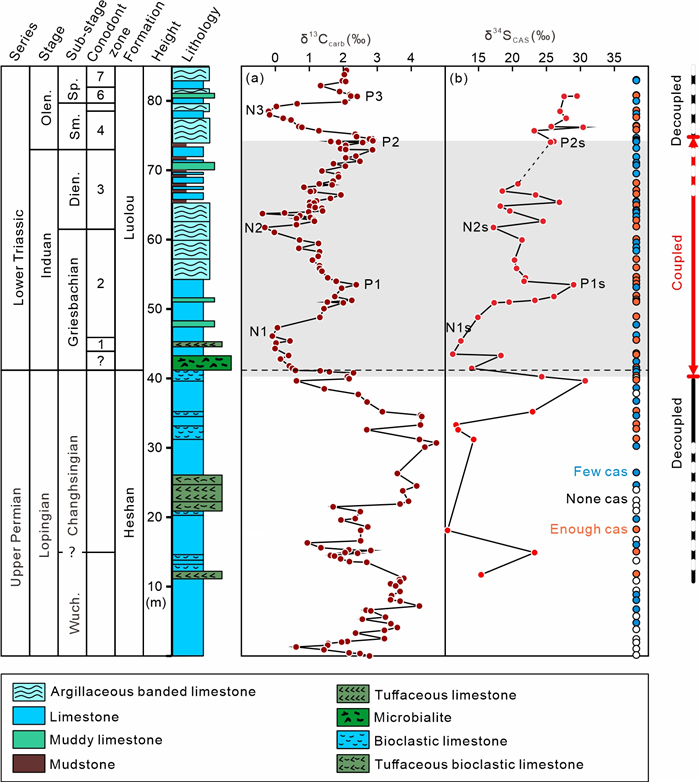
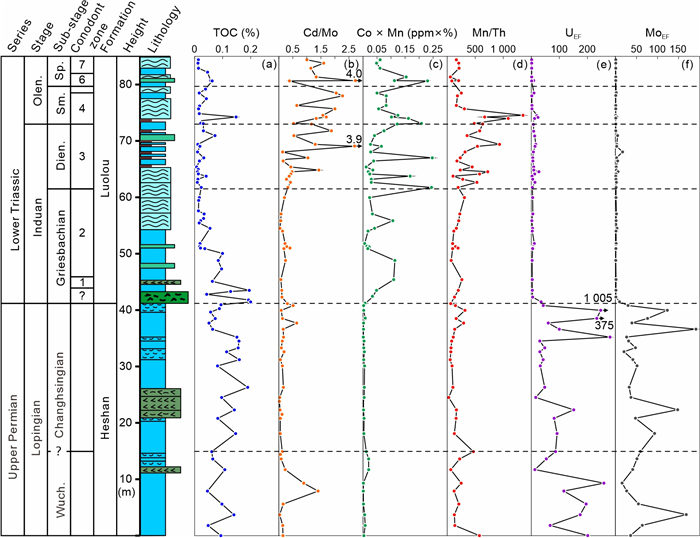
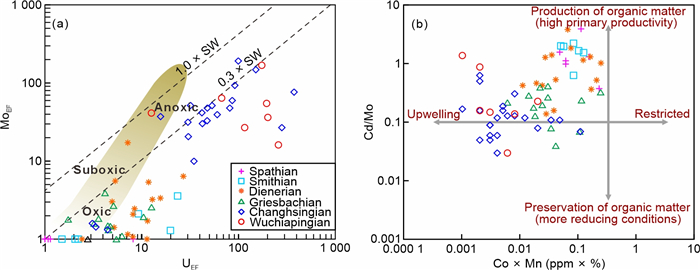
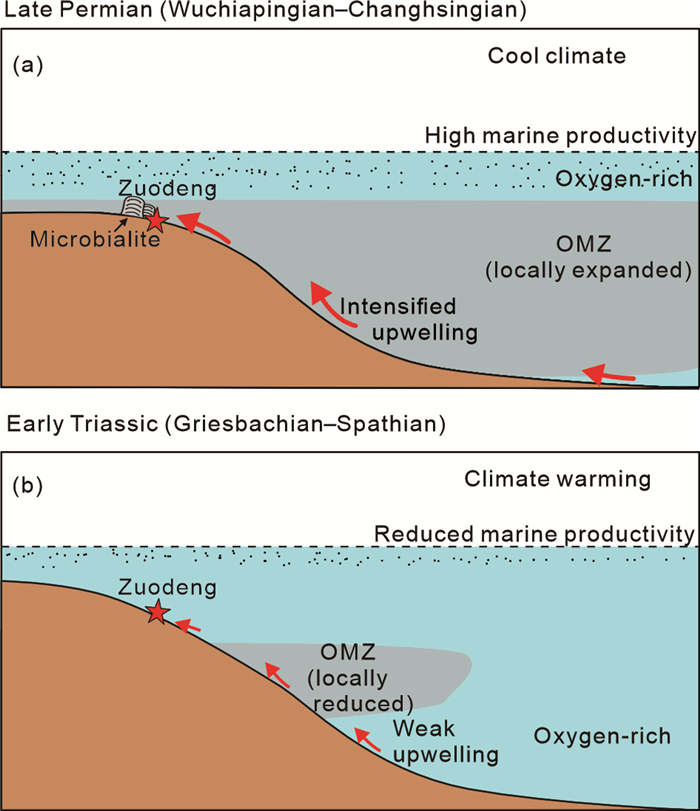
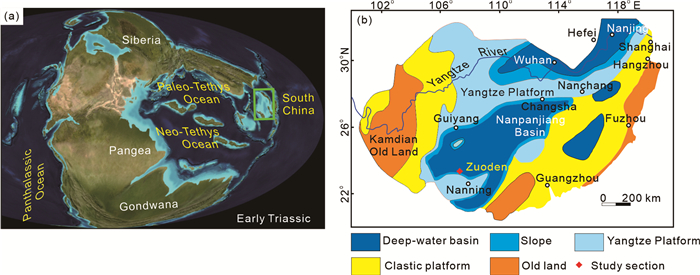
Marine carbon-sulfur cycles experienced long-term frequent perturbations through the Latest Permian to Early Triassic. However, relationships between carbon and sulfur isotopes are still unclear. Here, we report δ13Ccarb and δ34SCAS, and elemental proxies (UEF, MoEF, Mn/Th, Cd/Mo and Co × Mn) from the Wuchiapingian to Spathian successions (Zuodeng Section) in the southern Nanpanjiang Basin, South China. Sudden decreases in both UEF and MoEF values (from ~150 to < 10, and ~60 to < 10, respectively) and a gentle increase in Mn/Th ratios (< 200 to ~1 000) indicate a locally anoxic seawater condition during the Late Permian and an oxic condition during the Early Triassic. Variations of Cd/Mo, Co × Mn and TOC suggest that the Late Permian anoxic condition was related to locally intensive oceanic circulation (e.g., upwelling) and higher marine productivity, which was probably controlled by a relatively cool climate regime, whereas the Early Triassic climate warming may have resulted in intensive oceanic stratification, suppressed marine productivity, and thus narrowed the spatial distribution of the oxygen minimum zone, leaving the study site apart from anoxic water mass in that time. Both δ13Ccarb and δ34SCAS excursions were coupled during the Griesbachian and Dienerian substages probably due to elevated or suppressed marine productivity and co-burial of organic matter and pyrite driven by climatic variations. Decoupled δ13Ccarb-δ34SCAS excursions occurred during the Late Permian and the Smithian global warming, respectively probably because of elevated bacterial sulfate reduction and pyrite burial rate induced by serious global-oceanic anoxia. This study deciphers that dynamic variations of marine carbon-sulfur cycles may have been controlled by extremely environmental changes through the Late Permian to Early Triassic.

| Algeo, T. J., 2010. Anomalous Early Triassic Sediment Fluxes Due to Elevated Weathering Rates. Journal of Earth Science, 21(1): 107–110. https://doi.org/10.1007/s12583-010-0182-1 |
| Algeo, T. J., Li, C., 2020. Redox Classification and Calibration of Redox Thresholds in Sedimentary Systems. Geochimica et Cosmochimica Acta, 287: 8–26. https://doi.org/10.1016/j.gca.2020.01.055 |
| Algeo, T. J., Tribovillard, N., 2009. Environmental Analysis of Paleoceanographic Systems Based on Molybdenum-Uranium Covariation. Chemical Geology, 268(3/4): 211–225. https://doi.org/10.1016/j.chemgeo.2009.09.001 |
| Bernasconi, S. M., Meier, I., Wohlwend, S., et al., 2017. An Evaporite-Based High-Resolution Sulfur Isotope Record of Late Permian and Triassic Seawater Sulfate. Geochimica et Cosmochimica Acta, 204: 331–349. https://doi.org/10.1016/j.gca.2017.01.047 |
| Berner, R. A., 1985. Sulphate Reduction, Organic Matter Decomposition and Pyrite Formation. Philosophical Transactions of the Royal Society of London Series A, Mathematical and Physical Sciences, 315(1531): 25–38. https://doi.org/10.1098/rsta.1985.0027 |
| Bottrell, S. H., Newton, R. J., 2006. Reconstruction of Changes in Global Sulfur Cycling from Marine Sulfate Isotopes. Earth-Science Reviews, 75(1/2/3/4): 59–83. https://doi.org/10.1016/j.earscirev.2005.10.004 |
| Brand, U., 2004. Carbon, Oxygen and Strontium Isotopes in Paleozoic Carbonate Components: An Evaluation of Original Seawater-Chemistry Proxies. Chemical Geology, 204(1/2): 23–44. https://doi.org/10.1016/j.chemgeo.2003.10.013 |
| Brennecka, G. A., Herrmann, A. D., Algeo, T. J., et al., 2011. Rapid Expansion of Oceanic Anoxia Immediately before the End-Permian Mass Extinction. Proceedings of the National Academy of Sciences of the United States of America, 108(43): 17631–17634. https://doi.org/10.1073/pnas.1106039108 |
| Burgess, S. D., Bowring, S., Shen, S. Z., 2014. High-Precision Timeline for Earth's Most Severe Extinction. Proc. Natl. Acad. Sci. USA, 111(9): 3316–3321. https://doi.org/10.1073/pnas.1317692111 |
| Canfield, D. E., Kristensen, E., Thamdrup, B., 2005. The Iron and Manganese Cycles. Advances in Marine Biology, 48: 269–312 doi: 10.1016/S0065-2881(05)48008-6 |
| Canfield, D. E., Thamdrup, B., 2009. Towards a Consistent Classification Scheme for Geochemical Environments, or, Why We Wish the Term 'Suboxic' would Go Away. Geobiology, 7(4): 385–392. https://doi.org/10.1111/j.1472-4669.2009.00214.x |
| Chen, B., Joachimski, M. M., Wang, X. D., et al., 2016. Ice Volume and Paleoclimate History of the Late Paleozoic Ice Age from Conodont Apatite Oxygen Isotopes from Naqing (Guizhou, China). Palaeogeogr. Palaeoclimatol. Palaeoecol. , 448: 151–161 doi: 10.1016/j.palaeo.2016.01.002 |
| Chen, Y. L., Jiang, H. S., Lai, X. L., et al., 2015. Early Triassic Conodonts of Jiarong, Nanpanjiang Basin, Southern Guizhou Province, South China. Journal of Asian Earth Sciences, 105: 104–121. https://doi.org/10.1016/j.jseaes.2015.03.014 |
| Chen, Z. Q., Benton, M. J., 2012. The Timing and Pattern of Biotic Recovery Following the End-Permian Mass Extinction. Nature Geoscience, 5(6): 375–383. https://doi.org/10.1038/ngeo1475 |
| Chen, Z. Q., Fang, Y. H., Wignall, P. B., et al., 2022a. Microbial Blooms Triggered Pyrite Framboid Enrichment and Oxygen Depletion in Carbonate Platforms Immediately after the Latest Permian Extinction. Geophysical Research Letters, 49(7): e2021GL096998. https://doi.org/10.1029/2021gl096998 |
| Chen, Z. Q., Harper, D. A. T., Grasby, S., et al., 2022b. Catastrophic Event Sequences across the Permian–Triassic Boundary in the Ocean and on Land. Global and Planetary Change, 215: 103890. https://doi.org/10.1016/j.gloplacha.2022.103890 |
| Chen, Z. Q., Tong, J., Zhang, K., et al., 2009. Environmental and Biotic Turnover across the Permian–Triassic Boundary on a Shallow Carbonate Platform in Western Zhejiang, South China. Australian Journal of Earth Sciences, 56(6): 775–797. https://doi.org/10.1080/08120090903002607 |
| Chen, Z. Q., Yang, H., Luo, M., et al., 2015. Complete Biotic and Sedimentary Records of the Permian–Triassic Transition from Meishan Section, South China: Ecologically Assessing Mass Extinction and Its Aftermath. Earth-Science Reviews, 149: 67–107. https://doi.org/10.1016/j.earscirev.2014.10.005 |
| Chen, Z. Q., Zhao, L. S., Wang, X. D., et al., 2018. Great Paleozoic-Mesozoic Biotic Turnings and Paleontological Education in China: A Tribute to the Achievements of Professor Zunyi Yang. Journal of Earth Science, 29(4): 721–732. https://doi.org/10.1007/s12583-018-0797-1 |
| Clark, P. U., Pisias, N. G., Stocker, T. F., et al., 2002. The Role of the Thermohaline Circulation in Abrupt Climate Change. Nature, 415(6874): 863–869. https://doi.org/10.1038/415863a |
| Clarkson, M. O., Kasemann, S. A., Wood, R. A., et al., 2015. Ocean Acidification and the Permo–Triassic Mass Extinction. Science, 348(6231): 229–232 doi: 10.1126/science.aaa0193 |
| Clarkson, M. O., Wood, R. A., Poulton, S. W., et al., 2016. Dynamic Anoxic Ferruginous Conditions during the End-Permian Mass Extinction and Recovery. Nature Communications, 7(1): 1–9. https://doi.org/10.1038/ncomms12236 |
| Cui, Y., Li, M. S., van Soelen, E. E., et al., 2021. Massive and Rapid Predominantly Volcanic CO2 Emission during the End-Permian Mass Extinction. Proceedings of the National Academy of Sciences of the United States of America, 118(37): e2014701118. https://doi.org/10.1073/pnas.2014701118 |
| Enos, P., Lehrmann, D. J., Wei, J. Y., et al., 2006. Triassic Evolution of the Yangtze Platform in Guizhou Province, People's Republic of China. Geol. Soc. Am. Spec. Pap. , 417: 1–105. https://doi.org/10.1130/2006.2417 |
| Fan, J., Shen, S., Erwin, D. H., et al., 2020. A High-Resolution Summary of Cambrian to Early Triassic Marine Invertebrate Biodiversity. Science, 367: 272–277 doi: 10.1126/science.aax4953 |
| Fang, Y. H., Chen, Z. Q., Kershaw, S., et al., 2017. Permian–Triassic Boundary Microbialites at Zuodeng Section, Guangxi Province, South China: Geobiology and Palaeoceanographic Implications. Global and Planetary Change, 152: 115–128. https://doi.org/10.1016/j.gloplacha.2017.02.011 |
| Feng, X. Q., Chen, Z. Q., Benton, M. J., et al., 2022. Resilience of Infaunal Ecosystems during the Early Triassic Greenhouse Earth. Science Advances, 8(26): eabo0597. https://doi.org/10.1126/sciadv.abo0597 |
| Feng, Z. Z., Bao, Z. D., Wu, S. H., et al., 1997. Lithofacies Palaeogeography of the Early and Middle Triassic of South China. Chinese Journal of Geology, 32: 212–220 |
| Galfetti, T., Hochuli, P. A., Brayard, A., et al., 2007. Smithian-Spathian Boundary Event: Evidence for Global Climatic Change in the Wake of the End-Permian Biotic Crisis. Geology, 35(4): 291. https://doi.org/10.1130/g23117a.1 |
| Georgiev, S. V., Horner, T. J., Stein, H. J., et al., 2015. Cadmium-Isotopic Evidence for Increasing Primary Productivity during the Late Permian Anoxic Event. Earth and Planetary Science Letters, 410: 84–96. https://doi.org/10.1016/j.epsl.2014.11.010 |
| Gorjan, P., Kaiho, K., Kakegawa, T., et al., 2007. Paleoredox, Biotic and Sulfur-Isotopic Changes Associated with the End-Permian Mass Extinction in the Western Tethys. Chemical Geology, 244(3/4): 483–492. https://doi.org/10.1016/j.chemgeo.2007.07.003 |
| Grasby, S. E., Beauchamp, B., Embry, A., et al., 2013. Recurrent Early Triassic Ocean Anoxia. Geology, 41(2): 175–178. https://doi.org/10.1130/g33599.1 |
| Grasby, S. E., Shen, W. J., Yin, R. S., et al., 2017. Isotopic Signatures of Mercury Contamination in Latest Permian Oceans. Geology, 45(1): 55–58. https://doi.org/10.1130/g38487.1 |
| Holser, W. T., Schönlaub, H. P., Attrep, M. Jr, et al., 1989. A Unique Geochemical Record at the Permian/Triassic Boundary. Nature, 337(6202): 39–44. https://doi.org/10.1038/337039a0 |
| Horacek, M., Brandner, R., Abart, R., 2007. Carbon Isotope Record of the P/T Boundary and the Lower Triassic in the Southern Alps: Evidence for Rapid Changes in Storage of Organic Carbon. Palaeogeography, Palaeoclimatology, Palaeoecology, 252(1/2): 347–354. https://doi.org/10.1016/j.palaeo.2006.11.049 |
| Huang, Y. G., Chen, Z. Q., Roopnarine, P. D., et al., 2023. The Stability and Collapse of Marine Ecosystems during the Permian–Triassic Mass Extinction. Current Biology, 33(6): 1059–1070. e4. https://doi.org/10.1016/j.cub.2023.02.007 |
| Huang, Y. G., Chen, Z. Q., Wignall, P. B., et al., 2017. Latest Permian to Middle Triassic Redox Condition Variations in Ramp Settings, South China: Pyrite Framboid Evidence. Geological Society of America Bulletin, 129(1/2): 229–243. https://doi.org/10.1130/b31458.1 |
| Iacono-Marziano, G., Marecal, V., Pirre, M., et al., 2012. Gas Emissions Due to Magma-Sediment Interactions during Flood Magmatism at the Siberian Traps: Gas Dispersion and Environmental Consequences. Earth and Planetary Science Letters, 357/358: 308–318. https://doi.org/10.1016/j.epsl.2012.09.051 |
| Joachimski, M. M., Lai, X., Shen, S., et al., 2012. Climate Warming in the Latest Permian and the Permian–Triassic Mass Extinction. Geology, 40(3): 195–198. https://doi.org/10.1130/g32707.1 |
| Kaiho, K., Kajiwara, Y., Nakano, T., et al., 2001. End-Permian Catastrophe by a Bolide Impact: Evidence of a Gigantic Release of Sulfur from the Mantle. Geology, 29(9): 815. https://doi.org/10.1130/0091-7613(2001)0290815:epcbab2.0.co;2 |
| Kaiho, K., Oba, M., Fukuda, Y., et al., 2012. Changes in Depth-Transect Redox Conditions Spanning the End-Permian Mass Extinction and Their Impact on the Marine Extinction: Evidence from Biomarkers and Sulfur Isotopes. Global and Planetary Change, 94/95: 20–32. https://doi.org/10.1016/j.gloplacha.2012.05.024 |
| Korte, C., Kozur, H. W., Joachimski, M. M., et al., 2004. Carbon, Sulfur, Oxygen and Strontium Isotope Records, Organic Geochemistry and Biostratigraphy across the Permian/Triassic Boundary in Abadeh, Iran. International Journal of Earth Sciences, 93(4): 565–581. https://doi.org/10.1007/s00531-004-0406-7 |
| Kurtz, A. C., Kump, L. R., Arthur, M. A., et al., 2003. Early Cenozoic Decoupling of the Global Carbon and Sulfur Cycles. Paleoceanography, 18(4): 1–14. https://doi.org/10.1029/2003pa000908 |
| Lau, K. V., Maher, K., Altiner, D., et al., 2016. Marine Anoxia and Delayed Earth System Recovery after the End-Permian Extinction. Proceedings of the National Academy of Sciences of the United States of America, 113(9): 2360–2365. https://doi.org/10.1073/pnas.1515080113 |
| Lehrmann, D. J., Payne, J. L., Felix, S. V., et al., 2003. Permian-Triassic Boundary Sections from Shallow-Marine Carbonate Platforms of the Nanpanjiang Basin, South China: Implications for Oceanic Conditions Associated with the End-Permian Extinction and Its Aftermath. PALAIOS, 18(2): 138–152. https://doi.org/10.1669/0883-1351(2003)18138:pbsfsc2.0.co;2 |
| Lehrmann, D. J., Payne, J. L., Pei, D. H., et al., 2007. Record of the End-Permian Extinction and Triassic Biotic Recovery in the Chongzuo-Pingguo Platform, Southern Nanpanjiang Basin, Guangxi, South China. Palaeogeography, Palaeoclimatology, Palaeoecology, 252(1/2): 200–217. https://doi.org/10.1016/j.palaeo.2006.11.044 |
| Lehrmann, D., Enos, P., Payne, J., et al., 2005. Permian and Triassic Depositional History of the Yangtze Platform and Great Bank of Guizhou in the Nanpanjiang Basin of Guizhou and Guangxi, South China. Albertiana, 33: 149–168 |
| Linnert, C., Robinson, S. A., Lees, J. A., et al., 2014. Evidence for Global Cooling in the Late Cretaceous. Nature Communications, 5(1): 1–7. https://doi.org/10.1038/ncomms5194 |
| Luo, G. M., Kump, L. R., Wang, Y. B., et al., 2010. Isotopic Evidence for an Anomalously Low Oceanic Sulfate Concentration Following End-Permian Mass Extinction. Earth and Planetary Science Letters, 300(1/2): 101–111. https://doi.org/10.1016/j.epsl.2010.09.041 |
| Lyu, Z. Y., Zhang, L., Algeo, T. J., et al., 2019. Global-Ocean Circulation Changes during the Smithian–Spathian Transition Inferred from Carbon-Sulfur Cycle Records. Earth-Science Reviews, 195: 114–132. https://doi.org/10.1016/j.earscirev.2019.01.010 |
| Marenco, P. J., Corsetti, F. A., Hammond, D. E., et al., 2008. Oxidation of Pyrite during Extraction of Carbonate Associated Sulfate. Chemical Geology, 247(1/2): 124–132. https://doi.org/10.1016/j.chemgeo.2007.10.006 |
| Marshall, J. D., 1992. Climatic and Oceanographic Isotopic Signals from the Carbonate Rock Record and Their Preservation. Geological Magazine, 129(2): 143–160 doi: 10.1017/S0016756800008244 |
| McManus, J., Berelson, W. M., Klinkhammer, G. P., et al., 2005. Authigenic Uranium: Relationship to Oxygen Penetration Depth and Organic Carbon Rain. Geochimica et Cosmochimica Acta, 69(1): 95–108. https://doi.org/10.1016/j.gca.2004.06.023 |
| Newton, R. J., Pevitt, E. L., Wignall, P. B., et al., 2004. Large Shifts in the Isotopic Composition of Seawater Sulphate across the Permo–Triassic Boundary in Northern Italy. Earth and Planetary Science Letters, 218(3/4): 331–345. https://doi.org/10.1016/s0012-821x(03)00676-9 |
| Payne, J. L., Turchyn, A. V., Paytan, A., et al., 2010. Calcium Isotope Constraints on the End-Permian Mass Extinction. Proceedings of the National Academy of Sciences of the United States of America, 107(19): 8543–8548. https://doi.org/10.1073/pnas.0914065107 |
| Riccardi, A. L., Arthur, M. A., Kump, L. R., 2006. Sulfur Isotopic Evidence for Chemocline Upward Excursions during the End-Permian Mass Extinction. Geochimica et Cosmochimica Acta, 70(23): 5740–5752. https://doi.org/10.1016/j.gca.2006.08.005 |
| Riccardi, A., Kump, L. R., Arthur, M. A., et al., 2007. Carbon Isotopic Evidence for Chemocline Upward Excursions during the End-Permian Event. Palaeogeography, Palaeoclimatology, Palaeoecology, 248(1/2): 73–81. https://doi.org/10.1016/j.palaeo.2006.11.010 |
| Romano, C., Goudemand, N., Vennemann, T. W., et al., 2013. Climatic and Biotic Upheavals Following the End-Permian Mass Extinction. Nature Geoscience, 6(1): 57–60. https://doi.org/10.1038/ngeo1667 |
| Saitoh, M., Ueno, Y., Isozaki, Y., et al., 2021. Multiple Sulfur Isotope Chemostratigraphy across the Permian–Triassic Boundary at Chaotian, China: Implications for a Shoaling Model of Toxic Deep-Waters. Island Arc, 30(1): e12398. https://doi.org/10.1111/iar.12398 |
| Salisbury, J., Gröcke, D. R., Cheung, H. D. R. A., et al., 2022. An 80-Million-Year Sulphur Isotope Record of Pyrite Burial over the Permian–Triassic. Scientific Reports, 12: 17370. https://doi.org/10.1038/s41598-022-21542-4 |
| Sarmiento, J. L., Gruber, N., Brzezinski, M. A., et al., 2004. High-Latitude Controls of Thermocline Nutrients and Low Latitude Biological Productivity. Nature, 427(6969): 56–60. https://doi.org/10.1038/nature02127 |
| Schobben, M., Stebbins, A., Algeo, T. J., et al., 2017. Volatile Earliest Triassic Sulfur Cycle: A Consequence of Persistent Low Seawater Sulfate Concentrations and a High Sulfur Cycle Turnover Rate? Palaeogeography, Palaeoclimatology, Palaeoecology, 486: 74–85. https://doi.org/10.1016/j.palaeo.2017.02.025 |
| Schobben, M., Stebbins, A., Ghaderi, A., et al., 2015. Flourishing Ocean Drives the End-Permian Marine Mass Extinction. Proceedings of the National Academy of Sciences of the United States of America, 112(33): 10298–10303. https://doi.org/10.1073/pnas.1503755112 |
| Schoepfer, S. D., Shen, J., Wei, H. Y., et al., 2015. Total Organic Carbon, Organic Phosphorus, and Biogenic Barium Fluxes as Proxies for Paleomarine Productivity. Earth-Science Reviews, 149: 23–52. https://doi.org/10.1016/j.earscirev.2014.08.017 |
| Scholz, F., McManus, J., Sommer, S., 2013. The Manganese and Iron Shuttle in a Modern Euxinic Basin and Implications for Molybdenum Cycling at Euxinic Ocean Margins. Chemical Geology, 355: 56–68. https://doi.org/10.1016/j.chemgeo.2013.07.006 |
| Shen, J., Feng, Q. L., Algeo, T. J., et al., 2016. Two Pulses of Oceanic Environmental Disturbance during the Permian–Triassic Boundary Crisis. Earth and Planetary Science Letters, 443: 139–152. https://doi.org/10.1016/j.epsl.2016.03.030 |
| Shen, J., Schoepfer, S. D., Feng, Q. L., et al., 2015. Marine Productivity Changes during the End-Permian Crisis and Early Triassic Recovery. Earth-Science Reviews, 149: 136–162. https://doi.org/10.1016/j.earscirev.2014.11.002 |
| Shen, J., Chen, J. B., Algeo, T. J., et al., 2019a. Evidence for a Prolonged Permian–Triassic Extinction Interval from Global Marine Mercury Records. Nature Communications, 10: 1563. https://doi.org/10.1038/s41467-019-09620-0 |
| Shen, J., Yu, J. X., Chen, J. B., et al., 2019b. Mercury Evidence of Intense Volcanic Effects on Land during the Permian–Triassic Transition. Geology, 47(12): 1117–1121. https://doi.org/10.1130/g46679.1 |
| Sheng, J., Chen, C, Wang, Y, et al., 1984. Permian–Triassic Boundary in Middle and Eastern Tethys. Fac. Sci. Hokkaido Univ., 21: 133–181 |
| Siegenthaler, U., Sarmiento, J. L., 1993. Atmospheric Carbon Dioxide and the Ocean. Nature, 365(6442): 119–125. https://doi.org/10.1038/365119a0 |
| Sinninghe Damsté, J. S., van Bentum, E. C., Reichart, G. J., et al., 2010. A CO2 Decrease-Driven Cooling and Increased Latitudinal Temperature Gradient during the Mid-Cretaceous Oceanic Anoxic Event 2. Earth and Planetary Science Letters, 293(1/2): 97–103. https://doi.org/10.1016/j.epsl.2010.02.027 |
| Song, H. J., Kemp, D. B., Tian, L., et al., 2021. Thresholds of Temperature Change for Mass Extinctions. Nature Communications, 12: 4694. https://doi.org/10.1038/s41467-021-25019-2 |
| Song, H. J., Tong, J. N., Chen, Z. Q., et al., 2009. End-Permian Mass Extinction of Foraminifers in the Nanpanjiang Basin, South China. Journal of Paleontology, 83(5): 718–738. https://doi.org/10.1666/08-175.1 |
| Song, H. Y., Tong, J. N., Algeo, T. J., et al., 2013. Large Vertical δ13CDIC Gradients in Early Triassic Seas of the South China Craton: Implications for Oceanographic Changes Related to Siberian Traps Volcanism. Global and Planetary Change, 105: 7–20. https://doi.org/10.1016/j.gloplacha.2012.10.023 |
| Song, H. Y., Tong, J. N., Algeo, T. J., et al., 2014. Early Triassic Seawater Sulfate Drawdown. Geochimica et Cosmochimica Acta, 128: 95–113. https://doi.org/10.1016/j.gca.2013.12.009 |
| Stanley, S. M., 2009. Evidence from Ammonoids and Conodonts for Multiple Early Triassic Mass Extinctions. Proceedings of the National Academy of Sciences of the United States of America, 106(36): 15264–15267. https://doi.org/10.1073/pnas.0907992106 |
| Stebbins, A., Algeo, T. J., Krystyn, L., et al., 2019. Marine Sulfur Cycle Evidence for Upwelling and Eutrophic Stresses during Early Triassic Cooling Events. Earth-Science Reviews, 195: 68–82. https://doi.org/10.1016/j.earscirev.2018.09.007 |
| Stebbins, A., Algeo, T. J., Olsen, C., et al., 2019. Sulfur-Isotope Evidence for Recovery of Seawater Sulfate Concentrations from a PTB Minimum by the Smithian-Spathian Transition. Earth-Science Reviews, 195: 83–95. https://doi.org/10.1016/j.earscirev.2018.08.010 |
| Stouffer, R. J., Yin, J., Gregory, J. M., et al., 2006. Investigating the Causes of the Response of the Thermohaline Circulation to Past and Future Climate Changes. Journal of Climate, 19(8): 1365–1387. https://doi.org/10.1175/jcli3689.1 |
| Sun, H., Xiao, Y. L., Gao, Y. J., et al., 2018. Rapid Enhancement of Chemical Weathering Recorded by Extremely Light Seawater Lithium Isotopes at the Permian–Triassic Boundary. Proceedings of the National Academy of Sciences of the United States of America, 115(15): 3782–3787. https://doi.org/10.1073/pnas.1711862115 |
| Sun, Y. D., Joachimski, M. M., Wignall, P. B., et al., 2012. Lethally Hot Temperatures during the Early Triassic Greenhouse. Science, 338(6105): 366–370. https://doi.org/10.1126/science.1224126 |
| Sweere, T., van den Boorn, S., Dickson, A. J., et al., 2016. Definition of New Trace-Metal Proxies for the Controls on Organic Matter Enrichment in Marine Sediments Based on Mn, Co, Mo and Cd Concentrations. Chemical Geology, 441: 235–245. https://doi.org/10.1016/j.chemgeo.2016.08.028 |
| Thomazo, C., Brayard, A., Elmeknassi, S., et al., 2019. Multiple Sulfur Isotope Signals Associated with the Late Smithian Event and the Smithian/Spathian Boundary. Earth-Science Reviews, 195: 96–113. https://doi.org/10.1016/j.earscirev.2018.06.019 |
| Tong, J. N., Zuo, J. X., Chen, Z. Q., 2007. Early Triassic Carbon Isotope Excursions from South China: Proxies for Devastation and Restoration of Marine Ecosystems Following the End-Permian Mass Extinction. Geological Journal, 42(3/4): 371–389. https://doi.org/10.1002/gj.1084 |
| Tribovillard, N., Algeo, T. J., Baudin, F., et al., 2012. Analysis of Marine Environmental Conditions Based Onmolybdenum–Uranium Covariation—Applications to Mesozoic Paleoceanography. Chemical Geology, 324/325: 46–58. https://doi.org/10.1016/j.chemgeo.2011.09.009 |
| Tribovillard, N., Riboulleau, A., Lyons, T., et al., 2004. Enhanced Trapping of Molybdenum by Sulfurized Marine Organic Matter of Marine Origin in Mesozoic Limestones and Shales. Chemical Geology, 213(4): 385–401. https://doi.org/10.1016/j.chemgeo.2004.08.011 |
| Wang, X. D., Cawood, P. A., Zhao, H., et al., 2018. Mercury Anomalies across the End Permian Mass Extinction in South China from Shallow and Deep Water Depositional Environments. Earth and Planetary Science Letters, 496: 159–167. https://doi.org/10.1016/j.epsl.2018.05.044 |
| Wang, X. D., Cawood, P. A., Zhao, H., et al., 2019. Global Mercury Cycle during the End-Permian Mass Extinction and Subsequent Early Triassic Recovery. Earth Planet. Sci. Lett. , 513: 144–155 doi: 10.1016/j.epsl.2019.02.026 |
| Wei, H. Y., Tang, W., Gu, H., et al., 2021. Chemostratigraphy and Pyrite Morphology across the Wuchiapingian–Changhsingian Boundary in the Middle Yangtze Platform, South China. Geological Journal, 56(12): 6102–6116. https://doi.org/10.1002/gj.4153 |
| Wei, H. Y., Zhang, X., Qiu, Z., 2020. Millennial-Scale Ocean Redox and δ^13C Changes across the Permian–Triassic Transition at Meishan and Implications for the Biocrisis. International Journal of Earth Sciences, 109(5): 1753–1766. https://doi.org/10.1007/s00531-020-01869-x |
| Whitney, F. A., Crawford, W. R., Harrison, P. J., 2005. Physical Processes that Enhance Nutrient Transport and Primary Productivity in the Coastal and Open Ocean of the Subarctic NE Pacific. Deep Sea Research Part II: Topical Studies in Oceanography, 52(5/6): 681–706. https://doi.org/10.1016/j.dsr2.2004.12.023 |
| Wignall, P. B., 2023. Paleobiology: Anatomy of a Mass Extinction Double Whammy. Current Biology, 33(6): R233–R235. https://doi.org/10.1016/j.cub.2023.02.008 |
| Wotte, T., Strauss, H., Fugmann, A., et al., 2012. Paired δ34S Data from Carbonate-Associated Sulfate and Chromium-Reducible Sulfur across the Traditional Lower–Middle Cambrian Boundary of W-Gondwana. Geochimica et Cosmochimica Acta, 85: 228–253. https://doi.org/10.1016/j.gca.2012.02.013 |
| Yan, C. B., 2013. Study on Early–Middle Triassic Conodont Biostratigraphy in Nanpanjiang Area: [Dissertation]. China University of Geosciences, Wuhan |
| Yang, H., Chen, Z. Q., Ou, W. Q., 2015. Microconchids from Microbialites near the Permian–Triassic Boundary in the Zuodeng Section, Baise Area, Guangxi Zhuang Autonomous Region, South China and Their Paleoenvironmental Implications. Journal of Earth Science, 26(2): 157–165. https://doi.org/10.1007/s12583-015-0554-7 |
| Yang, S., Hao, W., Wang, X., 1999. Conodont Evolutionary Lineages, Zonation, and P–T Boundary Beds in Guangxi, China. In: Yao, A., Ezaki, Y., Hao, W., eds., Biotic and Geological Developments in the Paleo-Tethys in China. Peking University Press, Beijing |
| Young, S. A., Gill, B. C., Edwards, C. T., et al., 2016. Middle–Late Ordovician (Darriwilian–Sandbian) Decoupling of Global Sulfur and Carbon Cycles: Isotopic Evidence from Eastern and Southern Laurentia. Palaeogeography, Palaeoclimatology, Palaeoecology, 458: 118–132. https://doi.org/10.1016/j.palaeo.2015.09.040 |
| Zhang, F. F., Algeo, T. J., Cui, Y., et al., 2019. Global-Ocean Redox Variations across the Smithian-Spathian Boundary Linked to Concurrent Climatic and Biotic Changes. Earth-Science Reviews, 195: 147–168. https://doi.org/10.1016/j.earscirev.2018.10.012 |
| Zhang, F. F., Algeo, T. J., Romaniello, S. J., et al., 2018a. Congruent Permian-Triassic δ238U Records at Panthalassic and Tethyan Sites: Confirmation of Global-Oceanic Anoxia and Validation of the U-Isotope Paleoredox Proxy. Geology, 46(4): 327–330. https://doi.org/10.1130/g39695.1 |
| Zhang, F. F., Romaniello, S. J., Algeo, T. J., et al., 2018b. Multiple Episodes of Extensive Marine Anoxia Linked to Global Warming and Continental Weathering Following the Latest Permian Mass Extinction. Science Advances, 4(4): e1602921. https://doi.org/10.1126/sciadv.1602921 |
| Zhang, G. J., Zhang, X. L., Li, D. D., et al., 2021. Evidence for the Expansion of Anoxia during the Smithian from a Quantitative Interpretation of Paired C-Isotopes. Global and Planetary Change, 204: 103551. https://doi.org/10.1016/j.gloplacha.2021.103551 |
| Zhang, H. A., Zhang, F. F., Chen, J. B., et al., 2021. Felsic Volcanism as a Factor Driving the End-Permian Mass Extinction. Science Advances, 7(47): eabh1390. https://doi.org/10.1126/sciadv.abh1390 |
| Zhang, L., Algeo, T. J., Zhao, L. S., et al., Under Review. High-Frequency Cyclicity and Shallow-Deep Depositional Seesaw in a Lower Triassic Carbonate Platform-Slope System. Geol. Soc. Am. Bull., Under Review |
| Zhang, L., Orchard, M. J., Algeo, T. J., et al., 2019a. An Intercalibrated Triassic Conodont Succession and Carbonate Carbon Isotope Profile, Kamura, Japan. Palaeogeography, Palaeoclimatology, Palaeoecology, 519: 65–83. https://doi.org/10.1016/j.palaeo.2017.09.001 |
| Zhang, L., Orchard, M. J., Brayard, A., et al., 2019b. The Smithian/Spathian Boundary (Late Early Triassic): A Review of Ammonoid, Conodont, and Carbon-Isotopic Criteria. Earth-Science Reviews, 195: 7–36. https://doi.org/10.1016/j.earscirev.2019.02.014 |
| Zhang, L., Zhao, L., Chen, Z. Q., et al., 2015. Amelioration of Marine Environments at the Smithian–Spathian Boundary, Early Triassic. Biogeosciences, 12(5): 1597–1613. https://doi.org/10.5194/bg-12-1597-2015 |
| Zhao, H., Lyu, Z. Y., Chen, Z. Q., et al., 2021. Integrated Biochemostratigraphy of the Permian–Triassic Boundary Beds in a Shallow Carbonate Platform Setting (Yangou, South China). Global and Planetary Change, 206: 103583. https://doi.org/10.1016/j.gloplacha.2021.103583 |
| Zhou, W. F., Algeo, T. J., Luo, G. M., et al., 2021. Hydrocarbon Compound Evidence in Marine Successions of South China for Frequent Wildfires during the Permian–Triassic Transition. Global and Planetary Change, 200: 103472. https://doi.org/10.1016/j.gloplacha.2021.103472 |
Figures(7)
Copyright © 2013-2020 Journal of Earth Science 鄂ICP备15021562号-2
Tel: +86-27-67885075 Fax: +86-27-67885075 E-mail: xbb@cug.edu.cn
Address: Editorial Office of Journal, China University of Geosciences, Yujiashan, Wuhan, Hubei 430074, P. R. China
Supported by:
Beijing Renhe Information Technology Co. Ltd
E-mail:
info@rhhz.net


 DownLoad: