| Citation: | Kewen Luo, Teng Ma, Shuai Shen. Distribution and Source of Nitrate in Groundwater in the Hilly-Plain Transition Area of Jianghan Plain Using Dual N and O Isotopes of Nitrate. Journal of Earth Science, 2026, 37(2): 763-774. doi: 10.1007/s12583-023-1851-1

|
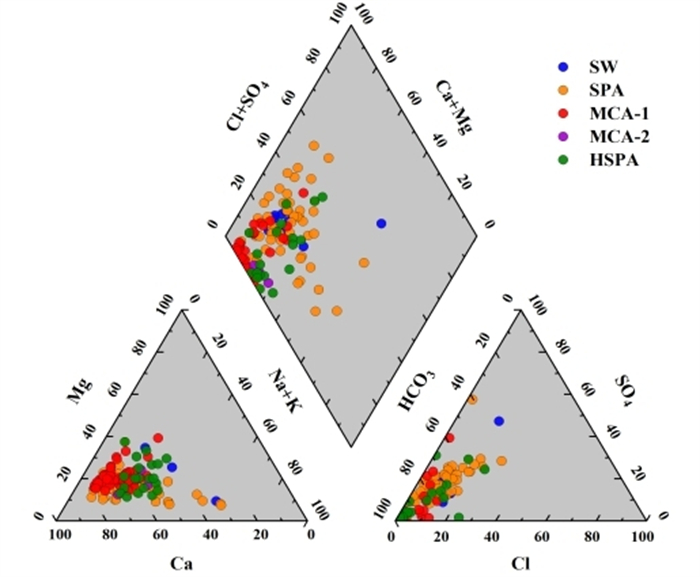
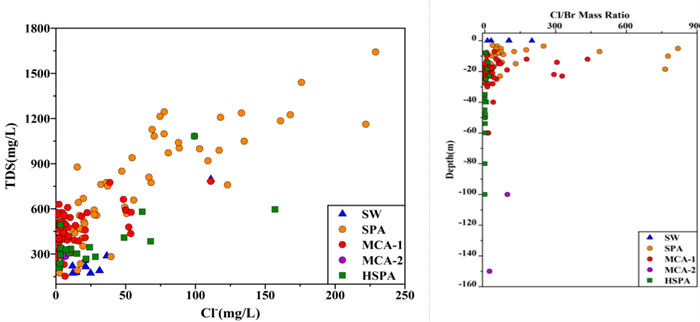
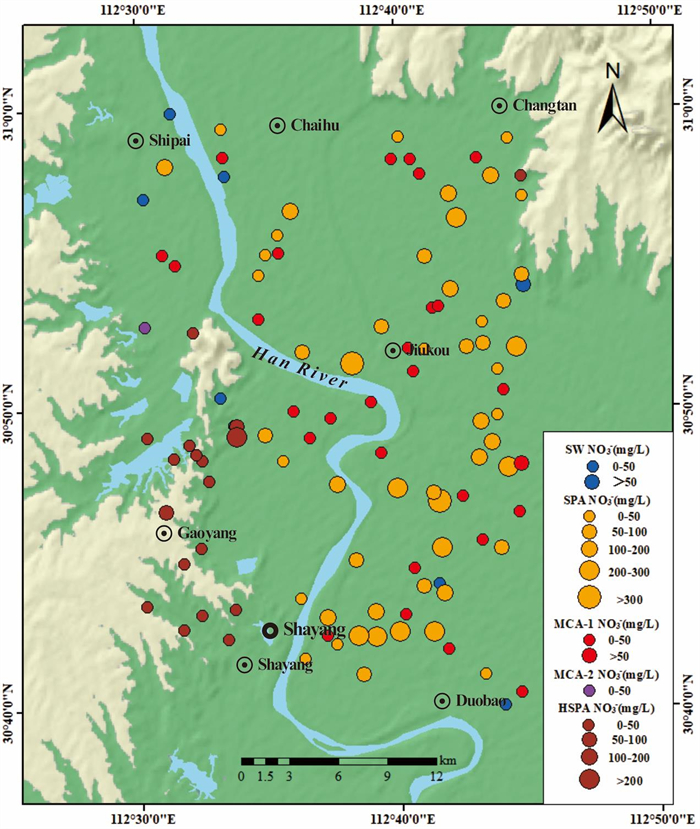
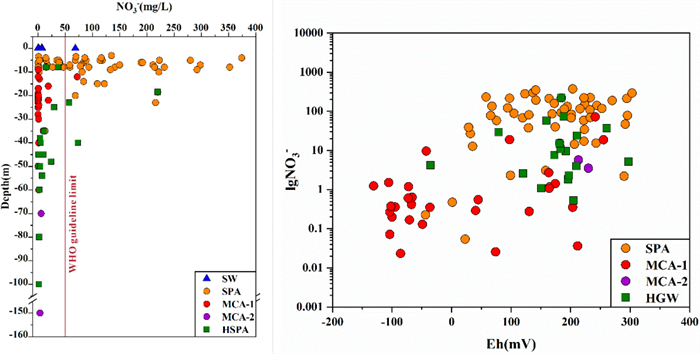
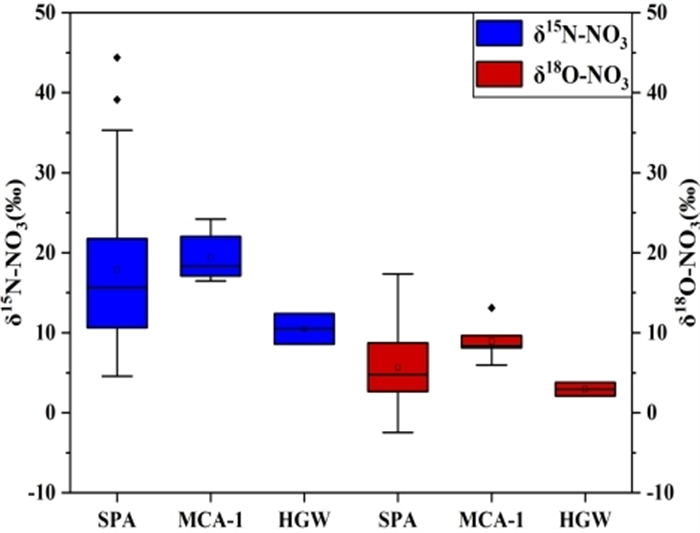
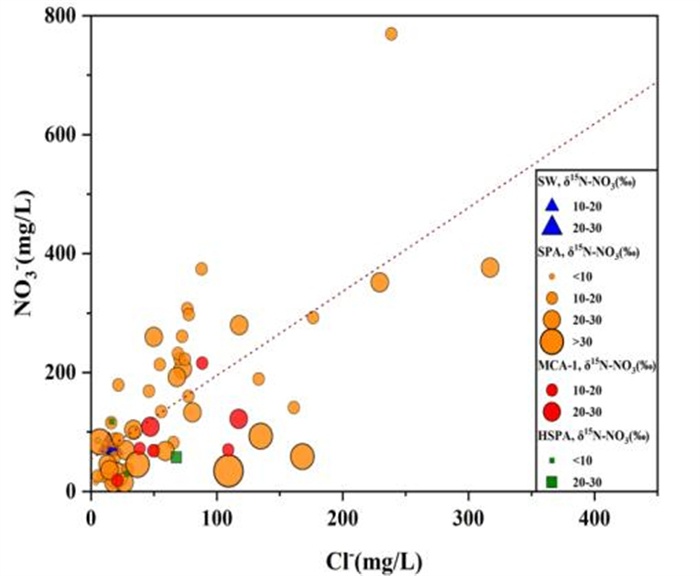
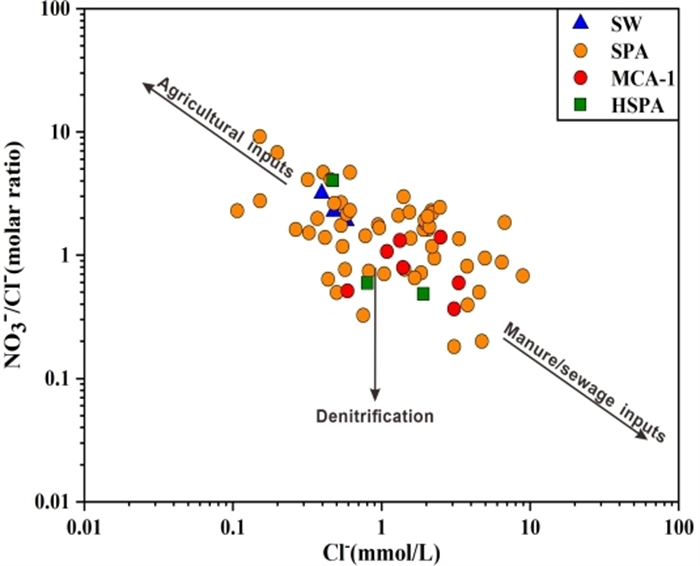
Nitrogen contamination of groundwater in the Jianghan Plain (JHP) in the middle reaches of the Yangtze River is widespread, but the sources and fate of nitrate (NO3-) in the transitional area between plains and hills are poorly understood. This paper characterized the distribution, sources and transformation processes of NO3- in groundwater in the hilly-plain transition area of JHP through hydrogeochemistry and dual isotopes (δ15N and δ18O-NO3-). The hydrogeochemical results showed that the NO3- in the plain and hilly areas is heterogeneous and controlled by topography. From plain to hilly areas in summer, NO3- in groundwater has a general trend of decreasing with the direction of groundwater flow. The groundwater in the plain area is strongly affected by anthropogenic activities, and the NO3- in the multi-level aquifer gradually decreases with increasing depth. Changes in redox conditions caused by river erosion may be responsible for higher NO3- in groundwater along the eroded banks. The isotopic results showed that NO3- in the hilly area mainly comes from soil organic nitrogen, which is a natural source. While, groundwater NO3- in the plain area is strongly affected by livestock manure and domestic sewage, which may be owing to the high density of residents and the impact of anthropogenic activities.

| Aeschbach-Hertig, W., Gleeson, T., 2012. Regional Strategies for the Accelerating Global Problem of Groundwater Depletion. Nature Geoscience, 5(12): 853–861. https://doi.org/10.1038/ngeo1617 |
| Bhatnagar, A., Sillanpää, M., 2011. A Review of Emerging Adsorbents for Nitrate Removal from Water. Chemical Engineering Journal, 168(2): 493–504. https://doi.org/10.1016/j.cej.2011.01.103 |
| Böttcher, J., Strebel, O., Voerkelius, S., et al., 1990. Using Isotope Fractionation of Nitrate-Nitrogen and Nitrate-Oxygen for Evaluation of Microbial Denitrification in a Sandy Aquifer. Journal of Hydrology, 114(3/4): 413–424. https://doi.org/10.1016/0022-1694(90)90068-9 |
| Burkart, M. R., Kolpin, D. W., 1993. Hydrologic and Land-Use Factors Associated with Herbicides and Nitrate in Near-Surface Aquifers. Journal of Environmental Quality, 22(4): 646–656. https://doi.org/10.2134/jeq1993.00472425002200040002x |
| Burow, K. R., Nolan, B. T., Rupert, M. G., et al., 2010. Nitrate in Groundwater of the United States, 1991–2003. Environmental Science & Technology, 44(13): 4988–4997. https://doi.org/10.1021/es100546y |
| Burt, T. P., Matchett, L. S., Goulding, K. W. T., et al., 1999. Denitrification in Riparian Buffer Zones: The Role of Floodplain Hydrology. Hydrological Processes, 13(10): 1451–1463. https://doi.org/10.1002/(sici)1099-1085(199907)13:101451:aid-hyp822>3.0.co;2-w doi: 10.1002/(sici)1099-1085(199907)13:101451:aid-hyp822>3.0.co;2-w |
| Carrey, R., Ballesté, E., Blanch, A. R., et al., 2021. Combining Multi-Isotopic and Molecular Source Tracking Methods to Identify Nitrate Pollution Sources in Surface and Groundwater. Water Research, 188: 116537. https://doi.org/10.1016/j.watres.2020.116537 |
| Chen, D. J. Z., MacQuarrie, K. T. B., 2005. Correlation of δ15N and δ18O in NO3- during Denitrification in Groundwater. Journal of Environmental Engineering and Science, 4(3): 221–226. https://doi.org/10.1139/s05-002 |
| Chen, Z. M., Ding, W. X., Xu, Y. H., et al., 2015. Importance of Heterotrophic Nitrification and Dissimilatory Nitrate Reduction to Ammonium in a Cropland Soil: Evidences from a 15N Tracing Study to Literature Synthesis. Soil Biology and Biochemistry, 91: 65–75. https://doi.org/10.1016/j.soilbio.2015.08.026 |
| Craig, H., 1961. Standard for Reporting Concentrations of Deuterium and Oxygen-18 in Natural Waters. Science, 133(3467): 1833–1834. https://doi.org/10.1126/science.133.3467.1833 |
| Dalai, T. K., Krishnaswami, S., Sarin, M. M., 2002. Major Ion Chemistry in the Headwaters of the Yamuna River System. Geochimica et Cosmochimica Acta, 66(19): 3397–3416. https://doi.org/10.1016/s0016-7037(02)00937-7 |
| Du, Y., Deng, Y. M., Ma, T., et al., 2018. Hydrogeochemical Evidences for Targeting Sources of Safe Groundwater Supply in Arsenic-Affected Multi-Level Aquifer Systems. Science of the Total Environment, 645: 1159–1171. https://doi.org/10.1016/j.scitotenv.2018.07.173 |
| Ernesto, P. Z., Rogelio, L. R., Harter, T., et al., 2014. Assessment of Sources and Fate of Nitrate in Shallow Groundwater of an Agricultural Area by Using a Multi-Tracer Approach. Science of the Total Environment, 470/471: 855–864. https://doi.org/10.1016/j.scitotenv.2013.10.043 |
| Fan, L. J., Zhao, F. H., Cheng, C., 2016. Research Advances in Stable Nitrogen Isotope in Water Bodies. Ying Yong Sheng Tai Xue Bao, 27(8): 2699–2707. https://doi.org/10.13287/j.1001-9332.201608.003 |
| Foster, S., Chilton, J., Nijsten, G. J., et al., 2013. Groundwater—A Global Focus on the 'Local Resource'. Current Opinion in Environmental Sustainability, 5(6): 685–695. https://doi.org/10.1016/j.cosust.2013.10.010 |
| Fukada, T., Hiscock, K. M., Dennis, P. F., et al., 2003. A Dual Isotope Approach to Identify Denitrification in Groundwater at a River-Bank Infiltration Site. Water Research, 37(13): 3070–3078. https://doi.org/10.1016/s0043-1354(03)00176-3 |
| Gibrilla, A., Fianko, J. R., Ganyaglo, S., et al., 2020. Nitrate Contamination and Source Apportionment in Surface and Groundwater in Ghana Using Dual Isotopes (15N and 18O-NO3) and a Bayesian Isotope Mixing Model. Journal of Contaminant Hydrology, 233: 103658. https://doi.org/10.1016/j.jconhyd.2020.103658 |
| Greer, F. R., Shannon, M., Nutrition, T. C. O., 2005. Infant Methemoglobinemia: The Role of Dietary Nitrate in Food and Water. Pediatrics, 116(3): 784–786. https://doi.org/10.1542/peds.2005-1497 |
| Gu, Y. S., Guan, S., Ma, T., et al., 2018. Quaternary Sedimentary Environment Documented by Borehole Stratigraphical Records in Eastern Jianghan Basin. Earth Science, 43(11): 3989–4000 (in Chinese with English Abstract) |
| Hinkle, S. R., Tesoriero, A. J., 2014. Nitrogen Speciation and Trends, and Prediction of Denitrification Extent, in Shallow US Groundwater. Journal of Hydrology, 509: 343–353. https://doi.org/10.1016/j.jhydrol.2013.11.048 |
| Hossain, M., 2015. Sustainable Arsenic Mitigation A Strategy for Scaling-Up Safe Water Access: A Strategy for Scaling-Up Safe Water Access. Stockholm University Press. https://api.core.ac.uk/oai/oai:DiVA.org:kth-179197 https://api.core.ac.uk/oai/oai:DiVA.org:kth-179197 |
| Kaown, D., Koh, D. C., Mayer, B., et al., 2009. Identification of Nitrate and Sulfate Sources in Groundwater Using Dual Stable Isotope Approaches for an Agricultural Area with Different Land Use (Chuncheon, Mid-Eastern Korea). Agriculture, Ecosystems & Environment, 132(3/4): 223–231. https://doi.org/10.1016/j.agee.2009.04.004 |
|
Kendall, C., 1998. Tracing Nitrogen Sources and Cycling in Catchments. Isotope Tracers in Catchment Hydrology. Elsevier, Amsterdam. |
|
Kendall, C., Elliott, E. M., Wankel, S. D., 2008. Tracing Anthropogenic Inputs of Nitrogen to Ecosystems. Stable Isotopes in Ecology and Environmental Science. Blackwell Publishing Ltd., Oxford. |
| Kim, S. H., Kim, H. R., Yu, S., et al., 2021. Shift of Nitrate Sources in Groundwater due to Intensive Livestock Farming on Jeju Island, South Korea: With Emphasis on Legacy Effects on Water Management. Water Research, 191: 116814. https://doi.org/10.1016/j.watres.2021.116814 |
| Korom, S. F., 1992. Natural Denitrification in the Saturated Zone: A Review. Water Resources Research, 28(6): 1657–1668. https://doi.org/10.1029/92wr00252 |
| Landon, M. K., Green, C. T., Belitz, K., et al., 2011. Relations of Hydrogeologic Factors, Groundwater Reduction-Oxidation Conditions, and Temporal and Spatial Distributions of Nitrate, Central-Eastside San Joaquin Valley, California, USA. Hydrogeology Journal, 19(6): 1203–1224. https://doi.org/10.1007/s10040-011-0750-1 |
| Li, J., Shi, Z. M., Liu, M. Z., et al., 2021. Identifying Anthropogenic Sources of Groundwater Contamination by Natural Background Levels and Stable Isotope Application in Pinggu Basin, China. Journal of Hydrology, 596: 126092. https://doi.org/10.1016/j.jhydrol.2021.126092 |
| Liang, X., Zhang, J. W., Lan, K., et al., 2020. Hydrochemical Characteristics of Groundwater and Analysis of Groundwater Flow Systems in Jianghan Plain. Geological Science and Technology Bulletin, 39(1): 21–33 (in Chinese with English Abstract) |
| Liu, C. Q., Li, S. L., Lang, Y. C., et al., 2006. Using Δ15N- and Δ18O-Values to Identify Nitrate Sources in Karst Ground Water, Guiyang, Southwest China. Environmental Science & Technology, 40(22): 6928–6933. https://doi.org/10.1021/es0610129 |
| Minet, E. P., Goodhue, R., Meier-Augenstein, W., et al., 2017. Combining Stable Isotopes with Contamination Indicators: A Method for Improved Investigation of Nitrate Sources and Dynamics in Aquifers with Mixed Nitrogen Inputs. Water Research, 124: 85–96. https://doi.org/10.1016/j.watres.2017.07.041 |
| Morrissy, J. G., Currell, M. J., Reichman, S. M., et al., 2021. Nitrogen Contamination and Bioremediation in Groundwater and the Environment: A Review. Earth-Science Reviews, 222: 103816. https://doi.org/10.1016/j.earscirev.2021.103816 |
| Niu, B. B., Wang, H. H., Loáiciga, H. A., et al., 2017. Temporal Variations of Groundwater Quality in the Western Jianghan Plain, China. Science of the Total Environment, 578: 542–550. https://doi.org/10.1016/j.scitotenv.2016.10.225 |
| Petelet-Giraud, E., Baran, N., Vergnaud-Ayraud, V., et al., 2021. Elucidating Heterogeneous Nitrate Contamination in a Small Basement Aquifer. A Multidisciplinary Approach: NO3 Isotopes, CFCS-SF6, Microbiological Activity, Geophysics and Hydrogeology. Journal of Contaminant Hydrology, 241: 103813. https://doi.org/10.1016/j.jconhyd.2021.103813 |
| Qin, S. P., Hu, C. S., Clough, T. J., et al., 2017. Irrigation of DOC-Rich Liquid Promotes Potential Denitrification Rate and Decreases N2O/(N2O + N2) Product Ratio in a 0–2 m Soil Profile. Soil Biology and Biochemistry, 106: 1–8. https://doi.org/10.1016/j.soilbio.2016.12.001 |
| Rivett, M. O., Buss, S. R., Morgan, P., et al., 2008. Nitrate Attenuation in Groundwater: A Review of Biogeochemical Controlling Processes. Water Research, 42(16): 4215–4232. https://doi.org/10.1016/j.watres.2008.07.020 |
| Robertson, G. P., Vitousek, P. M., 2009. Nitrogen in Agriculture: Balancing the Cost of an Essential Resource. Annual Review of Environment and Resources, 34: 97–125. https://doi.org/10.1146/annurev.environ.032108.105046 |
| Sebilo, M., Mayer, B., Nicolardot, B., et al., 2013. Long-Term Fate of Nitrate Fertilizer in Agricultural Soils. Proceedings of the National Academy of Sciences of the United States of America, 110(45): 18185–18189. https://doi.org/10.1073/pnas.1305372110 |
| Senbayram, M., Chen, R., Budai, A., et al., 2012. N2O Emission and the N2O/(N2O + N2) Product Ratio of Denitrification as Controlled by Available Carbon Substrates and Nitrate Concentrations. Agriculture, Ecosystems & Environment, 147: 4–12. https://doi.org/10.1016/j.agee.2011.06.022 |
| Shen, S., Ma, T., Du, Y., et al., 2018. The Spatial Distribution Characteristic and Genesis of Nitrogen of Shallow Groundwater in the East of Jianghan Plain. Environmental Science & Technology, 41(2): 47–56 (in Chinese with English Abstract) |
| Showers, W. J., Genna, B., McDade, T., et al., 2008. Nitrate Contamination in Groundwater on an Urbanized Dairy Farm. Environmental Science & Technology, 42(13): 4683–4688. https://doi.org/10.1021/es071551t |
| Singleton, M. J., Esser, B. K., Moran, J. E., et al., 2007. Saturated Zone Denitrification: Potential for Natural Attenuation of Nitrate Contamination in Shallow Groundwater under Dairy Operations. Environmental Science & Technology, 41(3): 759–765. https://doi.org/10.1021/es061253g |
| Stoliker, D. L., Repert, D. A., Smith, R. L., et al., 2016. Hydrologic Controls on Nitrogen Cycling Processes and Functional Gene Abundance in Sediments of a Groundwater Flow-through Lake. Environmental Science & Technology, 50(7): 3649–3657. https://doi.org/10.1021/acs.est.5b06155 |
| Wang, H. L., Lu, K. Y., Shen, C. Y., et al., 2021. Human Health Risk Assessment of Groundwater Nitrate at a Two Geomorphic Units Transition Zone in Northern China. Journal of Environmental Sciences, 110: 38–47. https://doi.org/10.1016/j.jes.2021.03.013 |
| Ward, M. H., Mark, S. D., Cantor, K. P., et al., 1996. Drinking Water Nitrate and the Risk of Non-Hodgkinʼs Lymphoma. Epidemiology, 7(5): 465–471. https://doi.org/10.1097/00001648-199609000-00003 |
| Xia, Y. Q., Li, Y. F., Zhang, X. Y., et al., 2017. Nitrate Source Apportionment Using a Combined Dual Isotope, Chemical and Bacterial Property, and Bayesian Model Approach in River Systems. Journal of Geophysical Research: Biogeosciences, 122(1): 2–14. https://doi.org/10.1002/2016jg003447 |
| Xiong, Y. J., Du, Y., Deng, Y. M., et al., 2021. Contrasting Sources and Fate of Nitrogen Compounds in Different Groundwater Systems in the Central Yangtze River Basin. Environmental Pollution, 290: 118119. https://doi.org/10.1016/j.envpol.2021.118119 |
| Xue, D. M., Botte, J., de Baets, B., et al., 2009. Present Limitations and Future Prospects of Stable Isotope Methods for Nitrate Source Identification in Surface- and Groundwater. Water Research, 43(5): 1159–1170. https://doi.org/10.1016/j.watres.2008.12.048 |
| Yue, F. J., Li, S. L., Liu, C. Q., et al., 2013. Using Dual Isotopes to Evaluate Sources and Transformation of Nitrogen in the Liao River, Northeast China. Applied Geochemistry, 36: 1–9. https://doi.org/10.1016/j.apgeochem.2013.06.009 |
| Zhang, J. W., Liang, X., Jin, M. G., et al., 2019. Identifying the Groundwater Flow Systems in a Condensed River-Network Interfluve between the Han River and Yangtze River (China) Using Hydrogeochemical Indicators. Hydrogeology Journal, 27(7): 2415–2430. https://doi.org/10.1007/s10040-019-01994-1 |
|
Zhou, J. H., Gao, Z., Ma, H., et al., 2011. Prevention and Study on Agricultural Non-Point Source Pollution in China. Advances in Electrical Engineering and Electrical Machines. Springer, Berlin, Heidelberg. |
| Zhou, X., Jiang, Y. H., 2007. Application of Nitrogen and Oxygen Isotopes in the Study of Nitrate Pollution in Groundwater. Journal of the Earth, 28(4): 389–395 (in Chinese with English Abstract) |
| Zhou, Y., Wang, Y. X., Li, Y. L., et al., 2013. Hydrogeochemical Characteristics of Central Jianghan Plain, China. Environmental Earth Sciences, 68(3): 765–778. https://doi.org/10.1007/s12665-012-1778-9 |
Figures(12)
Copyright © 2013-2020 Journal of Earth Science 鄂ICP备15021562号-2
Tel: +86-27-67885075 Fax: +86-27-67885075 E-mail: xbb@cug.edu.cn
Address: Editorial Office of Journal, China University of Geosciences, Yujiashan, Wuhan, Hubei 430074, P. R. China
Supported by:
Beijing Renhe Information Technology Co. Ltd
E-mail:
info@rhhz.net


 DownLoad: