| Citation: | Zhiyu Gao, Yanchuan Li, Xinjian Shan, Chuanchao Huang, Xing Huang, Kai Zheng, Bo Li. Quick Prediction of Earthquake Ground Shaking Intensity Using High-Rate GNSS: A Case Study of the 2021 Mw 7.3 Maduo Earthquake. Journal of Earth Science, 2026, 37(1): 351-360. doi: 10.1007/s12583-023-1854-y

|
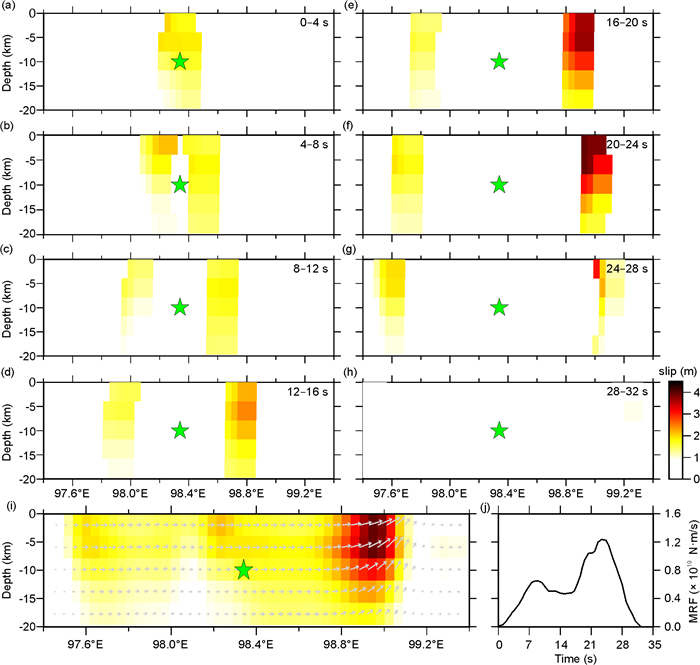
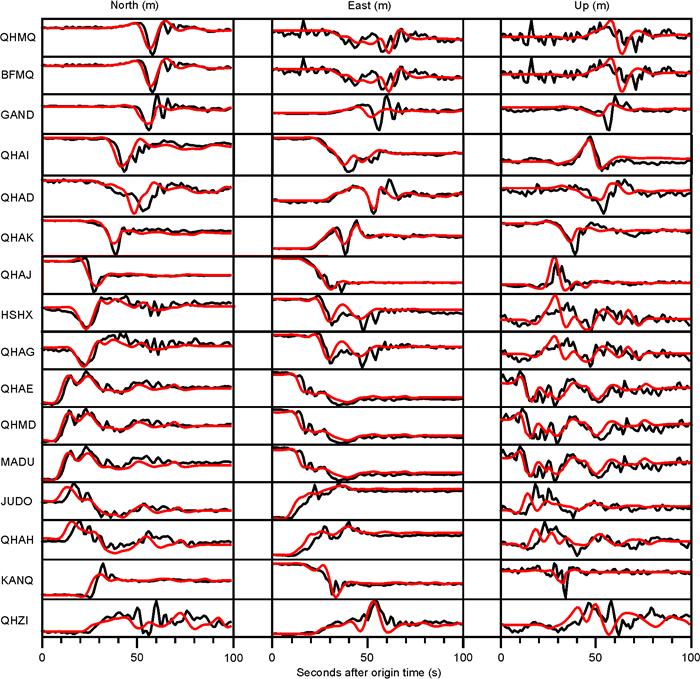
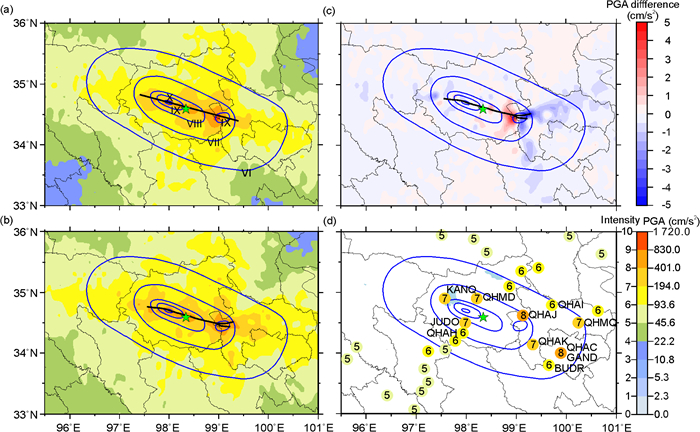
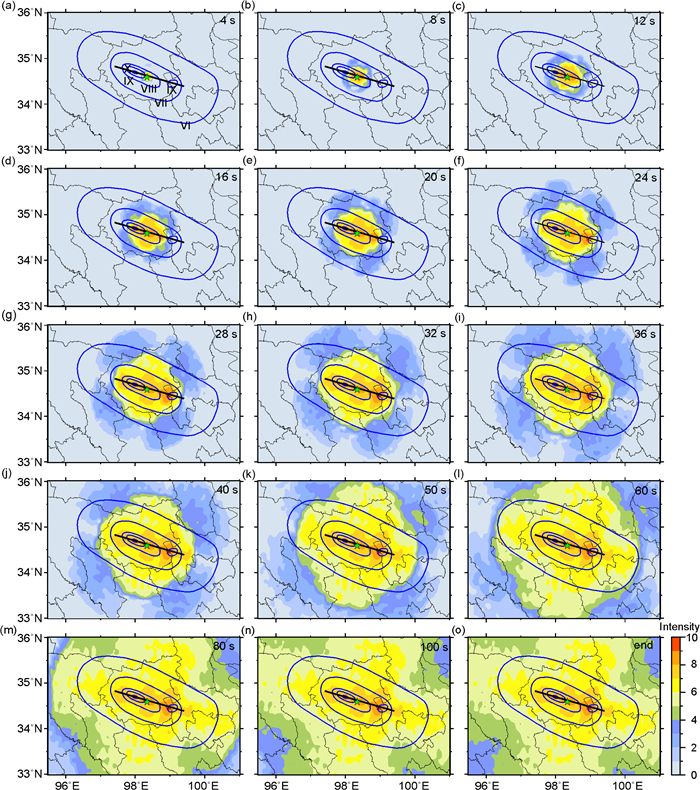
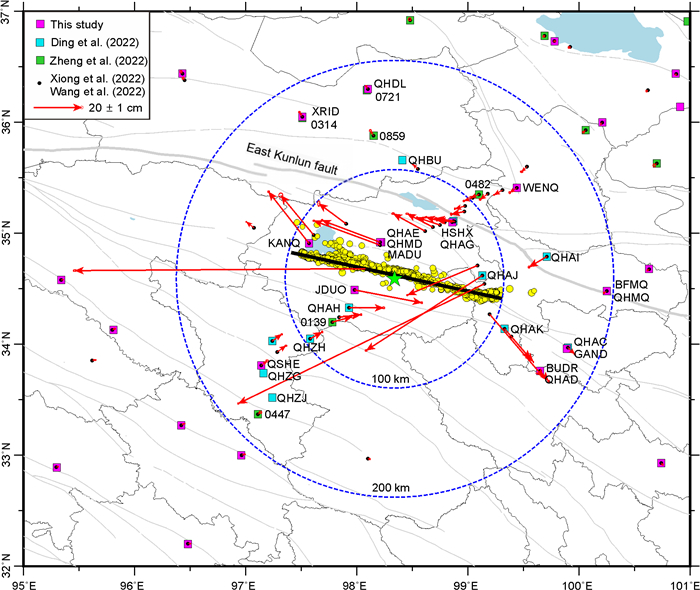
Seismic intensity is critical for post-earthquake hazard assessment and response, but is often delayed because field surveys are required. Here, we propose a simple scheme for quick prediction of earthquake ground shaking intensity using high-rate Global Navigation Satellite System (GNSS) data. In the scheme, high-rate GNSS displacement waveforms and static GNSS coseismic offsets are first used to invert the fault rupture process based on a one-fault model. The kinematic slip model is then employed as input for kinematic forward simulation to predict strong ground motion, which is subsequently convert into seismic intensities according to the China seismic intensity scale (GB/T 17742–2020). We take the 2021

| Allen, R. M., Kanamori, H., 2003. The Potential for Earthquake Early Warning in Southern California. Science, 300(5620): 786–789. https://doi.org/10.1126/science.1080912 |
| An, Y. R., Wang, D., Ma, Q., et al., 2023. Preliminary Report of the September 5, 2022 MS 6.8 Luding Earthquake, Sichuan, China. Earthquake Research Advances, 3(1): 100184. https://doi.org/10.1016/j.eqrea.2022.100184 |
| Chen, H., Qu, C. Y., Zhao, D. Z., et al., 2021. Rupture Kinematics and Coseismic Slip Model of the 2021 Mw 7.3 Maduo (China) Earthquake: Implications for the Seismic Hazard of the Kunlun Fault. Remote Sensing, 13(16): 3327. https://doi.org/10.3390/rs13163327 |
| Chen, K. J., Avouac, J. P., Geng, J. H., et al., 2022. The 2021 Mw 7.4 Madoi Earthquake: An Archetype Bilateral Slip-Pulse Rupture Arrested at a Splay Fault. Geophysical Research Letters, 49(2): e2021GL095243. https://doi.org/10.1029/2021GL095243 |
| Chen, W. K., Rao, G., Kang, D. J., et al., 2023. Early Report of the Source Characteristics, Ground Motions, and Casualty Estimates of the 2023 Mw 7.8 and 7.5 Turkey Earthquakes. Journal of Earth Science, 34(2): 297–303. https://doi.org/10.1007/s12583-023-1316-6 |
| Chen, W. K., Wang, D., Si, H. J., et al., 2022a. Rapid Estimation of Seismic Intensities Using a New Algorithm that Incorporates Array Technologies and Ground-Motion Prediction Equations (GMPEs). Bulletin of the Seismological Society of America, 112(3): 1647–1661. https://doi.org/10.1785/0120210207 |
| Chen, W. K., Wang, D., Zhang, C., et al., 2022b. Estimating Seismic Intensity Maps of the 2021 Mw 7.3 Madoi, Qinghai and Mw 6.1 Yangbi, Yunnan, China Earthquakes. Journal of Earth Science, 33(4): 839–846. https://doi.org/10.1007/s12583-021-1586-9 |
| Cheng, C., Wang, D., Yao, Q., et al., 2023. The 2021 Mw 7.3 Madoi, China Earthquake: Transient Supershear Ruptures on a Presumed Immature Strike-Slip Fault. Journal of Geophysical Research: Solid Earth, 128(2): e2022JB024641. https://doi.org/10.1029/2022JB024641 |
| Crowell, B. W., 2021. Near-Field Strong Ground Motions from GPS-Derived Velocities for 2020 Intermountain Western United States Earthquakes. Seismological Research Letters, 92(2A): 840–848. https://doi.org/10.1785/0220200325 |
| Crowell, B. W., Schmidt, D. A., Bodin, P., et al., 2018. G-FAST Earthquake Early Warning Potential for Great Earthquakes in Chile. Seismological Research Letters, 89(2A): 542–556. https://doi.org/10.1785/0220170180 |
| Ding, K. H., Wang, Q., Li, Z. C., et al., 2022. Rapid Source Determination of the 2021 Mw 7.4 Maduo Earthquake by a Dense High-Rate GNSS Network in the Tibetan Plateau. Seismological Research Letters, 93(6): 3234–3245. https://doi.org/10.1785/0220210307 |
| Fang, R. X., Zheng, J. W., Geng, J. H., et al., 2021. Earthquake Magnitude Scaling Using Peak Ground Velocity Derived from High-Rate GNSS Observations. Seismological Research Letters, 92(1): 227–237. https://doi.org/10.1785/0220190347 |
| Gao, Z. Y., Li, Y. C., Shan, X. J., et al., 2021. Earthquake Magnitude Estimation from High-Rate GNSS Data: A Case Study of the 2021 Mw 7.3 Maduo Earthquake. Remote Sensing, 13(21): 4478. https://doi.org/10.3390/rs13214478 |
| Gao, Z. Y., Li, Y. C., Shan, X. J., et al., 2022. Testing a Prototype Earthquake Early Warning System: A Retrospective Study of the 2021 Mw 7.4 Maduo, Tibet, Earthquake. Seismological Research Letters, 93(3): 1650–1659. https://doi.org/10.1785/0220210245 |
| Geng, J. H., Pan, Y. X., Li, X. T., et al., 2018. Noise Characteristics of High-Rate Multi-GNSS for Subdaily Crustal Deformation Monitoring. Journal of Geophysical Research: Solid Earth, 123(2): 1987–2002. https://doi.org/10.1002/2018JB015527 |
| Guo, R. M., Yang, H. F., Li, Y., et al., 2022. Complex Slip Distribution of the 2021 Mw 7.4 Maduo, China, Earthquake: An Event Occurring on the Slowly Slipping Fault. Seismological Research Letters, 93(2A): 653–665. https://doi.org/10.1785/0220210226 |
| Ha, G. H., Liu, J. R., Ren, Z. K., et al., 2022. The Interpretation of Seismogenic Fault of the Maduo Mw 7.3 Earthquake, Qinghai Based on Remote Sensing Images—A Branch of the East Kunlun Fault System. Journal of Earth Science, 33(4): 857–868. https://doi.org/10.1007/s12583-021-1556-2 |
|
Harris, R. A., 2004. Numerical Simulations of Large Earthquakes: Dynamic Rupture Propagation on Heterogeneous Faults. In: Donnellan, A., Mora, P., Matsu'ura, M., et al., eds., Computational Earthquake Science Part Ⅱ. Birkhäuser Basel, Basel. 2171–2181. |
| Harris, R. A., Barall, M., Aagaard, B., et al., 2018. A Suite of Exercises for Verifying Dynamic Earthquake Rupture Codes. Seismological Research Letters, 89(3): 1146–1162. https://doi.org/10.1785/0220170222 |
| He, K. F., Wen, Y. M., Xu, C. J., et al., 2022. Fault Geometry and Slip Distribution of the 2021 Mw 7.4 Maduo, China, Earthquake Inferred from InSAR Measurements and Relocated Aftershocks. Seismological Research Letters, 93(1): 8–20. https://doi.org/10.1785/0220210204 |
| He, L. J., Feng, G. C., Wu, X. X., et al., 2021. Coseismic and Early Postseismic Slip Models of the 2021 Mw 7.4 Maduo Earthquake (Western China) Estimated by Space-Based Geodetic Data. Geophysical Research Letters, 48(24): e2021GL095860. https://doi.org/10.1029/2021GL095860 |
| Huang, X. L., Peng, Y. Y., Cheng, C., et al., 2022. Determination and Comparison of ML, MS_BB, mB, MWp, MWW, Mdt, and M (GNSS) for the 22 May 2021 M 7.4 Madoi, Qinghai, China Earthquake. Journal of Earth Science, 33(4): 847–856. https://doi.org/10.1007/s12583-022-1680-7 |
| Jin, Z. Y., Fialko, Y., 2021. Coseismic and Early Postseismic Deformation Due to the 2021 M7.4 Maduo (China) Earthquake. Geophysical Research Letters, 48(21): e2021GL095213. https://doi.org/10.1029/2021GL095213 |
| Kanamori, H., 1977. The Energy Release in Great Earthquakes. Journal of Geophysical Research (1896–1977), 82(20): 2981–2987. https://doi.org/10.1029/JB082i020p02981 |
| Li, Z. C., Ding, K. H., Zhang, P., et al., 2021. Coseismic Deformation and Slip Distribution of 2021 Mw 7.4 Madoi Earthquake from GNSS Observation. Geomatics and Information Science of Wuhan University, 46(10): 1489–1497. https://doi.org/10.13203/j.whugis20210301 (in Chinese with English Abstract) |
| Lyu, M. Z., Chen, K. J., Chai, H. S., et al., 2022a. Joint Inversion of InSAR and High-Rate GNSS Displacement Waveforms for the Rupture Process of the 2022 Qinghai Menyuan M 6.9 Earthquake. Chinese Journal of Geophysics, 65(12): 4725–4738. https://doi.org/10.6038/cjg2022Q0304 (in Chinese with English Abstract) |
| Lyu, M. Z., Chen, K. J., Xue, C. H., et al., 2022b. Overall Subshear but Locally Supershear Rupture of the 2021 Mw 7.4 Maduo Earthquake from High-Rate GNSS Waveforms and Three-Dimensional InSAR Deformation. Tectonophysics, 839: 229542. https://doi.org/10.1016/j.tecto.2022.229542 |
| Melgar, D., Bock, Y., 2015. Kinematic Earthquake Source Inversion and Tsunami Runup Prediction with Regional Geophysical Data. Journal of Geophysical Research: Solid Earth, 120(5): 3324–3349. https://doi.org/10.1002/2014JB011832 |
| Melgar, D., Crowell, B. W., Melbourne, T. I., et al., 2020. Noise Characteristics of Operational Real-Time High-Rate GNSS Positions in a Large Aperture Network. Journal of Geophysical Research: Solid Earth, 125(7): e2019JB019197. https://doi.org/10.1029/2019JB019197 |
| Melgar, D., LeVeque, R. J., Dreger, D. S., et al., 2016. Kinematic Rupture Scenarios and Synthetic Displacement Data: An Example Application to the Cascadia Subduction Zone. Journal of Geophysical Research: Solid Earth, 121(9): 6658–6674. https://doi.org/10.1002/2016JB013314 |
| Olson, E. L., Allen, R. M., 2005. The Deterministic Nature of Earthquake Rupture. Nature, 438(7065): 212–215. https://doi.org/10.1038/nature04214 |
| Pan, J. W., Li, H. B., Chevalier, M. L., et al., 2022. Co-Seismic Rupture of the 2021, Mw 7.4 Maduo Earthquake (Northern Tibet): Short-Cutting of the Kunlun Fault Big Bend. Earth and Planetary Science Letters, 594: 117703. https://doi.org/10.1016/j.epsl.2022.117703 |
| Peng, C. Y., Yang, J. S., Zheng, Y., et al., 2017. New τc Regression Relationship Derived from All P Wave Time Windows for Rapid Magnitude Estimation. Geophysical Research Letters, 44(4): 1724–1731. https://doi.org/10.1002/2016GL071672 |
| Ruhl, C. J., Melgar, D., Grapenthin, R., et al., 2017. The Value of Real-Time GNSS to Earthquake Early Warning. Geophysical Research Letters, 44(16): 8311–8319. https://doi.org/10.1002/2017GL074502 |
| Shan, X. J., Li, Y. C., Wang, Z. J., et al., 2021. GNSS for Quasi-Real-Time Earthquake Source Determination in Eastern Tibet: A Prototype System Toward Early Warning Applications. Seismological Research Letters, 92(5): 2988–2997. https://doi.org/10.1785/0220190244 |
| Tao, Y., Liu, C., Liu, C. Y., et al., 2021. Empirical Wavelet Transform Method for GNSS Coordinate Series Denoising. Journal of Geovisualization and Spatial Analysis, 5(1): 9. https://doi.org/10.1007/s41651-021-00078-7 |
| Wang, M., Wang, F., Jiang, X., et al., 2022. GPS Determined Coseismic Slip of the 2021 Mw 7.4 Maduo, China, Earthquake and Its Tectonic Implication. Geophysical Journal International, 228(3): 2048–2055. https://doi.org/10.1093/gji/ggab460 |
| Wang, W. L., Fang, L. H., Wu, J. P., et al., 2021. Aftershock Sequence Relocation of the 2021 Ms 7.4 Maduo Earthquake, Qinghai, China. Science China Earth Sciences, 64(8): 1371–1380. https://doi.org/10.1007/s11430-021-9803-3 |
| Wei, G. G., Chen, K. J., Zou, R., et al., 2022. On the Potential of Rapid Moment Magnitude Estimation for Strong Earthquakes in Sichuan-Yunnan Region, China, Using Real-Time CMONOC GNSS Observations. Seismological Research Letters, 93(5): 2659–2669. https://doi.org/10.1785/0220210210 |
| Wells, D. L., Coppersmith, K. J., 1994. New Empirical Relationships among Magnitude, Rupture Length, Rupture Width, Rupture Area, and Surface Displacement. Bulletin of the Seismological Society of America, 84(4): 974–1002. https://doi.org/10.1785/bssa0840040974 |
| Wessel, P., Smith, W. H. F., Scharroo, R., et al., 2013. Generic Mapping Tools: Improved Version Released. Eos, Transactions American Geophysical Union, 94(45): 409–410. https://doi.org/10.1002/2013EO450001 |
| Xiao, L. H., Zheng, R., Zou, R., 2022. Coseismic Slip Distribution of the 2021 Mw 7.4 Maduo, Qinghai Earthquake Estimated from InSAR and GPS Measurements. Journal of Earth Science, 33(4): 885–891. https://doi.org/10.1007/s12583-022-1637-x |
| Xiong, W., Chen, W., Wang, D. Z., et al., 2022. Coseismic Slip and Early Afterslip of the 2021 Mw 7.4 Maduo, China Earthquake Constrained by GPS and InSAR Data. Tectonophysics, 840: 229558. https://doi.org/10.1016/j.tecto.2022.229558 |
| Yao, S. L., Yang, H. F., 2023. Towards Ground Motion Prediction for Potential Large Earthquakes from Interseismic Locking Models. Earth and Planetary Science Letters, 601: 117905. https://doi.org/10.1016/j.epsl.2022.117905 |
| Yu, H. Y., Hu, F., Xu, J. K., et al., 2022. Dynamic Rupture Simulation of the 1833 Songming, Yunnan, China, M 8.0 Earthquake: Effects from Stepover Location and Overlap Distance. Earth and Space Science, 9(2): e2021EA002100. https://doi.org/10.1029/2021EA002100 |
| Yuan, Z. D., Li, T., Su, P., et al., 2022. Large Surface-Rupture Gaps and Low Surface Fault Slip of the 2021 Mw 7.4 Maduo Earthquake along a Low-Activity Strike-Slip Fault, Tibetan Plateau. Geophysical Research Letters, 49(6): e2021GL096874. https://doi.org/10.1029/2021GL096874 |
| Yue, H., Shen, Z. K., Zhao, Z. Y., et al., 2022. Rupture Process of the 2021 M 7.4 Maduo Earthquake and Implication for Deformation Mode of the Songpan-Ganzi Terrane in Tibetan Plateau. Proceedings of the National Academy of Sciences of the United States of America, 119(23): e2116445119. https://doi.org/10.1073/pnas.2116445119 |
| Zang, J. F., Wen, Y. M., Li, Z. C., et al., 2022b. Rapid Source Models of the 2021 Mw 7.4 Maduo, China, Earthquake Inferred from High-Rate BDS3/2, GPS, Galileo and GLONASS Observations. Journal of Geodesy, 96(9): 58. https://doi.org/10.1007/s00190-022-01641-w |
| Zang, J. F., Xu, C. J., Li, X. X., 2020. Scaling Earthquake Magnitude in Real Time with High-Rate GNSS Peak Ground Displacement from Variometric Approach. GPS Solutions, 24(4): 101. https://doi.org/10.1007/s10291-020-01013-x |
| Zang, J. F., Xu, C. J., Wen, Y. M., et al., 2022a. Rapid Earthquake Source Description Using Variometric-Derived GPS Displacements Toward Application to the 2019 Mw 7.1 Ridgecrest Earthquake. Seismological Research Letters, 93(1): 56–67. https://doi.org/10.1785/0220210129 |
| Zhang, X., Feng, W. P., Du, H. L., et al., 2022. Supershear Rupture during the 2021 Mw 7.4 Maduo, China, Earthquake. Geophysical Research Letters, 49(6): e2022GL097984. https://doi.org/10.1029/2022GL097984 |
| Zhao, D. Z., Qu, C. Y., Chen, H., et al., 2021. Tectonic and Geometric Control on Fault Kinematics of the 2021 Mw 7.3 Maduo (China) Earthquake Inferred from Interseismic, Coseismic, and Postseismic InSAR Observations. Geophysical Research Letters, 48(18): e2021GL095417. https://doi.org/10.1029/2021GL095417 |
| Zheng, K., Liu, K. Z., Zhang, X. H., et al., 2022. First Results Using High-Rate BDS-3 Observations: Retrospective Real-Time Analysis of 2021 Mw 7.4 Madoi (Tibet) Earthquake. Journal of Geodesy, 96(8): 51. https://doi.org/10.1007/s00190-022-01639-4 |
| Zhu, L. P., Rivera, L. A., 2002. A Note on the Dynamic and Static Displacements from a Point Source in Multilayered Media. Geophysical Journal International, 148(3): 619–627. https://doi.org/10.1046/j.1365-246X.2002.01610.x |
| Zollo, A., Lancieri, M., Nielsen, S., 2006. Earthquake Magnitude Estimation from Peak Amplitudes of Very Early Seismic Signals on Strong Motion Records. Geophysical Research Letters, 33(23): L23312. https://doi.org/10.1029/2006GL027795 |
Figures(5)
Copyright © 2013-2020 Journal of Earth Science 鄂ICP备15021562号-2
Tel: +86-27-67885075 Fax: +86-27-67885075 E-mail: xbb@cug.edu.cn
Address: Editorial Office of Journal, China University of Geosciences, Yujiashan, Wuhan, Hubei 430074, P. R. China
Supported by:
Beijing Renhe Information Technology Co. Ltd
E-mail:
info@rhhz.net



 DownLoad: