| Citation: | Ruxin Ding, Zhenghai Wang, Kyoungwon Min, Nina Liu, Cleber Soares, Jing Liu-Zeng, Weitao Wang. Inversion of the Paleo-Geothermal Gradient Using Low-Temperature Thermochronology: A Case Study of the Haiyuan-Liupanshan Region. Journal of Earth Science, 2026, 37(1): 114-124. doi: 10.1007/s12583-023-1861-z

|
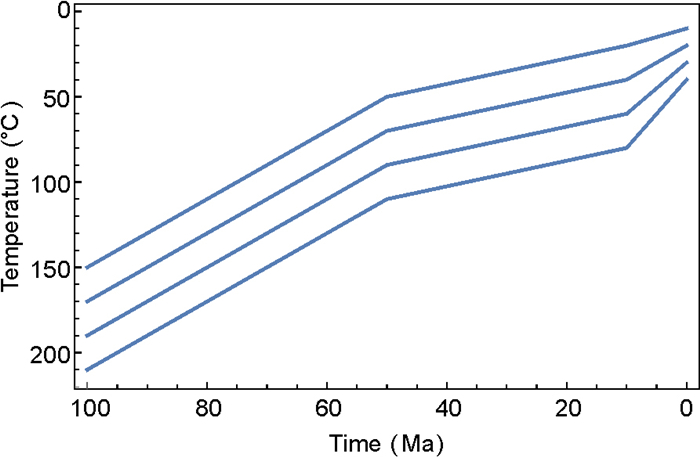
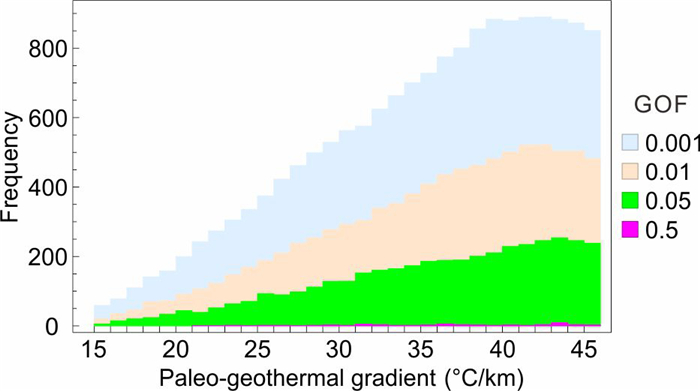
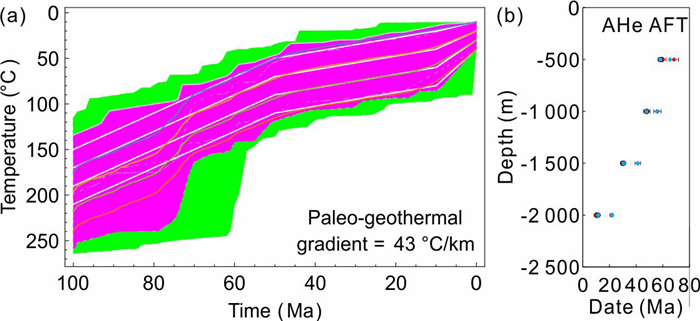
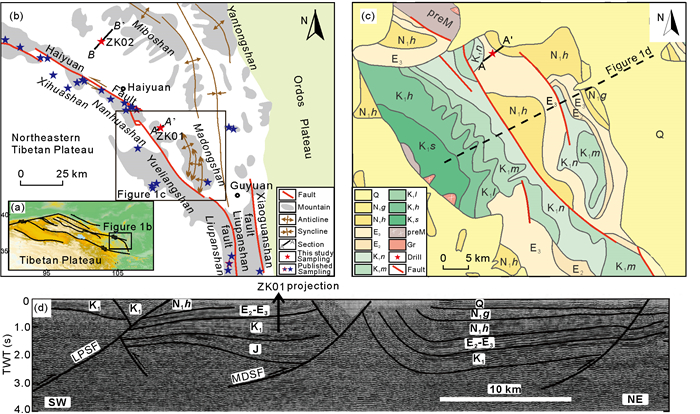
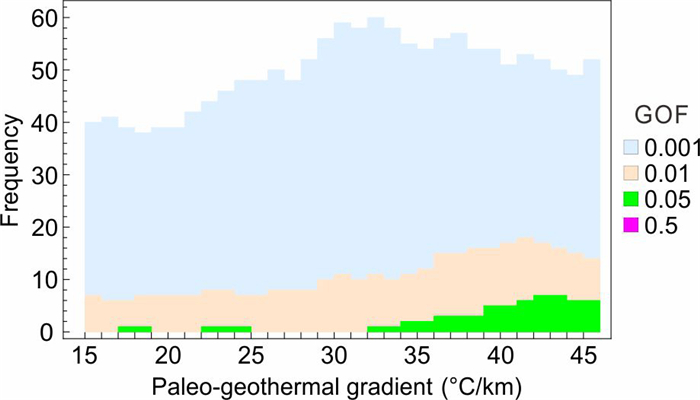
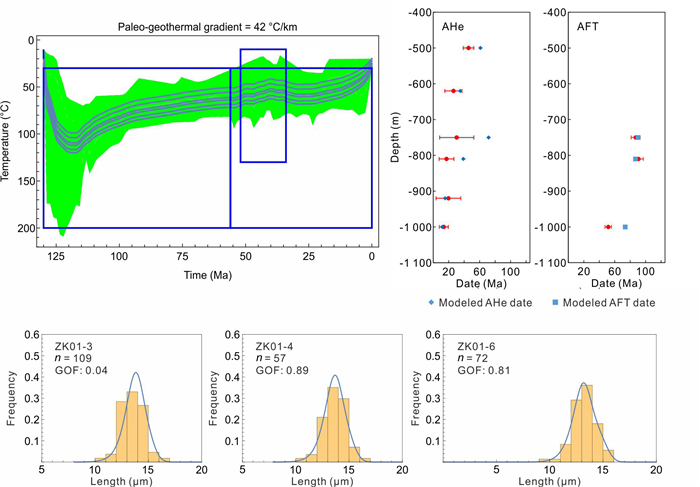
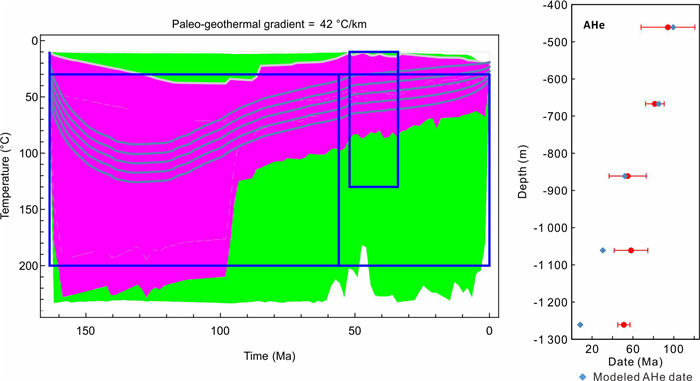
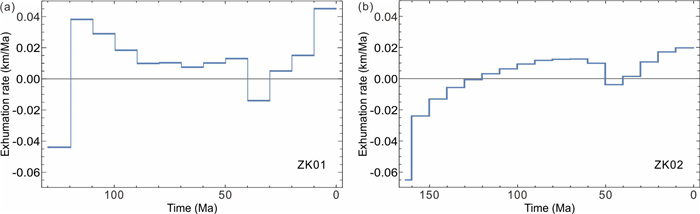
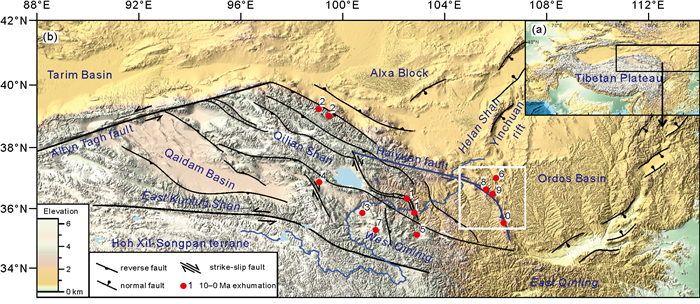
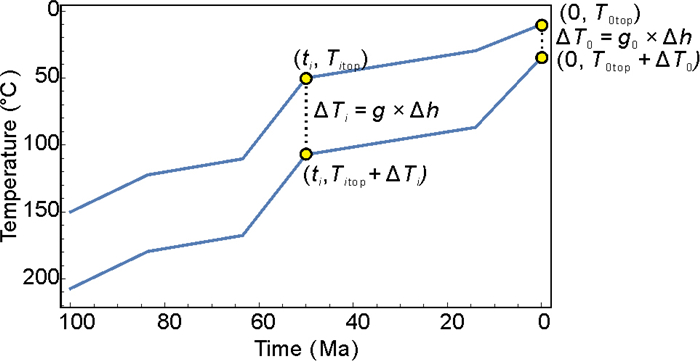
The paleo-geothermal gradient is a crucial parameter for converting the thermal history to the exhumation history. However, the precise estimation of this parameter has been a challenge. This paper presents a simple two-step method to model the paleo-geothermal gradient using low-temperature thermochronology. (1) It uses the Monte Carlo approach to generate thermal histories in a vertical section randomly and calculates the entire thermal history within the goodness-of-fit thresholds based on different paleo-geothermal gradients. (2) It selects the optimum paleo-geothermal gradient by comparing the entire thermal history within different goodness-of-fit thresholds. We validated the method with apatite (U-Th)/He and fission track data collected from two drill cores in the Haiyuan-Liupanshan region. The result revealed that the best-fit paleo-geothermal gradient was ~42 ℃/km during the Early Cretaceous–Miocene and has decreased rapidly to 20 ℃/km since ~10 Ma. The crust thickening in the study area may explain the rapid reduction in the paleo-geothermal gradient since ~10 Ma. Our results are consistent with earlier studies in the region, suggesting that our simple and more intuitive approach provides an alternative method for paleo-geothermal gradient modeling.

| An, Z. S., Kutzbach, J. E., Prell, W. L., et al., 2001. Evolution of Asian Monsoons and Phased Uplift of the Himalaya–Tibetan Plateau since Late Miocene Times. Nature, 411(6833): 62–66. https://doi.org/10.1038/35075035 |
| Bray, R. J., Green, P. F., Duddy, I. R., 1992. Thermal History Reconstruction Using Apatite Fission Track Analysis and Vitrinite Reflectance: A Case Study from the UK East Midlands and Southern North Sea. Geological Society, London, Special Publications, 67(1): 3–25. https://doi.org/10.1144/gsl.sp.1992.067.01.01 |
| Carslaw, H. S., Jaeger, J. C., 1959. Conduction of Heat in Solids: 2nd ed. Clarendon Press, Oxford |
| Chen, H. H., Wu, Y., Xiao, Q. G., 2013. Thermal Regime and Paleogeothermal Gradient Evolution of Mesozoic–Cenozoic Sedimentary Basins in the Tibetan Plateau, China. Earth Science, 38(3): 541–552 (in Chinese with English Abstract) |
| Craddock, W., Kirby, E., Zhang, H. P., 2011. Late Miocene–Pliocene Range Growth in the Interior of the Northeastern Tibetan Plateau. Lithosphere, 3(6): 420–438. https://doi.org/10.1130/l159.1 |
| Darby, B. J., Ritts, B. D., 2002. Mesozoic Contractional Deformation in the Middle of the Asian Tectonic Collage: The Intraplate Western Ordos Fold-Thrust Belt, China. Earth and Planetary Science Letters, 205(1/2): 13–24. https://doi.org/10.1016/S0012-821X(02)01026-9 |
| Ding, G. Y., Chen, J., Tian, Q. J., et al., 2004. Active Faults and Magnitudes of Left-Lateral Displacement along the Northern Margin of the Tibetan Plateau. Tectonophysics, 380(3/4): 243–260. https://doi.org/10.1016/j.tecto.2003.09.022 |
| Ding, R. X., 2023. Low Temperature Thermal History Reconstruction Based on Apatite Fission-Track Length Distribution and Apatite U-Th/He Age Using Low-T Thermo. Journal of Earth Science, 34(3): 717–725. https://doi.org/10.1007/s12583-020-1071-x |
| Ding, R. X., Chang, Y., Min, K., et al., 2021. Post-Orogenic Topographic Evolution of the Dabie Orogen, Eastern China: Insights from Apatite and Zircon (U-Th)/He Thermochronology. Geomorphology, 374: 107487. https://doi.org/10.1016/j.geomorph.2020.107487 |
| Donelick, R. A., O'Sullivan, P. B., Ketcham, R. A., 2005. Apatite Fission-Track Analysis. Reviews in Mineralogy and Geochemistry, 58(1): 49–94. https://doi.org/10.2138/rmg.2005.58.3 |
| Duvall, A. R., Clark, M. K., Kirby, E., et al., 2013. Low-Temperature Thermochronometry along the Kunlun and Haiyuan Faults, NE Tibetan Plateau: Evidence for Kinematic Change during Late-Stage Orogenesis. Tectonics, 32(5): 1190–1211. https://doi.org/10.1002/tect.20072 |
| Fan, L. G., Meng, Q. R., Wu, G. L., et al., 2019. Paleogene Crustal Extension in the Eastern Segment of the NE Tibetan Plateau. Earth and Planetary Science Letters, 514: 62–74. https://doi.org/10.1016/j.epsl.2019.02.036 |
| Fang, X. M., Fang, Y. H., Zan, J. B., et al., 2019. Cenozoic Magnetostratigraphy of the Xining Basin, NE Tibetan Plateau, and Its Constraints on Paleontological, Sedimentological and Tectonomorphological Evolution. Earth-Science Reviews, 190: 460–485. https://doi.org/10.1016/j.earscirev.2019.01.021 |
| Farley, K. A., 2002. (U-Th)/He Dating: Techniques, Calibrations, and Applications. Reviews in Mineralogy and Geochemistry, 47(1): 819–844. https://doi.org/10.2138/rmg.2002.47.18 |
| Flowers, R. M., Ketcham, R. A., Shuster, D. L., et al., 2009. Apatite (U-Th)/He Thermochronometry Using a Radiation Damage Accumulation and Annealing Model. Geochimica et Cosmochimica Acta, 73(8): 2347–2365. https://doi.org/10.1016/j.gca.2009.01.015 |
| Gallagher, K., 2012. Transdimensional Inverse Thermal History Modeling for Quantitative Thermochronology. Journal of Geophysical Research: Solid Earth, 117(B2): B02408. https://doi.org/10.1029/2011JB008825 |
| Gallagher, K., Stephenson, J., Brown, R., et al., 2005. Exploiting 3D Spatial Sampling in Inverse Modeling of Thermochronological Data. Reviews in Mineralogy and Geochemistry, 58(1): 375–387. https://doi.org/10.2138/rmg.2005.58.14 |
| Geological Survey Institute of Ningxia Hui Autonomous Region (GSINHAR), 2017. Regional Geology of China. Geological Publishing House, Beijing (in Chinese) |
| Hu, H. F., Dai, S., 2013. Early Cretaceous Magnetostratigraphy of Liupanshan Area and Its Tectonic Implications. Geoscience, 27(2): 278–287 (in Chinese with English Abstract) |
| Hu, S. B., Fu, M. X., Yang, S. C., et al., 2007. Palaeogeothermal Response and Record of Late Mesozoic Lithospheric Thinning in the Eastern North China Craton. Geological Society, London, Special Publications, 280(1): 267–280. https://doi.org/10.1144/sp280.13 |
| Jiang, G. Z., Gao, P., Rao, S., et al., 2016. Compilation of Heat Flow Data in the Continental Area of China(4th Edition). Chinese Journal of Geophysics, 59(8): 2892–2910(in Chinese with English Abstract) |
| Ketcham, R. A., Carter, A., Donelick, R. A., et al., 2007. Improved Modeling of Fission-Track Annealing in Apatite. American Mineralogist, 92(5/6): 799–810. https://doi.org/10.2138/am.2007.2281 |
| Ketcham, R. A., Gautheron, C., Tassan-Got, L., 2011. Accounting for Long Alpha-Particle Stopping Distances in (U-Th-Sm)/He Geochronology: Refinement of the Baseline Case. Geochimica et Cosmochimica Acta, 75(24): 7779–7791. https://doi.org/10.1016/j.gca.2011.10.011 |
| Lease, R. O., Burbank, D. W., Clark, M. K., et al., 2011. Middle Miocene Reorganization of Deformation along the Northeastern Tibetan Plateau. Geology, 39(4): 359–362. https://doi.org/10.1130/g31356.1 |
| Lease, R. O., Burbank, D. W., Hough, B., et al., 2012. Pulsed Miocene Range Growth in Northeastern Tibet: Insights from Xunhua Basin Magnetostratigraphy and Provenance. Geological Society of America Bulletin, 124(5/6): 657–677. https://doi.org/10.1130/b30524.1 |
| Lin, X. B., Chen, H. L., Wyrwoll, K. H., et al., 2011. The Uplift History of the Haiyuan-Liupan Shan Region Northeast of the Present Tibetan Plateau: Integrated Constraint from Stratigraphy and Thermochronology. The Journal of Geology, 119(4): 372–393. https://doi.org/10.1086/660190 |
| Liu, C. Y., Zhao, H. G., Wang, F., et al., 2005. Attributes of the Mesozoic Structure on the West Margin of the Ordos Basin. Acta Geologica Sinica, 79(6): 737–747 (in Chinese with English Abstract) |
| Liu, C. Y., Zhao, H. G., Zhao, J. F., et al., 2008. Temporo-Spatial Coordinates of Evolution of the Ordos Basin and Its Mineralization Responses. Acta Geologica Sinica: English Edition, 82(6): 1229–1243. https://doi.org/10.1111/j.1755-6724.2008.tb00725.x |
| Ma, L. F., 2002. Atlas of Geophysics in China. Geological Publishing House, Beijing |
| McDowell, F. W., McIntosh, W. C., Farley, K. A., 2005. A Precise 40Ar-39Ar Reference Age for the Durango Apatite (U-Th)/He and Fission-Track Dating Standard. Chemical Geology, 214(3/4): 249–263. https://doi.org/10.1016/j.chemgeo.2004.10.002 |
| Meng, Q. R., Zhang, G. W., 1999. Timing of Collision of the North and South China Blocks: Controversy and Reconciliation. Geology, 27(2): 123–126. https://doi.org/10.1130/0091-7613(1999)027<0123:tocotn>2.3.co;2 doi: 10.1130/0091-7613(1999)027<0123:tocotn>2.3.co;2 |
| Molnar, P., 2005. Mio-Pliocene Growth of the Tibetan Plateau and Evolution of East Asian Climate. Palaeontologia Electronica, 8 (1): 1–23 |
| O'Sullivan, P. B., 1999. Thermochronology, Denudation and Variations in Palaeosurface Temperature: a Case Study from the North Slope Foreland Basin, Alaska. Basin Research, 11(3): 191–204. https://doi.org/10.1046/j.1365-2117.1999.00094.x |
| Peng, H., Wang, J. Q., Liu, C. Y., et al., 2019. Thermochronological Constraints on the Meso-Cenozoic Tectonic Evolution of the Haiyuan-Liupanshan Region, Northeastern Tibetan Plateau. Journal of Asian Earth Sciences, 183: 103966. https://doi.org/10.1016/j.jseaes.2019.103966 |
| Reiners, P. W., Brandon, M. T., 2006. Using Thermochronology to Understand Orogenic Erosion. Annual Review of Earth and Planetary Sciences, 34: 419–466. https://doi.org/10.1146/annurev.earth.34.031405.125202 |
| Shi, W., Dong, S. W., Liu, Y., et al., 2015. Cenozoic Tectonic Evolution of the South Ningxia Region, Northeastern Tibetan Plateau Inferred from New Structural Investigations and Fault Kinematic Analyses. Tectonophysics, 649: 139–164. https://doi.org/10.1016/j.tecto.2015.02.024 |
| Shi, W., Zhang, Y. Q., Ma, Y. S., et al., 2006. Formation and Modification History of the Liupanshan Basin on the Southwestern Margin of Ordos Block and Tectonic Stress Field Evolution. Geology in China, 33: 1066-1074. https://doi.org/10.3969/j.issn.1000-3657.2006.05.016 (in Chinese with English Abstract) |
| Song, L. J., Mu, Q. H., Li, A. R., et al., 2013. Fission-Track Thermal Evolution History in the Formation Age of Yaoshan Formation. Coal Geology & Exploration, 41(4): 1–4 (in Chinese with English Abstract) |
| Tang, X., Guo, Z., Chen, H., et al., 1992. The Study and Petroleum Prospect of Thrust Nappe in the West Margin of Shaanxi-Gansu-Ningxia Basin. Northwest University Press, Xi'an (in Chinese) |
| Tapponnier, P., Zhiqin, X., Roger, F., et al., 2001. Oblique Stepwise Rise and Growth of the Tibet Plateau. Science, 294(5547): 1671–1677. https://doi.org/10.1126/science.105978 |
| Vermeesch, P., 2009. RadialPlotter: A Java Application for Fission Track, Luminescence and Other Radial Plots. Radiation Measurements, 44(4): 409–410. https://doi.org/10.1016/j.radmeas.2009.05.003 |
| Vermeesch, P., Tian, Y. T., 2014. Thermal History Modelling: HeFTy vs. QTQT. Earth-Science Reviews, 139: 279–290. https://doi.org/10.1016/j.earscirev.2014.09.010 |
| Wang, W. T., Zhang, P. Z., Zheng, D. W., et al., 2014. Late Cenozoic Tectonic Deformation of the Haiyuan Fault Zone in the Northeastern Margin of the Tibetan Plateau. Earth Science Frontiers, 21(4): 266–274. https://doi.org/10.13745/j.esf.2014.04.027 (in Chinese with English Abstract) |
| Yin, A., Harrison, T. M., 2000. Geologic Evolution of the Himalayan-Tibetan Orogen. Annual Review of Earth and Planetary Sciences, 28: 211–280. https://doi.org/10.1146/annurev.earth.28.1.211 |
| Zhang, H. P., Craddock, W. H., Lease, R. O., et al., 2012. Magnetostratigraphy of the Neogene Chaka Basin and Its Implications for Mountain Building Processes in the North-Eastern Tibetan Plateau. Basin Research, 24(1): 31–50. https://doi.org/10.1111/j.1365-2117.2011.00512.x |
| Zhang, P. Z., Zheng, D. W., Yin, G. L., et al., 2006. Discussion on Late Cenozoic Growth and Rise of Northeastern Margin of the Tibetan Plateau. Quaternary Sciences, 26: 5–13. https://doi.org/10.3321/j.issn:1001-7410.2006.01.002 (in Chinese with English Abstract) |
| Zhao, H. G., Liu, C. Y., Yao, Y. M., et al., 2007. Differential Uplift in the West Margin of Ordos Basin since Mesozoic from the Fission Track Evidence. Journal of Northwest University (Natural Science Edition), 37(3): 470–474 (in Chinese with English Abstract) |
| Zhao, M., Chen, X. M., Ji, J. F., et al., 2007. Evolution of Chlorite Composition in the Paleogene Prototype Basin of Jiyang Depression, Shandong, China, and Its Implication for Paleogeothermal Gradient. Science in China Series D: Earth Sciences, 50(11): 1645–1654. https://doi.org/10.1007/s11430-007-0112-y |
| Zheng, D. W., Clark, M. K., Zhang, P. Z., et al., 2010. Erosion, Fault Initiation and Topographic Growth of the North Qilian Shan (Northern Tibetan Plateau). Geosphere, 6(6): 937–941. https://doi.org/10.1130/ges00523.1 |
| Zheng, D. W., Zhang, P. Z., Wan, J. L., et al., 2006. Rapid Exhumation at ~8 Ma on the Liupan Shan Thrust Fault from Apatite Fission-Track Thermochronology: Implications for Growth of the Northeastern Tibetan Plateau Margin. Earth and Planetary Science Letters, 248(1/2): 198–208. https://doi.org/10.1016/j.epsl.2006.05.023 |
Figures(10) / Tables(1)
Copyright © 2013-2020 Journal of Earth Science 鄂ICP备15021562号-2
Tel: +86-27-67885075 Fax: +86-27-67885075 E-mail: xbb@cug.edu.cn
Address: Editorial Office of Journal, China University of Geosciences, Yujiashan, Wuhan, Hubei 430074, P. R. China
Supported by:
Beijing Renhe Information Technology Co. Ltd
E-mail:
info@rhhz.net


 DownLoad: