| Citation: | Peng Yang, Benli Guo, Jie Yuan, Honglian Xing, Wenjie Yuan, Yuanku Meng, Yilin Liu. Early Eocene Crust-Mantle Interaction in the Middle Gangdese Magmatic Belt, Southern Tibet: Evidence from a Host Granitic Pluton and Mafic Microgranular Enclaves. Journal of Earth Science, 2026, 37(1): 1-22. doi: 10.1007/s12583-023-1916-z

|
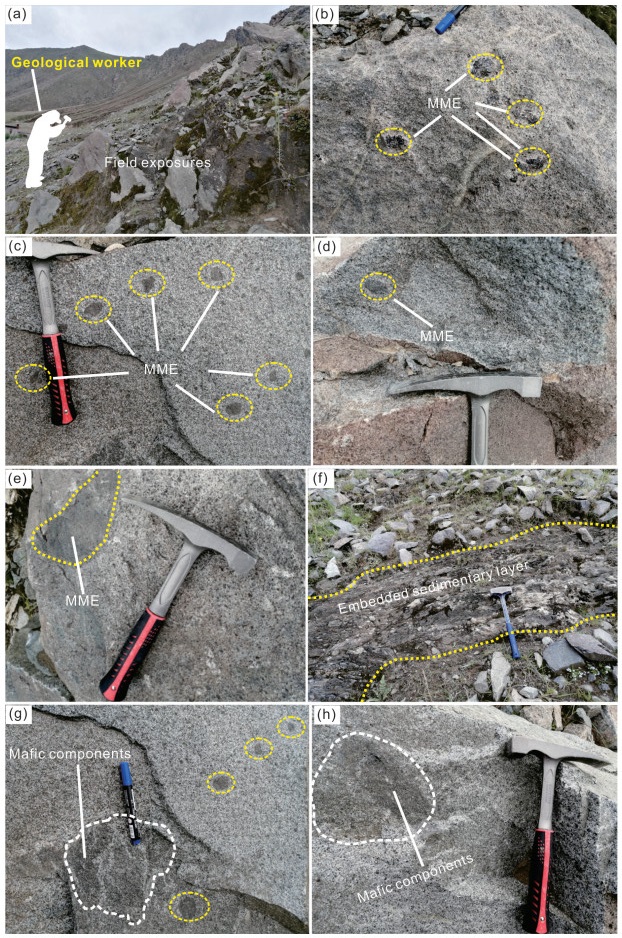
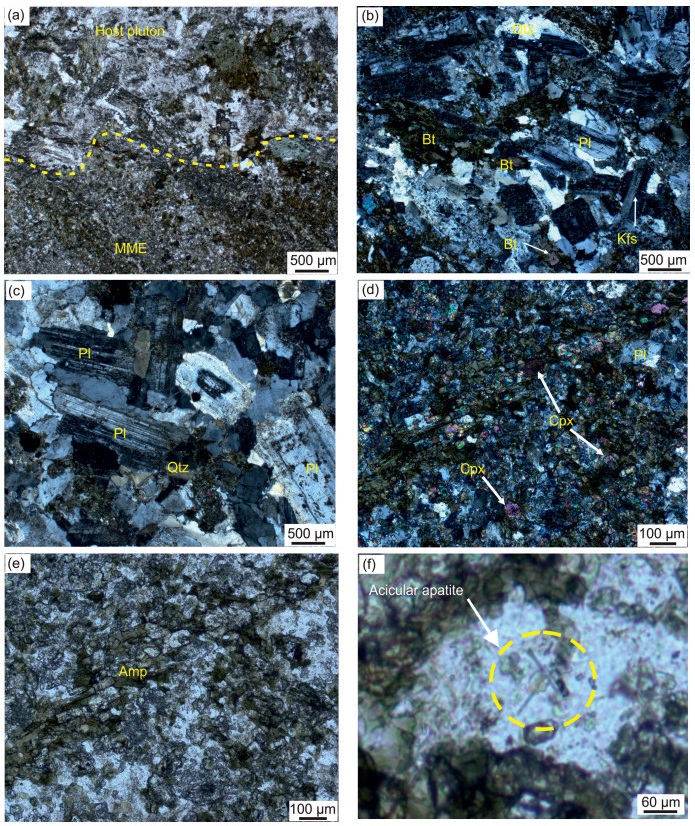
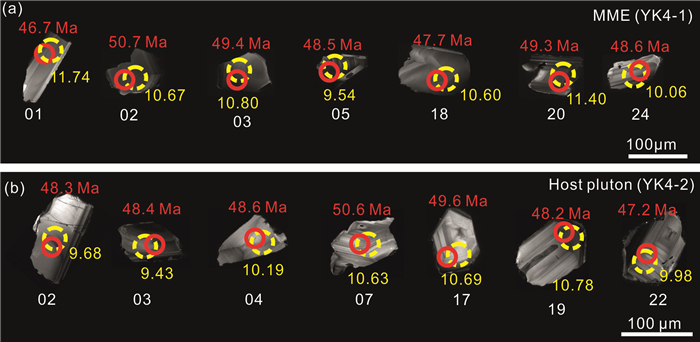
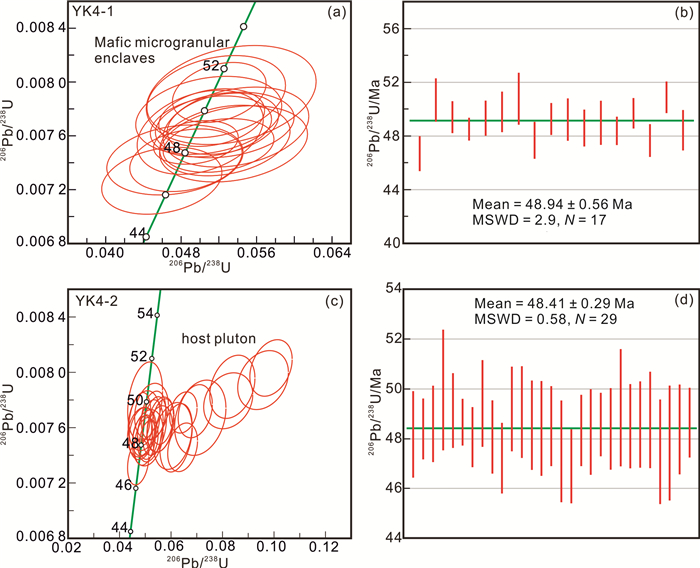
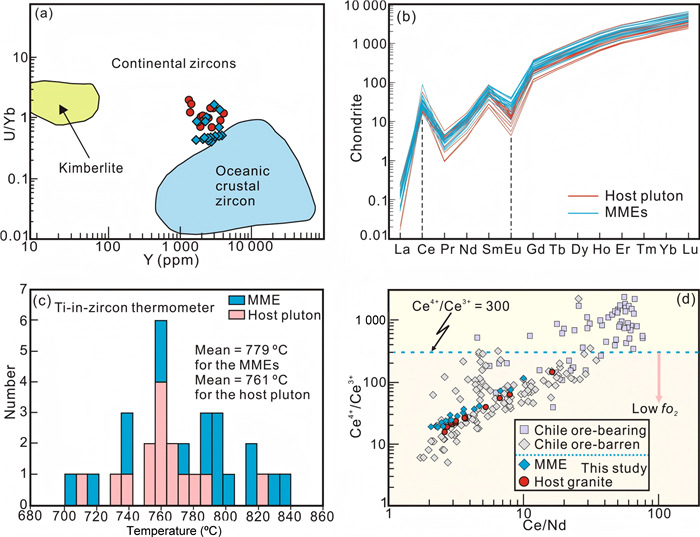
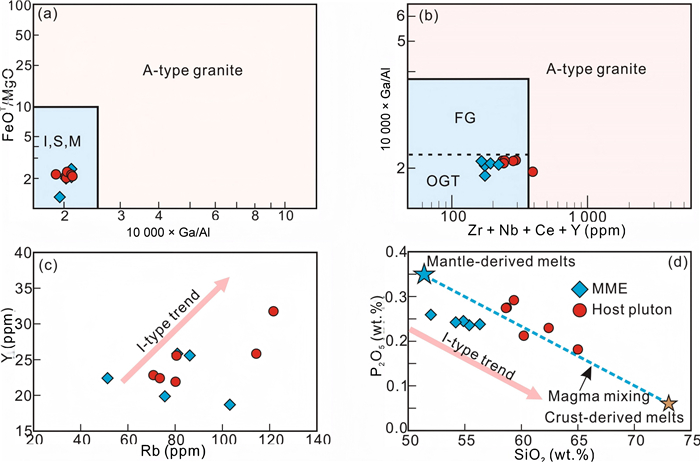
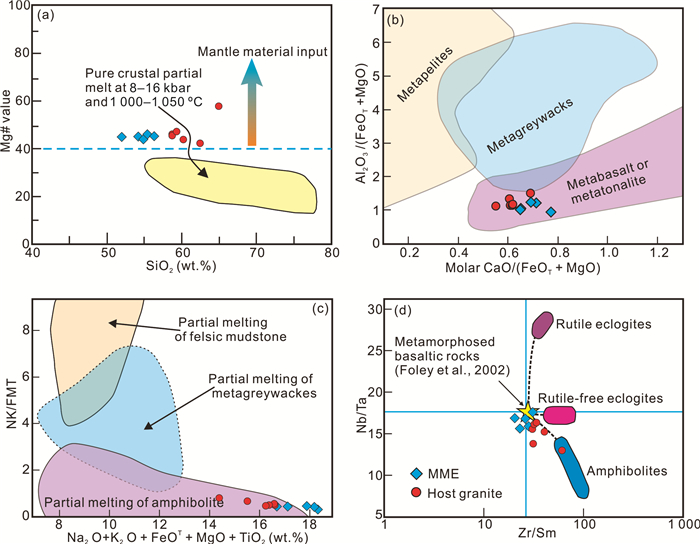
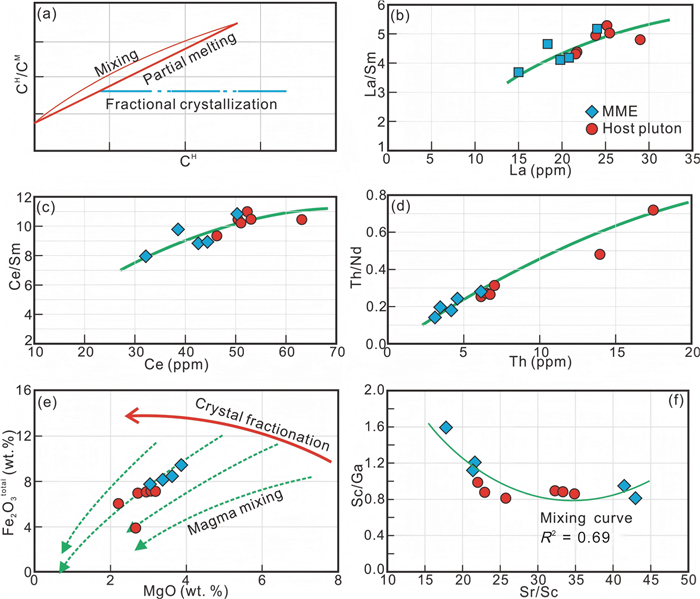
The Gangdese magmatic belt is ideal for studying crustal growth/reworking and crust-mantle interaction processes. In this study, we report a newly identified late Early Eocene granitic pluton and mafic microgranular enclaves (MMEs) in the Middle Gangdese magmatic belt. The MMEs hosted within the granitic pluton display fine-grained textures and contain more mafic minerals (amphibole and clinopyroxene) than the host pluton. The sharp contacts and fine-grained textures of the MMEs as well as acicular apatite crystals indicate a rapid quenching process. Zircon U-Pb dating results indicate that the host pluton formed ca. 48.41 ± 0.29 Ma (MSWD = 0.58), and MMEs crystallized at 48.94 ± 0.56 Ma (MSWD = 2.9), potentially suggesting a crust-mantle interaction process during the late Early Eocene. Geochemically, the host pluton has variable silica contents (SiO2) of 58.67 wt.%–64.65 wt.%, Mg# values of 42–58, and low aluminum saturation ratios (A/CNK = 0.81–0.91) that show an Ⅰ-type granitic affinity. Additionally, the host pluton is characterized by enrichment of light rare earth elements (LREEs) and large ion lithophile elements (LILEs), and depletion of high field strength elements (HFSEs) that show arc-type geochemical features. Like the host pluton, the MMEs also show arc-type geochemical features characterized by enrichment of LREEs and LILEs but depletion of HFSEs. Isotopically, the host pluton and associated MMEs both have depleted Hf isotopic compositions Additionally, the host pluton and MMEs have low Ce4+/Ce3+ ratios of 18.48–114.29 and 2.59–36.45, resembling Chilean ore-barren granitoid rocks. Integrated with petrological and whole-rock geochemical and zircon Hf isotopic features, we argue that the host pluton originated from partial melting of juvenile mafic lower crust with the contribution of mantle-derived materials. The MMEs were derived from partial melting of depleted mantle and was a product of two end-member magmas mixing. Based on the previous studies, we argue that the late Early Eocene magmatism and crust-mantle interaction were related to the breakoff the Neo-Tethyan oceanic slab, and further propose that crustal large-scale thickening might begin during the Middle–Late Eocene in the Gangdese magmatic belt rather than the Early Eocene.

| Altherr, R., Holl, A., Hegner, E., et al., 2000. High-Potassium, Calc-Alkaline I-Type Plutonism in the European Variscides: Northern Vosges (France) and Northern Schwarzwald (Germany). Lithos, 50(1/2/3): 51–73. https://doi.org/10.1016/S0024-4937(99)00052-3 |
| Andersen, T., 2002. Correction of Common Lead in U-Pb Analyses that Do Not Report 204Pb. Chemical Geology, 192(1/2): 59–79. https://doi.org/10.1016/S0009-2541(02)00195-X |
| Ballard, J. R., Palin, J. M., Campbell, I. H., 2002. Relative Oxidation States of Magmas Inferred from Ce(Ⅳ)/Ce(Ⅲ) in Zircon: Application to Porphyry Copper Deposits of Northern Chile. Contributions to Mineralogy and Petrology, 144(3): 347–364. https://doi.org/10.1007/s00410-002-0402-5 |
| Barbarin, B., 2005. Mafic Magmatic Enclaves and Mafic Rocks Associated with Some Granitoids of the Central Sierra Nevada Batholith, California: Nature, Origin, and Relations with the Hosts. Lithos, 80(1/2/3/4): 155–177. https://doi.org/10.1016/j.lithos.2004.05.010 |
| Belousova, E., Griffin, W., O’Reilly, S. Y., et al., 2002. Igneous Zircon: Trace Element Composition as an Indicator of Source Rock Type. Contributions to Mineralogy and Petrology, 143(5): 602–622. https://doi.org/10.1007/s00410-002-0364-7 |
| Black, L. P., Kamo, S. L., Allen, C. M., et al., 2003. TEMORA 1: A New Zircon Standard for Phanerozoic U-Pb Geochronology. Chemical Geology, 200(1/2): 155–170. https://doi.org/10.1016/S0009-2541(03)00165-7 |
|
Boynton, W. V., 1984. Cosmochemistry of the Rare Earth Elements: Meteorite Studies. In: Henderson, P., ed., Rare Earth Elements Geochemistry. Elsevier, Amsterdam. 63–114. |
| Chang, Z. S., Vervoort, J. D., McClelland, W. C., et al., 2006. U-Pb Dating of Zircon by LA-ICP-MS. Geochemistry, Geophysics, Geosystems, 7(5): 2005GC001100. https://doi.org/10.1029/2005GC001100 |
| Chappell, B. W., 1999. Aluminium Saturation in I- and S-Type Granites and the Characterization of Fractionated Haplogranites. Lithos, 46(3): 535–551. https://doi.org/10.1016/S0024-4937(98)00086-3 |
| Chappell, B. W., White, A. J. R., Wyborn, D., 1987. The Importance of Residual Source Material (Restite) in Granite Petrogenesis. Journal of Petrology, 28(6): 1111–1138. https://doi.org/10.1093/petrology/28.6.1111 |
| Chappell, B. W., Wyborn, D., 2012. Origin of Enclaves in S-Type Granites of the Lachlan Fold Belt. Lithos, 154: 235–247. https://doi.org/10.1016/j.lithos.2012.07.012 |
| Chen, Y. D., Price, R. C., White, A. J. R., 1989. Inclusions in Three S-Type Granites from Southeastern Australia. Journal of Petrology, 30(5): 1181–1218. https://doi.org/10.1093/petrology/30.5.1181 |
| Chung, S. L., Chu, M. F., Ji, J. Q., et al., 2009. The Nature and Timing of Crustal Thickening in Southern Tibet: Geochemical and Zircon Hf Isotopic Constraints from Postcollisional Adakites. Tectonophysics, 477(1/2): 36–48. https://doi.org/10.1016/j.tecto.2009.08.008 |
| Clemens, J. D., Darbyshire, D. P. F., Flinders, J., 2009. Sources of Post-Orogenic Calcalkaline Magmas: The Arrochar and Garabal Hill-Glen Fyne Complexes, Scotland. Lithos, 112(3/4): 524–542. https://doi.org/10.1016/j.lithos.2009.03.026 |
| Corfu, F., Hanchar, J. M., Hoskin, P. W. O., et al., 2003. Atlas of Zircon Textures. Reviews in Mineralogy and Geochemistry, 53(1): 469–500. https://doi.org/10.2113/0530469 |
| Donaire, T., Pascual, E., Pin, C., et al., 2005. Microgranular Enclaves as Evidence of Rapid Cooling in Granitoid Rocks: The Case of the Los Pedroches Granodiorite, Iberian Massif, Spain. Contributions to Mineralogy and Petrology, 149(3): 247–265. https://doi.org/10.1007/s00410-005-0652-0 |
| Dong, X., Zhang, Z. M., 2013. Genesis and tectonic significance of the Early Jurassic magmatic rocks from the southern Lhasa terrane. Acta Petrologica Sinica, 29(6): 1933–1948 (in Chinese with English Abstract) |
| Dong, X., Zhang, Z. M., Santosh, M., 2010. Zircon U-Pb Chronology of the Nyingtri Group, Southern Lhasa Terrane, Tibetan Plateau: Implications for Grenvillian and Pan-African Provenance and Mesozoic-Cenozoic Metamorphism. The Journal of Geology, 118(6): 677–690. https://doi.org/10.1086/656355 |
| Eby, G. N., 1992. Chemical Subdivision of the A-Type Granitoids: Petrogenetic and Tectonic Implications. Geology, 20(7): 641–644.https://doi.org/10.1130/0091-7613(1992)020<0641:csotat>2.3.co;2 doi: 10.1130/0091-7613(1992)020<0641:csotat>2.3.co;2 |
| Feeley, T. C., Wilson, L. F., Underwood, S. J., 2008. Distribution and Compositions of Magmatic Inclusions in the Mount Helen Dome, Lassen Volcanic Center, California: Insights into Magma Chamber Processes. Lithos, 106(1/2): 173–189. https://doi.org/10.1016/j.lithos.2008.07.010 |
| Ferrari, L., 2004. Slab Detachment Control on Mafic Volcanic Pulse and Mantle Heterogeneity in Central Mexico. Geology, 32(1): 77–80. https://doi.org/10.1130/g19887.1 |
| Ferry, J. M., Watson, E. B., 2007. New Thermodynamic Models and Revised Calibrations for the Ti-in-Zircon and Zr-in-Rutile Thermometers. Contributions to Mineralogy and Petrology, 154(4): 429–437. https://doi.org/10.1007/s00410-007-0201-0 |
| Foley, S., Tiepolo, M., Vannucci, R., 2002. Growth of Early Continental Crust Controlled by Melting of Amphibolite in Subduction Zones. Nature, 417(6891): 837–840. https://doi.org/10.1038/nature00799 |
| Frost, B. R., Barnes, C. G., Collins, W. J., et al., 2001. A Geochemical Classification for Granitic Rocks. Journal of Petrology, 42(11): 2033–2048. https://doi.org/10.1093/petrology/42.11.2033 |
| Frost, C. D., Frost, B. R., 2011. On Ferroan (A-Type) Granitoids: Their Compositional Variability and Modes of Origin. Journal of Petrology, 52(1): 39–53. https://doi.org/10.1093/petrology/egq070 |
| Gan, C. S., Wang, Y. J., Qian, X., et al., 2022. Diorite Enclaves and Host Granite of the Early Miocene Gorontalo Pluton in the North Sulawesi Arc, Indonesia: Implications for Recycled Oceanic Crust and Crust-Mantle Interaction. Journal of Asian Earth Sciences, 227: 105101. https://doi.org/10.1016/j.jseaes.2022.105101 |
| Goolaerts, A., Mattielli, N., de Jong, J., et al., 2004. Hf and Lu Isotopic Reference Values for the Zircon Standard 91500 by MC-ICP-MS. Chemical Geology, 206(1/2): 1–9. https://doi.org/10.1016/j.chemgeo.2004.01.008 |
| Griffin, W. L., Pearson, N. J., Belousova, E., et al., 2000. The Hf Isotope Composition of Cratonic Mantle: LAM-MC-ICPMS Analysis of Zircon Megacrysts in Kimberlites. Geochimica et Cosmochimica Acta, 64(1): 133–147. https://doi.org/10.1016/S0016-7037(99)00343-9 |
| Griffin, W. L., Wang, X., Jackson, S. E., et al., 2002. Zircon Chemistry and Magma Mixing, SE China: In-situ Analysis of Hf Isotopes, Tonglu and Pingtan Igneous Complexes. Lithos, 61(3/4): 237–269. https://doi.org/10.1016/S0024-4937(02)00082-8 |
| Grimes, C. B., John, B. E., Kelemen, P. B., et al., 2007. Trace Element Chemistry of Zircons from Oceanic Crust: A Method for Distinguishing Detrital Zircon Provenance. Geology, 35(7): 643–646. https://doi.org/10.1130/g23603a.1 |
| Hao, L. -L., Wang, Q., Wyman, D. A., et al., 2019. First Identification of Postcollisional A-Type Magmatism in the Himalayan-Tibetan Orogen. Geology, 47(2): 187–190. https://doi.org/10.1130/g45526.1 |
| Haproff, P. J., Zuza, A. V., Yin, A., et al., 2019. Geologic Framework of the Northern Indo-Burma Ranges and Lateral Correlation of Himalayan-Tibetan Lithologic Units across the Eastern Himalayan Syntaxis. Geosphere, 15(3): 856–881. https://doi.org/10.1130/ges02054.1 |
| Hermann, J., Rubatto, D., Korsakov, A., et al., 2001. Multiple Zircon Growth during Fast Exhumation of Diamondiferous, Deeply Subducted Continental Crust (Kokchetav Massif, Kazakhstan). Contributions to Mineralogy and Petrology, 141(1): 66–82. https://doi.org/10.1007/s004100000218 |
| Hildebrand, R. S., Whalen, J. B., Bowring, S. A., 2018. Resolving the Crustal Composition Paradox by 3.8 Billion Years of Slab Failure Magmatism and Collisional Recycling of Continental Crust. Tectonophysics, 734/735: 69–88. https://doi.org/10.1016/j.tecto.2018.04.001 |
| Hoskin, P. W. O., Schaltegger, U., 2003. The Composition of Zircon and Igneous and Metamorphic Petrogenesis. Reviews in Mineralogy and Geochemistry, 53(1): 27–62. https://doi.org/10.2113/0530027 |
| Hou, Z. Q., Duan, L. F., Lu, Y. J., et al., 2015. Lithospheric Architecture of the Lhasa Terrane and Its Control on Ore Deposits in the Himalayan-Tibetan Orogen. Economic Geology, 110(6): 1541–1575. https://doi.org/10.2113/econgeo.110.6.1541 |
| Hou, Z. Q., Zheng, Y. C., Lu, Z. W., et al., 2020. Growth, Thickening and Evolution of the Thickened Crust of the Tibet Plateau. Acta Geologica Sinica, 94(10): 2797–2815. https://doi.org/10.19762/j.cnki.dizhixuebao.2020199 (in Chinese with English Abstract) |
| Hu, F. Y., Ducea, M. N., Liu, S. W., et al., 2017. Quantifying Crustal Thickness in Continental Collisional Belts: Global Perspective and a Geologic Application. Scientific Reports, 7(1): 7058. https://doi.org/10.1038/s41598-017-07849-7 |
| Huang, F., Rooney, T. O., Xu, J. -F., et al., 2021. Magmatic Record of Continuous Neo-Tethyan Subduction after Initial India-Asia Collision in the Central Part of Southern Tibet. GSA Bulletin, 133(7/8): 1600–1612. https://doi.org/10.1130/b35444.1 |
| Huang, F., Xu, J. F., Wang, B. D., et al., 2020. Destiny of Neo-Tethyan Lithosphere during India-Asia Collision. Earth Science, 45(8): 2785–2804. https://doi.org/10.3799/dqkx.2020.180 (in Chinese with English Abstract) |
| Huang, F., Xu, J. F., Zeng, Y. C., et al., 2017. Slab Breakoff of the Neo-Tethys Ocean in the Lhasa Terrane Inferred from Contemporaneous Melting of the Mantle and Crust. Geochemistry, Geophysics, Geosystems, 18(11): 4074–4095. https://doi.org/10.1002/2017GC007039 |
| Huang, F., Zhang, Z., Xu, J. F., et al., 2019. Fluid Flux in the Lithosphere beneath Southern Tibet during Neo-Tethyan Slab Breakoff: Evidence from an Appinite-Granite Suite. Lithos, 344–345: 324–338. https://doi.org/10.1016/j.lithos.2019.07.004 |
| Huw Davies, J., von Blanckenburg, F., 1995. Slab Breakoff: A Model of Lithosphere Detachment and Its Test in the Magmatism and Deformation of Collisional Orogens. Earth and Planetary Science Letters, 129(1/2/3/4): 85–102. https://doi.org/10.1016/0012-821X(94)00237-S |
| Irvine, T. N., Baragar, W. R. A., 1971. A Guide to the Chemical Classification of the Common Volcanic Rocks. Canadian Journal of Earth Sciences, 8(5): 523–548. https://doi.org/10.1139/e71-055 |
| Jackson, S. E., Pearson, N. J., Griffin, W. L., et al., 2004. The Application of Laser Ablation-Inductively Coupled Plasma-Mass Spectrometry to in situ U-Pb Zircon Geochronology. Chemical Geology, 211(1/2): 47–69. https://doi.org/10.1016/j.chemgeo.2004.06.017 |
| Janoušek, V., Konopásek, J., Ulrich, S., et al., 2010. Geochemical Character and Petrogenesis of Pan-African Amspoort Suite of the Boundary Igneous Complex in the Kaoko Belt (NW Namibia). Gondwana Research, 18(4): 688–707. https://doi.org/10.1016/j.gr.2010.02.014 |
| Ji, W. Q., Wu, F. Y., Chung, S. L., et al., 2009. Zircon U-Pb Geochronology and Hf Isotopic Constraints on Petrogenesis of the Gangdese Batholith, Southern Tibet. Chemical Geology, 262(3/4): 229–245. https://doi.org/10.1016/j.chemgeo.2009.01.020 |
| Ji, W. Q., Wu, F. Y., Liu, C. Z., et al., 2012. Early Eocene Crustal Thickening in Southern Tibet: New Age and Geochemical Constraints from the Gangdese Batholith. Journal of Asian Earth Sciences, 53: 82–95. https://doi.org/10.1016/j.jseaes.2011.08.020 |
| Ji, W. -Q., Wu, F. -Y., Chung, S. L., et al., 2016. Eocene Neo-Tethyan Slab Breakoff Constrained by 45 Ma Oceanic Island Basalt-Type Magmatism in Southern Tibet. Geology, 44(4): 283–286. https://doi.org/10.1130/g37612.1 |
| Kemp, A. I. S., Hawkesworth, C. J., Foster, G. L., et al., 2007. Magmatic and Crustal Differentiation History of Granitic Rocks from Hf-O Isotopes in Zircon. Science, 315(5814): 980–983. https://www.jstor.org/stable/20039011 https://www.jstor.org/stable/20039011 |
| Kohn, M. J., Parkinson, C. D., 2002. Petrologic Case for Eocene Slab Breakoff during the Indo-Asian Collision. Geology, 30(7): 591–594.https://doi.org/10.1130/0091-7613(2002)030<0591:pcfesb>2.0.co;2 doi: 10.1130/0091-7613(2002)030<0591:pcfesb>2.0.co;2 |
| Kuno, H., 1968. Differentiation of Basalt Magmas. In: Hess, H. H., Poldervaart, A. A., eds., Basalts: the Poldervaart Treatise on Rocks of Basaltic Composition, 2. Interscience, New York. 623–688 |
| Lee, H. Y., Chung, S. L., Lo, C. H., et al., 2009. Eocene Neotethyan Slab Breakoff in Southern Tibet Inferred from the Linzizong Volcanic Record. Tectonophysics, 477(1/2): 20–35. https://doi.org/10.1016/j.tecto.2009.02.031 |
| Li, Z. H., Cui, F. Y., Yang, S. T., et al., 2023. Key Geodynamic Processes and Driving Forces of Tethyan Evolution. Science China Earth Sciences, 66(12): 2666–2685. https://doi.org/10.1007/s11430-022-1083-5 |
| Liang, X. F., Chen, Y., Tian, X. B., et al., 2016. 3D Imaging of Subducting and Fragmenting Indian Continental Lithosphere beneath Southern and Central Tibet Using Body-Wave Finite-Frequency Tomography. Earth and Planetary Science Letters, 443: 162–175. https://doi.org/10.1016/j.epsl.2016.03.029 |
| Lin, T. H., Chung, S. L., Kumar, A., et al., 2013. Linking a Prolonged Neo-Tethyan Magmatic Arc in South Asia: Zircon U-Pb and Hf Isotopic Constraints from the Lohit Batholith, NE India. Terra Nova, 25(6): 453–458. https://doi.org/10.1111/ter.12056 |
| Liu, S. G., Li, S. G., He, Y. S., et al., 2010. Geochemical Contrasts between Early Cretaceous Ore-Bearing and Ore-Barren High-Mg Adakites in Central-Eastern China: Implications for Petrogenesis and Cu-Au Mineralization. Geochimica et Cosmochimica Acta, 74(24): 7160–7178. https://doi.org/10.1016/j.gca.2010.09.003 |
| Ma, X. X., Xu, Z. Q., Meert, J. G., 2016. Eocene Slab Breakoff of Neotethys as Suggested by Dioritic Dykes in the Gangdese Magmatic Belt, Southern Tibet. Lithos, 248/249/250/251: 55–65. https://doi.org/10.1016/j.lithos.2016.01.008 |
| Ma, X. X., Xu, Z. Q., Meert, J. G., 2017. Syn-Convergence Extension in the Southern Lhasa Terrane: Evidence from Late Cretaceous Adakitic Granodiorite and Coeval Gabbroic-Dioritic Dykes. Journal of Geodynamics, 110: 12–30. https://doi.org/10.1016/j.jog.2017.07.004 |
| Maniar, P. D., Piccoli, P. M., 1989. Tectonic Discrimination of Granitoids. Geological Society of America Bulletin, 101(5): 635–643.https://doi.org/10.1130/0016-7606(1989)101<0635:tdog>2.3.co;2 doi: 10.1130/0016-7606(1989)101<0635:tdog>2.3.co;2 |
| Masberg, P., Mihm, D., Jung, S., 2005. Major and Trace Element and Isotopic (Sr, Nd, O) Constraints for Pan-African Crustally Contaminated Grey Granite Gneisses from the Southern Kaoko Belt, Namibia. Lithos, 84(1/2): 25–50. https://doi.org/10.1016/j.lithos.2005.02.001 |
| Meng, Y. K., Chen, J., Wang, X., et al., 2023. Late Neoarchean Crust-Mantle Interaction and Tectonic Implications in Western Shandong Province, North China Craton: Evidence from a Granodiorite Pluton and Associated Magmatic Enclaves. Lithos, 436/437: 106978. https://doi.org/10.1016/j.lithos.2022.106978 |
| Meng, Y. K., Santosh, M., Mao, G. Z., et al., 2020. New Constraints on the Tectono-Magmatic Evolution of the Central Gangdese Belt from Late Cretaceous Magmatic Suite in Southern Tibet. Gondwana Research, 80: 123–141. https://doi.org/10.1016/j.gr.2019.10.014 |
| Meng, Y. K., Xiong, F. H., Xu, Z. Q., et al., 2019a. Petrogenesis of Late Cretaceous Mafic Enclaves and Their Host Granites in the Nyemo Region of Southern Tibet: Implications for the Tectonic-Magmatic Evolution of the Central Gangdese Belt. Journal of Asian Earth Sciences, 176: 27–41. https://doi.org/10.1016/j.jseaes.2019.01.041 |
| Meng, Y. K., Xiong, F. H., Yang, J. S., et al., 2019b. Tectonic Implications and Petrogenesis of the Various Types of Magmatic Rocks from the Zedang Area in Southern Tibet. Journal of Earth Science, 30(6): 1125–1143. https://doi.org/10.1007/s12583-019-1248-3 |
| Meng, Y. K., Xu, Z. Q., Gao, C. S., et al., 2018. The Identification of the Eocene Magmatism and Tectonic Significance in the Middle Gangdese Magmatic Belt, Southern Tibet. Acta Petrologica Sinica, 34(3): 513–546 (in Chinese with English Abstract) |
| Meng, Y. K., Xu, Z. Q., Santosh, M., et al., 2016. Late Triassic Crustal Growth in Southern Tibet: Evidence from the Gangdese Magmatic Belt. Gondwana Research, 37: 449–464. https://doi.org/10.1016/j.gr.2015.10.007 |
| Meng, Y. K., Yuan, H. Q., Santosh, M., et al., 2021. Heavy Magnesium Isotopes in the Gangdese Magmatic Belt: Implications for Magmatism in the Mesozoic Subduction System of Southern Tibet. Lithos, 390/391: 106106. https://doi.org/10.1016/j.lithos.2021.106106 |
| Meng, Y. K., Yuan, H. Q., Wei, Y. Q., et al., 2022. Research Progress and Prospect of the Gangdese Magmatic Belt in Southern Tibet. Geological Journal of China Universities, 28(1): 1–31. https://doi.org/10.16108/j.issn1006-7493.2020057 (in Chinese with English Abstract) |
| Middlemost, E. A. K., 1994. Naming Materials in the Magma/Igneous Rock System. Earth-Science Reviews, 37(3/4): 215–224. https://doi.org/10.1016/0012-8252(94)90029-9 |
| Mo, X. X., Hou, Z. Q., Niu, Y. L., et al., 2007. Mantle Contributions to Crustal Thickening during Continental Collision: Evidence from Cenozoic Igneous Rocks in Southern Tibet. Lithos, 96(1/2): 225–242. https://doi.org/10.1016/j.lithos.2006.10.005 |
| Mo, X. X., Niu, Y. L., Dong, G. C., et al., 2008. Contribution of Syncollisional Felsic Magmatism to Continental Crust Growth: A Case Study of the Paleogene Linzizong Volcanic Succession in Southern Tibet. Chemical Geology, 250(1/2/3/4): 49–67. https://doi.org/10.1016/j.chemgeo.2008.02.003 |
| Moyen, J. F., 2009. High Sr/Y and La/Yb Ratios: The Meaning of the “Adakitic Signature”. Lithos, 112(3/4): 556–574. https://doi.org/10.1016/j.lithos.2009.04.001 |
| Niu, Y. L., Zhao, Z. D., Zhu, D. C., et al., 2013. Continental Collision Zones Are Primary Sites for Net Continental Crust Growth—A Testable Hypothesis. Earth-Science Reviews, 127: 96–110. https://doi.org/10.1016/j.earscirev.2013.09.004 |
| Patiño Douce, A. E., 1999. What do Experiments Tell Us about the Relative Contributions of Crust and Mantle to the Origin of Granitic Magmas? Geological Society, London, Special Publications, 168(1): 55–75. https://doi.org/10.1144/gsl.sp.1999.168.01.05 |
| Patiño Douce, A. E., Beard, J. S., 1995. Dehydration-Melting of Biotite Gneiss and Quartz Amphibolite from 3 to 15 kbar. Journal of Petrology, 36(3): 707–738. https://doi.org/10.1093/petrology/36.3.707 |
| Peccerillo, A., Taylor, S. R., 1976. Geochemistry of Eocene Calc-Alkaline Volcanic Rocks from the Kastamonu Area, Northern Turkey. Contributions to Mineralogy and Petrology, 58(1): 63–81. https://doi.org/10.1007/BF00384745 |
| Plail, M., Edmonds, M., Woods, A. W., et al., 2018. Mafic Enclaves Record Syn-Eruptive Basalt Intrusion and Mixing. Earth and Planetary Science Letters, 484: 30–40. https://doi.org/10.1016/j.epsl.2017.11.033 |
| Profeta, L., Ducea, M. N., Chapman, J. B., et al., 2016. Quantifying Crustal Thickness over Time in Magmatic Arcs. Scientific Reports, 5: 17786. https://doi.org/10.1038/srep17786 |
| Pullen, A., Kapp, P., DeCelles, P. G., et al., 2011. Cenozoic Anatexis and Exhumation of Tethyan Sequence Rocks in the Xiao Gurla Range, Southwest Tibet. Tectonophysics, 501(1/2/3/4): 28–40. https://doi.org/10.1016/j.tecto.2011.01.008 |
| Qian, X., Wang, Y. J., Zhang, Y. Z., et al., 2019. Petrogenesis of Permian–Triassic Felsic Igneous Rocks along the Truong Son Zone in Northern Laos and Their Paleotethyan Assembly. Lithos, 328/329: 101–114. https://doi.org/10.1016/j.lithos.2019.01.006 |
| Qiu, J. S., Wang, R. Q., Zhao, J. L., et al., 2015. Petrogenesis of the Early Jurassic Gabbro-Granite Complex in the Middle Segment of the Gangdese Belt and Its Implications for Tectonic Evolution of Neo-Tethys: A Case Study of the Dongga Pluton in Xi’gaze. Acta Petrologica Sinica, 31(12): 3569–3580 (in Chinese with English Abstract) |
| Rapp, R. P., Watson, E. B., 1995. Dehydration Melting of Metabasalt at 8–32 kbar: Implications for Continental Growth and Crust-Mantle Recycling. Journal of Petrology, 36(4): 891–931. https://doi.org/10.1093/petrology/36.4.891 |
| Rollinson, H., 2009. New Models for the Genesis of Plagiogranites in the Oman Ophiolite. Lithos, 112(3/4): 603–614. https://doi.org/10.1016/j.lithos.2009.06.006 |
| Rudnick, R. L., Barth, M., Horn, I., et al., 2000. Rutile-Bearing Refractory Eclogites: Missing Link between Continents and Depleted Mantle. Science, 287(5451): 278–281. https://doi.org/10.1126/science.287.5451.278 |
|
Rudnick, R. L., Gao, S., 2003. Composition of the Continental Crust. Treatise on Geochemistry. Amsterdam: Elsevier: 1–64. |
| Schiano, P., Monzier, M., Eissen, J. P., et al., 2010. Simple Mixing as the Major Control of the Evolution of Volcanic Suites in the Ecuadorian Andes. Contributions to Mineralogy and Petrology, 160(2): 297–312. https://doi.org/10.1007/s00410-009-0478-2 |
| Sisson, T. W., Ratajeski, K., Hankins, W. B., et al., 2005. Voluminous Granitic Magmas from Common Basaltic Sources. Contributions to Mineralogy and Petrology, 148(6): 635–661. https://doi.org/10.1007/s00410-004-0632-9 |
| Sun, S. S., McDonough, W. F., 1989. Chemical and Isotopic Systematics of Oceanic Basalts: Implications for Mantle Composition and Processes. Geological Society, London, Special Publications, 42(1): 313–345. https://doi.org/10.1144/gsl.sp.1989.042.01.19 |
| Sun, W. -D., Ling, M. -X., Chung, S. -L., et al., 2012. Geochemical Constraints on Adakites of Different Origins and Copper Mineralization. The Journal of Geology, 120(1): 105–120. https://doi.org/10.1086/662736 |
| Sylvester, P. J., 1998. Post-Collisional Strongly Peraluminous Granites. Lithos, 45(1/2/3/4): 29–44. https://doi.org/10.1016/S0024-4937(98)00024-3 |
| Tian, Y., Huang, F., Xu, J. F., et al., 2021. Neo-Tethyan Slab Tearing Constrained by Palaeocene N-MORB-Like Magmatism in Southern Tibet. Geological Journal, 56(1): 205–223. https://doi.org/10.1002/gj.3937 |
| van de Zedde, D. M. A., Wortel, M. J. R., 2001. Shallow Slab Detachment as a Transient Source of Heat at Midlithospheric Depths. Tectonics, 20(6): 868–882. https://doi.org/10.1029/2001TC900018 |
| Vernon, R. H., 1984. Microgranitoid Enclaves in Granites—Globules of Hybrid Magma Quenched in a Plutonic Environment. Nature, 309(5967): 438–439. https://doi.org/10.1038/309438a0 |
| Vervoort, J. D., Blichert-Toft, J., 1999. Evolution of the Depleted Mantle: Hf Isotope Evidence from Juvenile Rocks through Time. Geochimica et Cosmochimica Acta, 63(3/4): 533–556. https://doi.org/10.1016/S0016-7037(98)00274-9 |
| Wager, L. R., Deer, W. A., 1939. Geological Investigations in East Greenland, Part Ⅲ: the Petrology of the Skaergaard Intrusion, Kangerdluqssuaq, East Greenland. American Mineralogist: Journal of Earth and Planetary Materials, 24(1): 18–25. |
| Wang, B. D., Pan, G. T., Ding, J., et al., 2010. Geological Map and Instruction Book. Geological Publishing House, Beijing. 1–288 (in Chinese) |
| Wang, C., Ding, L., Zhang, L. Y., et al., 2016. Petrogenesis of Middle–Late Triassic Volcanic Rocks from the Gangdese Belt, Southern Lhasa Terrane: Implications for Early Subduction of Neo-Tethyan Oceanic Lithosphere. Lithos, 262: 320–333. https://doi.org/10.1016/j.lithos.2016.07.021 |
| Wang, Z. Z., Zhao, Z. D., Asimow, P. D., et al., 2022. Two Episodes of Eocene Mafic Magmatism in the Southern Lhasa Terrane Imply an Eastward Propagation of Slab Breakoff. Gondwana Research, 110: 31–43. https://doi.org/10.1016/j.gr.2022.05.019 |
| Wen, D. R., Liu, D. Y., Chung, S. L., et al., 2008. Zircon SHRIMP U-Pb Ages of the Gangdese Batholith and Implications for Neotethyan Subduction in Southern Tibet. Chemical Geology, 252(3/4): 191–201. https://doi.org/10.1016/j.chemgeo.2008.03.003 |
| Whalen, J. B., Currie, K. L., Chappell, B. W., 1987. A-Type Granites: Geochemical Characteristics, Discrimination and Petrogenesis. Contributions to Mineralogy and Petrology, 95(4): 407–419. https://doi.org/10.1007/BF00402202 |
| White, A. J. R., Chappell, B. W., Wyborn, D., 1999. Application of the Restite Model to the Deddick Granodiorite and Its Enclaves—A Reinterpretation of the Observations and Data of Maas et al. (1997). Journal of Petrology, 40(3): 413–421. https://doi.org/10.1093/petroj/40.3.413 |
| Wright, J. B., 1969. A Simple Alkalinity Ratio and Its Application to Questions of Non-Orogenic Granite Genesis. Geological Magazine, 106(4): 370–384. https://doi.org/10.1017/s0016756800058222 |
| Xiong, F. H., Meng, Y. K., Yang, J. S., et al., 2020. Geochronology and Petrogenesis of the Mafic Dykes from the Purang Ophiolite: Implications for Evolution of the Western Yarlung-Tsangpo Suture Zone, Southwestern Tibet. Geoscience Frontiers, 11(1): 277–292. https://doi.org/10.1016/j.gsf.2019.05.006 |
| Ye, L. J., Zhao, Z. D., Liu, D., et al., 2015. Late Cretaceous Diabase and Granite Dike in Namling, Tibet: Petrogenesis and Implications for Extension. Acta Petrologica Sinica, 31(5): 1298–1312 (in Chinese with English Abstract) |
| Yin, A., Harrison, T. M., 2000. Geologic Evolution of the Himalayan-Tibetan Orogen. Annual Review of Earth and Planetary Sciences, 28(1): 211–280. https://doi.org/10.1146/annurev.earth.28.1.211 |
| Zeng, L. S., Gao, L. E., Xie, K. J., et al., 2011. Mid-Eocene High Sr/Y Granites in the Northern Himalayan Gneiss Domes: Melting Thickened Lower Continental Crust. Earth and Planetary Science Letters, 303(3/4): 251–266. https://doi.org/10.1016/j.epsl.2011.01.005 |
| Zhang, L. P., Hu, Y. B., Deng, J. H., et al., 2021. Genesis and Mineralization Potential of the Late Cretaceous Chemen Granodioritic Intrusion in the Southern Gangdese Magmatic Belt, Tibet. Journal of Asian Earth Sciences, 217: 104829. https://doi.org/10.1016/j.jseaes.2021.104829 |
| Zhang, L. Y., Huang, F., Xu, J. F., et al., 2019. Petrogenesis and Geochemistry of Meso-Cenozoic Granitic Rocks and Implication of Crustal Structure Changes in Shannan Area, Southern Tibet. Earth Science, 44(6): 1822–1833. https://doi.org/10.3799/dqkx.2018.385 (in Chinese with English Abstract) |
| Zhou, H. Z., Zhang, D. H., Wei, J. H., et al., 2020. Petrogenesis of Late Triassic Mafic Enclaves and Host Granodiorite in the Eastern Kunlun Orogenic Belt, China: Implications for the Reworking of Juvenile Crust by Delamination-Induced Asthenosphere Upwelling. Gondwana Research, 84: 52–70. https://doi.org/10.1016/j.gr.2020.02.012 |
| Zhou, L. M., Wang, R., Hou, Z. Q., et al., 2018. Hot Paleocene-Eocene Gangdese Arc: Growth of Continental Crust in Southern Tibet. Gondwana Research, 62: 178–197. https://doi.org/10.1016/j.gr.2017.12.011 |
| Zhou, S., Mo, X. X., Dong, G. C., et al., 2004. 40Ar-39Ar Geochronology of Cenozoic Linzizong Volcanic Rocks from Linzhou Basin, Tibet, China, and Their Geological Implications. Chinese Science Bulletin, 49(18): 1970–1979. https://doi.org/10.1360/03wd0511 |
| Zhu, D. C., Wang, Q., Cawood, P. A., et al., 2017. Raising the Gangdese Mountains in Southern Tibet. Journal of Geophysical Research: Solid Earth, 122(1): 214–223. https://doi.org/10.1002/2016JB013508 |
| Zhu, D. C., Wang, Q., Zhao, Z. D., et al., 2015. Magmatic Record of India-Asia Collision. Scientific Reports, 5: 14289. https://doi.org/10.1038/srep14289 |
| Zhu, D. C., Zhao, Z. D., Niu, Y. L., et al., 2011. The Lhasa Terrane: Record of a Microcontinent and Its Histories of Drift and Growth. Earth and Planetary Science Letters, 301(1/2): 241–255. https://doi.org/10.1016/j.epsl.2010.11.005 |
| Zhu, D. C., Zhao, Z. D., Niu, Y. L., et al., 2013. The Origin and Pre-Cenozoic Evolution of the Tibetan Plateau. Gondwana Research, 23(4): 1429–1454. https://doi.org/10.1016/j.gr.2012.02.002 |
| Zhu, D. -C., Wang, Q., Chung, S. L., et al., 2019. Gangdese Magmatism in Southern Tibet and India-Asia Convergence since 120 Ma. Geological Society, London, Special Publications, 483(1): 583–604. https://doi.org/10.1144/sp483.14 |
| Zorpi, M. J., Coulon, C., Orsini, J. B., 1991. Hybridization between Felsic and Mafic Magmas in Calc-Alkaline Granitoids—A Case Study in Northern Sardinia, Italy. Chemical Geology, 92(1/2/3): 45–86. https://doi.org/10.1016/0009-2541(91)90049-W |
Figures(15)
Copyright © 2013-2020 Journal of Earth Science 鄂ICP备15021562号-2
Tel: +86-27-67885075 Fax: +86-27-67885075 E-mail: xbb@cug.edu.cn
Address: Editorial Office of Journal, China University of Geosciences, Yujiashan, Wuhan, Hubei 430074, P. R. China
Supported by:
Beijing Renhe Information Technology Co. Ltd
E-mail:
info@rhhz.net


 DownLoad: