| Citation: | Xuan Zhou, Tong Pan, Shan-Ping Li, Qing-Feng Ding. In-situ Elemental and Boron Isotopic Geochemistry of Tourmalines from Pegmatites in the Edanggang Li-Be Deposit in the Quanji Massif, NW China. Journal of Earth Science, 2026, 37(2): 468-483. doi: 10.1007/s12583-023-1939-5

|
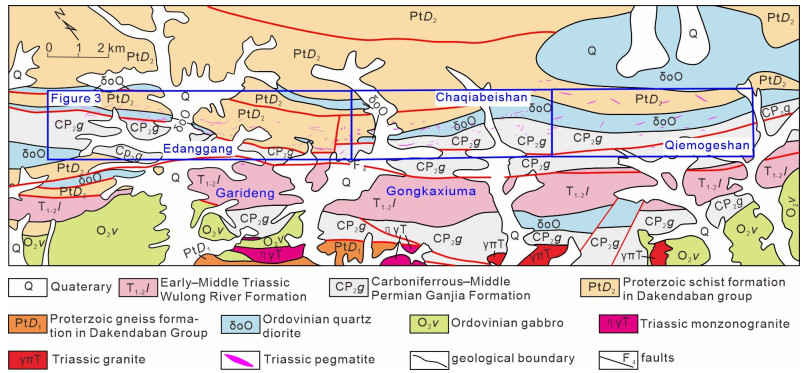
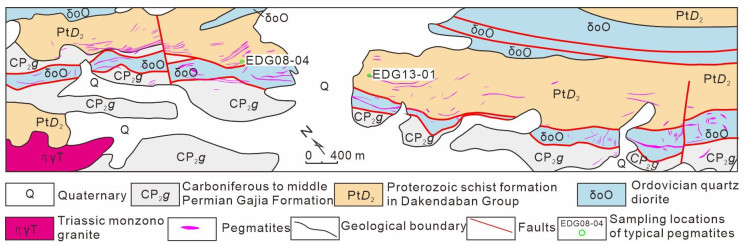
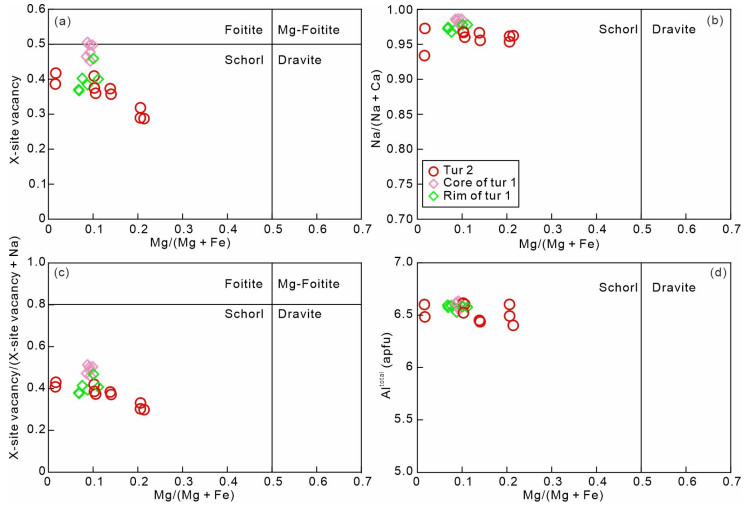
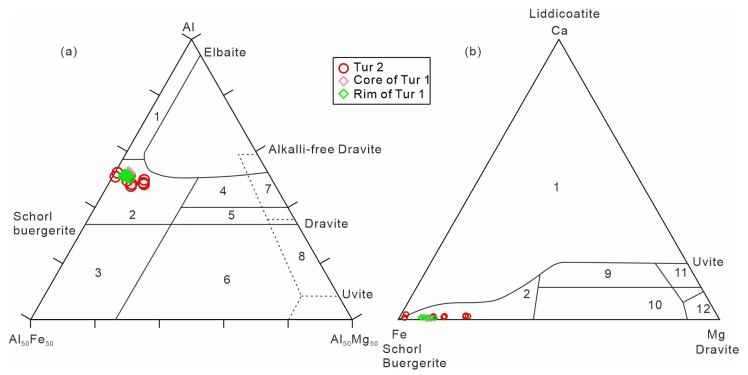
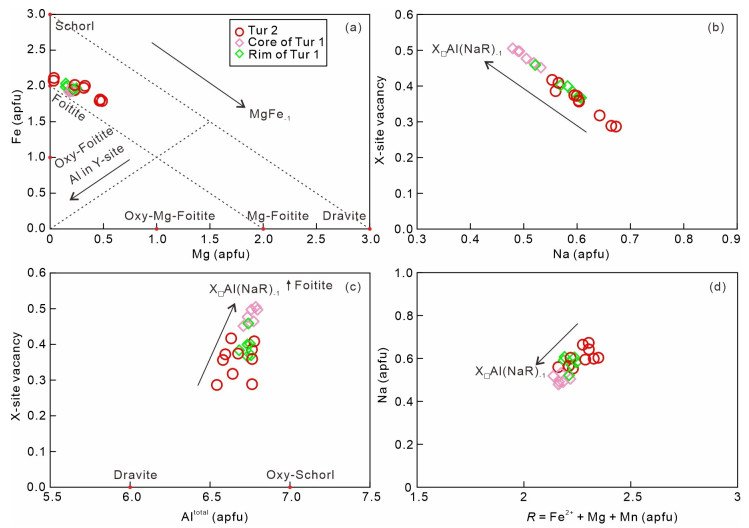
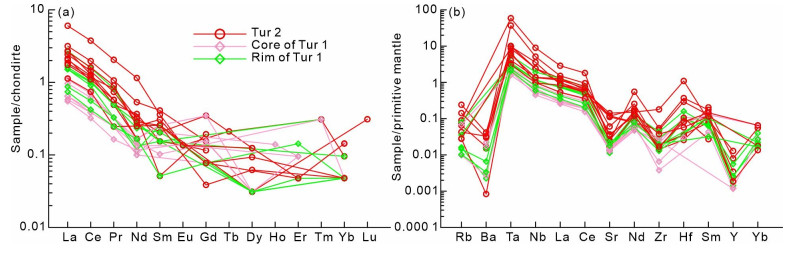
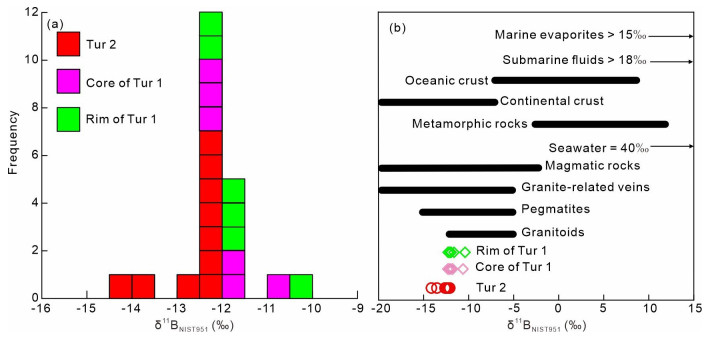
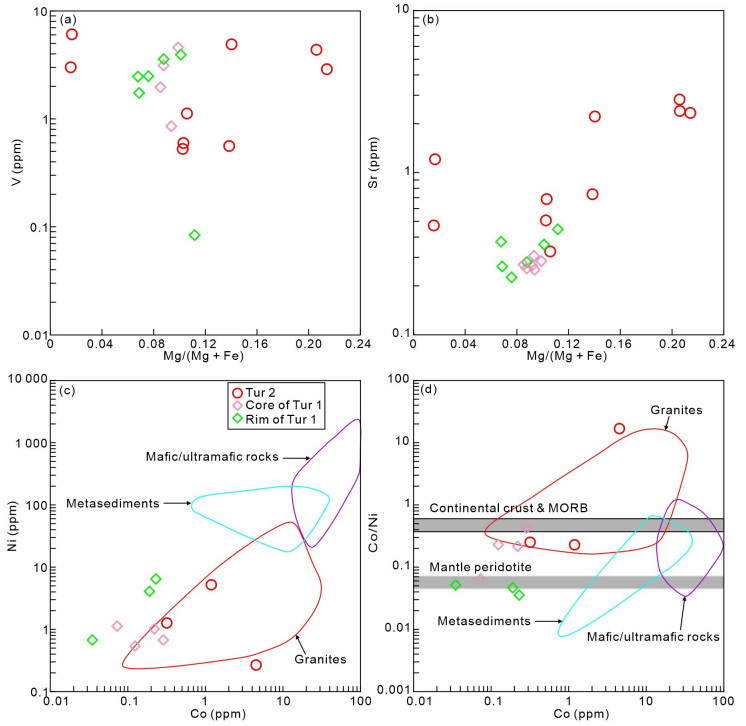
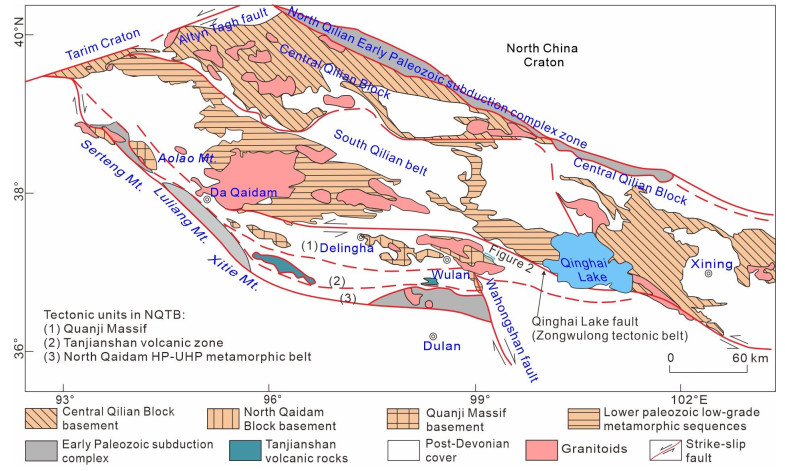
The Edanggang area is characterized by small-scale Li-Be-bearing granitic pegmatites in the Quanji Massif, northwest China. The genesis of these Li-Be-bearing pegmatites remains unresolved. In this study, we use tourmalines as an indicator to constrain the genesis of them.

| Baksheev, I. A., Trumbull, R. B., Popov, M. P., et al., 2018. Chemical and Boron Isotopic Composition of Tourmaline from the Mariinsky Emerald Deposit, Central Urals, Russia. Mineralium Deposita, 53(4): 565–583. https://doi.org/10.1007/s00126-017-0759-z |
| Barros, R., Kaeter, D., Menuge, J. F., et al., 2020. Controls on Chemical Evolution and Rare Element Enrichment in Crystallising Albite-Spodumene Pegmatite and Wallrocks: Constraints from Mineral Chemistry. Lithos, 352/353: 105289. https://doi.org/10.1016/j.lithos.2019.105289 |
| Boynton, W. V., 1984. Cosmochemistry of the Rare Earth Elements: Meteorite Studies. Rare Earth Element Geochemistry. Elsevier, Amsterdam. https://doi.org/10.1016/b978-0-444-42148-7.50008-3 |
| Cabral, A. R., Koglin, N., 2012. Hydrothermal Fluid Source Constrained by Co/Ni Ratios in Coexisting Arsenopyrite and Tourmaline: The Auriferous Lode of Passagem, Quadrilátero Ferrífero of Minas Gerais, Brazil. Mineralogy and Petrology, 104(3): 137–145. https://doi.org/10.1007/s00710-011-0183-5 |
| Chaussidon, M., Albarède, F., 1992. Secular Boron Isotope Variations in the Continental Crust: An Ion Microprobe Study. Earth and Planetary Science Letters, 108(4): 229–241. https://doi.org/10.1016/0012-821x(92)90025-q |
| Chen, J., Han, J., Yu, F., et al., 2022. 40Ar-39Ar Dating of Muscovite in Chaka Beishan Li-Polymetallic Deposit in Qinghai Province and the Geological Significance. Contributions to Geology and Mineral Resources Research, 37(2): 142–147 (in Chinese with English Abstract) |
| Chen, X., Jiang, S. Y., Palmer, M. R., et al., 2023. Tourmaline Chemistry, Boron, and Strontium Isotope Systematics Trace Multiple Melt-Fluid-Rock Interaction Stages in Deeply Subducted Continental Crust. Geochimica et Cosmochimica Acta, 340: 120–140. https://doi.org/10.1016/j.gca.2022.11.019 |
| Ding, Q. F., Pan, T., Zhou, X., et al., 2022. Geochronology, Petrogenesis, and Tectonic Significance of the Granites in the Chaqiabeishan Area of the Quanji Massif, Northwestern China. Geological Journal, 57(3): 1241–1261. https://doi.org/10.1002/gj.4338 |
| Drivenes, K., Larsen, R. B., Müller, A., et al., 2015. Late-Magmatic Immiscibility during Batholith Formation: Assessment of B Isotopes and Trace Elements in Tourmaline from the Land's End Granite, SW England. Contributions to Mineralogy and Petrology, 169(6): 56. https://doi.org/10.1007/s00410-015-1151-6 |
| Duan, Z. P., Jiang, S. Y., Su, H. M., et al., 2020. Tourmaline as a Recorder of Contrasting Boron Source and Potential Tin Mineralization in the Mopanshan Pluton from Inner Mongolia, Northeastern China. Lithos, 354/355: 105284. https://doi.org/10. 1016/j.lithos.2019.105284 doi: 10.1016/j.lithos.2019.105284 |
| Duchoslav, M., Marks, M. A. W., Drost, K., et al., 2017. Changes in Tourmaline Composition during Magmatic and Hydrothermal Processes Leading to Tin-Ore Deposition: The Cornubian Batholith, SW England. Ore Geology Reviews, 83: 215–234. https://doi.org/10.1016/j.oregeorev.2016.11.012 |
| Galbraith, C. G., Clarke, D. B., Trumbull, R. B., et al., 2009. Assessment of Tourmaline Compositions as an Indicator of Emerald Mineralization at the Tsa Da Glisza Prospect, Yukon Territory, Canada. Economic Geology, 104(5): 713–731. https://doi.org/10.2113/gsecongeo.104.5.713 |
| Gong, S. L., Chen, N. S., Geng, H. Y., et al., 2014. Zircon Hf Isotopes and Geochemistry of the Early Paleoproterozoic High-Sr Low-y Quartz-Diorite in the Quanji Massif, NW China: Crustal Growth and Tectonic Implications. Journal of Earth Science, 25(1): 74–86. https://doi.org/10.1007/s12583-014-04 01-2 doi: 10.1007/s12583-014-0401-2 |
| Gong, S. L., Chen, N. S., Wang, Q. Y., et al., 2012. Early Paleoproterozoic Magmatism in the Quanji Massif, Northeastern Margin of the Qinghai-Tibet Plateau and Its Tectonic Significance: LA-ICPMS U-Pb Zircon Geochronology and Geochemistry. Gondwana Research, 21(1): 152–166. https://doi.org/10.1016/j.gr.2011.07.011 |
| Gong, S. L., He, C., Wang, X. C., et al., 2019. No Plate Tectonic Shutdown in the Early Paleoproterozoic: Constraints from the ca. 2.4 Ga Granitoids in the Quanji Massif, NW China. Journal of Asian Earth Sciences, 172: 221–242. https://doi.org/10.1016/j.jseaes.2018.09.011 |
| Guo, A. L., Zhang, G. W., Qiang, J., et al., 2009. Indosinian Zongwulong Orogenic belt on the Northeastern Margin of the Qinghai Tibet Plateau. Acta Petrologica Sinica, 25: 1–12 (in Chinese with English Abstract) |
| Hazarika, P., Upadhyay, D., Pruseth, K. L., 2017. Episodic Tourmaline Growth and Re-Equilibration in Mica Pegmatite from the Bihar Mica Belt, India: Major- and Trace-Element Variations under Pegmatitic and Hydrothermal Conditions. Geological Magazine, 154(1): 68–86. https://doi.org/10.1017/s001675681 5000916 doi: 10.1017/s0016756815000916 |
| Henry, D. J., Dutrow, B. L., 2012. Tourmaline at Diagenetic to Low-Grade Metamorphic Conditions: Its Petrologic Applicability. Lithos, 154: 16–32. https://doi.org/10.1016/j.lithos.2012.08.013 |
| Henry, D. J., Guidotti, C. V., 1985. Tourmaline as a Petrogenetic Indicator Mineral: An Example from the Staurolite-Grade Metapelites of NW Maine. American Mineralogist, 70(1–2): 1–15 |
| Henry, D. J., Novak, M., Hawthorne, F. C., et al., 2011. Nomenclature of the Tourmaline-Supergroup Minerals. American Mineralogist, 96(5/6): 895–913. https://doi.org/10.2138/am.2011.3636 |
| Hofmann, A. W., 1988. Chemical Differentiation of the Earth: The Relationship between Mantle, Continental Crust, and Oceanic Crust. Earth and Planetary Science Letters, 90(3): 297–314. https://doi.org/10.1016/0012-821x(88)90132-x |
| Hou, K. J., Li, Y. H., Xiao, Y. K., et al., 2010. In-situ Boron Isotope Measurements of Natural Geological Materials by LA-MC-ICP-MS. Chinese Science Bulletin, 55(29): 3305–3311. https://doi.org/10.1007/s11434-010-4064-9 |
| Hu, D. L., Jiang, S. Y., 2020. In-situ Elemental and Boron Isotopic Variations of Tourmaline from the Maogongdong Deposit in the Dahutang W-Cu Ore Field of Northern Jiangxi Province, South China: Insights into Magmatic-Hydrothermal Evolution. Ore Geology Reviews, 122: 103502. https://doi.org/10.1016/j.oregeo rev.2020.103502 doi: 10.1016/j.oregeorev.2020.103502 |
| Jiang, S. Y., Su, H. M., Zhu, X. Y., et al., 2022. A New Type of Li Deposit: Hydrothermal Crypto-Explosive Breccia Pipe Type. Journal of Earth Science, 33(5): 1095–1113. https://doi.org/10.1 007/s12583-022-1736-8 doi: 10.1007/s12583-022-1736-8 |
| Jiang, S. Y., Wang, C. L., Zhang, L., et al., 2021. In-situ Trace Element Tracing and Isotopic Dating of Pegmatite Type Lithium Deposits: An Overview. Acta Geologica Sinica, 95(10): 3017–3038. https://doi.org/10.3969/j.issn.0001-5717.2021.10.006 |
| Jiang, S. Y., Wang, W., Su, H. M., 2023. Super-Enrichment Mechanisms of Strategic Critical Metal Deposits: Current Understanding and Future Perspectives. Journal of Earth Science, 34(4): 1295–1298. https://doi.org/10.1007/s12583-023-2001-5 |
| Jiang, S. Y., Yu, J. M., Lu, J. J., 2004. Trace and Rare-Earth Element Geochemistry in Tourmaline and Cassiterite from the Yunlong Tin Deposit, Yunnan, China: Implication for Migmatitic-Hydrothermal Fluid Evolution and Ore Genesis. Chemical Geology, 209(3/4): 193–213. https://doi.org/10.1016/j.chemgeo. 2004.04.021 doi: 10.1016/j.chemgeo.2004.04.021 |
| Jiang, S. -Y., Palmer, M. R., 1998. Boron Isotope Systematics of Tourmaline from Granites and Pegmatites: A Synthesis. European Journal of Mineralogy, 10(6): 1253–1266. https://doi.org/10.1127/ejm/10/6/1253 |
| Kalliomäki, H., Wagner, T., Fusswinkel, T., et al., 2017. Major and Trace Element Geochemistry of Tourmalines from Archean Orogenic Gold Deposits: Proxies for the Origin of Gold Mineralizing Fluids? Ore Geology Reviews, 91: 906–927. https://doi.org/10.1016/j.oregeorev.2017.08.014 |
| Kasemann, S., Erzinger, J., Franz, G., 2000. Boron Recycling in the Continental Crust of the Central Andes from the Palaeozoic to Mesozoic, NW Argentina. Contributions to Mineralogy and Petrology, 140(3): 328–343. https://doi.org/10.1007/s00410000 0189 doi: 10.1007/s004100000189 |
| Li, S. P., Pan, T., Wang, B. Z., et al., 2021. Characteristics and Tectonic Significance of Beryl-Bearing Pegmatites in Qiemoge Mountain, Northern Margin of Qaidam BASIN. Geotectonica et Metallogenia, 45(3): 608–619 (in Chinese with English Abstract) |
| Li, S. P., Pan, T., Yan, X. P., et al., 2022. REE Geochemical Characteristics and Provenance Analysis of Chaka North Mountain Pegmatite in the Eastern Part of the Northern margin of Qaidam Basin, Qinghai Province. China Rare Earths, 43(4): 88–99 (in Chinese with English Abstract) |
| Liao, F. X., Wang, Q. Y., Chen, N. S., et al., 2018. Geochemistry and Geochronology of the ∼0.82 Ga High-Mg Gabbroic Dykes from the Quanji Massif, Southeast Tarim Block, NW China: Implications for the Rodinia Supercontinent Assembly. Journal of Asian Earth Sciences, 157: 3–21. https://doi.org/10.1016/j.jseaes.2017.06.021 |
| Liao, F. X., Zhang, L., Chen, N. S., et al., 2014. Geochronology and Geochemistry of Meta-Mafic Dykes in the Quanji Massif, NW China: Paleoproterozoic Evolution of the Tarim Craton and Implications for the Assembly of the Columbia Supercontinent. Precambrian Research, 249: 33–56. https://doi.org/10.1016/j.precamres.2014.04.015 |
| Liu, C. X., Sun, F. Y., Qian, Y., et al., 2021. Vertical Zonation Characteristics of Chakabeishan Li-Be Rare-Metal Pegmatite Deposit in the Northern Margin of Qaidam Basin, Qinghai Province. Global Geology, 40(4): 847–859, 880 (in Chinese with English Abstract) |
| Liu, D. L., Jiang, S. Y., Li, W. T., et al., 2022. Neoproterozoic and Paleozoic Tectonic Evolution in North Qaidam, Northeastern Tibetan Plateau Recorded by Magmatism and Metamorphism. Gondwana Research, 103: 84–104. https://doi.org/10.1016/j.gr.2 021.11.005 doi: 10.1016/j.gr.2021.11.005 |
| Liu, J. H., Wang, Q., Xu, C. B., et al., 2022. Geochronology of the Chakabeishan Li-(Be) Rare-Element Pegmatite, Zongwulong Orogenic Belt, Northwest China: Constraints from Columbite-Tantalite U-Pb and Muscovite-Lepidolite 40Ar/39Ar Dating. Ore Geology Reviews, 146: 104930. https://doi.org/10.1016/j.oregeo rev.2022.104930 doi: 10.1016/j.oregeorev.2022.104930 |
| Liu, X. H., Li, B., Lai, J. Q., et al., 2022. Multistage in situ Fractional Crystallization of Magma Produced a Unique Rare Metal Enriched Quartz-Zinnwaldite-Topaz Rock. Ore Geology Reviews, 151: 105203. https://doi.org/10.1016/j.oregeorev.202 2.105203 doi: 10.1016/j.oregeorev.2022.105203 |
| Liu, Y., Hu, Z., Gao, S., et al., 2008. In-situ Analysis of Major and Trace Elements of Anhydrous Minerals by LA-ICP-MS without Applying an Internal Standard. Chemical Geology, 257(1–2): 34–43. https://doi.org/10.1016/j.chemgeo.2008.08.004 |
| London, D., 2018. Ore-Forming Processes within Granitic Pegmatites. Ore Geology Reviews, 101: 349–383. https://doi.org/10.1016/j.oregeorev.2018.04.020 |
| London, D., Manning, D. A. C., 1995. Chemical Variation and Significance of Tourmaline from Southwest England. Economic Geology, 90(3): 495–519. https://doi.org/10.2113/gsecongeo.9 0.3.495 doi: 10.2113/gsecongeo.90.3.495 |
| Marks, M. A. W., Marschall, H. R., Schühle, P., et al., 2013. Trace Element Systematics of Tourmaline in Pegmatitic and Hydrothermal Systems from the Variscan Schwarzwald (Germany): The Importance of Major Element Composition, Sector Zoning, and Fluid or Melt Composition. Chemical Geology, 344: 73–90. https://doi.org/10.1016/j.chemgeo.2013.0 2.025 doi: 10.1016/j.chemgeo.2013.02.025 |
| McDonough, W. F., Sun, S. S., 1995. The Composition of the Earth. Chemical Geology, 120(3/4): 223–253. https://doi.org/10.1016/0009-2541(94)00140-4 |
| Morgan, G. B., 2016. A Spreadsheet for Calculating Normative Mole Fractions of End-Member Species for Na-Ca-Li-Fe2+-Mg-Al Tourmalines from Electron Microprobe Data. American Mineralogist, 101(1): 111–119. https://doi.org/10.2138/am-2016-5392 |
| Mustafa, H. A., Wang, Q. Y., Chen, N. S., et al., 2016. Geochemistry of Metamafic Dykes from the Quanji Massif: Petrogenesis and Further Evidence for Oceanic Subduction, Late Paleoproterozoic, NW China. Journal of Earth Science, 27(4): 529–544. https://doi.org/10.1007/s12583-015-0659-z |
| Palmer, M. R., Slack, J. F., 1989. Boron Isotopic Composition of Tourmaline from Massive Sulfide Deposits and Tourmalinites. Contributions to Mineralogy and Petrology, 103(4): 434–451. https://doi.org/10.1007/bf01041751 |
| Pan, T., Ding, Q. F., Zhou, X., et al., 2021. Columbite-Tantalite Group Mineral U-Pb Geochronology of Chaqiabeishan Li-Rich Granitic Pegmatites in the Quanji Massif, NW China: Implications for the Genesis and Emplacement Ages of Pegmatites. Frontiers in Earth Science, 8: 606951. https://doi.org/10.3389/feart.2020.60 6951 doi: 10.3389/feart.2020.606951 |
| Pan, T., Li, S. P., Ren, H., et al., 2020. Metallogenic Conditions and Prospecting Potential of Lithium Polymetallic Deposits in North Qaidam Basin. Mineral Exploration, 11(6): 1101–1116 (in Chinese with English Abstract) |
| Pang, J. Z., Yu, J. X., Zheng, D. W., et al., 2019. Neogene Expansion of the Qilian Shan, North Tibet: Implications for the Dynamic Evolution of the Tibetan Plateau. Tectonics, 38(3): 1018–1032. https://doi.org/10.1029/2018tc005258 |
| Peng, Y., Zhang, Y. S., Sun, J. P., et al., 2018. Geochemistry of Late Carboniferous Sedimentary Rocks from the Zongwulong Structural Belt and Adjacent Areas, Qaidam Basin, China: Implications for Provenance and Tectonic Setting. Geosciences Journal, 22(2): 287–301. https://doi.org/10.1007/s12303-017-00 32-6 doi: 10.1007/s12303-017-0032-6 |
| Pesquera, A., Velasco, F., 1997. Mineralogy, Geochemistry and Geological Significance of Tourmaline-Rich Rocks from the Paleozoic Cinco Villas Massif (Western Pyrenees, Spain). Contributions to Mineralogy and Petrology, 129(1): 53–74. https://doi.org/10.1007/s004100050323 |
| QGS, 2022. Geological Survey Report of Lithium Rare Metal in Edanggang Area in Tianjun County, Qinghai Province. Qinghai Geological Survey (QGS), Xining |
| Rudnick, R. L., Gao, S., 2014. Composition of the Continental Crust. Treatise on Geochemistry. Elsevier, Amsterdam. https://doi.org/10.1016/b978-0-08-095975-7.00301-6 |
| Trumbull, R. B., Garda, G. M., Xavier, R. P., et al., 2019. Tourmaline in the Passagem de Mariana Gold Deposit (Brazil) Revisited: Major-Element, Trace-Element and B-Isotope Constraints on Metallogenesis. Mineralium Deposita, 54(3): 395–414. https://doi.org/10.1007/s00126-018-0819-z |
| van Hinsberg, V. J., Henry, D. J., Marschall, H. R., 2011. Tourmaline: An Ideal Indicator of Its Host Environment. The Canadian Mineralogist, 49(1): 1–16. https://doi.org/10.3749/canmin.49.1.1 |
| Wang, B. Z., Han, J., Xie, X. L., et al., 2020. Discovery of the Indosinian(Beryl-Bearing) Spodumene Pegmatitic Dike Swarm in the Chakaibeishan Area in the Northeastern Margin of the Tibetan Plateau: Implications for Li-Be Mineralization. Geotectonica et Metallogenia, 44(1): 69–79 (in Chinese with English Abstract) |
| Wang, L., Johnston, S. T., Chen, N. S., 2019. New Insights into the Precambrian Tectonic Evolution and Continental Affinity of the Qilian Block: Evidence from Geochronology and Geochemistry of Metasupracrustal Rocks in the North Wulan Terrane. GSA Bulletin, 131(9/10): 1723–1743. https://doi.org/10.1130/b35059.1 |
| Wang, L., Wang, H., He, C., et al., 2016. Mesoproterozoic Continental Breakup in NW China: Evidence from Gray Gneisses from the North Wulan Terrane. Precambrian Research, 281: 521–536.https://doi.org/10.1016/j.precamres.20 16.06.016 doi: 10.1016/j.precamres.2016.06.016 |
| Wang, Q. Y., Dong, Y. J., Pan, Y. M., et al., 2018. Early Paleozoic Granulite-Facies Metamorphism and Magmatism in the Northern Wulan Terrane of the Quanji Massif: Implications for the Evolution of the Proto-Tethys Ocean in Northwestern China. Journal of Earth Science, 29(5): 1081–1101.https://doi.org/10. 1007/s12583-018-0881-6 doi: 10.1007/s12583-018-0881-6 |
| Wu, C. L., Wu, D., Mattinson, C., et al., 2019. Petrogenesis of Granitoids in the Wulan Area: Magmatic Activity and Tectonic Evolution in the North Qaidam, NW China. Gondwana Research, 67: 147–171. https://doi.org/10.1016/j.gr.2018.09.010 |
| Xavier, R. P., Wiedenbeck, M., Trumbull, R. B., et al., 2008. Tourmaline B-Isotopes Fingerprint Marine Evaporites as the Source of High-Salinity Ore Fluids in Iron Oxide Copper-Gold Deposits, Carajás Mineral Province (Brazil). Geology, 36(9): 743. https://doi.org/10.1130/g24841a.1 |
| Yang, S. Y., 2022. Electron Probe Microanalysis in Geosciences: Analytical Procedures and Recent Advances. Atomic Spectroscopy, 43(2): 186–200.https://doi.org/10.46770/as.202 1.912 doi: 10.46770/as.2021.912 |
| Yang, S. Y., Jiang, S. Y., Zhao, K. D., et al., 2015. Tourmaline as a Recorder of Magmatic-Hydrothermal Evolution: An in situ Major and Trace Element Analysis of Tourmaline from the Qitianling Batholith, South China. Contributions to Mineralogy and Petrology, 170(5): 42. https://doi.org/10.1007/s00410-015-1195-7 |
| Zhang, L., Wang, Q. Y., Chen, N. S., et al., 2014. Geochemistry and Detrital Zircon U-Pb and Hf Isotopes of the Paragneiss Suite from the Quanji Massif, SE Tarim Craton: Implications for Paleoproterozoic Tectonics in NW China. Journal of Asian Earth Sciences, 95: 33–50.https://doi.org/10.1016/j.jseaes.2014.0 5.014 doi: 10.1016/j.jseaes.2014.05.014 |
| Zhang, R. X., Yang, S. Y., 2016. A Mathematical Model for Determining Carbon Coating Thickness and Its Application in Electron Probe Microanalysis. Microscopy and Microanalysis, 22(6): 1374–1380. https://doi.org/10.1017/s143192761601182x |
| Zhang, X., Yang, S. Y., Zhao, H., et al., 2019. Effect of Beam Current and Diameter on Electron Probe Microanalysis of Carbonate Minerals. Journal of Earth Science, 30(4): 834–842. https://doi.org/10.1007/s12583-017-0939-x |
| Zhao, H. D., Zhao, K. D., Palmer, M. R., et al., 2019. In-situ Elemental and Boron Isotopic Variations of Tourmaline from the Sanfang Granite, South China: Insights into Magmatic-Hydrothermal Evolution. Chemical Geology, 504: 190–204. https://doi.org/10.1016/j.chemgeo.2018.11.013 |
| Zhou, Q., Li, W. C., Wang, G. C., et al., 2019. Chemical and Boron Isotopic Composition of Tourmaline from the Conadong Leucogranite-Pegmatite System in South Tibet. Lithos, 326/327: 529–539. https://doi.org/10.1016/j.lithos.2019.01.003 |
Figures(11) / Tables(1)
Copyright © 2013-2020 Journal of Earth Science 鄂ICP备15021562号-2
Tel: +86-27-67885075 Fax: +86-27-67885075 E-mail: xbb@cug.edu.cn
Address: Editorial Office of Journal, China University of Geosciences, Yujiashan, Wuhan, Hubei 430074, P. R. China
Supported by:
Beijing Renhe Information Technology Co. Ltd
E-mail:
info@rhhz.net


 DownLoad: