| Citation: | Aipeng Guo, Longjiang Mao, Yiyuan Li, Haicheng Lai, Jiafu Zhang, Duowen Mo. Environmental Change and Human Occupation during Late Pleistocene in Hunan Province, South China. Journal of Earth Science, 2026, 37(2): 802-817. doi: 10.1007/s12583-023-1951-y

|
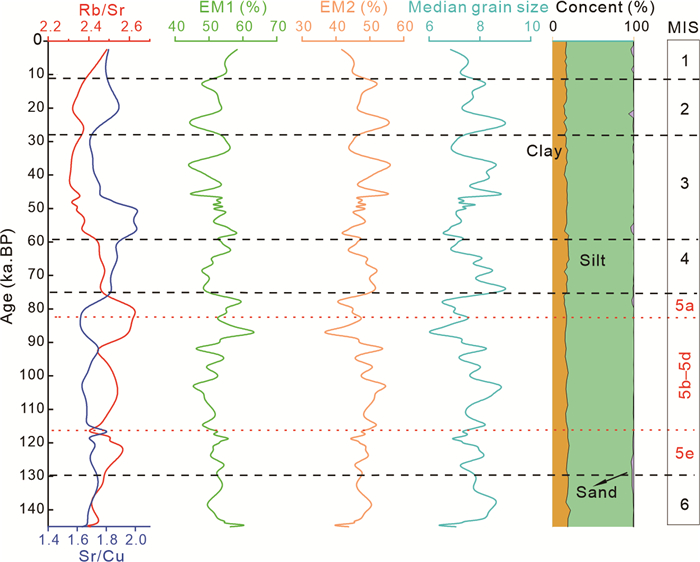
The Paleolithic sites in South China have caused controversy regarding human behaviors in response to the rapidly shifting environment of the Late Pleistocene. However, chronometric and high-resolution proxies are absent from interpreting the paleoenvironmental evolution. Here we present the chronology, grain size parameters, and geochemical elements records from the Hejialing (HJL) site in South China to reveal the crucial aspects of environmental evolution, and human occupation. The geochemical record shows that during MIS 5e–5a, northern Hunan experienced the influence of the summer monsoon and maintained a warm and humid climate. The laterite layer began to develop. During MIS 4, the climate transitioned to a dry and cold state, leading to the attraction of hominins to the HJL area due to the abundant water and lithic raw material resources, resulting in their establishment of a short-term camp. The HJL site was primarily inhabited by hunter-gatherer societies within a forested environment. From MIS 4 to MIS 2, Hunan experienced a prolonged period of dry and cold climatic conditions, with a brief rainfall recovery occurring in late MIS 3. Diminished vegetation and resource availability compelled human populations to broaden their activities and undertake migrations. The HJL site was abandoned amid the arid phase of MIS 2. The HJL area gradually became buried beneath eolian dust deposition (EM1) from distant sources and riverine dust from nearby sources (EM2), and the site was informed. In MIS 1, During MIS 1, the climate shifted to a warm and humid state, marking the emergence of early agricultural practices. As an essential part of South China, the environmental evolution process and diverse survival strategies employed by hominins in Hunan are vital for explaining how the paleoenvironment drove human occupation during the Late Pleistocene.

| Algeo, T. J., Morford, J., Cruse, A., 2012. New Applications of Trace Metals as Proxies in Marine Paleoenvironments. Chemical Geology, 306: 160–164. https://doi.org/10.1016/j.chemgeo.2012.03.009 |
| Andersen, K. K., Azuma, N., Barnola, J. M., et al., 2004. High-Resolution Record of Northern Hemisphere Climate Extending into the Last Interglacial Period. Nature, 431(7005): 147–151. https://doi.org/10.1038/nature02805 |
| Bae, C. J., Douka, K., Petraglia, M. D., 2017. On the Origin of Modern Humans. Science, 358(6368): 1269–1269 |
| Barrows, T. T., Mills, S. C., Fitzsimmons, K., et al., 2022. Low-Altitude Periglacial Activity in Southeastern Australia during the Late Pleistocene. Quaternary Research, 107: 125–146. https://doi.org/10.1017/qua.2021.72 |
| Beyene, Y., Katoh, S., WoldeGabriel, G., et al., 2013. The Characteristics and Chronology of the Earliest Acheulean at Konso, Ethiopia. Proceedings of the National Academy of Sciences of the United States of America, 110(5): 1584–1591 |
| Binford, L. R., 1982. The Archaeology of Place. Journal of Anthropological Archaeology, 1(1): 5–31. https://doi.org/10.1016/0278-4165(82)90006-x |
| Blaauw, M., 2010. Methods and Code for 'Classical' Age-Modelling of Radiocarbon Sequences. Quaternary Geochronology, 5(5): 512–518. https://doi.org/10.1016/j.quageo.2010.01.002 |
| Blome, M. W., Cohen, A. S., Tryon, C. A., et al., 2012. The Environmental Context for the Origins of Modern Human Diversity: A Synthesis of Regional Variability in African Climate 150 000–30 000 Years Ago. Journal of Human Evolution, 62(5): 563–592. https://doi.org/10.1016/j.jhevol.2012.01.011 |
| Boës, X., Rydberg, J., Martinez-Cortizas, A., et al., 2011. Evaluation of Conservative Lithogenic Elements (Ti, Zr, Al, and Rb) to Study Anthropogenic Element Enrichments in Lake Sediments. Journal of Paleolimnology, 46(1): 75–87. https://doi.org/10.1007/s10933-011-9515-z |
| Boivin, N., Fuller, D. Q., Dennell, R., et al., 2013. Human Dispersal across Diverse Environments of Asia during the Upper Pleistocene. Quaternary International, 300: 32–47. https://doi.org/10.1016/j.quaint.2013.01.008 |
| Bordes, F., 1968. The Old Stone Age. Weidenfeld & Nicolson, London |
| Cao, T. T., Liu, H., Xiao, J. Y., et al., 2024. Paleoenviromental Reconstruction and Organic Matter Accumulation Mechanism for Youganwo Formation Oil Shale in Maoming Basin. Earth Science, 49(4): 1367–1384. https://doi.org/10.3799/dqkx.2022.260(in Chinese with English Abstract) |
| Cartelle, V., Barlow, N. L. M., Hodgson, D. M., et al., 2021. Sedimentary Architecture and Landforms of the Late Saalian (MIS 6) Ice Sheet Margin Offshore of the Netherlands. Earth Surface Dynamics, 9(6): 1399–1421. https://doi.org/10.5194/esurf-9-1399-2021 |
| Chen, S. R., Xu, Z. J., Kong, J. T., et al., 2021. Paleoclimatic Evolution during Late Triassic-Early-Middle Jurassic in South Guangdong of South China Continental Margin and Its Responses to the Tectonic Regime Transition. Earth Science, 46(9): 3290–3306 (in Chinese with English Abstract) |
| Cheng, H., Edwards, R. L., Sinha, A., et al., 2016. The Asian Monsoon over the Past 640, 000 Years and Ice Age Terminations. Nature, 534(7609): 640–646. https://doi.org/10.1038/nature18591 |
| Cheng, H., Sinha, A., Wang, X. F., et al., 2012. The Global Paleomonsoon as Seen through Speleothem Records from Asia and the Americas. Climate Dynamics, 39(5): 1045–1062. https://doi.org/10.1007/s00382-012-1363-7 |
| Clark, G., 1961. World Prehistory: An Outline. University Press, Cambridge |
| de Menocal, P. B., 2011. Climate and Human Evolution. Science, 331(6017): 540–542. https://doi.org/10.1126/science.1190683 |
|
Debénath, A., Dibble, H. L., 1993. Handbook of Paleolithic Typology. University of Pennsylvania Press. |
| Dennell, R., Petraglia, M. D., 2012. The Dispersal of Homo sapiens across Southern Asia: How Early, How Often, How Complex? Quaternary Science Reviews, 47: 15–22. https://doi.org/10.1016/j.quascirev.2012.05.002 |
| Dennell, R., Roebroeks, W., 2005. An Asian Perspective on Early Human Dispersal from Africa. Nature, 438(7071): 1099–1104. https://doi.org/10.1038/nature04259 |
| Dietze, E., Maussion, F., Ahlborn, M., et al., 2014. Sediment Transport Processes across the Tibetan Plateau Inferred from Robust Grain-Size End Members in Lake Sediments. Climate of the Past, 10(1): 91–106. https://doi.org/10.5194/cp-10-91-2014 |
| Fang, X., Peng, B., Song, Z., et al., 2021, Geochemistry of Heavy Metal-Contaminated Sediments from the Four River Inlets of Dongting Lake, China. Environ. Sci. Pollut. Res., 10: 1–21 (in Chinese with English Abstract) |
| Fritz, M., Unkel, I., Lenz, J., et al., 2018. Regional Environmental Change versus Local Signal Preservation in Holocene Thermokarst Lake Sediments: A Case Study from Herschel Island, Yukon (Canada). Journal of Paleolimnology, 60(1): 77–96. https://doi.org/10.1007/s10933-018-0025-0 |
| Frumkin, A., Bar-Yosef, O., Schwarcz, H. P., 2011. Possible Paleohydrologic and Paleoclimatic Effects on Hominin Migration and Occupation of the Levantine Middle Paleolithic. Journal of Human Evolution, 60(4): 437–451. https://doi.org/10.1016/j.jhevol.2010.03.010 |
| Fu, J. H., Li, S. X., Xu, L. M., et al., 2018. Paleo-Sedimentary Environmental Restoration and Its Significance of Chang 7 Member of Triassic Yanchang Formation in Ordos Basin, NW China. Petroleum Exploration and Development, 45(6): 998–1008. https://doi.org/10.1016/s1876-3804(18)30104-6 |
| Grono, E., Piper, P. J., Nguyen, K. T. K., et al., 2022. The Identification of Dwellings and Site Formation Processes at Archaeological Settlements in the Tropics: A Micro-Geoarchaeological Case Study from Neolithic Loc Giang, Southern Vietnam. Quaternary Science Reviews, 291: 107654. https://doi.org/10.1016/j.quascirev.2022.107654 |
| Guo, A. P., Mao, L. J., Shan, S. W., et al., 2022. Hydrological Regime, Provenance, and Impacts on Cultural Development at Changsha Kiln Archaeological Site since 1300 A, Lower Xiangjiang River, China. Land, 11(6): 789. https://doi.org/10.3390/land11060789 |
| Guo, W., 2010. The Neolithic Culture and Society in Liyang Plain and Eastern Hanjiang River Region. Cultural Press, Beijing (in Chinese) |
| Guo, X. Q., Sun, X. F., Feng, X. B., et al., 2020. Luminescence Dating of the Jigongshan Paleolithic Site in Hubei Province, Southern China. Quaternary International, 554: 36–44. https://doi.org/10.1016/j.quaint.2020.08.014 |
| Hatch, J. R., Leventhal, J. S., 1992. Relationship between Inferred Redox Potential of the Depositional Environment and Geochemistry of the Upper Pennsylvanian (Missourian) Stark Shale Member of the Dennis Limestone, Wabaunsee County, Kansas, U. S. A. Chemical Geology, 99(1/2/3): 65–82. https://doi.org/10.1016/0009-2541(92)90031-y |
| Hong, H. L., Gu, Y. S., Yin, K., et al., 2010. Red Soils with White Net-Like Veins and Their Climate Significance in South China. Geoderma, 160(2): 197–207. https://doi.org/10.1016/j.geoderma.2010.09.019 |
| Horvat, M., Tomašić, N., Aljinović, D., et al., 2025. Eocene Weathering Oscillations Imprinted in Marl Mineral and Geochemical Record, Dinaric Foreland Basin, Croatia. Journal of Earth Science, 36(3): 1236–1250. https://doi.org/10.1007/s12583-023-1913-2 |
| Hu, X. F., Wei, J., Du, Y., et al., 2010. Regional Distribution of the Quaternary Red Clay with Aeolian Dust Characteristics in Subtropical China and Its Paleoclimatic Implications. Geoderma, 159(3/4): 317–334. https://doi.org/10.1016/j.geoderma.2010.08.008 |
| Hu, X., Du, Y., 2013. Soil Profile of Yellow-Brown Earth Overlying Red Clay in Southern Anhui Province: A Pedogenic Response to the Last Glacial-Interglacial Cycle in Mid-Subtropical China. EGU General Assembly Conference Abstracts, April 2013, Vienna |
| Huang, C. C., Pang, J. L., Zha, X. C., et al., 2010. Extraordinary Floods of 4100–4000a BP Recorded at the Late Neolithic Ruins in the Jinghe River Gorges, Middle Reach of the Yellow River, China. Palaeogeography, Palaeoclimatology, Palaeoecology, 289(1/2/3/4): 1–9. https://doi.org/10.1016/j.palaeo.2010.02.003 |
| Innes, J. B., Zong, Y. Q., Wang, Z. H., et al., 2014. Climatic and Palaeoecological Changes during the Mid- to Late Holocene Transition in Eastern China: High-Resolution Pollen and Non-Pollen Palynomorph Analysis at Pingwang, Yangtze Coastal Lowlands. Quaternary Science Reviews, 99: 164–175. https://doi.org/10.1016/j.quascirev.2014.06.013 |
| Jeong, G. Y., Cheong, C. S., Kim, J., 2006. Rb-Sr and K-Ar Systems of Biotite in Surface Environments Regulated by Weathering Processes with Implications for Isotopic Dating and Hydrological Cycles of Sr Isotopes. Geochimica et Cosmochimica Acta, 70(18): 4734–4749. https://doi.org/10.1016/j.gca.2006.07.012 |
| Jiu, K., Ding, W., Huang, W., et al., 2012. Formation Environment and Controlling Factors of Organic-Rich Shale of Lower Cambrian in Upper Yangtze Region. Geoscience, 26: 547–554 (in Chinese with English Abstract) |
| Jones, B., Manning, D. A. C., 1994. Comparison of Geochemical Indices Used for the Interpretation of Palaeoredox Conditions in Ancient Mudstones. Chemical Geology, 111(1/2/3/4): 111–129. https://doi.org/10.1016/0009-2541(94)90085-x |
| Kalinin, P. I., Kudrevatykh, I. Y., Vagapov, I. M., et al., 2018. Biogeochemical Processes in Steppe Landscapes of the Ergeni Upland in the Holocene. Eurasian Soil Science, 51(5): 495–505. https://doi.org/10.1134/s1064229318050058 |
| Kidder, T. R., Liu, H. W., Li, M. L., 2012. Sanyangzhuang: Early Farming and a Han Settlement Preserved beneath Yellow River Flood Deposits. Antiquity, 86(331): 30–47. https://doi.org/10.1017/s0003598x0006244x |
| Kuhn, S. L., 1992. On Planning and Curated Technologies in the Middle Paleolithic. Journal of Anthropological Research, 48(3): 185–214 doi: 10.1086/jar.48.3.3630634 |
| Kylander, M. E., Ampel, L., Wohlfarth, B., et al., 2011. High-Resolution X-Ray Fluorescence Core Scanning Analysis of Les Echets (France) Sedimentary Sequence: New Insights from Chemical Proxies. Journal of Quaternary Science, 26(1): 109–117. https://doi.org/10.1002/jqs.1438 |
| Lara, C., Iliopoulos, I., 2020. Ceramic Technology, Ethnic Identification and Multiethnic Contacts: The Archaeological Example of the Cuyes River Valley (Southeastern Ecuadorian Highlands). Journal of Archaeological Science: Reports, 33: 102557. https://doi.org/10.1016/j.jasrep.2020.102557 |
| Laskar, J., Robutel, P., Joutel, F., et al., 2004. A Long-Term Numerical Solution for the Insolation Quantities of the Earth. Astronomy & Astrophysics, 428(1): 261–285. https://doi.org/10.1051/0004-6361:20041335 |
| Lerman, A., 1979. Lakes: Chemistry, Geology, Physics. Science, 204: 825–826 |
| Li, G., Hu, B., Deng, T., et al., 2008. Petroleum Geological Significance of Microelements V and Ni. Natural Gas Geosci., 19(1): 13–17 (in Chinese with English Abstract) |
| Li, H., 2019. Acheulean Technology in Human Evolution. Science, 71(3): 10–14 (in Chinese with English Abstract) |
| Li, H., Li, Y. Y., Yu, L. P., et al., 2022. Continuous Technological and Behavioral Development of Late Pleistocene Hominins in Central South China: Multidisciplinary Analysis at Sandinggai. Quaternary Science Reviews, 298: 107850. https://doi.org/10.1016/j.quascirev.2022.107850 |
| Li, H., Zhang, Y. Z., Li, Y. Y., et al., 2021. Sediment Characteristics and the Formation Processes of Paleolithic Sites. Acta Anthropologica Sinica, 40(3): 363–377. https://doi.org/10.16359/j.1000-3193/aas.2021.0047 |
| Li, J., Zheng, Z., Cheddadi, R., et al., 2013. Pollen-Based Environmental Reconstruction around Dajiuhu Lake, Shennongjia Mountains since 40 Ka BP. Acta Geographica Sinica, 68(1): 69–81 (in Chinese with English Abstract) |
| Li, Y., 2019. The Excavation of the Tiaotougang Site of the Paleolithic Age in Linli County, Hunan. Archaeology, 618(3): 3–14 (in Chinese with English Abstract) |
| Li, Y., 2020. Lithic industries And Adaptation Behaviors: The Late Pleistocene Hominin Culture in the Lishui River Valley. Aurora Centre for the Study of Ancient Civilizations, Peking University Publication Series, Beijing |
| Li, Y., Wang, X., Lu, Y. J., et al., 2019. The 2011 Excavation at the Wuyashan Site in Lixian County, Hunan Province. Jianghan Archaeology, 6: 20–31 (in Chinese with English Abstract) |
| Lisiecki, L. E., Raymo, M. E., 2005. A Pliocene-Pleistocene Stack of 57 Globally Distributed Benthic δ18O Records. Paleoceanography, 20(1): 2004PA001071. https://doi.org/10.1029/2004pa001071 |
| Liu, M. J., He, M. Y., Hu, Z. J., et al., 2024. Environmental Changes Recorded by Trace Elements in Sediments of Cuopu Lake, Ganzi Prefecture, Sichuan Province in Recent 200 Years. Earth Science, 49(6): 2186–2198. https://doi.org/10.3799/dqkx.2022.107(in Chinese with English Abstract) |
| Liu, Q., Song, C. Z., Cui, W., et al., 2007. Element Geochemistry of the Middle Pleistocene Loess Deposits in the Source Area of Huaihe River and Its Paleoclimatic Significance. J. Earth Sci. Environ., 4: 356–361 (in Chinese with English Abstract) |
| Liu, W., Martinón-Torres, M., Cai, Y. J., et al., 2015. The Earliest Unequivocally Modern Humans in Southern China. Nature, 526(7575): 696–699. https://doi.org/10.1038/nature15696 |
| Liu, X. Q., Jiang, S. W., Tu, L. Y., et al., 2025. A Review of Paleoenvironmental Reconstruction Using Crater Lake Sediments in Monsoonal China. Journal of Earth Science, 36(6): 2730–2747. https://doi.org/10.1007/s12583-022-1733-y |
| Mangerud, J., Sønstegaard, E., Sejrup, H. P., 1979. Correlation of the Eemian (Interglacial) Stage and the Deep-Sea Oxygen-Isotope Stratigraphy. Nature, 277(5693): 189–192. https://doi.org/10.1038/277189a0 |
| Mao, L. J., Mo, D. W., Jiang, L. P., et al., 2008. Environmental Change since Mid-Pleistocene Re-Corded in Shangshan Achaeological Site of Zhejiang. Journal of Geographical Sciences, 18(2): 247–256. https://doi.org/10.1007/s11442-008-0247-6 |
| Martinson, D. G., Pisias, N. G., Hays, J. D., et al., 1987. Age Dating and the Orbital Theory of the Ice Ages: Development of a High-Resolution 0 to 300, 000-Year Chronostratigraphy. Quaternary Research, 27(1): 1–29. https://doi.org/10.1016/0033-5894(87)90046-9 |
| Moreno, A., Giralt, S., Valero-Garcés, B., et al., 2007. A 14 kyr Record of the Tropical Andes: The Lago Chungará Sequence (18 °S, Northern Chilean Altiplano). Quaternary International, 161(1): 4–21. https://doi.org/10.1016/j.quaint.2006.10.020 |
| Müller, G., Förstner, U., 1968. Sediment Transport Im Mündungsgebiet des Alpenrheins. Geologische Rundschau, 58(1): 229–259. https://doi.org/10.1007/bf01820606 |
| Osher, L. J., Buol, S. W., 1998. Relationship of Soil Properties to Parent Material and Landscape Position in Eastern Madre de Dios, Peru. Geoderma, 83(1/2): 143–166. https://doi.org/10.1016/s0016-7061(97)00133-x |
| Paterson, G. A., Heslop, D., 2015. New Methods for Unmixing Sediment Grain Size Data. Geochemistry, Geophysics, Geosystems, 16(12): 4494–4506. https://doi.org/10.1002/2015gc006070 |
| Pereira, M. G., da Silva, R. C., Junior, C. R. P., et al., 2022. Soil Genesis on the Soft Slopes of Ancient Coastal Plains, Southeastern Brazil. CATENA, 210: 105894. https://doi.org/10.1016/j.catena.2021.105894 |
| Petraglia, M. D., Alsharekh, A., 2003. The Middle Palaeolithic of Arabia: Implications for Modern Human Origins, Behaviour and Dispersals. Antiquity, 77(298): 671–684. https://doi.org/10.1017/s0003598x00061639 |
| Potts, R., Behrensmeyer, A. K., Ditchfield, P., 1999. Paleolandscape Variation and Early Pleistocene Hominid Activities: Members 1 and 7, Olorgesailie Formation, Kenya. Journal of Human Evolution, 37(5): 747–788. https://doi.org/10.1006/jhev.1999.0344 |
| Potts, R., Faith, J. T., 2015. Alternating High and Low Climate Variability: The Context of Natural Selection and Speciation in Plio-Pleistocene Hominin Evolution. Journal of Human Evolution, 87: 5–20. https://doi.org/10.1016/j.jhevol.2015.06.014 |
| Pye, K., 1987. Aeolian Dust and Dust Deposits. Academic Press, London |
| Rees, A. B. H., Holt, K. A., Hinojosa, J. L., et al., 2021. Duelling Narratives of Chironomids and Pollen Explain Climate Enigmas during the Last Glacial-Interglacial Transition in North Island New Zealand. Quaternary Science Reviews, 263: 106997. https://doi.org/10.1016/j.quascirev.2021.106997 |
| Reyes-Centeno, H., 2016. Out of Africa and into Asia: Fossil and Genetic Evidence on Modern Human Origins and Dispersals. Quaternary International, 416: 249–262. https://doi.org/10.1016/j.quaint.2015.11.063 |
| Ryabogina, N. E., Afonin, A. S., Ivanov, S. N., et al., 2019. Holocene Paleoenvironmental Changes Reflected in Peat and Lake Sediment Records of Western Siberia: Geochemical and Plant Macrofossil Proxies. Quaternary International, 528: 73–87. https://doi.org/10.1016/j.quaint.2019.04.006 |
| Schiffer, M. B., 1983. Toward the Identification of Formation Processes. American Antiquity, 48(4): 675–706. https://doi.org/10.2307/279771 |
| Schiffer, M. B., 1987. Formation Processes of the Archaeological Record. University of New Mexico Press, Albuquerque |
| Shea, J. J., 2008. Transitions or Turnovers? Climatically-Forced Extinctions of Homo Sapiens and Neanderthals in the East Mediterranean Levant. Quaternary Science Reviews, 27(23/24): 2253–2270. https://doi.org/10.1016/j.quascirev.2008.08.015 |
| Skurzyński, J., Jary, Z., Kenis, P., et al., 2020. Geochemistry and Mineralogy of the Late Pleistocene Loess-Palaeosol Sequence in Złota (near Sandomierz, Poland): Implications for Weathering, Sedimentary Recycling and Provenance. Geoderma, 375: 114459. https://doi.org/10.1016/j.geoderma.2020.114459 |
| Spratt, R. M., Lisiecki, L. E., 2016. A Late Pleistocene Sea Level Stack. Climate of the Past, 12(4): 1079–1092. https://doi.org/10.5194/cp-12-1079-2016 |
| Stankevica, K., Vincevica-Gaile, Z., Klavins, M., et al., 2020. Accumulation of Metals and Changes in Composition of Freshwater Lake Organic Sediments during the Holocene. Chemical Geology, 539: 119502. https://doi.org/10.1016/j.chemgeo.2020.119502 |
| Steegmann, T., 2004. Neanderthals and Modern Humans: An Ecological and Evolutionary Perspective. American Journal of Human Biology, 16(6): 718–719. https://doi.org/10.1002/ajhb.20070 |
| Sun, D. H., 2004. Monsoon and Westerly Circulation Changes Recorded in the Late Cenozoic Aeolian Sequences of Northern China. Global and Planetary Change, 41(1): 63–80. https://doi.org/10.1016/j.gloplacha.2003.11.001 |
| Sun, D. H., Su, R. X., Bloemendal, J., et al., 2008. Grain-Size and Accumulation Rate Records from Late Cenozoic Aeolian Sequences in Northern China: Implications for Variations in the East Asian Winter Monsoon and Westerly Atmospheric Circulation. Palaeogeography, Palaeoclimatology, Palaeoecology, 264(1/2): 39–53. https://doi.org/10.1016/j.palaeo.2008.03.011 |
| Tattersall, I., Schwartz, J. H., 2000. Extinct Humans. Westview Press, New York |
| Tribovillard, N., Algeo, T. J., Lyons, T., et al., 2006. Trace Metals as Paleoredox and Paleoproductivity Proxies: An Update. Chemical Geology, 232(1/2): 12–32. https://doi.org/10.1016/j.chemgeo.2006.02.012 |
| Trinkaus, E., 2005. Early Modern Humans. Annual Review of Anthropology, 34: 207–230. https://doi.org/10.1146/annurev.anthro.34.030905.154913 |
| Wang, H., 2017. Preliminary Discussion on the Epigenetic Changes of Site Landform. Cultural Relics in Southern China, 3: 47–52 (in Chinese with English Abstract) |
| Wang, L. H., Lin, Y. F., Chang, S. W., et al., 1982. Mammalian Fossils Found in Northwest Part of Hunan Province and Their Significance. Vertebrata Palasiatica, 20(4): 350–58+378 (in Chinese with English Abstract) |
| Weltje, G. J., Prins, M. A., 2003. Muddled or Mixed? Inferring Palaeoclimate from Size Distributions of Deep-Sea Clastics. Sedimentary Geology, 162(1/2): 39–62. https://doi.org/10.1016/s0037-0738(03)00235-5 |
| Wu, X., Poirier, F. E., 1995. Human Evolution in China. Oxford University Press, New York |
| Yang, D. Y., 1986. Paleoenvironment of the Mid-Lower Regions of the Yangtze River in Full-Glacial Period of Late Pleistocene. Acta Geographica Sinica, 41(4): 302–310 (in Chinese with English Abstract) |
| Yang, L., 2017. The Study of Sedimentary Characteristics Village and Genetic Mechanism of the Quaternary Red Clay in The Middle and Lower Reaches of Yangtze River: [Dissertation]. East China Normal University, Shanghai (in Chinese with English Abstract) |
| Yang, P., Xu, F., Xia, J., et al., 2025. Agricultural Drought Vulnerability in the Middle Reaches of Yangtze River Basin under Environmental Change. Journal of Earth Science, 36(1): 184–196. https://doi.org/10.1007/s12583-023-1865-8 |
| Yang, S., Zheng, Z., Zong, Y., et al., 2011. 100 000-Year Sporopollen Records and Paleoenvironmental Reconstruction of Maar Lake in Tropical South China. The Second Annual Meeting of the Eighth Sporopollen Branch of the Chinese Palaeontological Society, 88–89 (in Chinese with English Abstract) |
| Yin, Q. Z., Guo, Z. T., 2006. Mid-Pleistocene Vermiculated Red Soils in Southern China as an Indication of Unusually Strengthened East Asian Monsoon. Chinese Science Bulletin, 51(2): 213–220. https://doi.org/10.1007/s11434-005-0490-5 |
| Zhen, Z. G., Zhong, W., Xue, J. B., et al., 2008. Progress in the Studies of Climatic Features in Different Areas of China during the MIS-3. Journal of Glaciology and Geocryology, 30(5): 814–824 (in Chinese with English Abstract) |
| Zheng, Y., Yang, S. Y., Deng, C. L., 2019. Provenance and Climate Changes Inferred from Magnetic Properties of the Sediments from the Lower Yangtze River (China) during the Last 130 Years. Journal of Asian Earth Sciences, 175: 128–137. https://doi.org/10.1016/j.jseaes.2019.01.036 |
Figures(7) / Tables(2)
Copyright © 2013-2020 Journal of Earth Science 鄂ICP备15021562号-2
Tel: +86-27-67885075 Fax: +86-27-67885075 E-mail: xbb@cug.edu.cn
Address: Editorial Office of Journal, China University of Geosciences, Yujiashan, Wuhan, Hubei 430074, P. R. China
Supported by:
Beijing Renhe Information Technology Co. Ltd
E-mail:
info@rhhz.net


 DownLoad: