| Citation: | Yanmin Zhang, Zewei Gui, Xiaofei Gao, Jingxiao Zhang, Yunni Gao, Man Zhang, Guokun Yang, Xindang Zhang, Xulu Chang, Zixuan Gan, Xiaolin Meng, Xuejun Li, Hongchen Jiang. Microbial Communities and Their Influencing Factors in the Sediment of Upper and Mid–Lower Reaches of the Yellow River. Journal of Earth Science, 2026, 37(1): 317-328. doi: 10.1007/s12583-023-1964-6

|
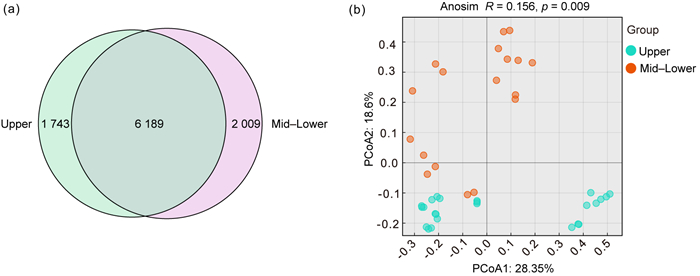
Sedimentary microbial communities play an important role in driving biogeochemical cycles in river ecosystems. The Yellow River is one of the rivers with the highest turbidity over the world. However, limited is known about the microbial variation and its influencing factors in the Yellow River. In this study, we examined the microbial communities and their influencing factors in the sediment of Upper and Mid–Lower reaches of the Yellow River. The results showed that

| Aufdenkampe, A. K., Mayorga, E., Raymond, P. A., et al., 2011. Riverine Coupling of Biogeochemical Cycles between Land, Oceans, and Atmosphere. Frontiers in Ecology and the Environment, 9(1): 53–60. https://doi.org/10.1890/100014 |
| Bastian, M., Heymann, S., Jacomy, M., 2009. Gephi: An Open Source Software for Exploring and Manipulating Networks. Proceedings of the International AAAI Conference on Web and Social Media, 3(1): 361–362. https://doi.org/10.1609/icwsm.v3i1.13937 |
| Battin, T. J., Lauerwald, R., Bernhardt, E. S., et al., 2023. River Ecosystem Metabolism and Carbon Biogeochemistry in a Changing World. Nature, 613(7944): 449–459. https://doi.org/10.1038/s41586-022-05500-8 |
| Bolyen, E., Rideout, J. R., Dillon, M. R., et al., 2019. Reproducible, Interactive, Scalable and Extensible Microbiome Data Science Using QIIME 2. Nature Biotechnology, 37(8): 852–857. https://doi.org/10.1038/s41587-019-0209-9 |
| Cai, W. J., Guo, X. H., Chen, C. A., et al., 2008. A Comparative Overview of Weathering Intensity and HCO3-Flux in the World's Major Rivers with Emphasis on the Changjiang, Huanghe, Zhujiang (Pearl) and Mississippi Rivers. Continental Shelf Research, 28(12): 1538–1549. https://doi.org/10.1016/j.csr.2007.10.014 |
| Caporaso, J. G., Lauber, C. L., Walters, W. A., et al., 2012. Ultra-High-Throughput Microbial Community Analysis on the Illumina HiSeq and MiSeq Platforms. The ISME Journal, 6(8): 1621–1624. https://doi.org/10.1038/ismej.2012.8 |
|
Chen, H. B., Boutros, P. C., 2011. VennDiagram: A Package for the Generation of Highly-Customizable Venn and Euler Diagrams in R. BMC Bioinformatics, 12(1): 1–7. |
| Chen, J., Xie, P., Yu, D. Z., et al., 2021. Dynamic Change of Sedimental Microbial Community during Black Bloom—An in Situ Enclosure Simulation Study. Microbial Ecology, 81(2): 304–313. https://doi.org/10.1007/s00248-020-01561-2 |
| Chen, Y. J., Liu, Y., Wang, X. Y., 2017. Spatiotemporal Variation of Bacterial and Archaeal Communities in Sediments of a Drinking Reservoir, Beijing, China. Applied Microbiology and Biotechnology, 101(8): 3379–3391. https://doi.org/10.1007/s00253-016-8019-1 |
| Chen, Y. P., Fu, B. J., Zhao, Y., et al., 2020. Sustainable Development in the Yellow River Basin: Issues and Strategies. Journal of Cleaner Production, 263: 121223. https://doi.org/10.1016/j.jclepro.2020.121223 |
| Cole, J. R., Wang, Q., Fish, J. A., et al., 2014. Ribosomal Database Project: Data and Tools for High Throughput rRNA Analysis. Nucleic Acids Research, 42(Database issue): D633–D642. https://doi.org/10.1093/nar/gkt1244 |
| Cui, G., Chen, J., Wang, P. F., et al., 2023. Biogeographic Distribution Patterns and Ecological Mechanisms of Benthic Eukaryotic Microorganisms in Jinsha River. Environmental Science, 44(2): 839–846. https://doi.org/10.13227/j.hjkx.202204255 (in Chinese with English Abstract) |
| Deng, Y., Jiang, Y. H., Yang, Y. F., et al., 2012. Molecular Ecological Network Analyses. BMC Bioinformatics, 13: 113. https://doi.org/10.1186/1471-2105-13-113 |
| Dethier, E. N., Renshaw, C. E., Magilligan, F. J., 2022. Rapid Changes to Global River Suspended Sediment Flux by Humans. Science, 376(6600): 1447–1452. https://doi.org/10.1126/science.abn7980 |
| Edgar, R. C., 2010. Search and Clustering Orders of Magnitude Faster than BLAST. Bioinformatics, 26(19): 2460–2461. https://doi.org/10.1093/bioinformatics/btq461 |
| Edgar, R. C., Haas, B. J., Clemente, J. C., et al., 2011. UCHIME Improves Sensitivity and Speed of Chimera Detection. Bioinformatics, 27(16): 2194–2200. https://doi.org/10.1093/bioinformatics/btr381 |
| Escalas, A., Hale, L., Voordeckers, J. W., et al., 2019. Microbial Functional Diversity: From Concepts to Applications. Ecology and Evolution, 9(20): 12000–12016. https://doi.org/10.1002/ece3.5670 |
| Fan, T. Y., Chen, Y. X., Wang, Y. L., et al., 2022. Aquatic Microbial Community Characteristics and Influencing Factors in Urban Landscape Rivers. Polish Journal of Environmental Studies, 31(6): 5661–5673. https://doi.org/10.15244/pjoes/152239 |
| Gao, X. F., Chen, H. H., Govaert, L., et al., 2019. Responses of Zooplankton Body Size and Community Trophic Structure to Temperature Change in a Subtropical Reservoir. Ecology and Evolution, 9(22): 12544–12555. https://doi.org/10.1002/ece3.5718 |
| Green, T. J., Barnes, A. C., Bartkow, M., et al., 2012. Sediment Bacteria and Archaea Community Analysis and Nutrient Fluxes in a Sub-Tropical Polymictic Reservoir. Aquatic Microbial Ecology, 65(3): 287–302. https://doi.org/10.3354/ame01549 |
| Han, M. X., Huang, J. R., Yang, J., et al., 2023. Distinct Assembly Mechanisms for Prokaryotic and Microeukaryotic Communities in the Water of Qinghai Lake. Journal of Earth Science, 34(4): 1189–1200. https://doi.org/10.1007/s12583-023-1812-8 |
| He, H. R., Pan, B. Z., Yu, K., et al., 2021. Determinants of Bacterioplankton Structures in the Typically Turbid Weihe River and Its Clear Tributaries from the Northern Foot of the Qinling Mountains. Ecological Indicators, 121: 107168. https://doi.org/10.1016/j.ecolind.2020.107168 |
| Jones, C. M., Graf, D. R., Bru, D., et al., 2013. The Unaccounted yet Abundant Nitrous Oxide-Reducing Microbial Community: A Potential Nitrous Oxide Sink. The ISME Journal, 7(2): 417–426. https://doi.org/10.1038/ismej.2012.125 |
| Kara, E. L., Hanson, P. C., Hu, Y. H., et al., 2013. A Decade of Seasonal Dynamics and Co-Occurrences within Freshwater Bacterioplankton Communities from Eutrophic Lake Mendota, WI, USA. The ISME Journal, 7(3): 680–684. https://doi.org/10.1038/ismej.2012.118 |
| Kong, D. X., Miao, C. Y., Li, J. H., et al., 2022. Full-Stream Erosion in the Lower Yellow River: Feasibility, Sustainability and Opportunity. Science of the Total Environment, 807: 150810. https://doi.org/10.1016/j.scitotenv.2021.150810 |
| Liu, S. F., Wang, H. Y., Chen, L. M., et al., 2020. Comammox Nitrospira within the Yangtze River Continuum: Community, Biogeography, and Ecological Drivers. The ISME Journal, 14(10): 2488–2504. https://doi.org/10.1038/s41396-020-0701-8 |
| Liu, T., Zhang, A. N., Wang, J. W., et al., 2018. Integrated Biogeography of Planktonic and Sedimentary Bacterial Communities in the Yangtze River. Microbiome, 6(1): 16. https://doi.org/10.1186/s40168-017-0388-x |
| Liu, W. Z., Yao, L., Jiang, X. L., et al., 2018. Sediment Denitrification in Yangtze Lakes Is Mainly Influenced by Environmental Conditions but Not Biological Communities. Science of the Total Environment, 616/617: 978–987. https://doi.org/10.1016/j.scitotenv.2017.10.221 |
| Magoč, T., Salzberg, S. L., 2011. FLASH: Fast Length Adjustment of Short Reads to Improve Genome Assemblies. Bioinformatics, 27(21): 2957–2963. https://doi.org/10.1093/bioinformatics/btr507 |
| Mao, Y. F., Liu, Y., Li, H., et al., 2019. Distinct Responses of Planktonic and Sedimentary Bacterial Communities to Anthropogenic Activities: Case Study of a Tributary of the Three Gorges Reservoir, China. Science of the Total Environment, 682: 324–332. https://doi.org/10.1016/j.scitotenv.2019.05.172 |
| Martiny, J. B. H., Bohannan, B. J. M., Brown, J. H., et al., 2006. Microbial Biogeography: Putting Microorganisms on the Map. Nature Reviews Microbiology, 4(2): 102–112. https://doi.org/10.1038/nrmicro1341 |
| Martiny, J. B. H., Eisen, J. A., Penn, K., et al., 2011. Drivers of Bacterial Β-Diversity Depend on Spatial Scale. Proceedings of the National Academy of Sciences of the United States of America, 108(19): 7850–7854. https://doi.org/10.1073/pnas.1016308108 |
| Millar, J. J., Payne, J. T., Ochs, C. A., et al., 2015. Particle-Associated and Cell-Free Extracellular Enzyme Activity in Relation to Nutrient Status of Large Tributaries of the Lower Mississippi River. Biogeochemistry, 124(1): 255–271. https://doi.org/10.1007/s10533-015-0096-1 |
| Pan, B. Z., Liu, X. Y., Sun, H., et al., 2022. Suspended Particulates Mediate Bacterial Community Coalescence in Different Habitats of a Large Sediment-Laden River. Ecological Indicators, 144: 109462. https://doi.org/10.1016/j.ecolind.2022.109462 |
| Pei, Y. X., Yu, Z. S., Ji, J., et al., 2018. Microbial Community Structure and Function Indicate the Severity of Chromium Contamination of the Yellow River. Frontiers in Microbiology, 9: 38. https://doi.org/10.3389/fmicb.2018.00038 |
| Pierangeli, G. M. F., Domingues, M. R., Choueri, R. B., et al., 2023. Spatial Variation and Environmental Parameters Affecting the Abundant and Rare Communities of Bacteria and Archaea in the Sediments of Tropical Urban Reservoirs. Microbial Ecology, 86(1): 297–310. https://doi.org/10.1007/s00248-022-02047-z |
| Schloss, P. D., Westcott, S. L., Ryabin, T., et al., 2009. Introducing Mothur: Open-Source, Platform-Independent, Community-Supported Software for Describing and Comparing Microbial Communities. Applied and Environmental Microbiology, 75(23): 7537–7541. https://doi.org/10.1128/AEM.01541-09 |
| Song, H., Li, Z., Du, B., et al., 2012. Bacterial Communities in Sediments of the Shallow Lake Dongping in China. Journal of Applied Microbiology, 112(1): 79–89. https://doi.org/10.1111/j.1365-2672.2011.05187.x |
| Song, J., Hou, C. Y., Liu, Q., et al., 2020. Spatial and Temporal Variations in the Plankton Community Because of Water and Sediment Regulation in the Lower Reaches of Yellow River. Journal of Cleaner Production, 261: 120972. https://doi.org/10.1016/j.jclepro.2020.120972 |
| Wang, J. N., Wang, L. D., Hu, W. F., et al., 2021. Assembly Processes and Source Tracking of Planktonic and Benthic Bacterial Communities in the Yellow River Estuary. Environmental Microbiology, 23(5): 2578–2591. https://doi.org/10.1111/1462-2920.15480 |
| Wang, P. F., Wang, X., Wang, C., et al., 2017. Shift in Bacterioplankton Diversity and Structure: Influence of Anthropogenic Disturbances along the Yarlung Tsangpo River on the Tibetan Plateau, China. Scientific Reports, 7: 12529. https://doi.org/10.1038/s41598-017-12893-4 |
| Weber, K. A., Achenbach, L. A., Coates, J. D., 2006. Microorganisms Pumping Iron: Anaerobic Microbial Iron Oxidation and Reduction. Nature Reviews Microbiology, 4(10): 752–764. https://doi.org/10.1038/nrmicro1490 |
| Wei, C. L., Bao, S. M., Zhu, X. Y., et al., 2008. Spatio-Temporal Variations of the Bacterioplankton Community Composition in Chaohu Lake, China. Progress in Natural Science, 18(9): 1115–1122. https://doi.org/10.1016/j.pnsc.2008.04.005 |
| Wu, N., Liu, S. M., Zhang, G. L., et al., 2021. Anthropogenic Impacts on Nutrient Variability in the Lower Yellow River. Science of the Total Environment, 755: 142488. https://doi.org/10.1016/j.scitotenv.2020.142488 |
| Xia, N., Xia, X. H., Liu, T., et al., 2014. Characteristics of Bacterial Community in the Water and Surface Sediment of the Yellow River, China, the Largest Turbid River in the World. Journal of Soils and Sediments, 14(11): 1894–1904. https://doi.org/10.1007/s11368-014-0974-5 |
| Xia, N., Xia, X., Zhu, B., et al., 2013. Bacterial Diversity and Community Structure in the Sediment of the Middle and Lower Reaches of the Yellow River, the Largest Turbid River in the World. Aquatic Microbial Ecology, 71(1): 43–55. https://doi.org/10.3354/ame01664 |
| Xia, X. H., Jia, Z. M., Liu, T., et al., 2017. Coupled Nitrification-Denitrification Caused by Suspended Sediment (SPS) in Rivers: Importance of SPS Size and Composition. Environmental Science & Technology, 51(1): 212–221. https://doi.org/10.1021/acs.est.6b03886 |
| Xia, X. H., Zhang, S. B., Li, S. L., et al., 2018. The Cycle of Nitrogen in River Systems: Sources, Transformation, and Flux. Environmental Science: Processes & Impacts, 20(6): 863–891. https://doi.org/10.1039/C8EM00042E |
| Xie, F. Y., Yu, M. C., Yuan, Q. K., et al., 2022. Spatial Distribution, Pollution Assessment, and Source Identification of Heavy Metals in the Yellow River. Journal of Hazardous Materials, 436: 129309. https://doi.org/10.1016/j.jhazmat.2022.129309 |
| Yamada, T., Sekiguchi, Y., Hanada, S., et al., 2006. Anaerolinea thermolimosa Sp. Nov., Levilinea saccharolytica Gen. Nov., Sp. Nov. and Leptolinea tardivitalis Gen. Nov., Sp. Nov., Novel Filamentous Anaerobes, and Description of the New Classes Anaerolineae Classis Nov. and Caldilineae Classis Nov. in the Bacterial Phylum Chloroflexi. International Journal of Systematic and Evolutionary Microbiology, 56(6): 1331–1340. https://doi.org/10.1099/ijs.0.64169-0 |
| Yang, C., Zeng, Z., Zhang, H., et al., 2022. Distribution of Sediment Microbial Communities and Their Relationship with Surrounding Environmental Factors in a Typical Rural River, Southwest China. Environmental Science and Pollution Research, 29(56): 84206–84225. https://doi.org/10.1007/s11356-022-21627-7 |
| Yang, Y. Z., Li, S. G., Gao, Y. C., et al., 2019. Environment-Driven Geographical Distribution of Bacterial Communities and Identification of Indicator Taxa in Songhua River. Ecological Indicators, 101: 62–70. https://doi.org/10.1016/j.ecolind.2018.12.047 |
| Yin, X. B., Wang, W. T., Wang, A. H., et al., 2022. Microbial Community Structure and Metabolic Potential in the Coastal Sediments around the Yellow River Estuary. Science of the Total Environment, 816: 151582. https://doi.org/10.1016/j.scitotenv.2021.151582 |
| Zhang, B. G., Shi, J. X., Diao, M. H., et al., 2021. Microbial Diversity and Biogeochemical Cycling of Nitrogen and Sulfur in the Source Region of the Lancang River on the Tibetan Plateau. ACS ES & T Water, 1(11): 2377–2389. https://doi.org/10.1021/acsestwater.1c00225 |
| Zhang, J. X., Yang, Y. Y., Zhao, L., et al., 2015. Distribution of Sediment Bacterial and Archaeal Communities in Plateau Freshwater Lakes. Applied Microbiology and Biotechnology, 99(7): 3291–3302. https://doi.org/10.1007/s00253-014-6262-x |
| Zhang, S. B., Xia, X. H., Wang, J. F., et al., 2022. Biogeographic Patterns and Elevational Differentiation of Sedimentary Bacterial Communities across River Systems in China. Applied and Environmental Microbiology, 88(12): e00597–22. https://doi.org/10.1128/aem.00597-22 |
| Zhang, Y. M., Wu, G., Jiang, H. C., et al., 2018. Abundant and Rare Microbial Biospheres Respond Differently to Environmental and Spatial Factors in Tibetan Hot Springs. Frontiers in Microbiology, 9: 2096. https://doi.org/10.3389/fmicb.2018.02096 |
| Zhao, M. M., Chen, Y. P., Xue, L. G., et al., 2018. Greater Health Risk in Wet Season than in Dry Season in the Yellow River of the Lanzhou Region. Science of the Total Environment, 644: 873–883. https://doi.org/10.1016/j.scitotenv.2018.07.006 |
Figures(5) / Tables(1)
Copyright © 2013-2020 Journal of Earth Science 鄂ICP备15021562号-2
Tel: +86-27-67885075 Fax: +86-27-67885075 E-mail: xbb@cug.edu.cn
Address: Editorial Office of Journal, China University of Geosciences, Yujiashan, Wuhan, Hubei 430074, P. R. China
Supported by:
Beijing Renhe Information Technology Co. Ltd
E-mail:
info@rhhz.net


 DownLoad: