| Citation: | He Du, Shouyu Xu, Jianwei Feng, Shuizhen Liu, Xiang Gao. Quantitative Prediction of Multi-Period Tight Sandstone Fractures in Thrust-Fold Belt Based on Minimum Energy Dissipation Theory in Kuqa Depression of Tarim Basin. Journal of Earth Science, 2026, 37(4): 1639-1653. doi: 10.1007/s12583-024-0019-y

|
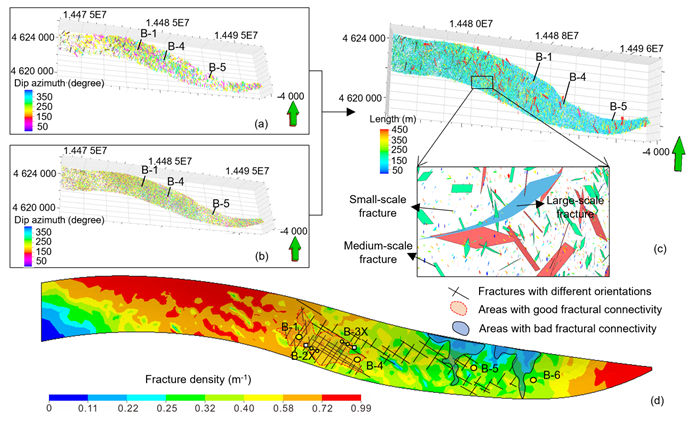
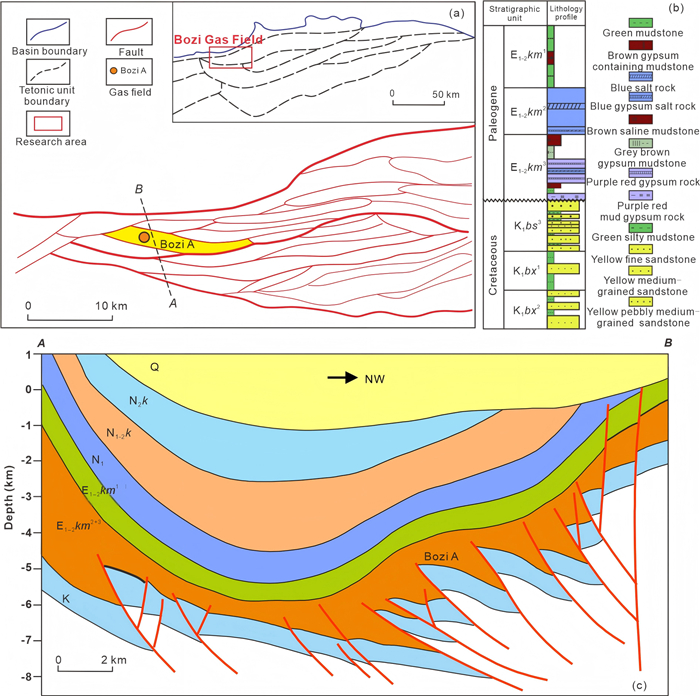
Deep tight sandstone reservoirs in the thrust-fold belt of the Kuqa depression, Tarim Basin, host substantial oil and gas resources. Structural fractures are the dominant reservoir space and seepage pathways in these tight reservoirs, yet their multi-periodic development and strong heterogeneity caused by multi-stage tectonic compression make accurate quantitative prediction extremely difficult. This study aims to establish a quantitative prediction method for multi-period tight sandstone fractures based on the minimum energy dissipation theory, targeting the Bozi Gas Field in the Kuqa depression. We first constructed a fine 3D geological model based on tectonic, drilling and logging data, then simulated the paleotectonic stress fields of key fracture-forming periods via 3D finite element analysis, and finally built a quantitative fracture parameter model of Bozi Gas Field by integrating the minimum energy dissipation theory with key fracture-controlling factors (thrust-fold structure, faults and lithology). The results show that the overlying thrust structure is the dominant control on the paleotectonic stress field distribution under intense tectonic compression, and the simulated fracture linear density shows a strong positive correlation with FMI logging interpretation results. The simulation result fully verifies the high accuracy and reliability of the method. This method provides critical guidance for tight gas exploration and development in the Kuqa depression, and a reference for fracture prediction in similar thrust-fold belts globally.

| Abendroth, M., Kuna, M., 2006. Identification of Ductile Damage and Fracture Parameters from the Small Punch Test Using Neural Networks. Engineering Fracture Mechanics, 73(6): 710–725. https://doi.org/10.1016/j.engfracmech.2005.10.007 |
| Barton, N., Bandis, S., Bakhtar, K., 1985. Strength, Deformation and Conductivity Coupling of Rock Joints. International Journal of Rock Mechanics and Mining Sciences & Geomechanics Abstracts, 22(3): 121–140. https://doi.org/10.1016/0148-9062(85)93227-9 |
|
Burberry, C. M., Jackson, A. L., 2012. Development of Structures Related to the Offshore Extent of the Minab Fault, Makran Accretionary Complex, Offshore Iran. AAPG Annual Convention and Exhibition, April 22–25, 2012, Long Beach, California, USA. AAPG Search and Discovery Article #90142. |
| Burrel, L., Teixell, A., 2021. Contractional Salt Tectonics and Role of Pre-Existing Diapiric Structures in the Southern Pyrenean Foreland Fold-Thrust Belt (Montsec and Serres Marginals). Journal of the Geological Society, 178(4): jgs2020-085. https://doi.org/10.1144/jgs2020-085 |
| Cai, Z. Z., Liu, J. S., Zhang, H., et al., 2025. Quantitative Prediction of in Situ Stress in Ultradeep Fracture-Cave Reservoirs and Its Applications. Journal of Earth Science, 36(6): 2598–2612. https://doi.org/10.1007/s12583-024-0001-8 |
|
Conti, J., Holtberg, P., Diefenderfer, J., et al., 2016. International Energy Outlook 2016 with Projections to 2040. U. S. Energy Information Administration (EIA), Washington, D. C. |
| Cooper, K. A., Hardy, S., Gawthorpe, R., 2003. Stratigraphic and Structural Expression of the Lateral Growth of Thrust Fault-Propagation Folds: Results and Implications from Kinematic Modelling. Basin Research, 15(2): 165–182. https://doi.org/10.1046/j.1365-2117.2003.00203.x |
| Dai, J. S., Feng, J. W., Li, M., et al., 2011. Discussion on the Extension Law of Structural Fracture in Sand-Mud Interbed Formation. Earth Science Frontiers, 18(2): 277–283 (in Chinese with English Abstract) |
| Dai, J. X., Huang, S. P., Liu, Y., et al., 2010. Significant Advancement in Natural Gas Exploration and Development in China During the Past Sixty Years. Oil & Gas Geology. 31(6): 689–698. https://www.cnki.com.cn/Article/CJFDTOTAL-SYYT201006004.htm (in Chinese with English Abstract) https://www.cnki.com.cn/Article/CJFDTOTAL-SYYT201006004.htm |
| De Grave, J., Buslov, M. M., Van den Haute, P., 2007. Distant Effects of India-Eurasia Convergence and Mesozoic Intracontinental Deformation in Central Asia: Constraints from Apatite Fission-Track Thermochronology. Journal of Asian Earth Sciences, 29(2/3): 188–204. https://doi.org/10.1016/j.jseaes.2006.03.001 |
| Ding, Y. C., Shao, Z. G., 2001. An Experimental Research into Determination of Highest Paleotectonic Stress State Experienced by Rock through Geological Ages. Earth Science, 26(1): 99–104 (in Chinese with English Abstract) |
| Feng, J. W., Liu, S. Z., Du, H., et al., 2023. Quantitative Prediction of Ultra-Deep Tight Sandstone Fractures Based on the Theory of Minimum Energy Dissipation. Geoenergy Science and Engineering, 226: 211749. https://doi.org/10.1016/j.geoen.2023.211749 |
| Feng, J. W., Qu, J. H., Wan, H. Q., et al., 2021. Quantitative Prediction of Multiperiod Fracture Distributions in the Cambrian-Ordovician Buried Hill within the Futai Oilfield, Jiyang Depression, East China. Journal of Structural Geology, 148: 104359. https://doi.org/10.1016/j.jsg.2021.104359 |
| Feng, J. W., Sun, J. F., Zhang, Y. J., et al., 2020. Control of Fault-Related Folds on Fracture Development in Kuqa Depression, Tarim Basin. Oil & Gas Geology, 41(3): 543–557. https://doi.org/10.11743/ogg20200311 (in Chinese with English Abstract) |
| Gao, L., Wang, X., Rao, G., et al., 2020. Two-Dimensional Balanced Restoration of Salt Structures and Analysis of Restored Cross Sections in the Western Kuqa Depression. Acta Geologica Sinica, 94(6): 1727–1739. https://www.geojournals.cn/dzxbe/dzxbe/article/abstract/2020127 (in Chinese with English Abstract) https://www.geojournals.cn/dzxbe/dzxbe/article/abstract/2020127 |
| Gudmundsson, A., Simmenes, T. H., Larsen, B., et al., 2010. Effects of Internal Structure and Local Stresses on Fracture Propagation, Deflection, and Arrest in Fault Zones. Journal of Structural Geology, 32(11): 1643–1655. https://doi.org/10.1016/j.jsg.2009.08.013 |
| He, D. F., John S., 2007. Theory and Application of Tri-Shear Fault Propagation Folding. Earth Science Frontiers, 14(6): 66–73. https://www.earthsciencefrontiers.net.cn/EN/Y2007/V14/I6/66 (in Chinese with English Abstract) https://www.earthsciencefrontiers.net.cn/EN/Y2007/V14/I6/66 |
| He, D. F., Zhou, X. Y., Yang, H. J., et al., 2009. Geological Structure and Its Controls on Giant Oil and Gas Fields in Kuqa Depression, Tarim Basin: A Clue from New Shot Seismic Data. Geotectonica et Metallogenia, 33(1): 19–32. https://www.cnki.com.cn/Article/CJFDTOTAL-DGYK200901004.htm (in Chinese with English Abstract) https://www.cnki.com.cn/Article/CJFDTOTAL-DGYK200901004.htm |
| He, G. Y., Lu, F. H., Wang, L. S., et al., 2003. Evidence for Paleogene Extensive Kuqa Basin, Tarim. Journal of Nanjing University (Natural Sciences), 39(1): 40–45 (in Chinese with English Abstract) |
| Hoek, E., Brown, E. T., 1980. Underground Excavations in Rock. The Institution of Mining and Metallurgy, London, 80–101 |
| Jia, D., Li, Y. Q., Wang, M. M., et al., 2011. Three-Dimensional Structural Geometry of Fault-Related Folds: Examples from 3-D Seismic Explored Blocks in the Western Sichuan Province, China. Acta Petrologica Sinica. 27(3): 732–740. https://www.researchgate.net/publication/256441149 (in Chinese with English Abstract) https://www.researchgate.net/publication/256441149 |
| Ju, W., Hou, G. T., Zhang, B., 2014. Insights into the Damage Zones in Fault-Bend Folds from Geomechanical Models and Field Data. Tectonophysics, 610: 182–194. https://doi.org/10.1016/j.tecto.2013.11.022 |
| Leykin, V. Z., 2015. Basic Laws of the Processes and the Principle of Minimum Energy Consumption during Pneumatic Transport and Distribution of Pulverized Fuel in Direct Pulverized Fuel Preparation Systems. Thermal Engineering, 62(8): 564–571. https://doi.org/10.1134/s0040601515080042 |
| Li, J., She, Y. Q., Gao, Y., et al., 2019. Onshore Deep and Ultra-Deep Natural Gas Exploration Fields and Potentials in China. China Petroleum Exploration, 24(4): 403–417. http://dx.chinadoi.cn/10.3969/j.issn.1672-7703.2019.04.001 (in Chinese with English Abstract) doi: 10.3969/j.issn.1672-7703.2019.04.001 |
| Li, L., Tang, H. M., Wang, Q., et al., 2017. Diagenetic Evolution of Cretaceous Ultra-Deep Reservoir in Keshen Belt, Kelasu Thrust Belt, Kuqa Depression. Xinjiang Petroleum Geology, 38(1): 7–14. https://www.zgxjpg.com/CN/10.7657/XJPG20170102 (in Chinese with English Abstract) doi: 10.7657/XJPG20170102 |
| Li, Z., Luo, W., Zeng, B. Y., et al., 2018. Fluid-Rock Interactions and Reservoir Formation Driven by Multiscale Structural Deformation in Basin Evolution. Earth Science, 43(10): 3498–3510. https://doi.org/10.3799/dqkx.2018.323 (in Chinese with English Abstract) |
| Liu, H. T., Zeng, L. B., 2004. Manifestation of Himalayan Movement in Kuqa Depression, Tarim Basin: Evidence from Rock Acoustic Emission Experiments. Geological Bulletin of China, 23(7): 676–679. http://doi.org/10.12097/gbc.200407122 (in Chinese with English Abstract) |
| Liu, J. S., Ding, W. L., Yang, H. M., et al., 2017. 3D Geomechanical Modeling and Numerical Simulation of in-situ Stress Fields in Shale Reservoirs: A Case Study of the Lower Cambrian Niutitang Formation in the Cen'gong Block, South China. Tectonophysics, 712/713: 663–683. https://doi.org/10.1016/j.tecto.2017.06.030 |
| Liu, J. S., Mei, L. F., Ding, W. L., et al., 2023. Asymmetric Propagation Mechanism of Hydraulic Fracture Networks in Continental Reservoirs. GSA Bulletin, 135(3/4): 678–688. https://doi.org/10.1130/b36358.1 |
| Liu, J. S., Yang, H. M., Xu, K., et al., 2022. Genetic Mechanism of Transfer Zones in Rift Basins: Insights from Geomechanical Models. GSA Bulletin, 134(9/10): 2436–2452. https://doi.org/10.1130/b36151.1 |
| Lu, H., Lu, X. S., Fan, J. J., et al., 2015. The Controlling Effects of Fractures on Gas Accumulation and Production in Tight Sandstone: A Case of Jurassic Dibei Gas Reservoir in the Eastern Kuqa Foreland Basin, China. Journal of Natural Gas Geoscience, 26(6): 1047–1056. https://doi.org/10.11764/j.issn.1672-1926.2015.06.1047 |
| Luo, Y. S., Tang, S. H., Liu, C. W., et al., 2009. Advances on the Least Energy Consumption Principle and Its Application. Journal of Railway Science and Engineering, 6(2): 79–86. https://doi.org/10.3969/j.issn.1672-7029.2009.02.017 (in Chinese with English Abstract) |
| McKinnon, S. D., Garrido de la Barra, I., 1998. Fracture Initiation, Growth and Effect on Stress Field: A Numerical Investigation. Journal of Structural Geology, 20(12): 1673–1689. https://doi.org/10.1016/s0191-8141(98)00080-7 |
| Mototake, Y., Ito, K., Demura, M., 2022. Quantitative Prediction of Fracture Toughness (KIc) of Polymer by Fractography Using Deep Neural Networks. Science and Technology of Advanced Materials: Methods, 2(1): 310–321. https://doi.org/10.1080/27660400.2022.2107883 |
| Najibi, A. R., Ghafoori, M., Lashkaripour, G. R., et al., 2017. Reservoir Geomechanical Modeling: In-situ Stress, Pore Pressure, and Mud Design. Journal of Petroleum Science and Engineering, 151: 31–39. https://doi.org/10.1016/j.petrol.2017.01.045 |
| Nelson, R. A., 2001. Geologic Analysis of Naturally Fractured Reservoirs. Gulf Professional Pub, Boston |
| Olson, J. E., Laubach, S. E., Lander, R. H., 2009. Natural Fracture Characterization in Tight Gas Sandstones: Integrating Mechanics and Diagenesis. AAPG Bulletin, 93(11): 1535–1549. https://doi.org/10.1306/08110909100 |
|
Price, N. J., 1966. Fault and Joint Development in Brittle and Semi-Brittle Rock. Elsevier, Amsterdam. |
|
Shrivastava, C., Lawatia, R., 2011. Tight Gas Reservoirs: Geological Evaluation of the Building Blocks. SPE Middle East Unconventional Gas Conference and Exhibition, January 31–February 2, 2011, Muscat, Oman. Society of Petroleum Engineers, Richardson, 2011. SPE 142713-MS. |
| Song, H. Z., 1999. An Attempt of Quantitative Prediction of Natural Fracture on Brittle Rock Reservoir. Journal of Geomechanics, 5(1): 78–86. https://pubs.cstam.org.cn/article/id/dzlxxb_bf209caf-2bc2-41f0-86b7-46e8dd61624a (in Chinese with English Abstract) https://pubs.cstam.org.cn/article/id/dzlxxb_bf209caf-2bc2-41f0-86b7-46e8dd61624a |
| Song, Z. Z., Liu, G. D., Yang, W. W., et al., 2018. Multi-Fractal Distribution Analysis for Pore Structure Characterization of Tight Sandstone—A Case Study of the Upper Paleozoic Tight Formations in the Longdong District, Ordos Basin. Marine and Petroleum Geology, 92: 842–854. https://doi.org/10.1016/j.marpetgeo.2017.12.018 |
| Sun, S., Hou, G. T., Zheng, C. F., 2017. Fracture Zones Constrained by Neutral Surfaces in a Fault-Related Fold: Insights from the Kelasu Tectonic Zone, Kuqa Depression. Journal of Structural Geology, 104: 112–124. https://doi.org/10.1016/j.jsg.2017.10.005 |
| Tabarrok, B., Leech, C. M., 2002. Hamiltonian Mechanics for Functionals Involving Second-Order Derivatives. Journal of Applied Mechanics, 69(6): 749–754. https://doi.org/10.1115/1.1505626 |
| Tang, L. J., Li, M., Yang, Y., et al., 2015. Differential Structural Deformation of Main Foreland Thrust Belts in Tarim Basin. Journal of Earch Sciences and Environment, 37(1): 46–56. https://doi.org/10.3969/j.issn.1672-6561.2015.01.005(in Chinese) |
| Wang, K., Cao, T., Wei, H. X., et al., 2020. The Palaeo Uplift of Late Cretaceous and Tectonic Stress Field Reconstruction of the Eastern Kuqa Depression. Acta Geologica Sinica, 94(6): 1716–1726. https://doi.org/10.19762/j.cnki.dizhixuebao.2020090 (in Chinese with English Abstract) |
| Wang, Q. H., Cheng, X. G., Xie, H. W., et al., 2025. Multiple Décollement Model and Its Petroleum Geological Significance in Kelasu Subsalt Structural Belt, Kuqa Depression. Earth Science—Journal of China University of Geosciences, 50(1): 97–109. https://doi.org/10.3799/dqkx.2024.060 (in Chinese with English Abstract) |
| Wang, R. Y., Ding, W. L., Zhang, Y. Q., et al., 2016. Analysis of Developmental Characteristics and Dominant Factors of Fractures in Lower Cambrian Marine Shale Reservoirs: A Case Study of Niutitang Formation in Cen'gong Block, Southern China. Journal of Petroleum Science and Engineering, 138: 31–49. https://doi.org/10.1016/j.petrol.2015.12.004 |
| Wang, X., Jia, C. Z., Yang, S. F., et al., 2002. The Time of Deformation on the Kuqa Fold-and-Thrust Belt in the Southern Tianshan: Based on the Kuqa River Area. Acta Geologica Sinica, 76(1): 55–63. https://www.geojournals.cn/dzxbe/dzxbe/article/abstract/20020113 (in Chinese with English Abstract) https://www.geojournals.cn/dzxbe/dzxbe/article/abstract/20020113 |
| Xu, K., Zhang, H., Liu, X. Y., et al., 2022. Current in-situ Stress Characteristics of Deep Fractured Reservoirs in Kuqa Depression and Its Guiding Significance to Natural Gas Exploration and Development. Petroleum Geology and Recovery Efficiency, 29(2): 34–45. http://yqdzycsl.cnjournals.com/pgreen/article/abstract/202202004 (in Chinese with English Abstract) http://yqdzycsl.cnjournals.com/pgreen/article/abstract/202202004 |
| Xu, K., Zhang, H., Wang, Z. M., et al., 2021. Tectonic Fracture Prediction and Its Implication for Hydrocarbon Development with a Case Study in Ultra-Deep Reservoirs of Kuqa Depression, Tarim Basin, NW China. IOP Conference Series: Earth and Environmental Science, 861(6): 062065. https://doi.org/10.1088/1755-1315/861/6/062065 |
| Xue, Y. C., Cheng, L. S., Mou, J. Y., et al., 2014. A New Fracture Prediction Method by Combining Genetic Algorithm with Neural Network in Low-Permeability Reservoirs. Journal of Petroleum Science and Engineering, 121: 159–166. https://doi.org/10.1016/j.petrol.2014.06.033 |
| Zeng, L. B., Tan, C. X., Zhang, M. L., 2004. Meso-Cenozoic Tectonic Stress Field and Hydrocarbon Migration and Accumulation in Kuqa Depression, Tarim Basin. Science in China Series D Earth Science, 34(S1): 98–106 (in Chineset) |
| Zeng, L. B., Wang, G. W., 2005. Distribution of Earth Stress in Kuche Thrust Belt, Tarim Basin. Petroleum Exploration & Development, 32(3): 59–60. https://doi.org/10.3321/j.issn:1000-0747.2005.03.013 (in Chinese with English Abstract) |
| Zeng, L. B., Wang, H. J., Gong, L., et al., 2010. Impacts of the Tectonic Stress Field on Natural Gas Migration and Accumulation: A Case Study of the Kuqa Depression in the Tarim Basin, China. Marine and Petroleum Geology, 27(7): 1616–1627. https://doi.org/10.1016/j.marpetgeo.2010.04.010 |
| Zhan, Y. H., 2012. Relationship between Cenozoic Tianshan Mountain Uplifting and Current Tectonic Topography in North Margin of Tarim Basin: An Evidence from Rock Acoustic Emission. Journal of Geomechanics, 18(2): 140–148, 194 (in Chinese with English Abstract) |
| Zhang, G. J., Zhang, B. X., Xu, K., et al., 2023. Fracture Characteristics of Ultra-Deep Tight Sandstone Reservoirs in Bozi Block, Kuqa Depression of Tarim Basin, and Effects on Oil-Gas Production. Bulletin of Geological Science and Technology, 43(2): 75–86. http://doi.org/10.19509/j.cnki.dzkq.tb20220454 (in Chinese with English Abstract). |
| Zhang, L., Yang, X. P., Wan, J. L., et al., 2018. Mesozoic and Cenozoic Differential Uplifting History of the North Tianshan and the South Tianshan from Apatite Fission-Track Date. Acta Petrologica Sinica, 34(3): 837–850 (in Chinese with English Abstract) |
| Zhang, Y. Z., Feng, J. W., Luo, R. L., et al., 2020. Study of Controlling Factors on Productivity of Keshen Gas Field: A Deep Tight Sandstone Reservoir in Kuqa Depression. IOP Conference Series: Earth and Environmental Science, 555(1): 012107. https://doi.org/10.1088/1755-1315/555/1/012107 |
| Zhao, J. Q., Cheng, X. Q., Chen, W. L., et al., 2026. Characteristics and Numerical Simulation Analysis of Subsalt Overthrust Belts in Middle Kelasu Structural Belt, Kuqa Depression. Earth Science, 51(1): 317–328. https://doi.org/10.3799/dqkx.2025.295 (in Chinese with English Abstract) |
| Zheng, C. F., Hou, G. T., Zhan, Y., et al., 2016. An Analysis of Cenozoic Tectonic Stress Fields in the Kuqa Depression. Geological Bulletin of China, 35(1): 130–139. http://doi.org/10.12097/gbc.dztb-35-1-130 (in Chinese with English Abstract) |
| Zhu, Z. X., Dong, L. H., Wang, K. Z., et al., 2013. Tectonic Division and Regional Tectonic Evolution of West Tianshan Organic Belt. Geological Bulletin of China, 32(2): 297–306. https://doi.org/10.3969/j.issn.1671-2552.2013.02.009 (in Chinese with English Abstract) |
Figures(10) / Tables(1)
Copyright © 2013-2020 Journal of Earth Science 鄂ICP备15021562号-2
Tel: +86-27-67885075 Fax: +86-27-67885075 E-mail: xbb@cug.edu.cn
Address: Editorial Office of Journal, China University of Geosciences, Yujiashan, Wuhan, Hubei 430074, P. R. China
Supported by:
Beijing Renhe Information Technology Co. Ltd
E-mail:
info@rhhz.net


 DownLoad: