| Citation: | Haoyuan Yu, Huili Zhang, Xiaoyu Zhang, Jingxin Jiang, Yukang Liang, Lihui Chen, Gang Zeng. Characteristics and Potential Origin of Carbonate Components in the Louisville Seamounts. Journal of Earth Science, 2026, 37(1): 36-49. doi: 10.1007/s12583-024-0027-y

|
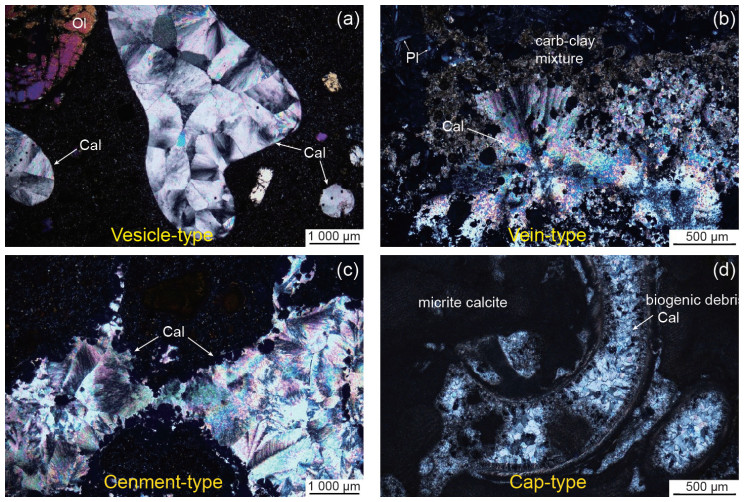
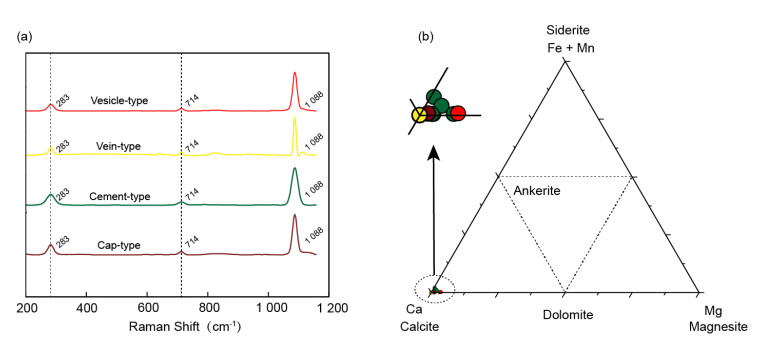
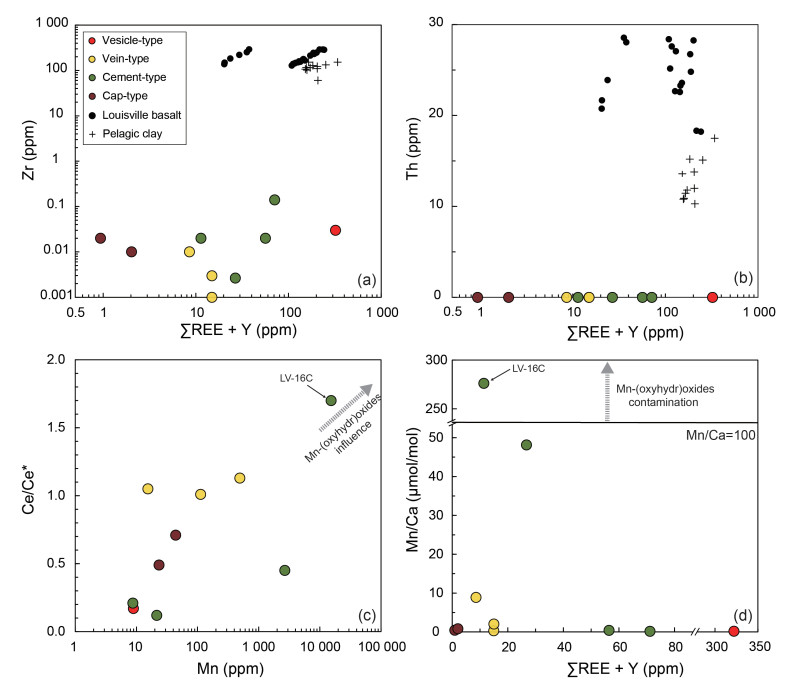
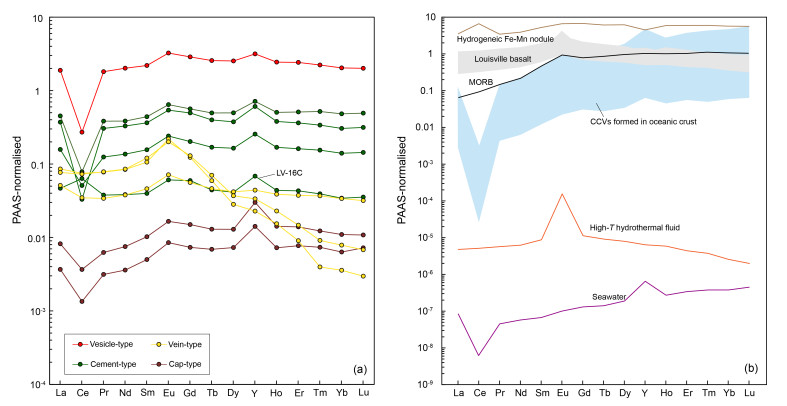
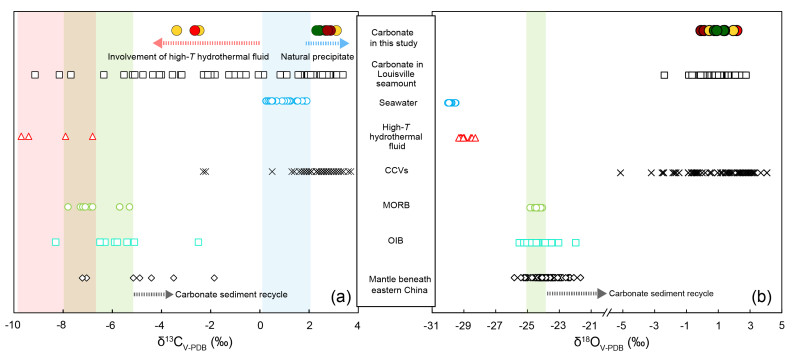
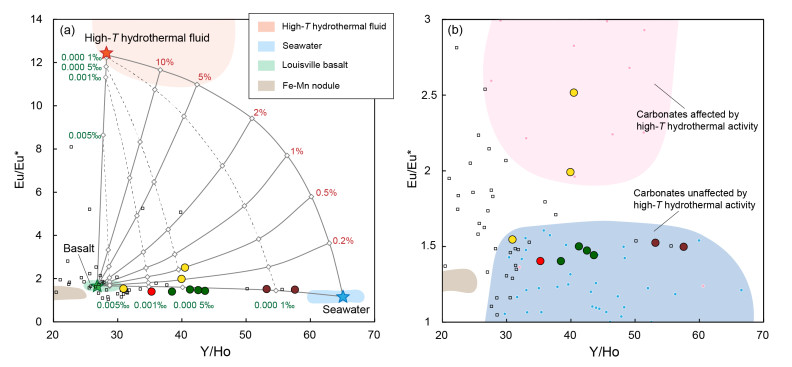
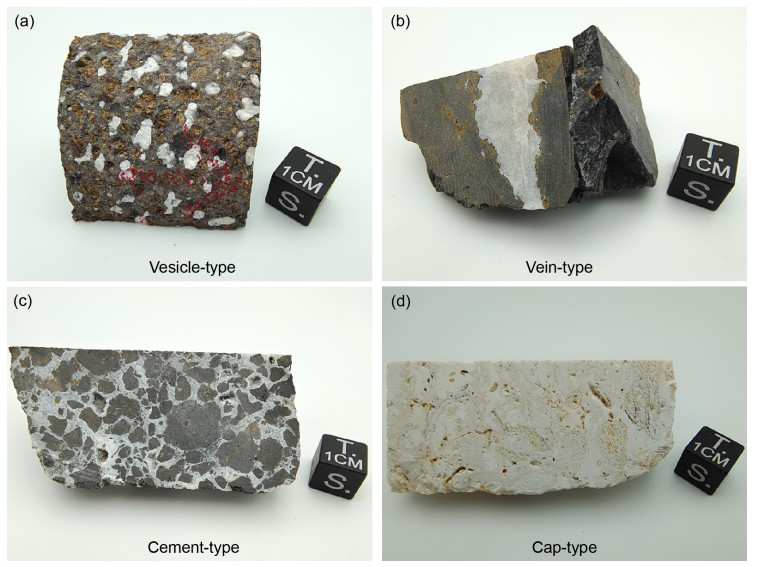
Carbonate, present in the marine sediments, oceanic crust and seamounts, can be transported into the mantle via subduction, playing a crucial role in deep carbon cycling. However, the characteristics and origin of carbonate in seamounts are rarely studied. Here we focus on the carbonates from the Louisville Seamount chain in the southwestern Pacific Ocean, which were drilled by the IODP Expedition 330. These carbonates are predominantly composed of calcite, and can be divided into vesicle-type, vein-type, cement-type, and cap-type. The vein-type carbonates show high Eu/Eu*, indicating the possible influence of high-temperature hydrothermal fluid. In contrast, the rare earth elemental (with high Y/Ho) and carbon-oxygen isotopic signatures of other types of carbonates are generally similar to those of carbonates found within the oceanic crust, indicating that they are also precipitated from the seawater driven by water-rock interaction. A low-temperature water-rock interaction is suggested since these carbonates are precipitated at a temperature of 4.1–14.5 ℃. Due to the high δ13CVPDB and δ18OVPDB for these carbonates in the seamount, the recycling of seamount is thus suggested to be a potential candidate for contributing the mantle source of intraplate alkaline basalts in certain regions, such as the Cenozoic basalts in eastern China.

| Abbott, A. N., Haley, B. A., McManus, J., et al., 2015. The Sedimentary Flux of Dissolved Rare Earth Elements to the Ocean. Geochimica et Cosmochimica Acta, 154: 186–200. https://doi.org/10.1016/j.gca.2015.01.010 |
| Albers, E., Jöns, S., Gerdes, A., et al., 2023. Timing of Carbon Uptake by Oceanic Crust Determined by Rock Reactivity. Geology, 51(9): 875–879. https://doi.org/10.1130/g51238.1 |
| Alt, J. C., Teagle, D. A. H., 1999. The Uptake of Carbon during Alteration of Ocean Crust. Geochimica et Cosmochimica Acta, 63(10): 1527–1535. https://doi.org/10.1016/S0016-7037(99)00123-4 |
| Alt, J. C., Teagle, D. A. H., 2003. Hydrothermal Alteration of Upper Oceanic Crust Formed at a Fast-Spreading Ridge: Mineral, Chemical, and Isotopic Evidence from ODP Site 801. Chemical Geology, 201(3/4): 191–211. https://doi.org/10.1016/S0009-2541(03)00201-8 |
| Arzilli, F., Burton, M., La Spina, G., et al., 2023. Decarbonation of Subducting Carbonate-Bearing Sediments and Basalts of Altered Oceanic Crust: Insights into Recycling of CO2 through Volcanic Arcs. Earth and Planetary Science Letters, 602: 117945. https://doi.org/10.1016/j.epsl.2022.117945 |
| Aubaud, C., Pineau, F., Hékinian, R., et al., 2006. Carbon and Hydrogen Isotope Constraints on Degassing of CO2 and H2O in Submarine Lavas from the Pitcairn Hotspot (South Pacific). Geophysical Research Letters, 33(2): L02308. https://doi.org/10.1029/2005GL024907 |
| Bach, W., Peucker-Ehrenbrink, B., Hart, S. R., et al., 2003. Geochemistry of Hydrothermally Altered Oceanic Crust: DSDP/ODP Hole 504B—Implications for Seawater-Crust Exchange Budgets and Sr- and Pb-Isotopic Evolution of the Mantle. Geochemistry, Geophysics, Geosystems, 4(3): 2002GC000419. https://doi.org/10.1029/2002GC000419 |
| Bach, W., Rosner, M., Jöns, N., et al., 2011. Carbonate Veins Trace Seawater Circulation during Exhumation and Uplift of Mantle Rock: Results from ODP Leg 209. Earth and Planetary Science Letters, 311(3/4): 242–252. https://doi.org/10.1016/j.epsl.2011.09.021 |
| Bao, S. X., Zhou, H. Y., Peng, X. T., et al., 2008. Geochemistry of REE and Yttrium in Hydrothermal Fluids from the Endeavour Segment, Juan de Fuca Ridge. Geochemical Journal, 42(4): 359–370. https://doi.org/10.2343/geochemj.42.359 |
| Bau, M., 1991. Rare-Earth Element Mobility during Hydrothermal and Metamorphic Fluid-Rock Interaction and the Significance of the Oxidation State of Europium. Chemical Geology, 93(3/4): 219–230. https://doi.org/10.1016/0009-2541(91)90115-8 |
| Bau, M., 1996. Controls on the Fractionation of Isovalent Trace Elements in Magmatic and Aqueous Systems: Evidence from Y/Ho, Zr/Hf, and Lanthanide Tetrad Effect. Contributions to Mineralogy and Petrology, 123(3): 323–333. https://doi.org/10.1007/s004100050159 |
| Bau, M., Balan, S., Schmidt, K., et al., 2010. Rare Earth Elements in Mussel Shells of the Mytilidae Family as Tracers for Hidden and Fossil High-Temperature Hydrothermal Systems. Earth and Planetary Science Letters, 299(3/4): 310–316. https://doi.org/10.1016/j.epsl.2010.09.011 |
| Bau, M., Dulski, P., 1999. Comparing Yttrium and Rare Earths in Hydrothermal Fluids from the Mid-Atlantic Ridge: Implications for Y and REE Behaviour during Near-Vent Mixing and for the Y/Ho Ratio of Proterozoic Seawater. Chemical Geology, 155(1/2): 77–90. https://doi.org/10.1016/S0009-2541(98)00142-9 |
| Bau, M., Möller, P., 1992. Rare Earth Element Fractionation in Metamorphogenic Hydrothermal Calcite, Magnesite and Siderite. Mineralogy and Petrology, 45(3): 231–246. https://doi.org/10.1007/BF01163114 |
| Bau, M., Möller, P., Dulski, P., 1997. Yttrium and Lanthanides in Eastern Mediterranean Seawater and Their Fractionation during Redox-Cycling. Marine Chemistry, 56(1/2): 123–131. https://doi.org/10.1016/S0304-4203(96)00091-6 |
| Bau, M., Schmidt, K., Koschinsky, A., et al., 2014. Discriminating between Different Genetic Types of Marine Ferro-Manganese Crusts and Nodules Based on Rare Earth Elements and Yttrium. Chemical Geology, 381: 1–9. https://doi.org/10.1016/j.chemgeo.2014.05.004 |
| Beier, C., Turner, S. P., Haase, K. M., et al., 2017. Trace Element and Isotope Geochemistry of the Northern and Central Tongan Islands with an Emphasis on the Genesis of High Nb/Ta Signatures at the Northern Volcanoes of Tafahi and Niuatoputapu. Journal of Petrology, 58(6): 1073–1106. https://doi.org/10.1093/petrology/egx047 |
| Cai, R. H., Xu, S., Ionov, D. A., et al., 2022. Carbonated Big Mantle Wedge Extending to the NE Edge of the Stagnant Pacific Slab: Constraints from Late Mesozoic-Cenozoic Basalts from far Eastern Russia. Journal of Earth Science, 33(1): 121–132. https://doi.org/10.1007/s12583-021-1516-x |
| Chen, H., Xia, Q. K., Ingrin, J., et al., 2017. Heterogeneous Source Components of Intraplate Basalts from NE China Induced by the Ongoing Pacific Slab Subduction. Earth and Planetary Science Letters, 459: 208–220. https://doi.org/10.1016/j.epsl.2016.11.030 |
| Chen, Y. F., Ussler, W., Haflidason, H., et al., 2010. Sources of Methane Inferred from Pore-Water δ13C of Dissolved Inorganic Carbon in Pockmark G11, Offshore Mid-Norway. Chemical Geology, 275(3/4): 127–138. https://doi.org/10.1016/j.chemgeo.2010.04.013 |
|
Cheng, Q., Park, K. -H., MacDougall, J. D., et al., 2013. Isotopic Evidence for a Hotspot Origin of the Louisville Seamount Chain. In: Keating, B. H., Fryer, P., Batiza, R., et al., eds., Seamounts, Islands, and Atolls. American Geophysical Union, Washington, DC. 43: 283–296. |
| Coggon, R. M., Teagle, D. A. H., Cooper, M. J., et al., 2004. Linking Basement Carbonate Vein Compositions to Porewater Geochemistry across the Eastern Flank of the Juan de Fuca Ridge, ODP Leg 168. Earth and Planetary Science Letters, 219(1/2): 111–128. https://doi.org/10.1016/S0012-821X(03)00697-6 |
| Coggon, R. M., Teagle, D. A. H., Smith-Duque, C. E., et al., 2010. Reconstructing Past Seawater Mg/Ca and Sr/Ca from Mid-Ocean Ridge Flank Calcium Carbonate Veins. Science, 327(5969): 1114–1117. https://doi.org/10.1126/science.1182252 |
| Coogan, L. A., Gillis, K. M., 2018. Low-Temperature Alteration of the Seafloor: Impacts on Ocean Chemistry. Annual Review of Earth and Planetary Sciences, 46: 21–45. https://doi.org/10.1146/annurev-earth-082517-010027 |
| Cui, H., Kaufman, A. J., Xiao, S. H., et al., 2017. Was the Ediacaran Shuram Excursion a Globally Synchronized Early Diagenetic Event? Insights from Methane-Derived Authigenic Carbonates in the Uppermost Doushantuo Formation, South China. Chemical Geology, 450: 59–80. https://doi.org/10.1016/j.chemgeo.2016.12.010 |
| Dasgupta, R., Hirschmann, M. M., 2010. The Deep Carbon Cycle and Melting in Earth’s Interior. Earth and Planetary Science Letters, 298(1/2): 1–13. https://doi.org/10.1016/j.epsl.2010.06.039 |
| De Baar, H. J. W., Brewer, P. G., Bacon, M. P., 1985. Anomalies in Rare Earth Distributions in Seawater: Gd and Tb. Geochimica et Cosmochimica Acta, 49(9): 1961–1969. https://doi.org/10.1016/0016-7037(85)90090-0 |
| Dias, Á. S., Früh-Green, G. L., Bernasconi, S. M., et al., 2011. Geochemistry and Stable Isotope Constraints on High-Temperature Activity from Sediment Cores of the Saldanha Hydrothermal Field. Marine Geology, 279(1/2/3/4): 128–140. https://doi.org/10.1016/j.margeo.2010.10.017 |
| Douville, E., Bienvenu, P., Charlou, J. L., et al., 1999. Yttrium and Rare Earth Elements in Fluids from Various Deep-Sea Hydrothermal Systems. Geochimica et Cosmochimica Acta, 63(5): 627–643. https://doi.org/10.1016/S0016-7037(99)00024-1 |
| Edwards, H. G. M., Villar, S. E. J., Jehlicka, J., et al., 2005. FT-Raman Spectroscopic Study of Calcium-Rich and Magnesium-Rich Carbonate Minerals. Spectrochimica Acta Part A: Molecular and Biomolecular Spectroscopy, 61(10): 2273–2280. https://doi.org/10.1016/j.saa.2005.02.026 |
| Elderfield, H., Greaves, M. J., 1982. The Rare Earth Elements in Seawater. Nature, 296(5854): 214–219. https://doi.org/10.1038/296214a0 |
| Elderfield, H., Upstill-Goddard, R., Sholkovitz, E. R., 1990. The Rare Earth Elements in Rivers, Estuaries, and Coastal Seas and Their Significance to the Composition of Ocean Waters. Geochimica et Cosmochimica Acta, 54(4): 971–991. https://doi.org/10.1016/0016-7037(90)90432-K |
| Elderfield, H., Wheat, C. G., Mottl, M. J., et al., 1999. Fluid and Geochemical Transport through Oceanic Crust: a Transect across the Eastern Flank of the Juan de Fuca Ridge. Earth and Planetary Science Letters, 172(1/2): 151–165. https://doi.org/10.1016/S0012-821X(99)00191-0 |
| Evans, W. C., White, L. D., Rapp, J. B., 1988. Geochemistry of Some Gases in Hydrothermal Fluids from the Southern Juan de Fuca Ridge. Journal of Geophysical Research: Solid Earth, 93(B12): 15305–15313. https://doi.org/10.1029/JB093iB12p15305 |
| Exley, R. A., Mattey, D. P., Clague, D. A., et al., 1986. Carbon Isotope Systematics of a Mantle “Hotspot”: A Comparison of Loihi Seamount and MORB Glasses. Earth and Planetary Science Letters, 78(2/3): 189–199. https://doi.org/10.1016/0012-821X(86)90060-9 |
| Fagel, N., André, L., Debrabant, P., 1997. Multiple Seawater-Derived Geochemical Signatures in Indian Oceanic Pelagic Clays. Geochimica et Cosmochimica Acta, 61(5): 989–1008. https://doi.org/10.1016/S0016-7037(96)00392-4 |
| Feng, D., Cheng, M., Kiel, S., et al., 2015. Using Bathymodiolus Tissue Stable Carbon, Nitrogen and Sulfur Isotopes to Infer Biogeochemical Process at a Cold Seep in the South China Sea. Deep Sea Research Part I: Oceanographic Research Papers, 104: 52–59. https://doi.org/10.1016/j.dsr.2015.06.011 |
| Fisher, A. T., Geoffrey Wheat, C., 2010. Seamounts as Conduits for Massive Fluid, Heat, and Solute Fluxes on Ridge Flanks. Oceanography, 23: 74–87. https://doi.org/10.5670/oceanog.2010.63 |
| Garcia, M. O., Muenow, D. W., Aggrey, K. E., et al., 1989. Major Element, Volatile, and Stable Isotope Geochemistry of Hawaiian Submarine Tholeiitic Glasses. Journal of Geophysical Research: Solid Earth, 94(B8): 10525–10538. https://doi.org/10.1029/JB094iB08p10525 |
| Gerlach, T. M., Thomas, D. M., 1986. Carbon and Sulphur Isotopic Composition of Kilauea Parental Magma. Nature, 319(6053): 480–483. https://doi.org/10.1038/319480a0 |
| Gillis, K. M., Coogan, L. A., 2011. Secular Variation in Carbon Uptake into the Ocean Crust. Earth and Planetary Science Letters, 302(3/4): 385–392. https://doi.org/10.1016/j.epsl.2010.12.030 |
| Godfrey Fitton, J., Williams, R., Barry, T. L., et al., 2021. The Role of Lithosphere Thickness in the Formation of Ocean Islands and Seamounts: Contrasts between the Louisville and Emperor-Hawaiian Hotspot Trails. Journal of Petrology, 61(11/12): egaa111. https://doi.org/10.1093/petrology/egaa111 |
| Gong, Q. L., Li, F., Lu, C. J., et al., 2021. Tracing Seawater- and Terrestrial-Sourced REE Signatures in Detritally Contaminated, Diagenetically Altered Carbonate Rocks. Chemical Geology, 570: 120169. https://doi.org/10.1016/j.chemgeo.2021.120169 |
| Gysi, A. P., Stefánsson, A., 2011. CO2-Water-Basalt Interaction. Numerical Simulation of Low Temperature CO2 Sequestration into Basalts. Geochimica et Cosmochimica Acta, 75(17): 4728–4751. https://doi.org/10.1016/j.gca.2011.05.037 |
| Hahm, D., Hilton, D. R., Cho, M., et al., 2008. Geothermal He and CO2 Variations at Changbaishan Intra-Plate Volcano (NE China) and the Nature of the Sub-Continental Lithospheric Mantle. Geophysical Research Letters, 35(22): L22304. https://doi.org/10.1029/2008GL035955 |
| Halevy, I., Bachan, A., 2017. The Geologic History of Seawater pH. Science, 355(6329): 1069–1071. https://doi.org/10.1126/science.aal4151 |
| Hanyu, T., 2014. Deep Plume Origin of the Louisville Hotspot: Noble Gas Evidence. Geochemistry, Geophysics, Geosystems, 15(3): 565–576. https://doi.org/10.1002/2013GC005085 |
| Hardie, L. A., 1996. Secular Variation in Seawater Chemistry: an Explanation for the Coupled Secular Variation in the Mineralogies of Marine Limestones and Potash Evaporites over the Past 600 M. y. Geology, 24(3): 279.https://doi.org/10.1130/0091-7613(1996)024<0279:svisca>2.3.co;2 doi: 10.1130/0091-7613(1996)024<0279:svisca>2.3.co;2 |
|
Hawkins, J. W., Lonsdale, P. F., Batiza, R., 1987. Petrologic Evolution of the Louisville Seamount Chain. In: Keating, B. H., Fryer, P., Batiza, R., et al., eds., Seamounts, Islands, and Atolls. American Geophysical Union, Washington, DC. 43: 235–254. |
| Herman, R. G., Bogdan, C. E., Sommer, A. J., et al., 1987. Discrimination among Carbonate Minerals by Raman Spectroscopy Using the Laser Microprobe. Applied Spectroscopy, 41(3): 437–440. https://doi.org/10.1366/0003702874448841 |
| Hilton, D. R., McMurtry, G. M., Kreulen, R., 1997. Evidence for Extensive Degassing of the Hawaiian Mantle Plume from Helium-Carbon Relationships at Kilauea Volcano. Geophysical Research Letters, 24(23): 3065–3068. https://doi.org/10.1029/97GL03046 |
| Huang, J., Li, S. G., Xiao, Y. L., et al., 2015. Origin of Low δ26Mg Cenozoic Basalts from South China Block and Their Geodynamic Implications. Geochimica et Cosmochimica Acta, 164: 298–317. https://doi.org/10.1016/j.gca.2015.04.054 |
| Ishibashi, J. I., Wakita, H., Nojiri, Y., et al., 1994. Helium and Carbon Geochemistry of Hydrothermal Fluids from the North Fiji Basin Spreading Ridge (Southwest Pacific). Earth and Planetary Science Letters, 128(3/4): 183–197. https://doi.org/10.1016/0012-821X(94)90144-9 |
| Kendrick, M. A., Zhao, J. X., Feng, Y. X., 2022. Early Accretion and Prolonged Carbonation of the Pacific Ocean’s Oldest Crust. Geology, 50(11): 1270–1275. https://doi.org/10.1130/g49985.1 |
| Kim, S. T., O’Neil, J. R., 1997. Equilibrium and Nonequilibrium Oxygen Isotope Effects in Synthetic Carbonates. Geochimica et Cosmochimica Acta, 61(16): 3461–3475. https://doi.org/10.1016/S0016-7037(97)00169-5 |
| Koppers, A. A. P., Duncan, R. A., Steinberger, B., 2004. Implications of a Nonlinear 40Ar/39Ar Age Progression along the Louisville Seamount Trail for Models of Fixed and Moving Hot Spots. Geochemistry, Geophysics, Geosystems, 5(6): 2003GC000671. https://doi.org/10.1029/2003GC000671 |
|
Koppers, A. A. P., Yamazaki, T., Geldmacher, J., et al., 2012. Louisville Seamount Trail. In: Proceeings of the Integrated Ocean Drilling Program Volume 330. Integrated Ocean Drilling Program Management International, Inc., for the Integrated Ocean Drilling Program. |
| Kraft, S., Frank, M., Hathorne, E. C., et al., 2013. Assessment of Seawater Nd Isotope Signatures Extracted from Foraminiferal Shells and Authigenic Phases of Gulf of Guinea Sediments. Geochimica et Cosmochimica Acta, 121: 414–435. https://doi.org/10.1016/j.gca.2013.07.029 |
| Levitt, N. P., Eiler, J. M., Romanek, C. S., et al., 2018. Near Equilibrium 13C-18O Bonding during Inorganic Calcite Precipitation under Chemo-Stat Conditions. Geochemistry, Geophysics, Geosystems, 19(3): 901–920. https://doi.org/10.1002/2017GC007089 |
| Li, H. Y., Xu, Y. G., Ryan, J. G., et al., 2016. Olivine and Melt Inclusion Chemical Constraints on the Source of Intracontinental Basalts from the Eastern North China Craton: Discrimination of Contributions from the Subducted Pacific Slab. Geochimica et Cosmochimica Acta, 178: 1–19. https://doi.org/10.1016/j.gca.2015.12.032 |
| Li, S. G., Yang, W., Ke, S., et al., 2017. Deep Carbon Cycles Constrained by a Large-Scale Mantle Mg Isotope Anomaly in Eastern China. National Science Review, 4(1): 111–120. https://doi.org/10.1093/nsr/nww070 |
| Liu, J. Q., Chen, L. H., Zeng, G., et al., 2016. Lithospheric Thickness Controlled Compositional Variations in Potassic Basalts of Northeast China by Melt-Rock Interactions. Geophysical Research Letters, 43(6): 2582–2589. https://doi.org/10.1002/2016GL068332 |
| Liu, X. M., Hardisty, D. S., Lyons, T. W., et al., 2019. Evaluating the Fidelity of the Cerium Paleoredox Tracer during Variable Carbonate Diagenesis on the Great Bahamas Bank. Geochimica et Cosmochimica Acta, 248: 25–42. https://doi.org/10.1016/j.gca.2018.12.028 |
| Lonsdale, P., 1988. Geography and History of the Louisville Hotspot Chain in the Southwest Pacific. Journal of Geophysical Research: Solid Earth, 93(B4): 3078–3104. https://doi.org/10.1029/JB093iB04p03078 |
| Müller, G., Irion, G., Förstner, U., 1972. Formation and Diagenesis of Inorganic Ca-Mg Carbonates in the Lacustrine Environment. Naturwissenschaften, 59(4): 158–164. https://doi.org/10.1007/BF00637354 |
|
Orcutt, B. N., Daniel, I., Dasgupta, R., et al., 2019. Introduction to Deep Carbon: Past to Present. In: Orcutt, B. N., Daniel, I., Dasgupta, R., eds., Deep Carbon. Cambridge University Press, Cambridge. 1–3. |
| Planavsky, N., Bekker, A., Rouxel, O. J., et al., 2010. Rare Earth Element and Yttrium Compositions of Archean and Paleoproterozoic Fe Formations Revisited: New Perspectives on the Significance and Mechanisms of Deposition. Geochimica et Cosmochimica Acta, 74(22): 6387–6405. https://doi.org/10.1016/j.gca.2010.07.021 |
|
Plank, T., 2014. The Chemical Composition of Subducting Sediments. In: Holland, H. D., Turekian, K. K., eds., Treatise on Geochemistry. Elsevier, Amsterdam. 607–629. |
| Plank, T., Langmuir, C. H., 1998. The Chemical Composition of Subducting Sediment and Its Consequences for the Crust and Mantle. Chemical Geology, 145(3/4): 325–394. https://doi.org/10.1016/S0009-2541(97)00150-2 |
| Plank, T., Manning, C. E., 2019. Subducting Carbon. Nature, 574(7778): 343–352. https://doi.org/10.1038/s41586-019-1643-z |
| Quandt, D., Micheuz, P., Kurz, W., et al., 2019. Geochemistry of Vein Calcites Hosted in the Troodos Pillow Lavas and Their Implications for the Timing and Physicochemical Environment of Fracturing, Fluid Circulation, and Vein Mineral Growth. Geochemistry, Geophysics, Geosystems, 20(12): 5913–5938. https://doi.org/10.1029/2019GC008369 |
| Quandt, D., Micheuz, P., Kurz, W., et al., 2020. Geochemistry and Microtextures of Vein Calcites Pervading the Izu-Bonin Forearc and Rear Arc Crust: New Insights from IODP Expeditions 352 and 351. Geochemistry, Geophysics, Geosystems, 21(2): e2019GC008745. https://doi.org/10.1029/2019GC008745 |
|
Rogers, A. D., 2019. Threats to Seamount Ecosystems and Their Management. In: Sheppard, C. ed., World Seas: An Environmental Evaluation. Elsevier, Amsterdam. 427–451. |
| Sakuyama, T., Tian, W., Kimura, J. I., et al., 2013. Melting of Dehydrated Oceanic Crust from the Stagnant Slab and of the Hydrated Mantle Transition Zone: Constraints from Cenozoic Alkaline Basalts in Eastern China. Chemical Geology, 359: 32–48. https://doi.org/10.1016/j.chemgeo.2013.09.012 |
|
Schmidt, G. A., Bigg, G. R., Rohling, E. J., 1999. Global Seawater Oxygen-18 Database: v1.22. National Aeronautics and Space Administration, Goddard Institute for Space Studies, New York. |
| Shanks, W. C., 2001. Stable Isotopes in Seafloor Hydrothermal Systems: Vent Fluids, Hydrothermal Deposits, Hydrothermal Alteration, and Microbial Processes. Reviews in Mineralogy and Geochemistry, 43(1): 469–525. https://doi.org/10.2138/gsrmg.43.1.469 |
| Sholkovitz, E. R., Landing, W. M., Lewis, B. L., 1994. Ocean Particle Chemistry: The Fractionation of Rare Earth Elements between Suspended Particles and Seawater. Geochimica et Cosmochimica Acta, 58(6): 1567–1579. https://doi.org/10.1016/0016-7037(94)90559-2 |
| Storch, B., Regelous, M., Noebel, K. M., et al., 2022. Extreme Geochemical Heterogeneity beneath the North Tonga Arc: Interaction of a Subduction Zone with Intraplate Seamount Chains. Chemical Geology, 603: 120903. https://doi.org/10.1016/j.chemgeo.2022.120903 |
| Sun, S. S., McDonough, W. F., 1989. Chemical and Isotopic Systematics of Oceanic Basalts: Implications for Mantle Composition and Processes. Geological Society, London, Special Publications, 42(1): 313–345. https://doi.org/10.1144/gsl.sp.1989.042.01.19 |
| Tanaka, K., Tani, Y., Takahashi, Y., et al., 2010. A Specific Ce Oxidation Process during Sorption of Rare Earth Elements on Biogenic Mn Oxide Produced by Acremonium Sp. Strain KR21-2. Geochimica et Cosmochimica Acta, 74(19): 5463–5477. https://doi.org/10.1016/j.gca.2010.07.010 |
|
Tarduno, J. A., Duncan, R. A., Scholl, D. W., et al., 2002. Leg 197 Summary. In: Proceedings of the Ocean Drilling Program, Initial Reports. 1–92. |
| Tessier, A., Campbell, P. G. C., Bisson, M., 1979. Sequential Extraction Procedure for the Speciation of Particulate Trace Metals. Analytical Chemistry, 51(7): 844–851. https://doi.org/10.1021/ac50043a017 |
| Timm, C., Bassett, D., Graham, I. J., et al., 2013. Louisville Seamount Subduction and Its Implication on Mantle Flow beneath the Central Tonga-Kermadec Arc. Nature Communications, 4: 1720. https://doi.org/10.1038/ncomms2702 |
| Ulrich, M., Hémond, C., Nonnotte, P., et al., 2012. OIB/Seamount Recycling as a Possible Process for E-MORB Genesis. Geochemistry, Geophysics, Geosystems, 13(6): Q0AC19. https://doi.org/10.1029/2012GC004078 |
| Wang, X. J., Chen, L. H., Hofmann, A. W., et al., 2017. Mantle Transition Zone-Derived EM1 Component beneath NE China: Geochemical Evidence from Cenozoic Potassic Basalts. Earth and Planetary Science Letters, 465: 16–28. https://doi.org/10.1016/j.epsl.2017.02.028 |
| Wang, Z. Z., Liu, S. A., Chen, L. H., et al., 2018. Compositional Transition in Natural Alkaline Lavas through Silica-Undersaturated Melt-Lithosphere Interaction. Geology, 46(9): 771–774. https://doi.org/10.1130/g45145.1 |
| Wanless, V. D., Perfit, M. R., Ridley, W. I., et al., 2011. Volatile Abundances and Oxygen Isotopes in Basaltic to Dacitic Lavas on Mid-Ocean Ridges: The Role of Assimilation at Spreading Centers. Chemical Geology, 287(1/2): 54–65. https://doi.org/10.1016/j.chemgeo.2011.05.017 |
| Watkins, J. M., Hunt, J. D., 2015. A Process-Based Model for Non-Equilibrium Clumped Isotope Effects in Carbonates. Earth and Planetary Science Letters, 432: 152–165. https://doi.org/10.1016/j.epsl.2015.09.042 |
| Watts, A. B., Weissel, J. K., Duncan, R. A., et al., 1988. Origin of the Louisville Ridge and Its Relationship to the Eltanin Fracture Zone System. Journal of Geophysical Research: Solid Earth, 93(B4): 3051–3077. https://doi.org/10.1029/JB093iB04p03051 |
| Wei, G. -Y., Ling, H. -F., Shields, G. A., et al., 2021. Revisiting Stepwise Ocean Oxygenation with Authigenic Barium Enrichments in Marine Mudrocks. Geology, 49(9): 1059–1063. https://doi.org/10.1130/g48825.1 |
| Wei, G. -Y., Planavsky, N. J., Tarhan, L. G., et al., 2018. Marine Redox Fluctuation as a Potential Trigger for the Cambrian Explosion. Geology, 46(7): 587–590. https://doi.org/10.1130/g40150.1 |
| Wheat, C. G., McManus, J., Mottl, M. J., et al., 2003. Oceanic Phosphorus Imbalance: Magnitude of the Mid-Ocean Ridge Flank Hydrothermal Sink. Geophysical Research Letters, 30(17): 2003GL017318. https://doi.org/10.1029/2003GL017318 |
| White, S. N., 2009. Laser Raman Spectroscopy as a Technique for Identification of Seafloor Hydrothermal and Cold Seep Minerals. Chemical Geology, 259(3/4): 240–252. https://doi.org/10.1016/j.chemgeo.2008.11.008 |
| Whiticar, M. J., 1999. Carbon and Hydrogen Isotope Systematics of Bacterial Formation and Oxidation of Methane. Chemical Geology, 161(1/2/3): 291–314. https://doi.org/10.1016/S0009-2541(99)00092-3 |
| Xu, R., Liu, Y. S., Wang, X. C., et al., 2020. Generation of Continental Intraplate Alkali Basalts and Implications for Deep Carbon Cycle. Earth-Science Reviews, 201: 103073. https://doi.org/10.1016/j.earscirev.2019.103073 |
| Yesson, C., Clark, M. R., Taylor, M. L., et al., 2011. The Global Distribution of Seamounts Based on 30 Arc Seconds Bathymetry Data. Deep Sea Research Part I: Oceanographic Research Papers, 58(4): 442–453. https://doi.org/10.1016/j.dsr.2011.02.004 |
| Zeng, G., Chen, L. H., Hofmann, A. W., et al., 2021. Nephelinites in Eastern China Originating from the Mantle Transition Zone. Chemical Geology, 576: 120276. https://doi.org/10.1016/j.chemgeo.2021.120276 |
| Zeng, G., Chen, L. H., Xu, X. S., et al., 2010. Carbonated Mantle Sources for Cenozoic Intra-Plate Alkaline Basalts in Shandong, North China. Chemical Geology, 273(1/2): 35–45. https://doi.org/10.1016/j.chemgeo.2010.02.009 |
| Zhang, C., Pu, H. X., Liu, J. Q., et al., 2025. Coexisting Carbonatite and Silicate Melt Inclusions in the Cretaceous Volcanic Rock from the Central Great Xing’an Range, Northeast China: Evidence for Recycled Carbonate from Subducted Paleo-Pacific Plate. Journal of Earth Science, 36(1): 364–372. https://doi.org/10.1007/s12583-024-0135-8 |
| Zhang, H. L., Zeng, G., Liu, J. Q., et al., 2023. Carbonated Eclogitic Component beneath Eastern China Revealed by Olivine Phenocrysts in Nephelinites. Chemical Geology, 640: 121744. https://doi.org/10.1016/j.chemgeo.2023.121744 |
| Zhang, J., Nozaki, Y., 1996. Rare Earth Elements and Yttrium in Seawater: ICP-MS Determinations in the East Caroline, Coral Sea, and South Fiji Basins of the Western South Pacific Ocean. Geochimica et Cosmochimica Acta, 60(23): 4631–4644. https://doi.org/10.1016/S0016-7037(96)00276-1 |
| Zhao, M. Y., Zheng, Y. F., 2014. Marine Carbonate Records of Terrigenous Input into Paleotethyan Seawater: Geochemical Constraints from Carboniferous Limestones. Geochimica et Cosmochimica Acta, 141: 508–531. https://doi.org/10.1016/j.gca.2014.07.001 |
| Zhao, Y. Y., Wei, W., Santosh, M., et al., 2022. A Review of Retrieving Pristine Rare Earth Element Signatures from Carbonates. Palaeogeography, Palaeoclimatology, Palaeoecology, 586: 110765. https://doi.org/10.1016/j.palaeo.2021.110765 |
| Zhao, Y. Y., Zhao, M. Y., Li, S. Z., 2018. Evidences of Hydrothermal Fluids Recorded in Microfacies of the Ediacaran Cap Dolostone: Geochemical Implications in South China. Precambrian Research, 306: 1–21. https://doi.org/10.1016/j.precamres.2017.12.028 |
| Zhong, Y., Chen, L. H., Wang, X. J., et al., 2017. Magnesium Isotopic Variation of Oceanic Island Basalts Generated by Partial Melting and Crustal Recycling. Earth and Planetary Science Letters, 463: 127–135. https://doi.org/10.1016/j.epsl.2017.01.040 |
| Zou, Z. Q., Wang, Z. C., Foley, S., et al., 2022. Origin of Low-MgO Primitive Intraplate Alkaline Basalts from Partial Melting of Carbonate-Bearing Eclogite Sources. Geochimica et Cosmochimica Acta, 324: 240–261. https://doi.org/10.1016/j.gca.2022.02.022 |
Figures(7)
Copyright © 2013-2020 Journal of Earth Science 鄂ICP备15021562号-2
Tel: +86-27-67885075 Fax: +86-27-67885075 E-mail: xbb@cug.edu.cn
Address: Editorial Office of Journal, China University of Geosciences, Yujiashan, Wuhan, Hubei 430074, P. R. China
Supported by:
Beijing Renhe Information Technology Co. Ltd
E-mail:
info@rhhz.net


 DownLoad: