| Citation: | Ruiqi Chen, Wenjie Xu, Yingtao Hu, Yunmin Chen, Jinlong Li, Duanyang Zhuang. Feasibility Analysis of Hypergravity Experiment of Density-Driven Convection of Dissolved CO2. Journal of Earth Science, 2026, 37(1): 125-136. doi: 10.1007/s12583-024-0030-3

|
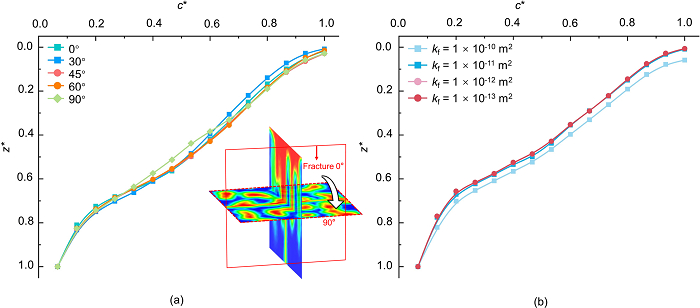
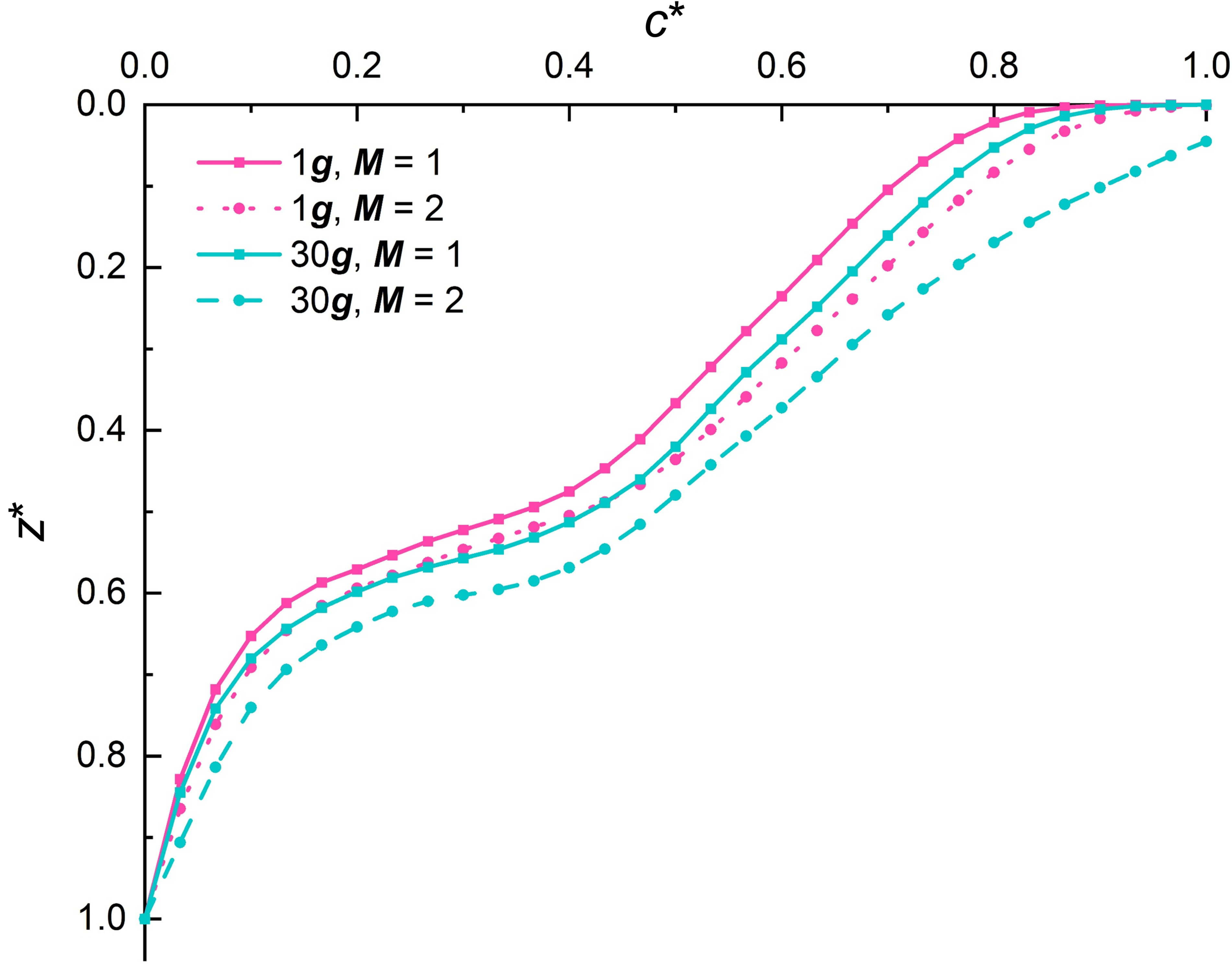
Dissolution trapping is one of the most promising mechanisms for safe geological carbon storage. Density-driven convection substantially accelerates the conversion of free-phase CO2 to the dissolved state, enhancing the sequestration safety. Since this process occurs on time scales of hundreds to thousands of years, reproducing it through conventional laboratory physical model tests is challenging. The hypergravity experiment reduces the model size and shortens the experimental time, enabling the modeling of gravity-driven flow processes at the field scale. However, it is uncertain whether the preferential flow effect caused by fractures can be reproduced in a hypergravity experiment. In this study, a three-dimensional discrete fracture-matrix model (3D-DFM) was used to evaluate the feasibility of hypergravity experiment of the transport of dissolved CO2 in fractured reservoirs. Numerical hypergravity tests were performed to examine the feasibility of modeling density-driven convection in homogeneous and heterogeneous media at different centrifuge accelerations. The hypergravity experiment can be used to study density-driven convection of dissolved CO2 at the field scale in homogeneous system. The numerical results show that the hypergravity experiment enables a faster breakthrough of plume and overestimates CO2 migration in the matrix surrounding the fractures.

| Agartan, E., Illangasekare, T. H., Vargas-Johnson, J., et al., 2020. Experimental Investigation of Assessment of the Contribution of Heterogeneous Semi-Confining Shale Layers on Mixing and Trapping of Dissolved CO2 in Deep Geologic Formations. International Journal of Greenhouse Gas Control, 93: 102888. https://doi.org/10.1016/j.ijggc.2019.102888 |
| Ali, M., Jha, N. K., Pal, N., et al., 2022. Recent Advances in Carbon Dioxide Geological Storage, Experimental Procedures, Influencing Parameters, and Future Outlook. Earth-Science Reviews, 225: 103895. https://doi.org/10.1016/j.earscirev.2021.103895 |
| Amann-Hildenbrand, A., Bertier, P., Busch, A., et al., 2013. Experimental Investigation of the Sealing Capacity of Generic Clay-Rich Caprocks. International Journal of Greenhouse Gas Control, 19: 620–641. https://doi.org/10.1016/j.ijggc.2013.01.040 |
| Celia, M. A., Bachu, S., Nordbotten, J. M., et al., 2015. Status of CO2 Storage in Deep Saline Aquifers with Emphasis on Modeling Approaches and Practical Simulations. Water Resources Research, 51(9): 6846–6892. https://doi.org/10.1002/2015wr017609 |
| Chen, R., Chen, Y., Xu, W., et al., 2022. The Influence of the Hypergravity Field during Bubble Ripening in Porous Media. Geophysical Research Letters, 49(10): e2021GL097005. https://doi.org/10.1029/2021gl097005 |
| Culligan, P. J., Banno, K., Barry, D. A., et al., 2002. Preferential Flow of a Nonaqueous Phase Liquid in Dry Sand. Journal of Geotechnical and Geoenvironmental Engineering, 128(4): 327–337. https://doi.org/10.1061/(asce)1090-0241(2002)128:4(327) |
| Culligan, P. J., Barry, D. A., 1998. Similitude Requirements for Modelling NAPL Movement with a Geotechnical Centrifuge. Proceedings of the Institution of Civil Engineers: Geotechnical Engineering, 131(3): 180–186. https://doi.org/10.1680/igeng.1998.30474 |
| Culligan, P. J., Barry, D. A., Parlange, J. Y., 1997. Scaling Unstable Infiltration in the Vadose Zone. Canadian Geotechnical Journal, 34(3): 466–470. https://doi.org/10.1139/t97-005 |
| De Paoli, M., 2021. Influence of Reservoir Properties on the Dynamics of a Migrating Current of Carbon Dioxide. Physics of Fluids, 33: 016602. https://doi.org/10.1063/5.0031632 |
| Diersch, H. J. G., Kolditz, O., 2002. Variable-Density Flow and Transport in Porous Media: Approaches and Challenges. Advances in Water Resources, 25(8/9/10/11/12): 899–944. https://doi.org/10.1016/S0309-1708(02)00063-5 |
| Emami-Meybodi, H., Hassanzadeh, H., Green, C. P., et al., 2015. Convective Dissolution of CO2 in Saline Aquifers: Progress in Modeling and Experiments. International Journal of Greenhouse Gas Control, 40: 238–266. https://doi.org/10.1016/j.ijggc.2015.04.003 |
| Ennis-King, J., Paterson, L., 2005. Role of Convective Mixing in the Long-Term Storage of Carbon Dioxide in Deep Saline Formations. SPE Journal, 10(3): 349–356. https://doi.org/10.2118/84344-pa |
| Faisal, T. F., Chevalier, S., Bernabe, Y., et al., 2015. Quantitative and Qualitative Study of Density Driven CO2 Mass Transfer in a Vertical Hele-Shaw Cell. International Journal of Heat and Mass Transfer, 81: 901–914. https://doi.org/10.1016/j.ijheatmasstransfer.2014.11.017 |
| Farajzadeh, R., Ranganathan, P., Zitha, P. L. J., et al., 2011. The Effect of Heterogeneity on the Character of Density-Driven Natural Convection of CO2 Overlying a Brine Layer. Advances in Water Resources, 34(3): 327–339. https://doi.org/10.1016/j.advwatres.2010.12.012 |
| Gilfillan, S. M. V., Lollar, B. S., Holland, G., et al., 2009. Solubility Trapping in Formation Water as Dominant CO2 Sink in Natural Gas Fields. Nature, 458(7238): 614–618. https://doi.org/10.1038/nature07852 |
| Graf, T., Therrien, R., 2007. Variable-Density Groundwater Flow and Solute Transport in Irregular 2D Fracture Networks. Advances in Water Resources, 30(3): 455–468. https://doi.org/10.1016/j.advwatres.2006.05.003 |
| Graf, T., Therrien, R., 2005. Variable-Density Groundwater Flow and Solute Transport in Porous Media Containing Nonuniform Discrete Fractures. Advances in Water Resources, 28(12): 1351–1367. https://doi.org/10.1016/j.advwatres.2005.04.011 |
| Guo, R. C., Sun, H. X., Wang, H. S., et al., 2023. Using 3D-Printed Fluidics to Study the Role of Permeability Heterogeneity on Miscible Density-Driven Convection in Porous Media. Advances in Water Resources, 178: 104496. https://doi.org/10.1016/j.advwatres.2023.104496 |
| Guo, R. C., Sun, H. X., Zhao, Q. Q., et al., 2021. A Novel Experimental Study on Density-Driven Instability and Convective Dissolution in Porous Media. Geophysical Research Letters, 48(23): e2021GL095619. https://doi.org/10.1029/2021GL095619 |
| Gurumoorthy, C., Singh, D. N., 2005. Centrifuge Modeling of Diffusion through Rock Mass. Journal of Testing and Evaluation, 33(1): 44–50. https://doi.org/10.1520/jte11434 |
| Hu, Y. T., Xu, W. J., Chen, Y. M., et al., 2024. Experimental Study on the Influence of Hypergravity on the Nonlinear Flow Behaviour in Rock Fracture. Rock Mechanics and Rock Engineering, 57(2): 961–978. https://doi.org/10.1007/s00603-023-03589-5 |
| Hu, Y. T., Xu, W. J., Zhan, L. T., et al., 2022. Modeling of Solute Transport in a Fracture-Matrix System with a Three-Dimensional Discrete Fracture Network. Journal of Hydrology, 605: 127333. https://doi.org/10.1016/j.jhydrol.2021.127333 |
| Hyman, J. D., Karra, S., Makedonska, N., et al., 2015. DfnWorks: A Discrete Fracture Network Framework for Modeling Subsurface Flow and Transport. Computers & Geosciences, 84: 10–19. https://doi.org/10.1016/j.cageo.2015.08.001 |
| Iding, M., Blunt, M. J., 2011. Enhanced Solubility Trapping of CO2 in Fractured Reservoirs. Energy Procedia, 4: 4961–4968. https://doi.org/10.1016/j.egypro.2011.02.466 |
| Iding, M., Ringrose, P., 2010. Evaluating the Impact of Fractures on the Performance of the in Salah CO2 Storage Site. International Journal of Greenhouse Gas Control, 4(2): 242–248. https://doi.org/10.1016/j.ijggc.2009.10.016 |
| Kim, M., Kim, K. Y., Han, W. S., et al., 2019. Density-Driven Convection in a Fractured Porous Media: Implications for Geological CO2 Storage. Water Resources Research, 55(7): 5852–5870. https://doi.org/10.1029/2019WR024822 |
| Kneafsey, T. J., Pruess, K., 2010. Laboratory Flow Experiments for Visualizing Carbon Dioxide-Induced, Density-Driven Brine Convection. Transport in Porous Media, 82(1): 123–139. https://doi.org/10.1007/s11242-009-9482-2 |
| Kolditz, O., Görke, U. -J., Shao, H., et al., 2012a. Thermo-Hydro-Mechanical-Chemical Processes in Porous Media: Benchmarks and Examples. Springer, Berlin, Heidelberg. https://doi.org/10.1007/978-3-642-27177-9 |
| Kolditz, O., Görke, U. -J., Shao, H., et al., 2012b. Thermo-Hydro-Mechanical-Chemical Processes in Fractured Porous Media. Lecture Notes in Computational Science and Engineering, 86: 1–6. https://doi.org/10.1007/978-3-642-27177-9_1 |
| Kolditz, O., Ratke, R., Diersch, H. G., et al., 1998. Coupled Groundwater Flow and Transport: 1. Verification of Variable Density Flow and Transport Models. Advances in Water Resources, 21(1): 27–46. https://doi.org/10.1016/S0309-1708(96)00034-6 |
| Krevor, S., Blunt, M. J., Benson, S. M., et al., 2015. Capillary Trapping for Geologic Carbon Dioxide Storage: From Pore Scale Physics to Field Scale Implications. International Journal of Greenhouse Gas Control, 40: 221–237. https://doi.org/10.1016/j.ijggc.2015.04.006 |
| Krevor, S., de Coninck, H., Gasda, S. E., et al., 2023. Subsurface Carbon Dioxide and Hydrogen Storage for a Sustainable Energy Future. Nature Reviews Earth & Environment, 4(2): 102–118. https://doi.org/10.1038/s43017-022-00376-8 |
| Krevor, S. C. M., Pini, R., Zuo, L., et al., 2012. Relative Permeability and Trapping of CO2 and Water in Sandstone Rocks at Reservoir Conditions. Water Resources Research, 48(2): 2011WR010859. https://doi.org/10.1029/2011WR010859 |
| Kumar, R. P., Singh, D. N., 2012. Geotechnical Centrifuge Modeling of Chloride Diffusion through Soils. International Journal of Geomechanics, 12(3): 327–332. https://doi.org/10.1061/(asce)gm.1943-5622.0000139 |
| Levy, L. C., Culligan, P. J., Germaine, J. T., 2002. Use of the Geotechnical Centrifuge as a Tool to Model Dense Nonaqueous Phase Liquid Migration in Fractures. Water Resources Research, 38(8): 34-1–34-12. https://doi.org/10.1029/2001WR000660 |
| Li, Y. Y., Zhang, Z. W., 2025. Stability Assessment of CO2 Geological Storage Based on a Fracture Network Model. Earth Science. https://doi.org/10.3799/dqkx.2025.240 (in Chinese with Abstract) |
| Ma, G. W., Li, T., Wang, Y., et al., 2019. Numerical Simulations of Nuclide Migration in Highly Fractured Rock Masses by the Unified Pipe-Network Method. Computers and Geotechnics, 111: 261–276. https://doi.org/10.1016/j.compgeo.2019.03.024 |
| Mahyapour, R., Mahmoodpour, S., Singh, M., et al., 2022. Effect of Permeability Heterogeneity on the Dissolution Process during Carbon Dioxide Sequestration in Saline Aquifers: Two-and Three-Dimensional Structures. Geomechanics and Geophysics for Geo-Energy and Geo-Resources, 8(2): 70. https://doi.org/10.1007/s40948-022-00377-3 |
| March, R., Doster, F., Geiger, S., 2018. Assessment of CO2 Storage Potential in Naturally Fractured Reservoirs with Dual-Porosity Models. Water Resources Research, 54(3): 1650–1668. https://doi.org/10.1002/2017WR022159 |
| Michel-Meyer, I., Shavit, U., Tsinober, A., et al., 2020. The Role of Water Flow and Dispersive Fluxes in the Dissolution of CO2 in Deep Saline Aquifers. Water Resources Research, 56(11): e2020WR028184. https://doi.org/10.1029/2020WR028184 |
| Neufeld, J. A., Hesse, M. A., Riaz, A., et al., 2010. Convective Dissolution of Carbon Dioxide in Saline Aquifers. Geophysical Research Letters, 37(22): 2010GL044728. https://doi.org/10.1029/2010gl044728 |
| Nordbotten, J. M., Celia, M. A., Bachu, S., 2005. Injection and Storage of CO2 in Deep Saline Aquifers: Analytical Solution for CO2 Plume Evolution during Injection. Transport in Porous Media, 58(3): 339–360. https://doi.org/10.1007/s11242-004-0670-9 |
| Pau, G. S. H., Bell, J. B., Pruess, K., et al., 2010. High-Resolution Simulation and Characterization of Density-Driven Flow in CO2 Storage in Saline Aquifers. Advances in Water Resources, 33(4): 443–455. https://doi.org/10.1016/j.advwatres.2010.01.009 |
| Rezk, M. G., Foroozesh, J., 2019. Study of Convective-Diffusive Flow during CO2 Sequestration in Fractured Heterogeneous Saline Aquifers. Journal of Natural Gas Science and Engineering, 69: 102926. https://doi.org/10.1016/j.jngse.2019.102926 |
| Schofield, A. N., 1980. Cambridge Geotechnical Centrifuge Operations. Géotechnique, 30(3): 227–268. https://doi.org/10.1680/geot.1980.30.3.227 |
| Sheng, D. N., Wang, H. M., Sheng, J. C., et al., 2025. Effect of Random Fracture Network Orientations on Sealing Performance of Caprock in CO2 Geological Sequestration. Earth Science, 50(1): 349–360. https://doi.org/10.3799/dqkx.2023.192 (in Chinese with Abstract) |
| Sherman, T., Hyman, J., Dentz, M., et al., 2020. Characterizing the Influence of Fracture Density on Network Scale Transport. Journal of Geophysical Research: Solid Earth, 125(1): e2019JB018547. https://doi.org/10.1029/2019JB018547 |
| Shikaze, S. G., Sudicky, E. A., Schwartz, F. W., 1998. Density-Dependent Solute Transport in Discretely-Fractured Geologic Media: Is Prediction Possible? Journal of Contaminant Hydrology, 34(3): 273–291. https://doi.org/10.1016/S0169-7722(98)00080-1 |
| Singh, D. N., Gupta, A. K., 2000. Modelling Hydraulic Conductivity in a Small Centrifuge. Canadian Geotechnical Journal, 37(5): 1150–1155. https://doi.org/10.1139/cgj-37-5-1150 |
| Soga, K., Kawabata, J., Kechavarzi, C., et al., 2003. Centrifuge Modeling of Nonaqueous Phase Liquid Movement and Entrapment in Unsaturated Layered Soils. Journal of Geotechnical and Geoenvironmental Engineering, 129(2): 173–182. https://doi.org/10.1061/(asce)1090-0241(2003)129:2(173) |
| Vujević, K., Graf, T., 2015. Combined Inter- and Intra-Fracture Free Convection in Fracture Networks Embedded in a Low-Permeability Matrix. Advances in Water Resources, 84: 52–63. https://doi.org/10.1016/j.advwatres.2015.07.014 |
| Vujević, K., Graf, T., Simmons, C. T., et al., 2014. Impact of Fracture Network Geometry on Free Convective Flow Patterns. Advances in Water Resources, 71: 65–80. https://doi.org/10.1016/j.advwatres.2014.06.001 |
| Wang, S. J., Cheng, Z. C., Zhang, Y., et al., 2021. Unstable Density-Driven Convection of CO2 in Homogeneous and Heterogeneous Porous Media with Implications for Deep Saline Aquifers. Water Resources Research, 57(3): e2020WR028132. https://doi.org/10.1029/2020WR028132 |
| Xu, C. S., Dowd, P., 2010. A New Computer Code for Discrete Fracture Network Modelling. Computers & Geosciences, 36(3): 292–301. https://doi.org/10.1016/j.cageo.2009.05.012 |
| Xu, W. J., Chen, R. Q., Hu, Y. T., et al., 2024. Effects of Roughness on Density-Driven Convection of Dissolved CO2 in Discrete Fracture-Matrix System. Computers and Geotechnics, 166: 105996. https://doi.org/10.1016/j.compgeo.2023.105996 |
| Xu, W. J., Hu, Y. T., Chen, Y. M., et al., 2023. Hyper-Gravity Experiment of Solute Transport in Fractured Rock and Evaluation Method for Long-Term Barrier Performance. Rock Mechanics Bulletin, 2(3): 100042. https://doi.org/10.1016/j.rockmb.2023.100042 |
| Yang, C. D., Gu, Y. A., 2006. Accelerated Mass Transfer of CO2 in Reservoir Brine Due to Density-Driven Natural Convection at High Pressures and Elevated Temperatures. Industrial & Engineering Chemistry Research, 45(8): 2430–2436. https://doi.org/10.1021/ie050497r |
| Yang, G. D., Li, Y. L., Atrens, A., et al., 2017. Reactive Transport Modeling of Long-Term CO2 Sequestration Mechanisms at the Shenhua CCS Demonstration Project, China. Journal of Earth Science, 28(3): 457–472. https://doi.org/10.1007/s12583-016-0919-6 |
| Zhan, L. T., Hu, Y. T., Zou, L. C., et al., 2022. Effects of Multiscale Heterogeneity on Transport in Three-Dimensional Fractured Porous Rock with a Rough-Walled Fracture Network. Computers and Geotechnics, 148: 104836. https://doi.org/10.1016/j.compgeo.2022.104836 |

Figures(10) / Tables(1)
Copyright © 2013-2020 Journal of Earth Science 鄂ICP备15021562号-2
Tel: +86-27-67885075 Fax: +86-27-67885075 E-mail: xbb@cug.edu.cn
Address: Editorial Office of Journal, China University of Geosciences, Yujiashan, Wuhan, Hubei 430074, P. R. China
Supported by:
Beijing Renhe Information Technology Co. Ltd
E-mail:
info@rhhz.net


 DownLoad: