| Citation: | Luzhen Wu, Ming Shangguan, Jintao Zhu, Qimin Deng, Shuyun Zhao, Wuke Wang. Prediction of Sea Ice Concentration Anomalies in the Barents-Kara Sea Based on Machine Learning. Journal of Earth Science, 2026, 37(3): 1007-1020. doi: 10.1007/s12583-024-0045-9

|
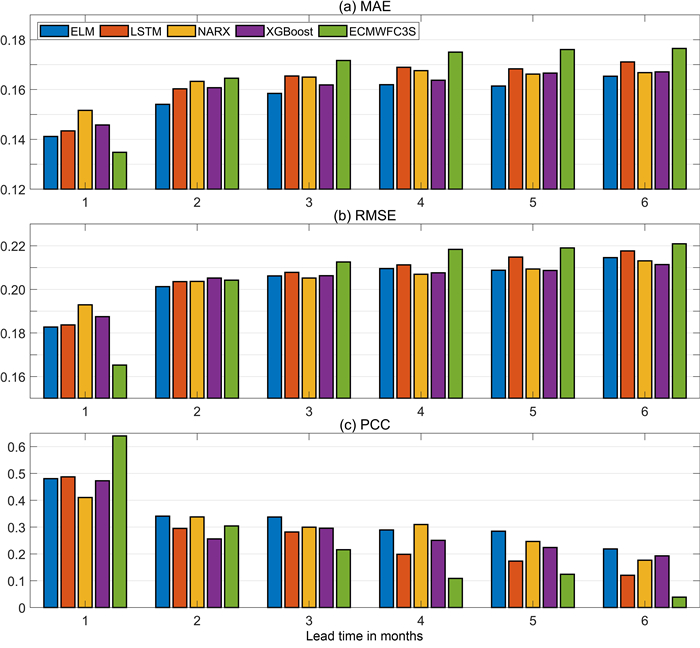
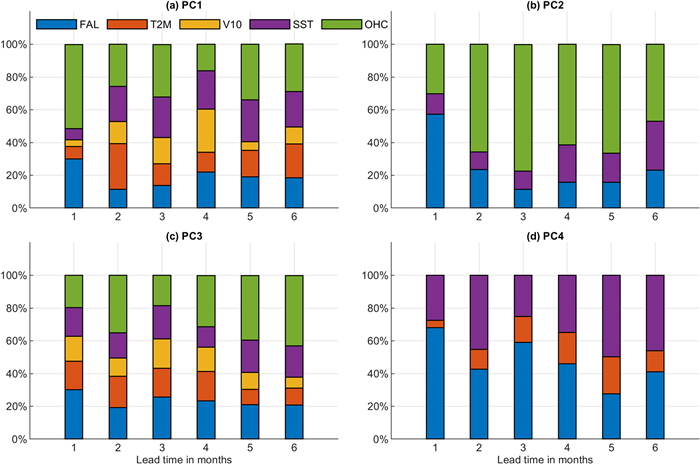
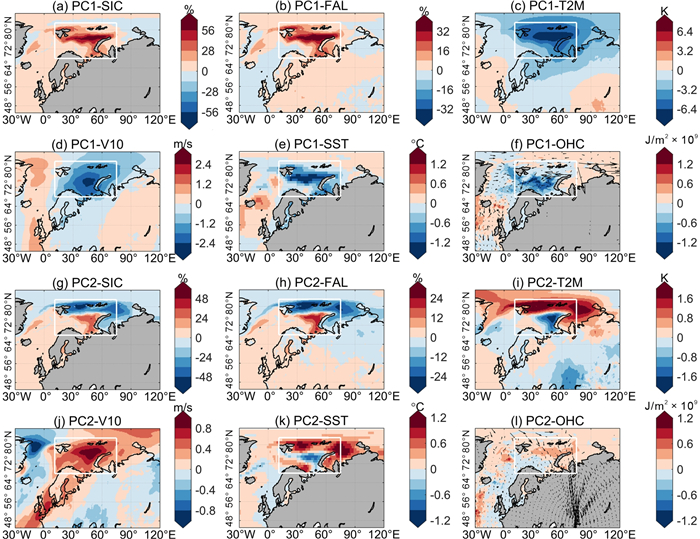
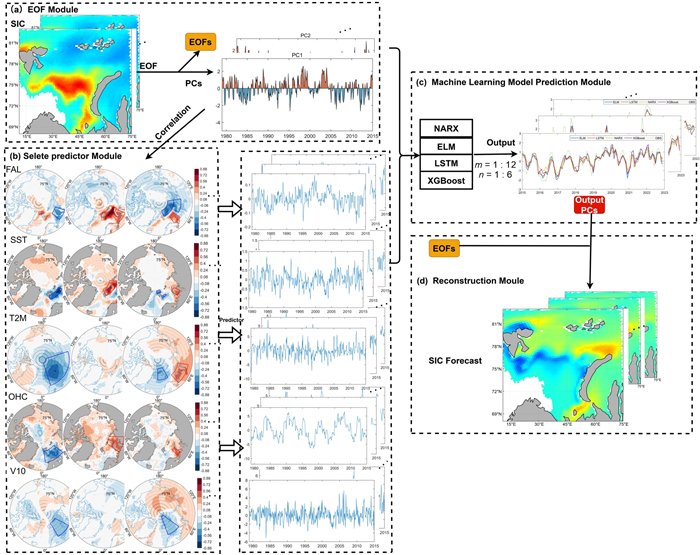
Variations of sea ice in the Barents-Kara seas attracts global attention because of its both local and remote climate impacts. The accurate prediction of Barents-Kara Seas sea ice concentration anomalies (BKSICA) is critically important for science and economics. This study employs four machine learning (ML) models, including extreme learning machine (ELM), nonlinear autoregressive exogenous model (NARX), long short-term memory (LSTM), and extreme gradient boosting (XGBoost), combined with empirical orthogonal function (EOF) methods to predict seasonal BKSICA. The ML models are trained based on the 1979–2014 oceanic and meteorological data, and are then used to predict the BKSICA for 2015–2022. Results indicate that the ML models provide reliable prediction up to 6 months, achieving a PCC over 0.6. Such prediction skill outperforms the state-of-the-art dynamical model at 2–6 months' prediction, although it is slightly less accurate at 1 month lead time. Among them, the ELM exhibits the optimal performance, attaining a regional average Pearson correlation coefficient (PCC) of 0.18 higher than the ECMWF at a 6-month lead time. The physical interpretability of the ML models is also analyzed, showing that subsurface ocean heat content anomalies to be a critical new predictor for BKSICA. These results highlight the effectiveness of the ML models in seasonal sea ice prediction.

| Ahn, J., Hong, S., Cho, J., et al., 2014. Statistical Modeling of Sea Ice Concentration Using Satellite Imagery and Climate Reanalysis Data in the Barents and Kara Seas, 1979–2012. Remote Sensing, 6(6): 5520–5540. https://doi.org/10.3390/rs6065520 |
| Altmann, A., Toloşi, L., Sander, O., et al., 2010. Permutation Importance: A Corrected Feature Importance Measure. Bioinformatics, 26(10): 1340–1347. https://doi.org/10.1093/bioinformatics/btq134 |
| Andersson, T. R., Hosking, J. S., Pérez-Ortiz, M., et al., 2021. Seasonal Arctic Sea Ice Forecasting with Probabilistic Deep Learning. Nature Communications, 12: 5124. https://doi.org/10.1038/s41467-021-25257-4 |
| Bushuk, M., Msadek, R., Winton, M., et al., 2017. Summer Enhancement of Arctic Sea Ice Volume Anomalies in the September-Ice Zone. Journal of Climate, 30(7): 2341–2362. https://doi.org/10.1175/JCLI-D-16-0470.1 |
|
Bushuk, M., Winton, M., Haumann, F. A., et al., 2021. Seasonal Prediction and Predictability of Regional Antarctic Sea Ice. Journal of Climate, 34(15): 6207–6233. |
| Bushuk, M., Zhang, Y. F., Winton, M., et al., 2022. Mechanisms of Regional Arctic Sea Ice Predictability in Two Dynamical Seasonal Forecast Systems. Journal of Climate, 35(13): 4207–4231. https://doi.org/10.1175/jcli-d-21-0544.1 |
| Chen, L., Huang, Y., Li, S. L., et al., 2025. Impacts of Mid-High Latitude Cyclones in the Southern Hemisphere on Antarctic Sea Ice Extent. Earth Science, 50(9): 3395–3407. https://doi.org/10.3799/dqkx.2024.111 (in Chinese with English Abstract) |
|
Chen, T. Q., Guestrin, C., 2016. XGBoost: A Scalable Tree Boosting System. Proceedings of the 22nd ACM SIGKDD International Conference on Knowledge Discovery and Data Mining. Aug. 13–17, 2016. San Francisco. 785–794. |
| Chen, X. Y., Tung, K. K., 2018. Global Surface Warming Enhanced by Weak Atlantic Overturning Circulation. Nature, 559(7714): 387–391. https://doi.org/10.1038/s41586-018-0320-y |
| Chi, J., Bae, J., Kwon, Y. J., 2021. Two-Stream Convolutional Long- and Short-Term Memory Model Using Perceptual Loss for Sequence-to-Sequence Arctic Sea Ice Prediction. Remote Sensing, 13(17): 3413. https://doi.org/10.3390/rs13173413 |
| Chi, J., Kim, H. C., 2017. Prediction of Arctic Sea Ice Concentration Using a Fully Data Driven Deep Neural Network. Remote Sensing, 9(12): 1305. https://doi.org/10.3390/rs9121305 |
| Chylek, P., Folland, C., Klett, J. D., et al., 2022. Annual Mean Arctic Amplification 1970–2020: Observed and Simulated by CMIP6 Climate Models. Geophysical Research Letters, 49(13): e2022GL099371. https://doi.org/10.1029/2022GL099371 |
| Dai, P. X., Gao, Y. Q., Counillon, F., et al., 2020. Seasonal to Decadal Predictions of Regional Arctic Sea Ice by Assimilating Sea Surface Temperature in the Norwegian Climate Prediction Model. Climate Dynamics, 54(9/10): 3863–3878. https://doi.org/10.1007/s00382-020-05196-4 |
| Ding, Q. H., Schweiger, A., L'Heureux, M., et al., 2017. Influence of High-Latitude Atmospheric Circulation Changes on Summertime Arctic Sea Ice. Nature Climate Change, 7(4): 289–295. https://doi.org/10.1038/nclimate3241 |
| Eguíluz, V. M., Fernández-Gracia, J., Irigoien, X., et al., 2016. A Quantitative Assessment of Arctic Shipping in 2010–2014. Scientific Reports, 6: 30682. https://doi.org/10.1038/srep30682 |
| Guemas, V., Blanchard-Wrigglesworth, E., Chevallier, M., et al., 2016. A Review on Arctic Sea-Ice Predictability and Prediction on Seasonal to Decadal Time-Scales. Quarterly Journal of the Royal Meteorological Society, 142(695): 546–561. https://doi.org/10.1002/qj.2401 |
| Guzman, S. M., Paz, J. O., Tagert, M. L. M., 2017. The Use of NARX Neural Networks to Forecast Daily Groundwater Levels. Water Resources Management, 31(5): 1591–1603. https://doi.org/10.1007/s11269-017-1598-5 |
| Hersbach, H., Bell, B., Berrisford, P., et al., 2020. The ERA5 Global Reanalysis. Quarterly Journal of the Royal Meteorological Society, 146(730): 1999–2049. https://doi.org/10.1002/qj.3803 |
| Hirahara, S., Ishii, M., Fukuda, Y., 2014. Centennial-Scale Sea Surface Temperature Analysis and Its Uncertainty. Journal of Climate, 27(1): 57–75. https://doi.org/10.1175/jcli-d-12-00837.1 |
| Hochreiter, S., Schmidhuber, J., 1997. Long Short-Term Memory. Neural Computation, 9(8): 1735–1780. https://doi.org/10.1162/neco.1997.9.8.1735 |
| Holland, M. M., Stroeve, J., 2011. Changing Seasonal Sea Ice Predictor Relationships in a Changing Arctic Climate: Changing Seasonal Sea Ice Predictors. Geophysical Research Letters, 38(18): L18501. https://doi.org/10.1029/2011GL049303 |
| Huang, G. B., Zhu, Q. Y., Siew, C. K., 2006. Extreme Learning Machine: Theory and Applications. Neurocomputing, 70(1–3): 489–501. https://doi.org/10.1016/j.neucom.2005.12.126 |
| Ji, J. J., Cheng, Q. M., Zhang, Y., et al., 2025. Machine Learning Discovers South American Subduction Zone Hotter than Previously Predicted. Journal of Earth Science, 36(3): 1277–1289. https://doi.org/10.1007/s12583-025-0222-5 |
| Kim, Y. H., Min, S. K., Gillett, N. P., et al., 2023. Observationally-Constrained Projections of an Ice-Free Arctic even under a Low Emission Scenario. Nature Communications, 14(1): 3139. https://doi.org/10.1038/s41467-023-38511-8 |
| Kim, Y. J., Kim, H. C., Han, D., et al., 2020. Prediction of Monthly Arctic Sea Ice Concentrations Using Satellite and Reanalysis Data Based on Convolutional Neural Networks. The Cryosphere, 14(3): 1083–1104. https://doi.org/10.5194/tc-14-1083-2020 |
| Ledley, T. S., 1988. A Coupled Energy Balance Climate-Sea Ice Model: Impact of Sea Ice and Leads on Climate. Journal of Geophysical Research: Atmospheres, 93(D12): 15919–15932. https://doi.org/10.1029/JD093iD12p15919 |
| Leontaritis, I. J., Billings, S. A., 1985. Input-Output Parametric Models for Non-Linear Systems Part Ⅰ: Deterministic Non-Linear Systems. International Journal of Control, 41(2): 303–328. https://doi.org/10.1080/0020718508961129 |
| Li, J. Y., Yuan, X., 2023. Daily Streamflow Forecasts Based on Cascade Long Short-Term Memory (LSTM) Model over the Yangtze River Basin. Water, 15(6): 1019. https://doi.org/10.3390/w15061019 |
| Li, Y. X., Chang, L., Gao, G. P., 2022. Impact of Arctic Oscillation on Cloud Radiative Forcing and September Sea Ice Retreat. Acta Oceanologica Sinica, 41(10): 131–139. https://doi.org/10.1007/s13131-022-2010-8 |
| Liang, X., Losch, M., Nerger, L., et al., 2019. Using Sea Surface Temperature Observations to Constrain Upper Ocean Properties in an Arctic Sea Ice-Ocean Data Assimilation System. Journal of Geophysical Research: Oceans, 124(7): 4727–4743. https://doi.org/10.1029/2019JC015073 |
| Liang, Y. C., Kwon, Y. O., Frankignoul, C., et al., 2020. Quantification of the Arctic Sea Ice-Driven Atmospheric Circulation Variability in Coordinated Large Ensemble Simulations. Geophysical Research Letters, 47(1): e2019GL085397. https://doi.org/10.1029/2019GL085397 |
| Ling, F. H., Luo, J. J., Li, Y., et al., 2022. Multi-Task Machine Learning Improves Multi-Seasonal Prediction of the Indian Ocean Dipole. Nature Communications, 13(1): 7681. https://doi.org/10.1038/s41467-022-35412-0 |
| Liu, Y., Bogaardt, L., Attema, J., et al., 2021. Extended Range Arctic Sea Ice Forecast with Convolutional Long Short-Term Memory Networks. Monthly Weather Review, 149(6): 1673–1693. https://doi.org/10.1175/MWR-D-20-0113.1 |
| Liu, Z. F., Risi, C., Codron, F., et al., 2022. Atmospheric Forcing Dominates Winter Barents-Kara Sea Ice Variability on Interannual to Decadal Time Scales. Proceedings of the National Academy of Sciences of the United States of America, 119(36): e2120770119. https://doi.org/10.1073/pnas.2120770119 |
|
Meier, W. N., Fetterer, F., Windnagel, A. K., et al., 2021. NOAA/NSIDC Climate Data Record of Passive Microwave Sea Ice Concentration, Version 4. |
| Mohamed, B., Nilsen, F., Skogseth, R., 2022. Interannual and Decadal Variability of Sea Surface Temperature and Sea Ice Concentration in the Barents Sea. Remote Sensing, 14(17): 4413. https://doi.org/10.3390/rs14174413 |
| North, G. R., Bell, T. L., Cahalan, R. F., et al., 1982. Sampling Errors in the Estimation of Empirical Orthogonal Functions. Monthly Weather Review, 110(7): 699–706. https://doi.org/10.1175/1520-0493(1982)1100699:SEITEO>2.0.CO;2 doi: 10.1175/1520-0493(1982)1100699:SEITEO>2.0.CO;2 |
| Onarheim, I. H., Eldevik, T., Årthun, M., et al., 2015. Skillful Prediction of Barents Sea Ice Cover. Geophysical Research Letters, 42(13): 5364–5371. https://doi.org/10.1002/2015GL064359 |
| Qian, Q. F., Jia, X. J., 2023. Seasonal Forecast of Winter Precipitation over China Using Machine Learning Models. Atmospheric Research, 294: 106961. https://doi.org/10.1016/j.atmosres.2023.106961 |
| Qian, Q. F., Jia, X. J., Lin, H., et al., 2021. Seasonal Forecast of Nonmonsoonal Winter Precipitation over the Eurasian Continent Using Machine Learning Models. Journal of Climate: 1–42. https://doi.org/10.1175/JCLI-D-21-0113.1 |
| Rantanen, M., Karpechko, A. Y., Lipponen, A., et al., 2022. The Arctic has Warmed nearly Four Times Faster than the Globe since 1979. Communications Earth & Environment, 3(1): 168. https://doi.org/10.1038/s43247-022-00498-3 |
| Sato, K., Inoue, J., Watanabe, M., 2014. Influence of the Gulf Stream on the Barents Sea Ice Retreat and Eurasian Coldness during Early Winter. Environmental Research Letters, 9(8): 084009. https://doi.org/10.1088/1748-9326/9/8/084009 |
| Schröder, D., Feltham, D. L., Flocco, D., et al., 2014. September Arctic Sea-Ice Minimum Predicted by Spring Melt-Pond Fraction. Nature Climate Change, 4(5): 353–357. https://doi.org/10.1038/nclimate2203 |
| Screen, J. A., Simmonds, I., Deser, C., et al., 2013. The Atmospheric Response to Three Decades of Observed Arctic Sea Ice Loss. Journal of Climate, 26(4): 1230–1248. https://doi.org/10.1175/ JCLI-D -12-00063.1 doi: 10.1175/JCLI-D-12-00063.1 |
| Segal, R. A., Scharien, R. K., Duerden, F., et al., 2020. The Best of Both Worlds: Connecting Remote Sensing and Arctic Communities for Safe Sea Ice Travel. Arctic, 73(4): 461–484. https://doi.org/10.14430/arctic71896 |
| Shu, Q., Wang, Q., Song, Z. Y., et al., 2021. The Poleward Enhanced Arctic Ocean Cooling Machine in a Warming Climate. Nature Communications, 12(1): 2966. https://doi.org/10.1038/s41467-021-23321-7 |
| Singarayer, J. S., Bamber, J. L., 2003. EOF Analysis of Three Records of Sea-Ice Concentration Spanning the Last 30 Years. Geophysical Research Letters, 30(5): 1251. https://doi.org/10.1029/2002GL016640 |
| Stroeve, J., Frei, A., McCreight, J., et al., 2008. Arctic Sea-Ice Variability Revisited. Annals of Glaciology, 48: 71–81. https://doi.org/10.3189/172756408784700699 |
| Stroeve, J., Hamilton, L. C., Bitz, C. M., et al., 2014. Predicting September Sea Ice: Ensemble Skill of the SEARCH Sea Ice Outlook 2008–2013: Stroeve et al. : Predicting September Sea Ice. Geophysical Research Letters, 41(7): 2411–2418. https://doi.org/10.1002/2014GL059388 |
| Sun, J. Q., Liu, S. C., Cohen, J., et al., 2022. Influence and Prediction Value of Arctic Sea Ice for Spring Eurasian Extreme Heat Events. Communications Earth & Environment, 3(1): 172. https://doi.org/10.1038/s43247-022-00503-9 |
| Wayand, N. E., Bitz, C. M., Blanchard-Wrigglesworth, E., 2019. A Year-Round Subseasonal-to-Seasonal Sea Ice Prediction Portal. Geophysical Research Letters, 46(6): 3298–3307. https://doi.org/10.1029/2018GL081565 |
| Wei, J. F., Hang, R. L., Luo, J. J., 2022. Prediction of Pan-Arctic Sea Ice Using Attention-Based LSTM Neural Networks. Frontiers in Marine Science, 9: 860403. https://doi.org/10.3389/fmars.2022.860403 |
| Xie, F., Ma, X., Li, J. P., et al., 2020. Using Observed Signals from the Arctic Stratosphere and Indian Ocean to Predict April–May Precipitation in Central China. Journal of Climate, 33(1): 131–143. https://doi.org/10.1175/JCLI-D-18-0512.1 |
| Yan, J. N., Mu, L., Wang, L. Z., et al., 2020. Temporal Convolutional Networks for the Advance Prediction of ENSO. Scientific Reports, 10(1): 8055. https://doi.org/10.1038/s41598-020-65070-5 |
| Yang, M., Qiu, Y. B., Huang, L., et al., 2023. Changes in Sea Surface Temperature and Sea Ice Concentration in the Arctic Ocean over the Past Two Decades. Remote Sensing, 15(4): 1095. https://doi.org/10.3390/rs15041095 |
| Zampieri, L., Goessling, H. F., Jung, T., 2018. Bright Prospects for Arctic Sea Ice Prediction on Subseasonal Time Scales. Geophysical Research Letters, 45(18): 9731–9738. https://doi.org/10.1029/2018GL079394 |
| Zhang, J. K., Tian, W. S., Pyle, J. A., et al., 2022. Responses of Arctic Sea Ice to Stratospheric Ozone Depletion. Science Bulletin, 67(11): 1182–1190. https://doi.org/10.1016/j.scib.2022.03.015 |
| Zhang, R. N., Screen, J. A., Zhang, R. H., 2022. Arctic and Pacific Ocean Conditions were Favorable for Cold Extremes over Eurasia and North America during Winter 2020/21. Bulletin of the American Meteorological Society, 103(10): E2285–E2301. https://doi.org/10.1175/BAMS-D-21-0264.1 |
| Zhang, X. Q., Wu, X. Y., 2023. Combined Forecasting Model of Precipitation Based on the CEEMD-ELM-FFOA Coupling Model. Water, 15(8): 1485. https://doi.org/10.3390/w15081485 |
| Zhang, Y. F., Bushuk, M., Winton, M., et al., 2022. Subseasonal-to-Seasonal Arctic Sea Ice Forecast Skill Improvement from Sea Ice Concentration Assimilation. Journal of Climate, 35(13): 4233–4252. https://doi.org/10.1175/JCLI-D-21-0548.1 |
| Zhao, J. P., Barber, D., Zhang, S. G., et al., 2018. Record Low Sea-Ice Concentration in the Central Arctic during Summer 2010. Advances in Atmospheric Sciences, 35(1): 106–115. https://doi.org/10.1007/s00376-017-7066-6 |
| Zheng, Q. Y., Li, W., Shao, Q., et al., 2022. A Mid- and Long-Term Arctic Sea Ice Concentration Prediction Model Based on Deep Learning Technology. Remote Sensing, 14(12): 2889. https://doi.org/10.3390/rs14122889 |
| Zhou, F., Liu, M. H., Shi, J., et al., 2023. Long-Lasting Impact of Winter North Atlantic Oscillation on Barents-Kara Sea Ice Anomaly in Recent Decades. Environmental Research Letters, 18(4): 044015. https://doi.org/10.1088/1748-9326/acc474 |
Figures(7)
Copyright © 2013-2020 Journal of Earth Science 鄂ICP备15021562号-2
Tel: +86-27-67885075 Fax: +86-27-67885075 E-mail: xbb@cug.edu.cn
Address: Editorial Office of Journal, China University of Geosciences, Yujiashan, Wuhan, Hubei 430074, P. R. China
Supported by:
Beijing Renhe Information Technology Co. Ltd
E-mail:
info@rhhz.net


 DownLoad: