| Citation: | Ting Wei, Zhiwen Dong, Eric Parteli, Xiaoli Liu, Shichang Kang, Yaping Shao. Composition, Distribution and Constraining Factors of Fe Isotope (δ56Fe) in the Surface Soils of the Tibetan Plateau. Journal of Earth Science, 2026, 37(1): 280-288. doi: 10.1007/s12583-024-0057-5

|
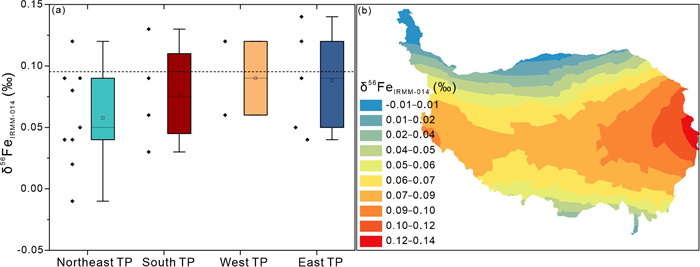
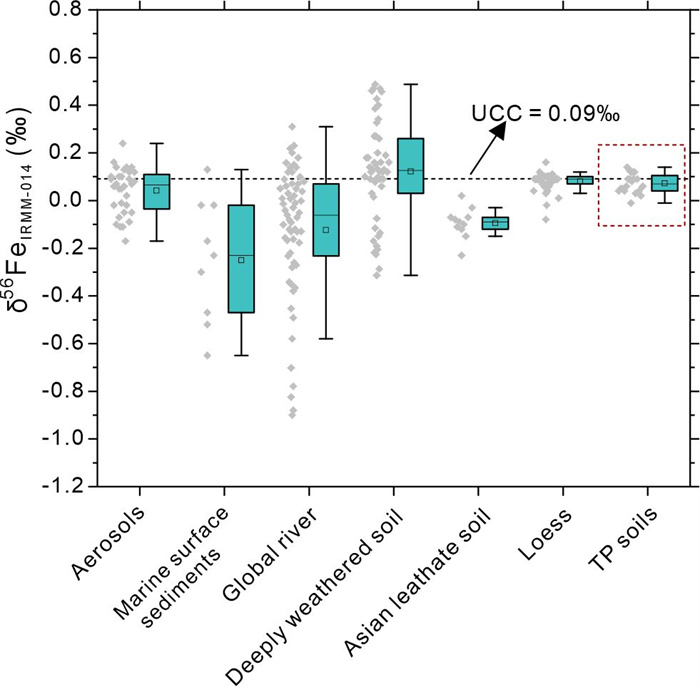
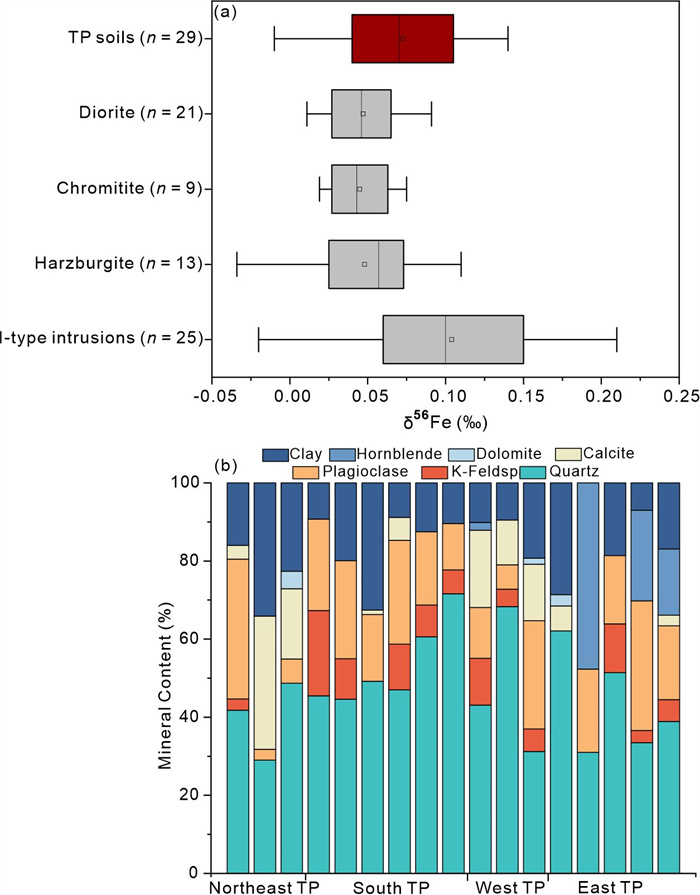
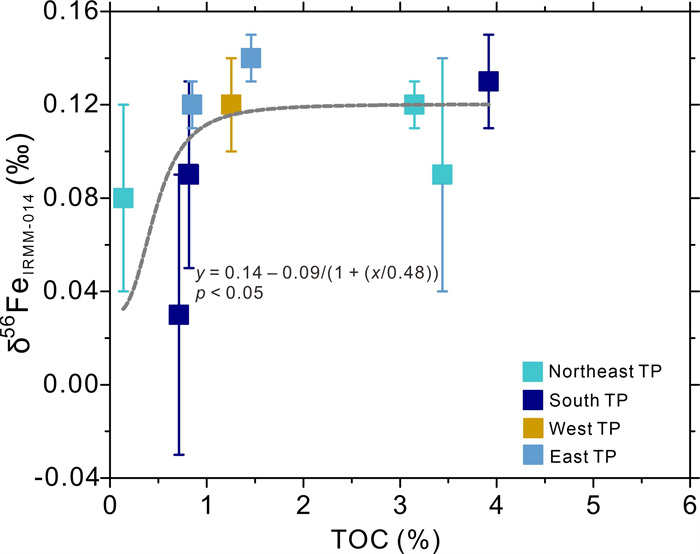
Iron isotopes, represented by δ56Fe, serve as valuable tools for constraining the surface iron processes and as potent tracers for studying the biogeochemical cycle of iron. Nevertheless, our comprehension of iron isotopes in the land surface processes of the Tibetan Plateau (TP) remains limited. In this study, we present the results of iron isotopic composition (δ56Fe) in the surface soils of the TP, encompassing both glacial and non-glacial regions characterized by rugged and flat topographies. Our findings reveal that soil δ56Fe values ranged from -0.01‰ ± 0.05‰ to 0.14‰ ± 0.01‰, with the highest values observed in eastern locations (0.14‰) and the lowest appeared in the northeast (-0.1‰). On a global scale, the δ56Fe values observed in Tibetan soils exhibited relatively small variability compared to reservoirs marked by significant iron isotope fractionation. By contrast, the range of TP soils measured here was slightly larger than that of the Chinese Loess. Furthermore, we discerned noticeable spatial variations in δ56Fe across the large-scale region of TP, indicating a gradual increase trend from the northeast to the south and from the west to the east. These regional disparities in δ56Fe likely arise from a combination of constraining factors, including differences in mineralogy, lithological variations, organic matter content, and variations in chemical weathering intensity. This study is pivotal in advancing our understanding of land surface iron isotope dynamics and its role in the biogeochemical cycle within the TP region.

| Akerman, A., Poitrasson, F., Oliva, P., et al., 2014. The Isotopic Fingerprint of Fe Cycling in an Equatorial Soil-Plant-Water System: The Nsimi Watershed, South Cameroon. Chemical Geology, 385: 104–116. https://doi.org/10.1016/j.chemgeo.2014.07.003 |
| Beard, B. L., Johnson, C. M., Skulan, J. L., et al., 2003. Application of Fe Isotopes to Tracing the Geochemical and Biological Cycling of Fe. Chemical Geology, 195(1/2/3/4): 87–117. https://doi.org/10.1016/S0009-2541(02)00390-X |
| Brantley, S. L., Liermann, L. J., Guynn, R. L., et al., 2004. Fe Isotopic Fractionation during Mineral Dissolution with and without Bacteria1. Geochimica et Cosmochimica Acta, 68(15): 3189–3204. https://doi.org/10.1016/j.gca.2004.01.023 |
| Brantley, S. L., Liermann, L., Bullen, T. D., 2001. Fractionation of Fe Isotopes by Soil Microbes and Organic Acids. Geology, 29(6): 535–538. https://doi.org/10.1130/0091-7613(2001)029<0535:fofibs>2.0.co;2 doi: 10.1130/0091-7613(2001)029<0535:fofibs>2.0.co;2 |
| Chen, C. M., Dong, Y. J., Thompson, A., 2023. Electron Transfer, Atom Exchange, and Transformation of Iron Minerals in Soils: The Influence of Soil Organic Matter. Environmental Science & Technology, 57(29): 10696–10707. https://doi.org/10.1021/acs.est.3c01876 |
| Chen, C. M., Dynes, J. J., Wang, J., et al., 2014. Properties of Fe-Organic Matter Associations via Coprecipitation versus Adsorption. Environmental Science & Technology, 48(23): 13751–13759. https://doi.org/10.1021/es503669u |
| Chen, K. Y., Yuan, H. L., Liang, P., et al., 2017. Improved Nickel-Corrected Isotopic Analysis of Iron Using High-Resolution Multi-Collector Inductively Coupled Plasma Mass Spectrometry. International Journal of Mass Spectrometry, 421: 196–203. https://doi.org/10.1016/j.ijms.2017.07.002 |
| Chen, T. Y., Li, W. Q., Guo, B., et al., 2020. Reactive Iron Isotope Signatures of the East Asian Dust Particles: Implications for Iron Cycling in the Deep North Pacific. Chemical Geology, 531: 119342. https://doi.org/10.1016/j.chemgeo.2019.119342 |
| Cong, Z. Y., Gao, S. P., Zhao, W. C., et al., 2018. Iron Oxides in the Cryoconite of Glaciers on the Tibetan Plateau: Abundance, Speciation and Implications. The Cryosphere, 12(10): 3177–3186. https://doi.org/10.5194/tc-12-3177-2018 |
| Di, J., Dong, Z. W., Parteli, E. J. R., et al., 2022. Insight into Atmospheric Deposition and Spatial Distribution of Bioavailable Iron in the Glaciers of Northeastern Tibetan Plateau. Science of the Total Environment, 825: 153946. https://doi.org/10.1016/j.scitotenv.2022.153946 |
| Ding, Z. L., Sun, J. M., Yang, S. L., et al., 2001. Geochemistry of the Pliocene Red Clay Formation in the Chinese Loess Plateau and Implications for Its Origin, Source Provenance and Paleoclimate Change. Geochimica et Cosmochimica Acta, 65(6): 901–913. https://doi.org/10.1016/S0016-7037(00)00571-8 |
| Dong, Z. W., Jiang, H. C., Baccolo, G., et al., 2023. Biological and Pollution Aerosols on Snow and Ice—Interplay between the Atmosphere and the Cryosphere. Journal of Earth Science, 34(6): 1951–1956. https://doi.org/10.1007/s12583-023-2004-2 |
| Emmanuel, S., Erel, Y., Matthews, A., et al., 2005. A Preliminary Mixing Model for Fe Isotopes in Soils. Chemical Geology, 222(1/2): 23–34. https://doi.org/10.1016/j.chemgeo.2005.07.002 |
| Eusterhues, K., Wagner, F. E., Häusler, W., et al., 2008. Characterization of Ferrihydrite-Soil Organic Matter Coprecipitates by X-Ray Diffraction and Mössbauer Spectroscopy. Environmental Science & Technology, 42(21): 7891–7897. https://doi.org/10.1021/es800881w |
| Fantle, M. S., DePaolo, D. J., 2004. Iron Isotopic Fractionation during Continental Weathering. Earth and Planetary Science Letters, 228(3/4): 547–562. https://doi.org/10.1016/j.epsl.2004.10.013 |
| Gong, Y. Z., Xia, Y., Huang, F., et al., 2017. Average Iron Isotopic Compositions of the Upper Continental Crust: Constrained by Loess from the Chinese Loess Plateau. Acta Geochimica, 36(2): 125–131. https://doi.org/10.1007/s11631-016-0131-5 |
| Huang, X. Y., Liu, X. W., Chen, L. S., et al., 2023. Iron-Bound Organic Carbon Dynamics in Peatland Profiles: The Preservation Equivalence of Deep and Surface Soil. Fundamental Research, 3(6): 852–860. https://doi.org/10.1016/j.fmre.2022.09.026 |
| Jickells, T. D., An, Z. S., Andersen, K. K., et al., 2005. Global Iron Connections between Desert Dust, Ocean Biogeochemistry, and Climate. Science, 308(5718): 67–71. https://doi.org/10.1126/science.1105959 [PubMed] doi: 10.1126/science.1105959[PubMed |
| Johnson, C., Beard, B., Weyer, S., 2020. The Modern Surficial World. Iron Geochemistry: An Isotopic Perspective. Springer International Publishing, Cham. 149–214. https://doi.org/10.1007/978-3-030-33828-2_5. |
| Kiczka, M., Wiederhold, J. G., Frommer, J., et al., 2011. Iron Speciation and Isotope Fractionation during Silicate Weathering and Soil Formation in an Alpine Glacier Forefield Chronosequence. Geochimica et Cosmochimica Acta, 75(19): 5559–5573. https://doi.org/10.1016/j.gca.2011.07.008 |
| Lalonde, K., Mucci, A., Ouellet, A., et al., 2012. Preservation of Organic Matter in Sediments Promoted by Iron. Nature, 483(7388): 198–200. https://doi.org/10.1038/nature10855 |
| Li, Q. W., Nebel, O., Nebel-Jacobsen, Y., et al., 2019. Crustal Reworking at Convergent Margins Traced by Fe Isotopes in Ⅰ-Type Intrusions from the Gangdese Arc, Tibetan Plateau. Chemical Geology, 510: 47–55. https://doi.org/10.1016/j.chemgeo.2019.02.007 |
| Li, X. Y., Ding, Y. J., Hood, E., et al., 2019. Dissolved Iron Supply from Asian Glaciers: Local Controls and a Regional Perspective. Global Biogeochemical Cycles, 33(10): 1223–1237. https://doi.org/10.1029/2018GB006113 |
| Liu, Q., Liu, S. Y., Zhang, Y., et al., 2010. Recent Shrinkage and Hydrological Response of Hailuogou Glacier, a Monsoon Temperate Glacier on the East Slope of Mount Gongga, China. Journal of Glaciology, 56(196): 215–224. https://doi.org/10.3189/002214310791968520 |
| Liu, Y. S., Qin, X., Chen, J. Z., et al., 2018. Variations of Laohugou Glacier No. 12 in the Western Qilian Mountains, China, from 1957 to 2015. Journal of Mountain Science, 15(1): 25–32. https://doi.org/10.1007/s11629-017-4492-y |
| Majestic, B. J., Anbar, A. D., Herckes, P., 2009. Stable Isotopes as a Tool to Apportion Atmospheric Iron. Environmental Science & Technology, 43(12): 4327–4333. https://doi.org/10.1021/es900023w |
| Martin, J. H., 1990. Glacial-Interglacial CO2 Change: The Iron Hypothesis. Paleoceanography, 5(1): 1–13. https://doi.org/10.1029/PA005i001p00001 |
| Mead, C., Herckes, P., Majestic, B. J., et al., 2013. Source Apportionment of Aerosol Iron in the Marine Environment Using Iron Isotope Analysis. Geophysical Research Letters, 40(21): 5722–5727. https://doi.org/10.1002/2013GL057713 |
| Nesbitt, H. W., Young, G. M., 1982. Early Proterozoic Climates and Plate Motions Inferred from Major Element Chemistry of Lutites. Nature, 299(5885): 715–717. https://doi.org/10.1038/299715a0 |
| Pinedo-González, P., Hawco, N. J., Bundy, R. M., et al., 2020. Anthropogenic Asian Aerosols Provide Fe to the North Pacific Ocean. Proceedings of the National Academy of Sciences of the United States of America, 117(45): 27862–27868. https://doi.org/10.1073/pnas.2010315117 |
| Stevenson, E. I., Fantle, M. S., Das, S. B., et al., 2017. The Iron Isotopic Composition of Subglacial Streams Draining the Greenland Ice Sheet. Geochimica et Cosmochimica Acta, 213: 237–254. https://doi.org/10.1016/j.gca.2017.06.002 |
| Talpur, S. A., Baloch, M. Y. J., Su, C. L., et al., 2024. Application of Synthetic Iron Oxyhydroxide with Influencing Factors for Removal of As(Ⅴ) and As(Ⅲ) from Groundwater. Journal of Earth Science, 35(3): 998–1009. https://doi.org/10.1007/s12583-023-1862-y |
| Taylor, S. R., McLennan, S. M., 1985. The Continental Crust: Its Composition and Evolution. Blackwell Scientific Publications, Oxford. 312 |
| Wang F., Liu, F. L., Liu, P. H., et al., 2011. Geochemical Characteristics of Amphibole-Bearing Metamorphic Rocks in Sanjiang Region, Southeastern Tibetan Plateau. Acta Petrologica et Mineralogica, 30(5): 844–852 (in Chinese with English Abstract). |
| Wang, J. B., Zhu, L. P., Wang, Y., et al., 2012. A Comparison of Different Methods for Determining the Organic and Inorganic Carbon Content of Lake Sediment from Two Lakes on the Tibetan Plateau. Quaternary International, 250: 49–54. https://doi.org/10.1016/j.quaint.2011.06.030 |
| Wang, J., Xie, Z. M., Wang, J., et al., 2021. Influence of Bioreduction of Arsenic-Bearing Goethite by Bacteria under Sulfur Mediation on Migration and Transformation of Arsenic. Earth Science, 46(2): 642–651 (in Chinese with English Abstract) |
| Wang, N. L., He, J. Q., Pu, J. C., et al., 2010. Variations in Equilibrium Line Altitude of the Qiyi Glacier, Qilian Mountains, over the Past 50 Years. Chinese Science Bulletin, 55(33): 3810–3817. https://doi.org/10.1007/s11434-010-4167-3 |
| Wei, T., Brahney, J., Dong, Z. W., et al., 2021. Hf-Nd-Sr Isotopic Composition of the Tibetan Plateau Dust as a Fingerprint for Regional to Hemispherical Transport. Environmental Science & Technology, 55(14): 10121–10132. https://doi.org/10.1021/acs.est.0c04929 |
| Welch, S. A., Beard, B. L., Johnson, C. M., et al., 2003. Kinetic and Equilibrium Fe Isotope Fractionation between Aqueous Fe(Ⅱ) and Fe(Ⅲ). Geochimica et Cosmochimica Acta, 67(22): 4231–4250. https://doi.org/10.1016/S0016-7037(03)00266-7 |
| Wiederhold, J. G., Kraemer, S. M., Teutsch, N., et al., 2006. Iron Isotope Fractionation during Proton-Promoted, Ligand-Controlled, and Reductive Dissolution of Goethite. Environmental Science & Technology, 40(12): 3787–3793. https://doi.org/10.1021/es052228y |
| Wiederhold, J. G., Teutsch, N., Kraemer, S. M., et al., 2007. Iron Isotope Fractionation in Oxic Soils by Mineral Weathering and Podzolization. Geochimica et Cosmochimica Acta, 71(23): 5821–5833. https://doi.org/10.1016/j.gca.2007.07.023 |
| Wu, B., Amelung, W., Xing, Y., et al., 2019. Iron Cycling and Isotope Fractionation in Terrestrial Ecosystems. Earth-Science Reviews, 190: 323–352. https://doi.org/10.1016/j.earscirev.2018.12.012 |
| Xu, L. X., Wang, F., Yao, Y., et al., 2024. Key Role of Microbial Necromass and Iron Minerals in Retaining Micronutrients and Facilitating Biological Nitrogen Fixation in Paddy Soils. Fundamental Research. https://doi.org/10.1016/j.fmre.2024.02.007 |
| Yao, T. D., Thompson, L., Yang, W., et al., 2012. Different Glacier Status with Atmospheric Circulations in Tibetan Plateau and Surroundings. Nature Climate Change, 2(9): 663–667. https://doi.org/10.1038/nclimate1580 |
| Yi, K., Cao, X. Y., 2025. Recent Vegetation Shifts on the Tibetan Plateau Exceed the Range of Variations Seen over Past Millennia in Pollen Record. Journal of Earth Science, 36(3): 1348–1350. https://doi.org/10.1007/s12583-025-2029-9 |
| Yin, A., Harrison, T. M., 2000. Geologic Evolution of the Himalayan-Tibetan Orogen. Annual Review of Earth and Planetary Sciences, 28: 211–280. https://doi.org/10.1146/annurev.earth.28.1.211 |
| Yin, C. Q., Ou, J., Long, X. P., et al., 2020. Late Cretaceous Neo-Tethyan Slab Roll-Back: Evidence from Zircon U-Pb-O and Whole-Rock Geochemical and Sr-Nd-Fe Isotopic Data of Adakitic Plutons in the Himalaya-Tibetan Plateau. GSA Bulletin, 132(1/2): 409–426. https://doi.org/10.1130/b35242.1 |
| Yu, D., Peng, H. B., Yu, C. L., et al., 2025. Freezing-Induced Redistribution of Fe(Ⅱ) Species within Clay Minerals for Nonlinear Variations in Hydroxyl Radical Yield and Contaminant Degradation. Journal of Earth Science, 36(3): 1226–1235. https://doi.org/10.1007/s12583-024-0119-8 |
| Yuan Y., Liu Y., Q., 2025. Research Progress on Microbes Involved in Lacustrine Iron/Sulfur Cycling. Earth Science, 50(3): 887–907. https://doi.org/10.3799/dqkx.2024.055 (in Chinese with English Abstract) |
| Zhao S., F., Liu, H., Zhao, L., et al., 2021. Responses of Different Iron and Nitrogen Transformation Functional Microorganisms to Fe(Ⅱ) Chemical Oxidation. Earth Science, 46(4): 1481–1489. https://doi.org/10.3799/dqkx.2020.131 (in Chinese with English Abstract) |
| Zhu, X. K., Guo, Y., O'Nions, R. K., et al., 2001. Isotopic Homogeneity of Iron in the Early Solar Nebula. Nature, 412(6844): 311–313. https://doi.org/10.1038/35085525 |
| Zuo, P. J., Huang, Y. M., Liu, P. F., et al., 2022. Stable Iron Isotopic Signature Reveals Multiple Sources of Magnetic Particulate Matter in the 2021 Beijing Sandstorms. Environmental Science & Technology Letters, 9(4): 299–305. https://doi.org/10.1021/acs.estlett.2c00144 |
Figures(6) / Tables(1)
Copyright © 2013-2020 Journal of Earth Science 鄂ICP备15021562号-2
Tel: +86-27-67885075 Fax: +86-27-67885075 E-mail: xbb@cug.edu.cn
Address: Editorial Office of Journal, China University of Geosciences, Yujiashan, Wuhan, Hubei 430074, P. R. China
Supported by:
Beijing Renhe Information Technology Co. Ltd
E-mail:
info@rhhz.net


 DownLoad: