| Citation: | Jinwei Li, Wei Gao, Yuzhou Zhuo, Yitong Guo. In situ Sulfur Isotopic Analysis of Pyrite from Qinglong Antimony Deposit in the Youjiang Basin, SW China: Implications for Ore Genesis. Journal of Earth Science, 2026, 37(3): 1152-1165. doi: 10.1007/s12583-024-0058-4

|
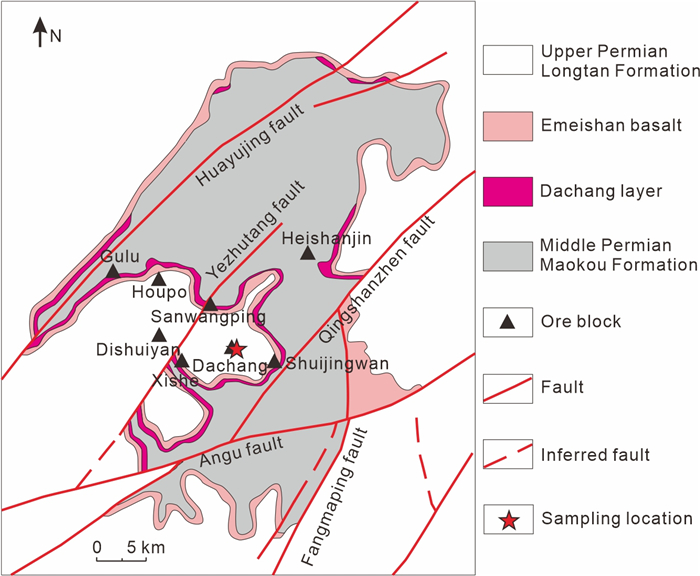
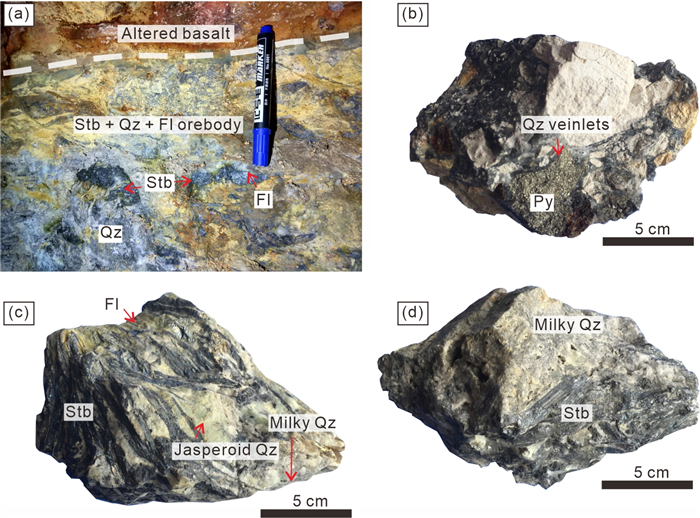
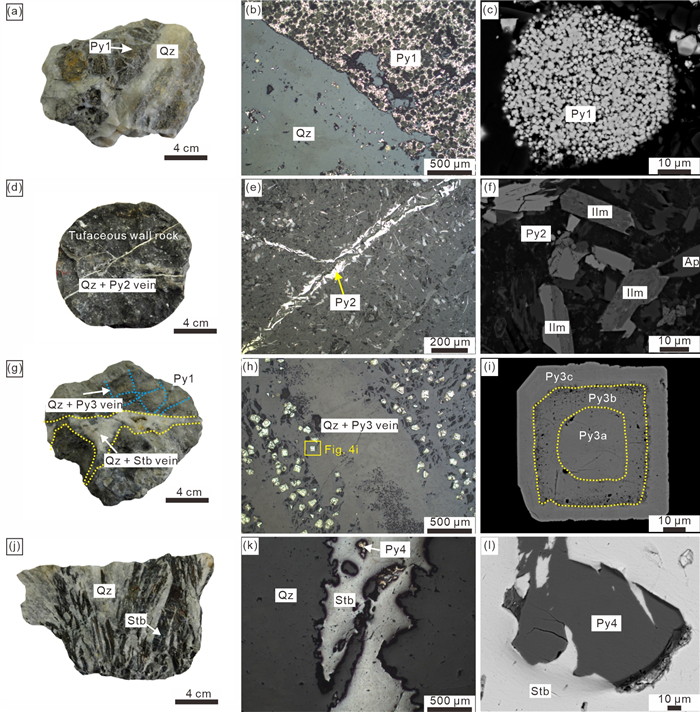
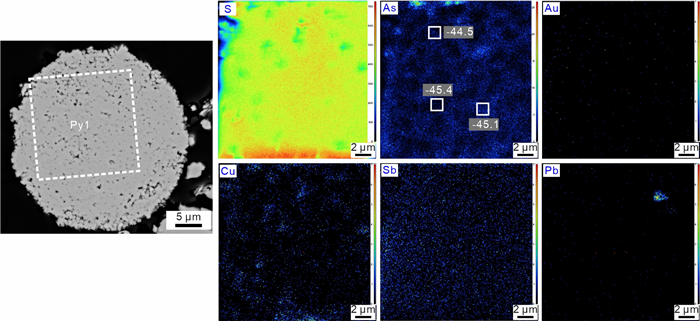
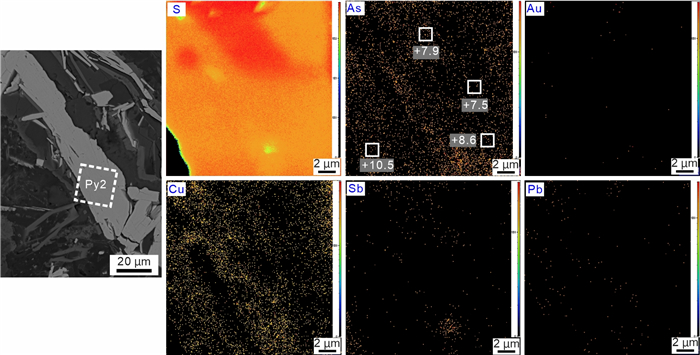
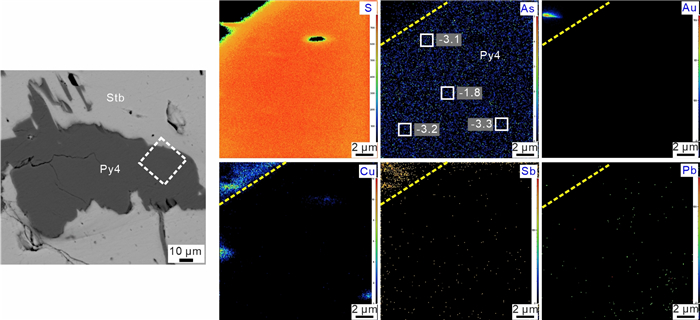
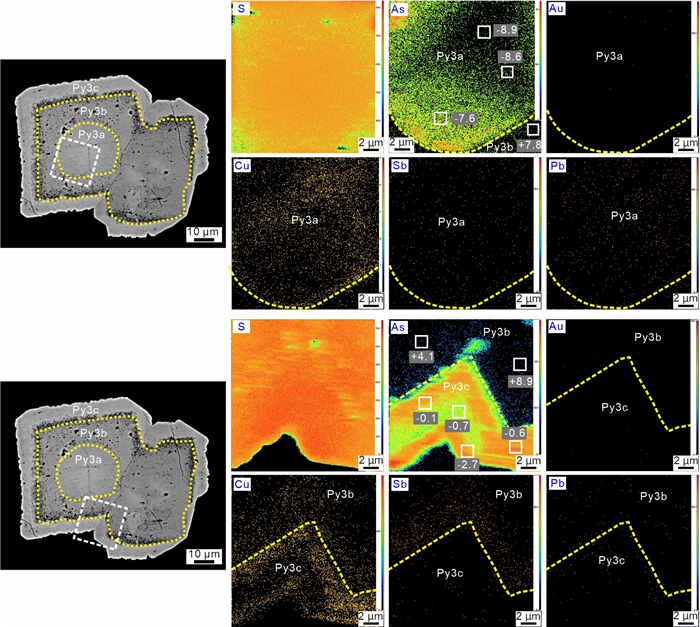
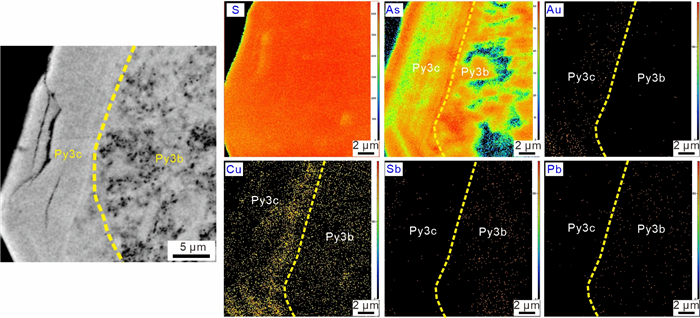
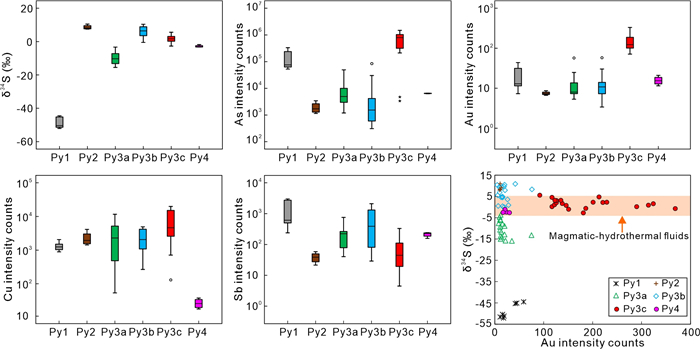
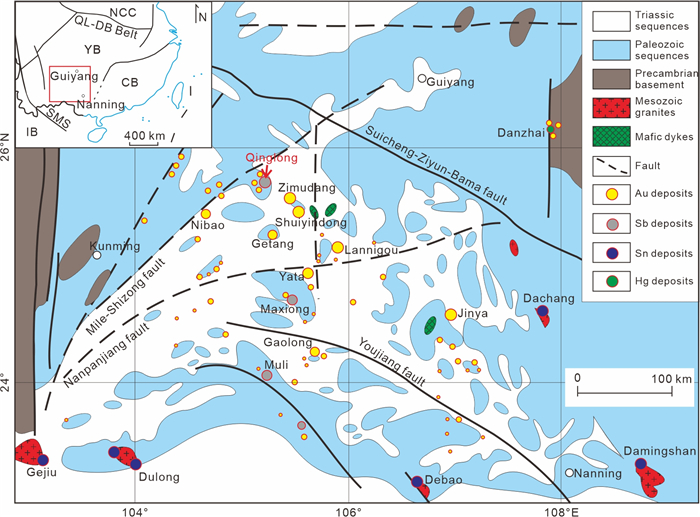
Gold (Au) and antimony (Sb) are two critical metals that commonly co-occur in sedimentary rock-hosted deposits. However, the genetic relationship between Au and Sb mineralization remains unclear. The Youjiang Basin, located in the low-temperature metallogenic domain of South China, hosts many important Au-Sb deposits. Among these, the Qinglong Deposit stands out as the largest vein-type Sb deposit in the basin, with approximately 300 kilotons of Sb and extensive Au mineralization. In this study, novel data from Nano-SIMS elemental mapping and sulfur isotopic analysis on paragenetically-constrained pyrite from Qinglong are provided, aiming to better understand the origin of reduced sulfur in the Au and Sb mineralization stages, as well as the genetic mechanism of Au and Sb mineralization. Four types of pyrite were identified at Qinglong based on microtextural observations and chemical features. Framboidal pyrite (Py1) and columnar pyrite (Py2) are mainly identified from the least-altered host rocks, contain no Au and Sb, and display largely negative δ34S values (-52.1‰– -44.5‰) and positive δ34S values (7.5‰–10.5‰), respectively, suggesting they formed during sedimentary and diagenetic stages. Zoned pyrite (Py3), which only occurs in hydrothermal mineralized samples, exhibits core (Py3a)-mantle (Py3b)-rim (Py3c) textures. Py3b contains elevated Sb and Pb but no Au, and has high δ34S values (-0.5‰–10.4‰), recording a possible episode of hydrothermal fluids that predated Au mineralization. Additionally, the alteration and recrystallization of Py1 by this episode of fluids led to the formation of Py3a. Py3c contains high As and Au contents, and shows most δ34S values between -1‰ and 3.2‰, representing Au mineralization stage. The sharp boundaries, distinct trace elements, and different δ34S values between Py3b and Py3c suggest that they formed from two discrete hydrothermal events. Relatively homogeneous pyrite (Py4) is intergrown with stibnite and formed specifically during Sb mineralization stage. Both Py3c and Py4 display similar δ34S signatures consistent with magmatic sulfur. Based on these observations, we propose that ore-forming fluids of Au and Sb mineralization at Qinglong may be originated from same deep magmatic-hydrothermal system, and fluids evolution and precipitation mechanism were the key factors controlling their differentiation. Meanwhile, our study demonstrates that the high-resolution in situ sulfur isotopic and trace elemental analysis of pyrite can effectively discern ore-forming fluid events and elucidate the differentiation mechanism of ore-forming elements.

| Chen, J., Huang, Z. L., Yang, R. D., et al., 2021. Gold and Antimony Metallogenic Relations and Ore-Forming Process of Qinglong Sb(Au) Deposit in Youjiang Basin, SW China: Sulfide Trace Elements and Sulfur Isotopes. Geoscience Frontiers, 12(2): 605–623. https://doi.org/10.1016/j.gsf.2020.08.010 |
| Chen, J., Yang, R. D., Du, L. J., et al., 2018. Mineralogy, Geochemistry and Fluid Inclusions of the Qinglong Sb-(Au) Deposit, Youjiang Basin (Guizhou, SW China). Ore Geology Reviews, 92: 1–18. https://doi.org/10.1016/j.oregeorev.2017.11.009 |
| Chen, J., Yang, R. D., Du, L. J., et al., 2020. Multistage Fluid Sources and Evolution of Qinglong Sb-(Au) Deposit in Northern Margin of Youjiang Basin, SW China: REE Geochemistry and Sr-H-O Isotopes of Ore-Related Jasperoid, Quartz and Fluorite. Ore Geology Reviews, 127: 103851. https://doi.org/10.1016/j.oregeorev.2020.103851 |
| Chen, M. H., Mao, J. W., Li, C., et al., 2015. Re-Os Isochron Ages for Arsenopyrite from Carlin-Like Gold Deposits in the Yunnan-Guizhou-Guangxi "Golden Triangle", Southwestern China. Ore Geology Reviews, 64: 316–327. https://doi.org/10.1016/j.oregeorev.2014.07.019 |
| Cheng, Y., Hu, Y. Z., Wang, D., et al., 2021. Oil-Source Rock Analysis and Metallogenic Significance of the Palaeo-Oil Reservoir in the Qinglong Antimony Deposit, South China. Ore Geology Reviews, 137: 104281. https://doi.org/10.1016/j.oregeorev.2021.104281 |
| Cline, J. S., 2018. Nevada's Carlin-Type Gold Deposits: What We've Learned during the Past 10 to 15 Years. Reviews in Economic Geology, 20: 1–28. https://doi.org/10.5382/rev.20.01 |
| Du, Y. S., Huang, H., Yang, J. H., et al., 2013. The Basin Translation from Late Paleozoic to Triassic of the Youjiang Basin and Its Tectonic Signification. Geological Review, 59(1): 1–11. https://doi.org/10.3969/j.issn.0371-5736.2013.01.001 (in Chinese with English Abstract) |
| Gao, W., Hu, R. Z., Hofstra, A. H., et al., 2021. U-Pb Dating on Hydrothermal Rutile and Monazite from the Badu Gold Deposit Supports an Early Cretaceous Age for Carlin-Type Gold Mineralization in the Youjiang Basin, Southwestern China. Economic Geology, 116(6): 1355–1385. https://doi.org/10.5382/econgeo.4824 |
| Gao, W., Hu, R. Z., Huang, Y., et al., 2024. Hydrothermal Apatite as a Robust U-Th-Pb Chronometer for the Carlin-Type Gold Deposits in the Youjiang Basin, SW China. Mineralium Deposita, 59(1): 109–131. https://doi.org/10.1007/s00126-023-01196-6 |
| Gao, W., Hu, R. Z., Mei, L., et al., 2022. Monitoring the Evolution of Sulfur Isotope and Metal Concentrations across Gold-Bearing Pyrite of Carlin-Type Gold Deposits in the Youjiang Basin, SW China. Ore Geology Reviews, 147: 104990. https://doi.org/10.1016/j.oregeorev.2022.104990 |
| Gao, W., Hu, R. Z., Wang, X. Y., et al., 2023. Large-Scale Basement Mobilization Endows the Giant Carlin-Type Gold Mineralization in the Youjiang Basin, South China: Insights from Mercury Isotopes. GSA Bulletin, 135(11/12): 3163–3172. https://doi.org/10.1130/b36636.1 |
| Gu, X. X., Zhang, Y. M., Li, B. H., et al., 2012. Hydrocarbon- and Ore-Bearing Basinal Fluids: A Possible Link between Gold Mineralization and Hydrocarbon Accumulation in the Youjiang Basin, South China. Mineralium Deposita, 47(6): 663–682. https://doi.org/10.1007/s00126-011-0388-x |
| Hagemann, S. G., Lüders, V., 2003. P-T-X Conditions of Hydrothermal Fluids and Precipitation Mechanism of Stibnite-Gold Mineralization at the Wiluna Lode-Gold Deposits, Western Australia: Conventional and Infrared Microthermometric Constraints. Mineralium Deposita, 38(8): 936–952. https://doi.org/10.1007/s00126-003-0351-6 |
|
Hofstra, A. H., Emsbo, P., Christiansen, W. D., et al., 2005. Source of Ore Fluids in Carlin-Type Gold Deposits, China: Implications for Genetic Models. Mineral Deposit Research: Meeting the Global Challenge. Springer, Berlin, Heidelberg. 533–536. |
| Hofstra, A., Cline, J. S., 2000. Characteristics and Models for Carlin-Type Gold Deposits. Society of Economic Geologists, 163–220. https://doi.org/10.5382/rev.13.05 |
| Holser, W. T., 1977. Catastrophic Chemical Events in the History of the Ocean. Nature, 267(5610): 403–408. https://doi.org/10.1038/267403a0 |
| Hou, L., Peng, H. J., Ding, J., et al., 2016. Textures and in situ Chemical and Isotopic Analyses of Pyrite, Huijiabao Trend, Youjiang Basin, China: Implications for Paragenesis and Source of Sulfur. Economic Geology, 111(2): 331–353. https://doi.org/10.2113/econgeo.111.2.331 |
| Hu, R. Z., Fu, S. L., Huang, Y., et al., 2017. The Giant South China Mesozoic Low-Temperature Metallogenic Domain: Reviews and a New Geodynamic Model. Journal of Asian Earth Sciences, 137: 9–34. https://doi.org/10.1016/j.jseaes.2016.10.016 |
| Hu, R. Z., Su, W. C., Bi, X. W., et al., 2002. Geology and Geochemistry of Carlin-Type Gold Deposits in China. Mineralium Deposita, 37(3/4), 378–392. https://doi.org/10.1007/s00126-001-0242-7 |
| Hu, R. Z., Zhou, M. F., 2012. Multiple Mesozoic Mineralization Events in South China: An Introduction to the Thematic Issue. Mineralium Deposita, 47(6): 579–588. https://doi.org/10.1007/s00126-012-0431-6 |
| Hu, X. L., Gong, Y. J., Zeng, G. P., et al., 2018. Multistage Pyrite in the Getang Sediment-Hosted Disseminated Gold Deposit, South-western Guizhou Province, China: Insights from Textures and in situ Chemical and Sulfur Isotopic Analyses. Ore Geology Reviews, 99: 1–16. https://doi.org/10.1016/j.oregeorev.2018.05.020 |
| Hu, Y. Z., 2011. Analysis of Sedimentary Basin and Metallogenic Study of Antimony Gold in Southwest Guizhou Depression: [Dissertation]. Kunming University, Kunming (in Chinese with English Abstract) |
| Huang, X. W., Yang, Y. P., Zhou, M. F., et al., 2024. Linkage of Mineral Inclusions and Zoning of Magnetite with Fluid Evolution of Hydrothermal Systems: A Case Study of the Fenghuangshan Cu-Fe-Au Skarn Deposit, Eastern China. Journal of Earth Science, 35(6): 1902–1917. https://doi.org/10.1007/s12583-024-0073-5 |
| Huang, Y., Hu, R. Z., Bi, X. W., et al., 2019. Low-Temperature Thermochronology of the Carlin-Type Gold Deposits in Southwestern Guizhou, China: Implications for Mineralization Age and Geological Thermal Events. Ore Geology Reviews, 115: 103178. https://doi.org/10.1016/j.oregeorev.2019.103178 |
| Jiang, S. Y., Ling, H. F., 2004. Stable Isotope Geochemistry. In: Chen, J., Wang, H. N., eds., Geochemistry. Science Press, Beijing. 129–141 (in Chinese) |
| Jiang, Y. F., Qian, H. D., Zhou, G. Q., 2016. Mineralogy and Geochemistry of Different Morphological Pyrite in Late Permian Coals, South China. Arabian Journal of Geosciences, 9(11): 590. https://doi.org/10.1007/s12517-016-2612-6 |
| Jin, X. Y., 2017. Geology, Mineralization and Genesis of the Nibao, Shuiyindong and Yata Gold Deposit in SW Guizhou Province, China: [Dissertation]. China University of Geosciences, Wuhan (in Chinese with English Abstract) |
| Jin, X. Y., Hofstra, A. H., Hunt, A. G., et al., 2020. Noble Gases Fingerprint the Source and Evolution of Ore-Forming Fluids of Carlin-Type Gold Deposits in the Golden Triangle, South China. Economic Geology, 115(2), 455–469. https://doi.org/10.5382/econgeo.115.2.455 |
| Krupp, R. E., 1988. Solubility of Stibnite in Hydrogen Sulfide Solutions, Speciation, and Equilibrium Constants, from 25 to 350 ℃. Geochimica et Cosmochimica Acta, 52(12): 3005–3015. https://doi.org/10.1016/0016-7037(88)90164-0 |
| LaFlamme, C., Sugiono, D., Thébaud, N., et al., 2018. Multiple Sulfur Isotopes Monitor Fluid Evolution of an Archean Orogenic Gold Deposit. Geochimica et Cosmochimica Acta, 222: 436–446. https://doi.org/10.1016/j.gca.2017.11.003 |
| Large, R. R., Bull, S. W., Maslennikov, V. V., 2011. A Carbonaceous Sedimentary Source-Rock Model for Carlin-Type and Orogenic Gold Deposits. Economic Geology, 106(3): 331–358. https://doi.org/10.2113/econgeo.106.3.331 |
| Large, S. J. E., Bakker, E. Y. N., Weis, P., et al., 2016. Trace Elements in Fluid Inclusions of Sediment-Hosted Gold Deposits Indicate a Magmatic-Hydrothermal Origin of the Carlin Ore Trend. Geology, 44(12): 1015–1018. https://doi.org/10.1130/g38351.1 |
| Li, J. W., 2020. Micro-Textures and Geochemical Characteristics of Hydrothermal Quartz from Low-Temperature Gold and Antimony Deposits in the Youjiang Basin, SW China: Implications for the Mineralization Process: [Dissertation]. Institute of Geochemistry, Chinese Academy of Sciences, Guiyang (in Chinese with English Abstract) |
| Li, J. W., Hu, R. Z., Xiao, J. F., et al., 2020. Genesis of Gold and Antimony Deposits in the Youjiang Metallogenic Province, SW China: Evidence from in situ Oxygen Isotopic and Trace Element Compositions of Quartz. Ore Geology Reviews, 116: 103257. https://doi.org/10.1016/j.oregeorev.2019.103257 |
| Li, J. X., 2019. Study on the Metallogenetic Source and the Fluid Evolution of Carlin Type Gold Deposits: A Case Study of in situ Sulfur Isotopes and Trace Elements of Pyrites of Gold Deposits from Two Sedimentary Facies in the Youjiang Basin: [Dissertation]. Institute of Geochemistry, Chinese Academy of Sciences, Guiyang (in Chinese with English Abstract) |
| Li, X. H., Bai, L. G., Yue, Z. H., et al., 2021. Mineralization Processes Involved in the Formation of the Jinya Carlin-Type Au Deposit, Northwestern Guangxi, China: Evidence from in situ Trace Element and S Isotope Geochemistry of Au-Bearing Zoned Pyrite. Ore Geology Reviews, 138: 104376. https://doi.org/10.1016/j.oregeorev.2021.104376 |
| Li, X., Guo, Q. H., Zhao, Q., 2024. Dissolution of Stibnite and Morphological Distribution of Antimony in Its Products under Different Aqueous Conditions. Earth Science, 49(11): 4022–4034. https://doi.org/10.3799/dqkx.2023.172 (in Chinese with English Abstract) |
| Liang, J. L., Li, J., Liu, X. M., et al., 2020. Multiple Element Mapping and in-situ S Isotopes of Au-Carrying Pyrite of Shuiyindong Gold Deposit, Southwestern China Using NanoSIMS: Constraints on Au Sources, Ore Fluids, and Mineralization Processes. Ore Geology Reviews, 123: 103576. https://doi.org/10.1016/j.oregeorev.2020.103576 |
| Liu, X. T., Wang, H. J., Liu, J. R., et al., 2024. Microbial Sulfate Reduction and Its Role in Carbon Sequestration in Marine Sediments. Journal of Earth Science, 35(4): 1378–1381. https://doi.org/10.1007/s12583-024-1998-4 |
| Lou, Y. L., Liu, X. H., Zeng, H., et al., 2024. Genesis of Xingfengshan Au-W Deposit in Central Hunan Province: Constraints from Hydrothermal Apatite U-Pb Dating and in Situ S Isotopes. Earth Science, 49(12): 4265–4277. https://doi.org/10.3799/dqkx.2024.059 (in Chinese with English Abstract) |
| Metcalfe, I., 2006. Palaeozoic and Mesozoic Tectonic Evolution and Palaeogeography of East Asian Crustal Fragments: The Korean Peninsula in Context. Gondwana Research, 9(1/2): 24–46. https://doi.org/10.1016/j.gr.2005.04.002 |
| Ohmoto, H., 1972. Systematics of Sulfur and Carbon Isotopes in Hydrothermal Ore Deposits. Economic Geology, 67(5): 551–578. https://doi.org/10.2113/gsecongeo.67.5.551 |
| Ohmoto, H., Goldhaber, M. B., 1997. Sulfur and Carbon Isotopes. In: Barnes H. L., ed., Geochemistry of Hydrothermal Ore Deposits. Wiley, Hoboken. 517–611 |
| Palin, J. M., Xu, Y., 2000. Gilt by Association Origins of Pyritic Gold Ores in the Victory Mesothermal Gold Deposit, Western Australia. Economic Geology, 95(8): 1627–1634. https://doi.org/10.2113/gsecongeo.95.8.1627 |
| Peng, J. T., Hu, R. Z., Jiang, G. H., 2003. Samarium-Neodymium Isotope System of Fluorites from the Qinglong Antimony Deposit, Guizhou Province: Constraints on the Mineralizing Age Ore-Forming Materials' Sources. Acta Petrologica Sinica, 19: 785–791 (in Chinese with English Abstract) |
| Pi, Q. H., Hu, R. Z., Xiong, B., et al., 2017. In situ SIMS U-Pb Dating of Hydrothermal Rutile: Reliable Age for the Zhesang Carlin-Type Gold Deposit in the Golden Triangle Region, SW China. Mineralium Deposita, 52(8): 1179–1190. https://doi.org/10.1007/s00126-017-0715-y |
| Pokrovski, G. S., Borisova, A. Y., Roux, J., et al., 2006. Antimony Speciation in Saline Hydrothermal Fluids: A Combined X-Ray Absorption Fine Structure Spectroscopy and Solubility Study. Geochimica et Cosmochimica Acta, 70(16): 4196–4214. https://doi.org/10.1016/j.gca.2006.06.1549 |
| Sasmaz, A., Sukach, V., Bondarenko, S., et al., 2025. Newly Identified Au-Ag-Bi-Te Mineralization in the Aydindere Skarn Fe and Cu Deposit, Giresun, NE Turkey: Implications of Gold Mineralization during Retrograde Skarn Evolution. Journal of Earth Science, 36(2): 543–561. https://doi.org/10.1007/s12583-023-1976-x |
| Seal, R. R., 2006. Sulfur Isotope Geochemistry of Sulfide Minerals. Reviews in Mineralogy and Geochemistry, 61(1): 633–677. https://doi.org/10.2138/rmg.2006.61.12 |
| Su, W. C., Dong, W. D., Zhang, X. C., et al., 2018. Carlin-Type Gold Deposits in the Dian-Qian-Gui "Golden Triangle" of Southwest China. Reviews in Economic Geology, 20: 99–115. https://doi.org/10.5382/rev.20.05 |
| Su, W. C., Hu, R. Z., Xia, B., et al., 2009a. Calcite Sm-Nd Isochron Age of the Shuiyindong Carlin-Type Gold Deposit, Guizhou, China. Chemical Geology, 258(3/4): 269–274. https://doi.org/10.1016/j.chemgeo.2008.10.030 |
| Su, W. C., Heinrich, C. A., Pettke, T., et al., 2009b. Sediment-Hosted Gold Deposits in Guizhou, China: Products of Wall-Rock Sulfidation by Deep Crustal Fluids. Economic Geology, 104(1): 73–93. https://doi.org/10.2113/gsecongeo.104.1.73 |
| Su, W. C., Xia, B., Zhang, H. T., et al., 2008. Visible Gold in Arsenian Pyrite at the Shuiyindong Carlin-Type Gold Deposit, Guizhou, China: Implications for the Environment and Processes of Ore Formation. Ore Geology Reviews, 33(3/4): 667–679. https://doi.org/10.1016/j.oregeorev.2007.10.002 |
| Su, W. C., Zhang, H. T., Hu, R. Z., et al., 2012. Mineralogy and Geochemistry of Gold-Bearing Arsenian Pyrite from the Shuiyin-dong Carlin-Type Gold Deposit, Guizhou, China: Implications for Gold Depositional Processes. Mineralium Deposita, 47(6): 653–662. https://doi.org/10.1007/s00126-011-0328-9 |
| Su, W. C., Zhu, L. Y., Ge, X., et al., 2015. Infrared Microthermometry of Fluid Inclusions in Stibnite from the Dachang Antimony Deposit, Guizhou. Acta Petrologica Sinica, 31(4): 918–924 (in Chinese with English Abstract) |
| Tan, Q. P., Xia, Y., Xie, Z. J., et al., 2015. S, C, O, H, and Pb Isotopic Studies for the Shuiyindong Carlin-Type Gold Deposit, Southwest Guizhou, China: Constraints for Ore Genesis. Chinese Journal of Geochemistry, 34(4): 525–539. https://doi.org/10.1007/s11631-015-0063-5 |
| Wang, J. S., Song, Q., Lin, Q., et al., 2025. Enlargement of Pyrite Framboid Size in Sulfate-Methane Transition Zone of Marine Sediments and Its Implying of Marine Methane Event. Earth Science, 50(3): 908–917. https://doi.org/10.3799/dqkx.2024.132 (in Chinese with English Abstract) |
| Wang, X., Qi, N., Zhu, X. Y., et al., 2025. Magmatic to Hydrothermal Evolution of Bianjiadayuan Ag-Pb-Zn-Sn Deposit, NE China: A Quartz Texture and Trace Elements Study. Journal of Earth Science, 36(4): 1493–1504. https://doi.org/10.1007/s12583-024-0110-4 |
| Wei, D. T., Xia, Y., Gregory, D. D., et al., 2020. Multistage Pyrites in the Nibao Disseminated Gold Deposit, Southwestern Guizhou Province, China: Insights into the Origin of Au from Textures, in situ Trace Elements, and Sulfur Isotope Analyses. Ore Geology Reviews, 122: 103446. https://doi.org/10.1016/j.oregeorev.2020.103446 |
| Williams-Jones, A. E., Norman, C., 1997. Controls of Mineral Parageneses in the System Fe-Sb-S-O. Economic Geology, 92(3): 308–324. https://doi.org/10.2113/gsecongeo.92.3.308 |
| Wood, S. A., Crerar, D. A., Borcsik, M. P., 1987. Solubility of the Assemblage Pyrite-Pyrrhotite-Magnetite-Sphalerite-Galena-Gold-Stibnite-Bismuthinite-Argentite-Molybdenite in H2O-NaCl-CO2 Solutions from 200° to 350 ℃. Economic Geology, 82(7): 1864–1887. https://doi.org/10.2113/gsecongeo.82.7.1864 |
| Wu, W., 2018. Mineralization of the Jinya and Nakuang Carlin-Like Gold Deposits in Northwest Guangxi: [Dissertation]. China University of Geosciences, Beijing (in Chinese with English Abstract) |
| Wu, Y. F., Evans, K., Li, J. W., et al., 2019. Metal Remobilization and Ore-Fluid Perturbation during Episodic Replacement of Auriferous Pyrite from an Epizonal Orogenic Gold Deposit. Geochimica et Cosmochimica Acta, 245: 98–117. https://doi.org/10.1016/j.gca.2018.10.031 |
| Xie, Z. J., Xia, Y., Cline, J. S., et al., 2018. Magmatic Origin for Sediment-Hosted Au Deposits, Guizhou Province, China: In situ Chemistry and Sulfur Isotope Composition of Pyrites, Shuiyindong and Jinfeng Deposits. Economic Geology, 113(7): 1627–1652. https://doi.org/10.5382/econgeo.2018.4607 |
| Xue, C. J., Chi, G. X., Fayek, M., 2015. Micro-Textures and in situ Sulfur Isotopic Analysis of Spheroidal and Zonal Sulfides in the Giant Jinding Zn-Pb Deposit, Yunnan, China: Implications for Biogenic Processes. Journal of Asian Earth Sciences, 103: 288–304. https://doi.org/10.1016/j.jseaes.2014.07.009 |
| Yan, J., Hu, R. Z., Liu, S., et al., 2018. NanoSIMS Element Mapping and Sulfur Isotope Analysis of Au-Bearing Pyrite from Lannigou Carlin-Type Au Deposit in SW China: New Insights into the Origin and Evolution of Au-Bearing Fluids. Ore Geology Reviews, 92: 29–41. https://doi.org/10.1016/j.oregeorev.2017.10.015 |
| Yang, J. H., Cawood, P. A., Du, Y. S., et al., 2012. Detrital Record of Indosinian Mountain Building in SW China: Provenance of the Middle Triassic Turbidites in the Youjiang Basin. Tectonophysics, 574: 105–117. https://doi.org/10.1016/j.tecto.2012.08.027 |
| Zhang, J. B., Huang, J., Xu, R., et al., 2025. Mantle Heterogeneity Recorded by Mass-Independent Fractionation of Sulfur Isotopes and Dynamic Implications. Earth Science, 50(7): 2482–2497. https://doi.org/10.3799/dqkx.2025.129 (in Chinese with English Abstract) |
| Zhang, J. C., Lin, Y. T., Yang, W., et al., 2014. Improved Precision and Spatial Resolution of Sulfur Isotope Analysis Using NanoSIMS. Journal of Analytical Atomic Spectrometry, 29(10): 1934–1943. https://doi.org/10.1039/c4ja00140k |
| Zhang, X. C., Spiro, B., Halls, C., et al., 2003. Sediment-Hosted Disseminated Gold Deposits in Southwest Guizhou, PRC: Their Geological Setting and Origin in Relation to Mineralogical, Fluid Inclusion, and Stable-Isotope Characteristics. International Geology Review, 45(5): 407–470. https://doi.org/10.2747/0020-6814.45.5.407 |
| Zhao, J. H., Zhou, M. F., Yan, D. P., et al., 2011. Reappraisal of the Ages of Neoproterozoic Strata in South China: No Connection with the Grenvillian Orogeny. Geology, 39(4): 299–302. https://doi.org/10.1130/g31701.1 |
| Zhao, J., Liang, J. L., Li, J., et al., 2020. Gold and Sulfur Sources of the Taipingdong Carlin-Type Gold Deposit: Constraints from Simultaneous Determination of Sulfur Isotopes and Trace Elements in Pyrite Using Nanoscale Secondary Ion Mass Spectroscopy. Ore Geology Reviews, 117: 103299. https://doi.org/10.1016/j.oregeorev.2019.103299 |
| Zhao, J., Liang, J. L., Long, X. P., et al., 2018. Genesis and Evolution of Framboidal Pyrite and Its Implications for the Ore-Forming Process of Carlin-Style Gold Deposits, Southwestern China. Ore Geology Reviews, 102: 426–436. https://doi.org/10.1016/j.oregeorev.2018.09.022 |
| Zheng, Y. F., Chen, J. F., 2000. Stable Isotope Geochemistry. Science Press, Beijing. 218–245 (in Chinese with English Abstract) |
| Zhou, X. M., Sun, T., Shen, W. Z., et al., 2006. Petrogenesis of Mesozoic Granitoids and Volcanic Rocks in South China: A Response to Tectonic Evolution. Episodes, 29(1): 26–33. https://doi.org/10.18814/epiiugs/2006/v29i1/004 |
| Zhu, J. J., Zhong, H., Xie, G. Q., et al., 2016. Origin and Geological Implication of the Inherited Zircon from Felsic Dykes, Youjiang Basin, China. Acta Petrologica Sinica, 32(11): 3269–3280 (in Chinese with English Abstract) |
| Zotov, A. V., Shikina, N. D., Akinfiev, N. N., 2003. Thermodynamic Properties of the Sb(Ⅲ) Hydroxide Complex Sb(OH)3(Aq) at Hydrothermal Conditions. Geochimica et Cosmochimica Acta, 67(10): 1821–1836. https://doi.org/10.1016/S0016-7037(02)01281-4 |
Figures(10)
Copyright © 2013-2020 Journal of Earth Science 鄂ICP备15021562号-2
Tel: +86-27-67885075 Fax: +86-27-67885075 E-mail: xbb@cug.edu.cn
Address: Editorial Office of Journal, China University of Geosciences, Yujiashan, Wuhan, Hubei 430074, P. R. China
Supported by:
Beijing Renhe Information Technology Co. Ltd
E-mail:
info@rhhz.net


 DownLoad: