| Citation: | Hechun Ruan, Huayong Chen, Wanyu Zhao, Xiao Li. Process and Mechanism of Controlling Outburst Floods of Landslide Dams through Artificial Structures: Physical Experiments. Journal of Earth Science, 2026, 37(3): 1304-1318. doi: 10.1007/s12583-024-0059-3

|
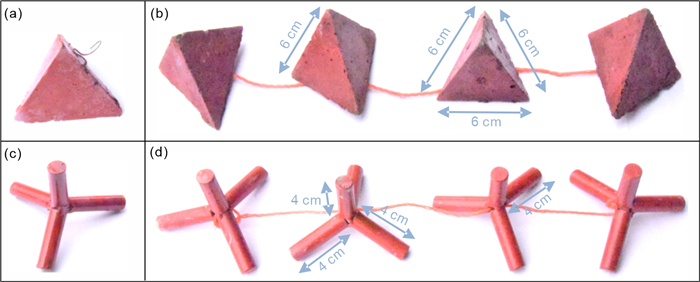
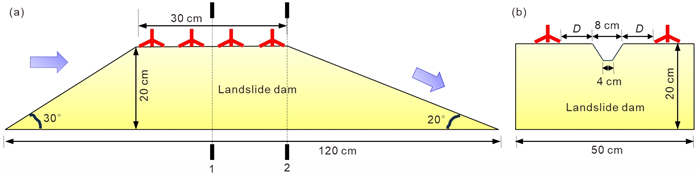
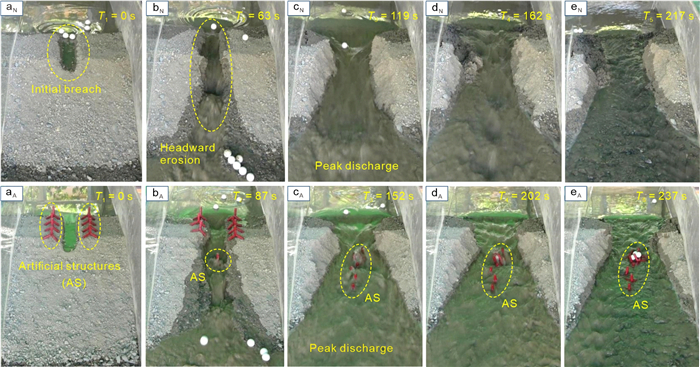
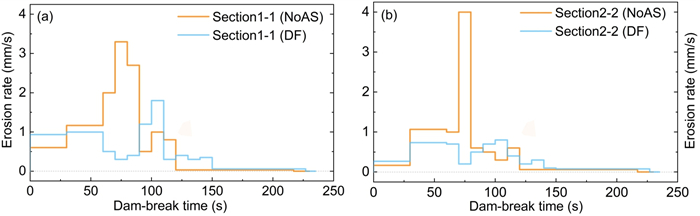
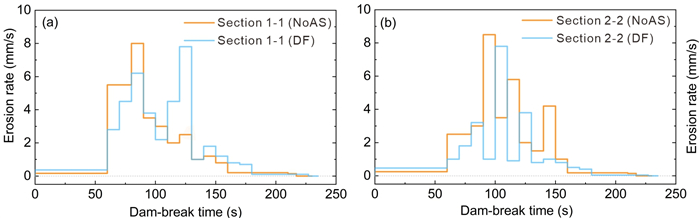
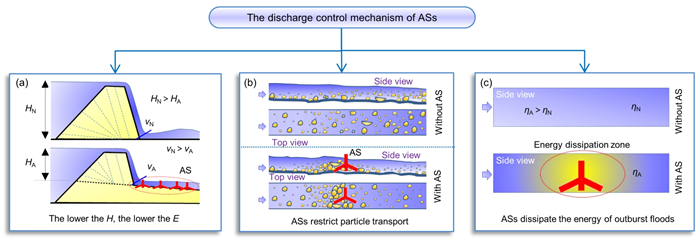
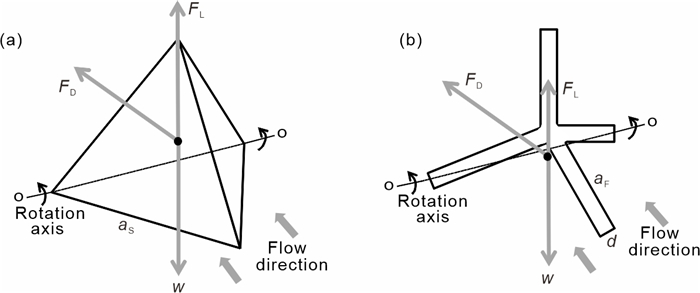
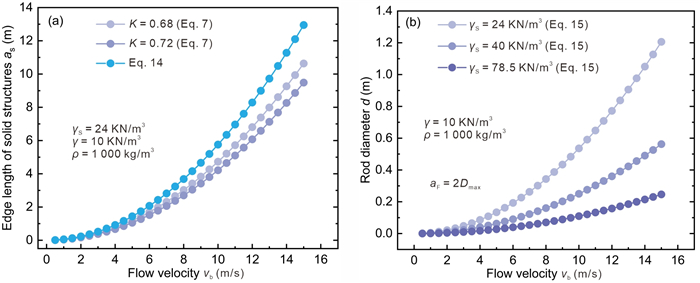
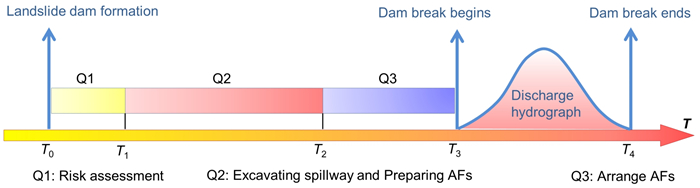
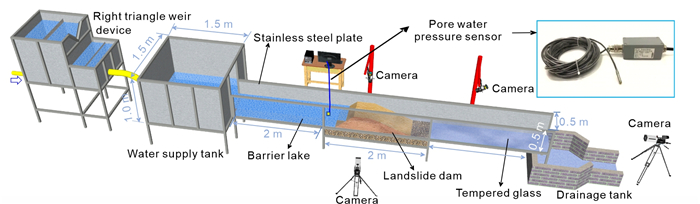
The scale of the outburst flood resulting from a landslide dam failure significantly influences the extent of the disaster and losses downstream. This study proposes a method for controlling the discharge of landslide dam failure using the artificial structure (AS). The primary approach involves strategically arranging the designed AS on both sides of the excavated spillway. As the breach is eroded, ASs gradually fall into the breach, serving to control the discharge. Fourteen sets of flume experiments were conducted to investigate the impact of various factors, including AS types, distances from the breach boundary, arrangements, columns, numbers, on the discharge control effectiveness. The mechanism how AS controls outburst discharge was revealed. Results indicate a pronounced control effect of AS on landslide dam-break discharge, with the maximum reducing rate of the peak discharge in the experiment reaching 47.4%. In controlling outburst discharge, four-sided framed structures demonstrate superior performance compared to four-sided solid structures, and serial structures outperform discrete structures. When arranging ASs, it is essential to ensure that the structure initiates its descent into the breach at the onset of the rapid increase in outburst discharge and continues until the peak discharge occurs. Building upon this foundation, augmenting the number of ASs and columns significantly enhances the efficacy of discharge control. The fundamental rationale for this discharge control lies in the AS's capacity to reduce the headward scarp height, constrain sediment transport, and diminish the erosion capacity of the outburst flood, ultimately lowering the breach erosion rate. Lastly, a calculation method for the size design of the AS is established based on mechanical analysis. The research findings offer a new technological option for the emergency disposal of landslide dams.

| Cai, Y. J., Luan, Y. S., Peng, W. X., et al., 2021. Analysis on Typical Cases of Barrier Lake: Cause, Disaster and Emergency Response. Changjiang Press, Wuhan (in Chinese with English Abstract) |
| Chen, H. Y., Ruan, H. C., Chen, J. G., et al., 2022. Review of Investigations on Hazard Chains Triggered by River-Blocking Debris Flows and Dam-Break Floods. Frontiers in Earth Science, 10: 830044. https://doi.org/10.3389/feart.2022.830044 |
| Chen, X. Q., Zhao, W. Y., Gao, Q., et al., 2011. Experimental Investigation and Design of Artificial Structures Controlling Dam-Break Floods. Journal of Southwest Jiaotong University, 46(2): 228–234. https://doi.org/10.3969/j.issn.0258-2724.2011.02.009 (in Chinese with English Abstract) |
| Chen, Z. Y., Ma, L. Q., Yu, S., et al., 2015. Back Analysis of the Draining Process of the Tangjiashan Barrier Lake. Journal of Hydraulic Engineering, 141(4): 05014011. https://doi.org/10.1061/(asce)hy.1943-7900.0000965 |
| Daneshfaraz, R., Sadeghi, H., Ghaderi, A., et al., 2024. Characteristics of Hydraulic Jump and Energy Dissipation in the Downstream of Stepped Spillways with Rough Steps. Flow Measurement and Instrumentation, 96(3): 102506. https://doi.org/10.1016/j.flowmeasinst.2023.102506 |
| Du, G. L., Zhang, Y. S., Yang, Z. H., et al., 2025. Rapid Assessment of the Co-Seismic Landslide Hazard Triggered by the 2022 Ms 6.8 Luding Earthquake. Journal of Earth Science, 36(6): 2627–2641. https://doi.org/10.1007/s12583-023-1846-y |
| Dyer, K. R., 1986. Coastal and Estuarine Sediment Dynamics. John Wiley & Sons |
| Fan, X. M., Dufresne, A., Whiteley, J., et al., 2021. Recent Technological and Methodological Advances for the Investigation of Landslide Dams. Earth-Science Reviews, 218: 103646. https://doi.org/10.1016/j.earscirev.2021.103646 |
| Guo, C. B., Wu, R. A., Zhong, N., et al., 2024. Large Landslides along Active Tectonic Zones of Eastern Tibetan Plateau: Background and Mechanism of Landslide Formation. Earth Science, 49(12): 4635–4658. https://doi.org/10.3799/dqkx.2024.124 (in Chinese with English Abstract) |
| He, X. R., Yin, Y. P., Zhao, L. M., et al., 2024. Disintegration and Fragmentation Effect of High Position Rock Landslide Debris Flow Based on Large Scale Physical Model Test. Earth Science, 49(7): 2650–2661. https://doi.org/10.3799/dqkx.2023.021 (in Chinese with English Abstract) |
| Il'inskaya, A. I., Bobkov, A. V., Gara, V. S., et al., 2017. Closure of the Bureya River in April 2016 and Filling of the Plinth of the Lower Bureya Dam. Power Technology and Engineering, 51(3): 274-280. https://doi.org/10.1007/s10749-017-0824-x |
| Jiang, X. G., Cui, P., Chen, H. Y., et al., 2017. Formation Conditions of Outburst Debris Flow Triggered by Overtopped Natural Dam Failure. Landslides, 14(3): 821–831. https://doi.org/10.1007/s10346-016-0751-1 |
| Jiang, X. G., Huang, J. H., Wei, Y. W., et al., 2018. The Influence of Materials on the Breaching Process of Natural Dams. Landslides, 15(2): 243–255. https://doi.org/10.1007/s10346-017-0877-9-019. |
| Jiang, X. G., Wei, Y. W., 2019. Natural Dam Breaching due to Overtopping: Effects of Initial Soil Moisture. Bulletin of Engineering Geology and the Environment, 78(7): 4821–4831. https://doi.org/10.1007/s10064-018-01441-7 |
| Jiang, X. G., Wei, Y. W., 2020. Erosion Characteristics of Outburst Floods on Channel Beds under the Conditions of Different Natural Dam Downstream Slope Angles. Landslides, 17(8): 1823–1834. https://doi.org/10.1007/s10346-020-01381-y |
| Li, B., Bai, Z. W., Sun, R., et al., 2025. Economic Loss Assessment of Upstream Inundation under Time-Varying Water Levels in Landslide-Dammed Lakes: A Case Study of Tangjiashan Dammed Lake. Earth Science, 50(10): 3873–3884. https://doi.org/10.3799/dqkx.2025.148 (in Chinese with English Abstract) |
| Li, D. Y., Zheng, D. F., Wu, H., et al., 2021. Numerical Simulation on the Longitudinal Breach Process of Landslide Dams Using an Improved Coupled DEM-CFD Method. Frontiers in Earth Science, 9: 673249. https://doi.org/10.3389/feart.2021.673249 |
| Li, D. S., Yang, K. C., Zhou, S. W., 2022. Effect of Residual Cofferdam at the Diversion Tunnel Inlet on the Index of River Closure and the Dumped Materials: A Case Study. Ain Shams Engineering Journal, 13(3): 101616. https://doi.org/10.1016/j.asej.2021.10.011 |
| Li, S., Peng, M., Shi, Z. M., et al., 2025. Simulation and Analysis of Cascading Hazard Based on Fluid-Soil Coupled SPH Method. Earth Science, 50(10): 3967–3981. https://doi.org/10.3799/dqkx.2025.112 (in Chinese with English Abstract) |
| Li, Y. C., Guo, S. F., Zheng, B. W., et al., 2025. Analysis of Ancient Rongcharong Landslide Dam Failure Events in the Suwalong Reach of the Upper Reaches of the Jinsha River. Journal of Earth Science, 36(5): 2005–2022. https://doi.org/10.1007/s12583-024-0052-x |
| Lin, J. B., Jin, S., Ai, C. F., et al., 2020. Experimental and Numerical Investigation of River Closure Project. Water, 12(1): 241. https://doi.org/10.3390/w12010241 |
| Long, X. Y., Hu, Y. X., Gan, B. R., et al., 2024. Numerical Simulation of the Mass Movement Process of the 2018 Sedongpu Glacial Debris Flow by Using the Fluid-Solid Coupling Method. Journal of Earth Science, 35(2): 583–596. https://doi.org/10.1007/s12583-022-1625-1 |
| Meng, C. K., Chen, K. T., Niu, Z. P., et al., 2021. Influence of Internal Structure on Breaking Process of Short-Lived Landslide Dams. Frontiers in Earth Science, 9: 604635. https://doi.org/10.3389/feart.2021.604635 |
| Meng, Z., Yang, W. J., 2012. Preliminary Exploration of Difference between Submarine Angle of Repose and Internal Friction Angle of Sediment Particles. Journal of Sediment Research, 37(4): 76–80. https://doi.org/10.16239/j.cnki.0468-155x.2012.04.011 (in Chinese with English Abstract) |
| Parsaie, A., Haghiabi, A., 2021. Hydraulic Investigation of Finite Crested Stepped Spillways. Water Supply, 21(5): 2437–2443. https://doi.org/10.2166/ws.2021.078 |
| Peng, M., Zhang, L. M., 2012. Breaching Parameters of Landslide Dams. Landslides, 9(1): 13–31. https://doi.org/10.1007/s10346-011-0271-y |
| Peng, M., Zhang, L. M., 2013. Dynamic Decision Making for Dam-Break Emergency Management: Part 2: Application to Tangjiashan Landslide Dam Failure. Natural Hazards and Earth System Sciences, 13(2): 439–454. https://doi.org/10.5194/nhess-13-439-2013 |
| Peng, M., Zhang, L. M., Chang, D. S., et al., 2014. Engineering Risk Mitigation Measures for the Landslide Dams Induced by the 2008 Wenchuan Earthquake. Engineering Geology, 180: 68–84. https://doi.org/10.1016/j.enggeo.2014.03.016 |
| Peng, X. L., Wang, F. W., Chen, Y., et al., 2025. Research on Effects of Spatial Structure and Strength Characteristics of Tectonic Mélanges in Baige Landslide on Formation of Sliding Zone and Long Runout Movement. Earth Science, 50(10): 3844–3856. https://doi.org/10.3799/dqkx.2025.079 (in Chinese with English Abstract) |
| Rhoads, B. L., 2020. River Dynamics: Geomorphology to Support Management. Cambridge University Press, Cambridge. https://doi.org/10.1017/9781108164108 |
| Ruan, H. C., Chen, H. Y., Chen, X. Q., et al., 2023. Modeling of Breaching Parameters for Debris Flow Dams. Journal of Mountain Science, 20(10): 2835–2851. https://doi.org/10.1007/s11629-023-8052-3 |
| Ruan, H. C., Chen, H. Y., Wang, T., et al., 2021. Modeling Flood Peak Discharge Caused by Overtopping Failure of a Landslide Dam. Water, 13(7): 921. https://doi.org/10.3390/w13070921 |
| Sanginov, A. A., Kabirov, V. K., Estifeeva, A. G., 2023. Pskem River Closure during Construction of the Pskem Hydropower Plant. Power Technology and Engineering, 56(6): 801–807. https://doi.org/10.1007/s10749-023-01590-0 |
| Shen, D. Y., Shi, Z. M., Zheng, H. C., et al., 2022. Effects of Grain Composition on the Stability, Breach Process, and Breach Parameters of Landslide Dams. Geomorphology, 413: 108362. https://doi.org/10.1016/j.geomorph.2022.108362 |
| Tomaschitz, J. O. P., Mannich, M., Ota, J. J., 2018. Experimental Results for Guidance and Design Criteria of Horizontal End-Dumping Type River Closure. Brazilian Journal of Water Resources, 23: e18. https://doi.org/10.1590/2318-0331.231820180036 |
| Wang, J. W., Wang, R., Zhang, C., et al., 2024. Long-Term and Short-Term Disposal of Landslide Dams at Steep Ⅴ-Shaped Valleys. Landslides, 21(1): 135–153. https://doi.org/10.1007/s10346-023-02145-0 |
| Xiao, H. X., 2000. Estimation Research on Riprap Grain Size for Closure by Vertical Blockade. Design of Hydroelectric Power Station, 16(1): 1–7. https://doi.org/10.3969/j.issn.1003-9805. 2000.01.001 (in Chinese with English Abstract) doi: 10.3969/j.issn.1003-9805.2000.01.001 |
| Yan, Y. Q., Guo, C. B., Zhang, Y. N., et al., 2024. Development and Deformation Characteristics of Large Ancient Landslides in the Intensely Hazardous Xiongba-Sela Section of the Jinsha River, Eastern Tibetan Plateau, China. Journal of Earth Science, 35(3): 980–997. https://doi.org/10.1007/s12583-023-1925-y |
| Yang, Z. W., Liu, W. M., Garcia-Castellanos, D., et al., 2022. Geomorphic Response of Outburst Floods: Insight from Numerical Simulations and Observations: The 2018 Baige Outburst Flood in the Upper Yangtze River. Science of the Total Environment, 851: 158378. https://doi.org/10.1016/j.scitotenv.2022.158378 |
|
Zhang, L. M., He, J., Xiao, T., 2021. Engineering Risk Mitigation for Landslide Hazard Chains: The Baige Landslides on the Jinsha River in 2018. In: Tiwari, B., Sassa, K., Bobrowsky, P. T., et al., eds., Understanding and Reducing Landslide Disaster Risk: Volume 4 Testing, Modeling and Risk Assessment. Springer, Cham. 109–120. |
| Zhong, Q. M., Chen, S. S., Mei, S. A., et al., 2018. Numerical Simulation of Landslide Dam Breaching due to Overtopping. Landslides, 15(6): 1183–1192. https://doi.org/10.1007/s10346-017-0935-3 |
| Zhong, Q. M., Chen, S. S., Wang, L., et al., 2020. Back Analysis of Breaching Process of Baige Landslide Dam. Landslides, 17(7): 1681–1692. https://doi.org/10.1007/s10346-020-01398-3 |
| Zhong, Q. M., Wang, L., Chen, S. S., et al., 2021. Breaches of Embankment and Landslide Dams: State of the Art Review. Earth-Science Reviews, 216: 103597. https://doi.org/10.1016/j.earscirev.2021.103597 |
| Zhou, G. G. D., Zhou, M. J., Shrestha, M. S., et al., 2019. Experimental Investigation on the Longitudinal Evolution of Landslide Dam Breaching and Outburst Floods. Geomorphology, 334: 29–43. https://doi.org/10.1016/j.geomorph.2019.02.035 |
| Zhou, J. W., Jiang, N., Li, H. B., 2024. Automatic Discontinuity Identification and Quantitative Monitoring of Unstable Blocks Using Terrestrial Laser Scanning in Large Landslide during Emergency Disposal. Landslides, 21(3): 607–620. https://doi.org/10.1007/s10346-023-02169-6 |
Figures(16) / Tables(4)
Copyright © 2013-2020 Journal of Earth Science 鄂ICP备15021562号-2
Tel: +86-27-67885075 Fax: +86-27-67885075 E-mail: xbb@cug.edu.cn
Address: Editorial Office of Journal, China University of Geosciences, Yujiashan, Wuhan, Hubei 430074, P. R. China
Supported by:
Beijing Renhe Information Technology Co. Ltd
E-mail:
info@rhhz.net



 DownLoad: