| Citation: | Huiying Ge, Hongyi Li, Tongli Wang, Shengzhong Zhang, Bowen Cui. Seismicity Analysis of the Beijing Area from an Enhanced Long-Term Earthquake Catalog. Journal of Earth Science, 2026, 37(4): 1852-1862. doi: 10.1007/s12583-024-0093-1

|
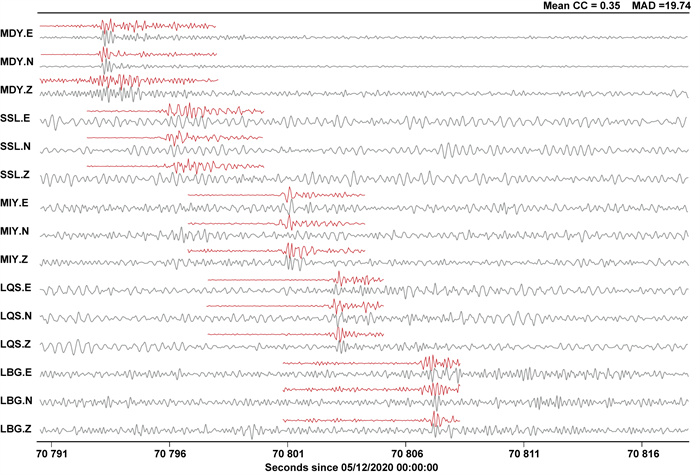
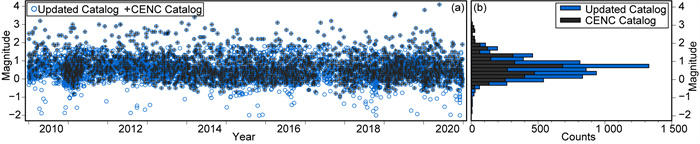
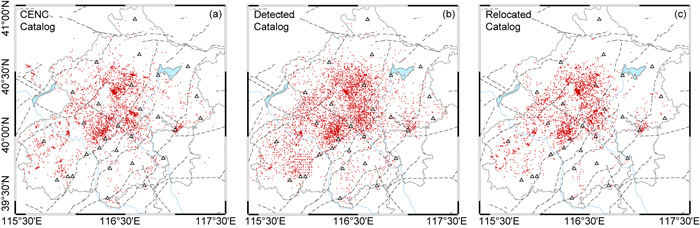
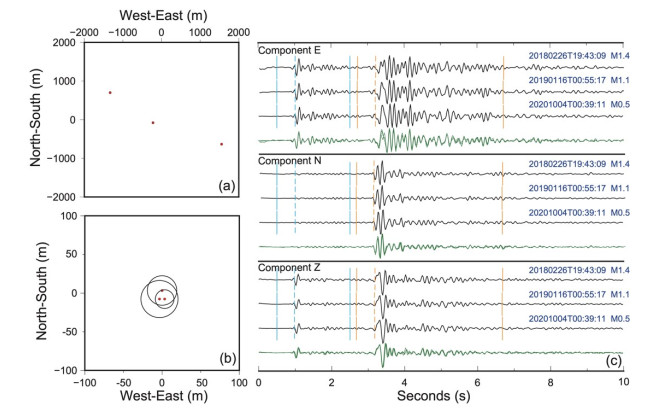
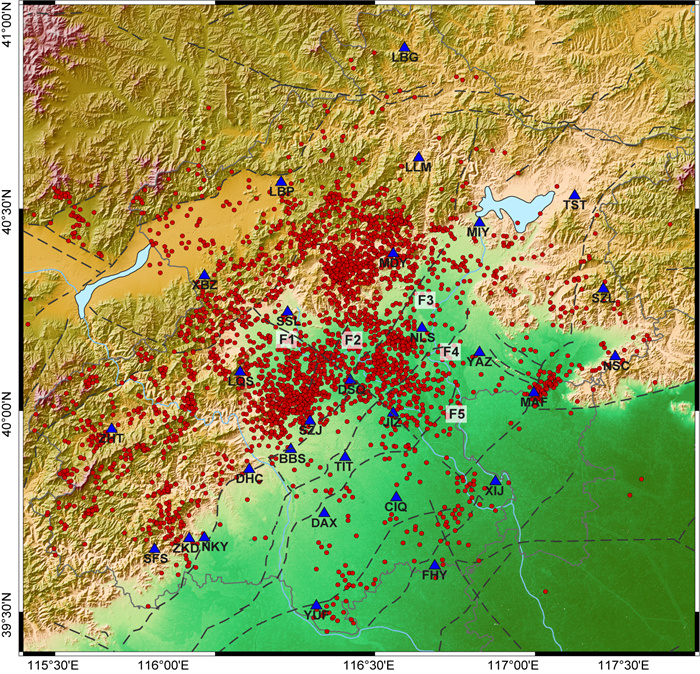
Beijing, a major central city, is located at the junction of Northeast Asia and North China, bordered by the Taihang Mountains to the west and the Yanshan Mountain Range to the north. In this study, continuous waveform data from 29 seismic stations operated by the China Earthquake Networks Center (CENC) covering the period from 2010 to 2020 are collected to construct an enhanced catalog for the Beijing area through the integration of both template matching and machine learning methodologies. We first selected 1 884 earthquakes with high signal-to-noise ratios (SNRs) as template events from 3 405 earthquakes, utilizing the graphics processing unit-based match and locate (GPU-M&L) for earthquake detection and location, and a total of 10 392 events were detected. Then, DeepDenoiser, a deep learning-based technique for noise reduction, was applied to extract seismic signals from continuous raw data, and we identified 7 516 seismic events, approximately 2.2 times the number listed in the CENC earthquake catalog. We then employed PhaseNet, a deep neural network-based method, to pick seismic arrival-time, and HypoDD for relocation. Repeating earthquakes were identified by a segmented cross-correlation method through both time and frequency domains. Our study obtains an enhanced catalog for the Beijing area, adding approximately 5 000 earthquakes primarily in the 0–1 magnitude range. The distribution of earthquakes in the Beijing region is mainly concentrated in three main clusters, revealing a potential concealed fault in the Jiudu River area and new evidence of a southern extension of the Xiaotangshan-Dongbeiwang fault zone. Our results provide a reliable and comprehensive data foundation for assessing earthquake risks and enhancing disaster prevention and mitigation strategies in the Beijing region.

| Ardid, A., Dempsey, D., Caudron, C., et al., 2023. Using Template Matching to Detect Hidden Fluid Release Episodes beneath Crater Lakes in Ruapehu, Copahue, and Kawah Ijen Volcanoes. Journal of Geophysical Research: Solid Earth, 128(10): e2023JB026729. https://doi.org/10.1029/2023jb026729 |
| Duan, Y. H., Wang, F. Y., Zhang, X. K., et al., 2016. Three-Dimensional Crustal Velocity Structure Model of the Middle-Eastern North China Craton (HBCrust1.0). Science China Earth Sciences, 59(7): 1477–1488. https://doi.org/10.1007/s11430-016-5301-0 |
| Gao, Z. W., Chen, Q. F., Huang, J. L., et al., 2010. Velocity Structure beneath the Active Faults in Beijing Area and Their Seismo-Tectonic Characteristics. Technology for Earthquake Disaster Prevention, 5(3): 271–282 (in Chinese with English Abstract) |
| Cheng, G., Wang, H., Luo, Y., et al., 2015. Study of the Deformation Mechanism of the Gaoliying Ground Fissure. Proceedings of the International Association of Hydrological Sciences, 372: 231–234. https://doi.org/10.5194/piahs-372-231-2015 |
| Crotwell, H. P., Owens, T. J., Ritsema, J., 1999. The TauP Toolkit: Flexible Seismic Travel-Time and Ray-Path Utilities. Seismological Research Letters, 70(2): 154–160. https://doi.org/10.1785/gssrl.70.2.154 |
| Gibbons, S. J., Ringdal, F., 2006. The Detection of Low Magnitude Seismic Events Using Array-Based Waveform Correlation. Geophysical Journal International, 165(1): 149–166. https://doi.org/10.1111/j.1365-246x.2006.02865.x |
| Guo, H., Thurber, C., Warren, I., et al., 2023. Enhanced Microseismicity during Production Pumping Cessation at the San Emidio Geothermal Field (Nevada, USA) in December 2016. Journal of Geophysical Research: Solid Earth, 128(11): e2023JB027008. https://doi.org/10.1029/2023jb027008 |
| Jiang, Y., Yin, N., 2021. Study on the Spatiotemporal Distribution Characteristics of Earthquakes in the Beijing Area. Earthquake Research in Shanxi, 4: 1–7 (in Chinese with English Abstract) |
| He, Z. T., Ma, B. Q., Lu, H. F., 2009. Evidence of the Dongbeiwang-Xiaotangshan Fault in Beijing. Seismology and Geology, 31(2): 233–246 (in Chinese with English Abstract) |
| Igarashi, T., Matsuzawa, T., Hasegawa, A., 2003. Repeating Earthquakes and Interplate Aseismic Slip in the Northeastern Japan Subduction Zone. Journal of Geophysical Research: Solid Earth, 108(B5): 2002JB001920. https://doi.org/10.1029/2002jb001920 |
| Kanamori, H., Anderson, D. L., 1975. Theoretical Basis of Some Empirical Relations in Seismology. Bulletin of the Seismological Society of America, 65(5): 1073–1095 |
| Lee, H. Y., Douilly, R., 2023. Earthquake Swarms in Southern Hispaniola Revealed by Spatiotemporal Evolution of Seismicity from Multi-Station Template Matching. Bulletin of the Seismological Society of America, 113(1): 115–130. https://doi.org/10.1785/0120220125 |
| Li, L., Chen, Q. F., Cheng, X., et al., 2007. Spatial Clustering and Repeating of Seismic Events Observed along the 1976 Tangshan Fault, North China. Geophysical Research Letters, 34(23): L23309. https://doi.org/10.1029/2007gl031594 |
| Li, L., Chen, Q. F., Niu, F. L., et al., 2009. Slip Rate along the Lijiang-Ninglang Fault Zone Estimated from Repeating Microearthquak- es. Science Bulletin, 54(3): 447–455. https://doi.org/10.1007/s11434-008-0406-2 |
| Li, L., Chen, Q. F., 2010. Slip Rates at Depth Along the Buried Faults in Beijing Plain Area Estimated from Repeating Microearthquakes. Seismology and Geology, 32(3): 508–519. https://doi.org/10.3969/j.issn.0253-4967.2010.03.018 (in Chinese with English Abstract) |
| Li, L., Chen, Q. F., Niu, F. L., et al., 2011. Deep Slip Rates along the Longmen Shan Fault Zone Estimated from Repeating Microearthquakes. Journal of Geophysical Research, 116(B9): B09310. https://doi.org/10.1029/2011jb008406 |
| Liu, M., Li, H. Y., Peng, Z. G., et al., 2019. Spatial-Temporal Distribution of Early Aftershocks Following the 2016 Ms 6.4 Menyuan, Qinghai, China Earthquake. Tectonophysics, 766: 469–479. https://doi.org/10.1016/j.tecto.2019.06.022 |
| Liu, M., Li, L., Zhang, M., et al., 2023. Complexity of Initiation and Evolution of the 2013 Yunlong Earthquake Swarm. Earth and Planetary Science Letters, 612: 118168. https://doi.org/10.1016/j.epsl.2023.118168 |
| Liu, M., Li, H. Y., Zhang, M., et al., 2020. Graphics Processing Unit-Based Match and Locate (GPU-M&L): an Improved Match and Locate Method and Its Application. Seismological Research Letters, 91(2A): 1019–1029. https://doi.org/10.1785/0220190241 |
| Meng, X. F., Peng, Z. G., Hardebeck, J. L., 2013. Seismicity around Parkfield Correlates with Static Shear Stress Changes Following the 2003 Mw 6.5 San Simeon Earthquake. Journal of Geophysical Research: Solid Earth, 118(7): 3576–3591. https://doi.org/10.1002/jgrb.50271 |
| Morton, E. A., Bilek, S. L., Rowe, C. A., 2023. Cascadia Subduction Zone Fault Heterogeneities from Newly Detected Small Magnitude Earthquakes. Journal of Geophysical Research: Solid Earth, 128(6): e2023JB026607. https://doi.org/10.1029/2023jb026607 |
| Neves, M., Peng, Z. G., Lin, G. Q., 2023. A High-Resolution Earthquake Catalog for the 2004 Mw 6 Parkfield Earthquake Sequence Using a Matched Filter Technique. Seismological Research Letters, 94(1): 507–521. https://doi.org/10.1785/0220220206 |
| Peng, Z. G., Zhao, P., 2009. Migration of Early Aftershocks Following the 2004 Parkfield Earthquake. Nature Geoscience, 2(12): 877–881. https://doi.org/10.1038/ngeo697 |
| Ren, Z. Q., 1996. Historical Earthquakes in the Beijing Region. Progress in Earthquake Sciences, (9): 34–35 (in Chinese) |
| Ross, Z. E., Trugman, D. T., Hauksson, E., et al., 2019. Searching for Hidden Earthquakes in Southern California. Science, 364(6442): 767–771. https://doi.org/10.1126/science.aaw6888 |
| Sammis, C. G., Rice, J. R., 2001. Repeating Earthquakes as Low-Stress-Drop Events at a Border between Locked and Creeping Fault Patches. Bulletin of the Seismological Society of America, 91(3): 532–537. https://doi.org/10.1785/0120000075 |
| Saito, T., Noda, A., 2020. Strain Energy Released by Earthquake Faulting with Random Slip Components. Geophysical Journal International, 220(3): 2009–2020. https://doi.org/10.1093/gji/ggz561 |
| Shakibay Senobari, N., Funning, G. J., 2019. Widespread Fault Creep in the Northern San Francisco Bay Area Revealed by Multistation Cluster Detection of Repeating Earthquakes. Geophysical Research Letters, 46(12): 6425–6434. https://doi.org/10.1029/2019gl082766 |
| Shelly, D. R., 2020. A High-Resolution Seismic Catalog for the Initial 2019 Ridgecrest Earthquake Sequence: Foreshocks, Aftershocks, and Faulting Complexity. Seismological Research Letters, 91(4): 1971–1978. https://doi.org/10.1785/0220190309 |
| Waldhauser, F., Ellsworth, W. L., 2000. A Double-Difference Earthquake Location Algorithm: Method and Application to the Northern Hayward Fault, California. Bulletin of the Seismological Society of America, 90(6): 1353–1368. https://doi.org/10.1785/0120000006 |
| Xiang, H. F., Fang, Z. J., Zhang, W. X., et al., 1993. Join Profile Survey of Active Features for the Late Quaternary Surface Facefaults in Beijing Plain Region. Journal of Seismological Research, 15(3): 385–388 (in Chinese with English Abstract) |
| Yu, P. L., Dempsey, D., Rinaldi, A. P., et al., 2023. Association between Injection and Microseismicity in Geothermal Fields with Multiple Wells: Data-Driven Modeling of Rotokawa, New Zealand, and Húsmúli, Iceland. Journal of Geophysical Research: Solid Earth, 128(4): e2022JB025952. https://doi.org/10.1029/2022jb025952 |
| Zhai, Q. S., Peng, Z. G., Matsubara, M., et al., 2023. Spatiotemporal Variations of Intermediate-Depth Earthquakes before and after 2011 Tohoku Earthquake Revealed by a Template Matching Catalog. Geophysical Research Letters, 50(22): e2023GL104068. https://doi.org/10.1029/2023gl104068 |
| Zhao, C. P., Chen, Z. L., Hua, W., et al., 2011. A Study on the Source Parameters of Small to Moderate Earthquakes in the Main Seismic Activity Zones of Mainland China. Chinese Journal of Geophysics, 54(6): 1478–1489 (in Chinese with English Abstract) |
| Zhao, S., Meng, Y. Q., Ma, Z. N., et al., 2019. Fault Attitude of the North Section of Huangzhuang-Gaoliying Fault at Beijing, China and Its Effects on the Ground Rupture. Journal of Environmental and Engineering Geophysics, 24(4): 549–555. https://doi.org/10.2113/jeeg24.4.549 |
| Zhao, Y., Cai, X. M., Wang, J. M., et al., 2015. The Division of "Small Blocks" of Structure in Beijing Plain and a Discussion on the Activity of Micro Block in Quaternary Period. Geology in China, 42(6): 1876–1884. https://doi.org/10.12029/gc20150615 (in Chinese with English Abstract) |
| Zhang, L., Zhang, X. L., Bai, L. Y., et al., 2017. Activity Study and Disaster Effect Analysis of the North Section of Huangzhuang-Gaoliying Fault in Beijing. Journal of Geomechanics, 23(7): 548–557 (in Chinese with English Abstract) |
| Zhang, X. L., Zhang, L., Cai X. M., et al., 2016. A Study of Structure and Activity Characteristics of the Northern Segment of Huangzhuang-Gaoliying Fault in Beijing Plain Area. Geology in China, 43(4): 1258–1265. https://doi.org/10.12029/gc20160412 (in Chinese with English Abstract) |
| Zhu, W. Q., Beroza, G. C., 2019. PhaseNet: A Deep-Neural-Network-Based Seismic Arrival-Time Picking Method. Geophysical Journal International, 216(1): 261–273. https://doi.org/10.1093/gji/ggy423 |
| Zhu, W. Q., Mousavi, S. M., Beroza, G. C., 2019. Seismic Signal Denoising and Decomposition Using Deep Neural Networks. IEEE Transactions on Geoscience and Remote Sensing, 57(11): 9476–9488. https://doi.org/10.1109/TGRS.2019.2926772 |
| Zuccarello, L., De Angelis, S., Minio, V., et al., 2022. Volcanic Tremor Tracks Changes in Multi-Vent Activity at Mt. Etna, Italy: Evidence from Analyses of Seismic Array Data. Geophysical Research Letters, 49(22): e2022GL100056. https://doi.org/10.1029/2022gl100056 |
| Shelly, D. R., Beroza, G. C., Ide, S., 2007. Non-Volcanic Tremor and Low-Frequency Earthquake Swarms. Nature, 446(7133): 305–307. https://doi.org/10.1038/nature05666 |
| Trugman, D. T., Shearer, P. M., 2017. GrowClust: A Hierarchical Clustering Algorithm for Relative Earthquake Relocation, with Application to the Spanish Springs and Sheldon, Nevada, Earthquake Sequences. Seismological Research Letters, 88(2A): 379–391. https://doi.org/10.1785/0220160188 |
| Zhao, M., Chen, S., 2021. Study on the Generalization of Deep Learning-Based Earthquake Detection Models in Regional Seismic Networks. Earthquake, 41(1): 166–179 (in Chinese with English Abstract) |
| Beaucé, E., van der Hilst, R. D., Campillo, M., 2022. Microseismic Constraints on the Mechanical State of the North Anatolian Fault Zone 13 Years after the 1999 M 7.4 Izmit Earthquake. Journal of Geophysical Research: Solid Earth, 127(9): e2022JB024416. https://doi.org/10.1029/2022jb024416 |
| Truttmann, S., Diehl, T., Herwegh, M., 2023. Hypocenter-Based 3D Imaging of Active Faults: Method and Applications in the Southwestern Swiss Alps. Journal of Geophysical Research: Solid Earth, 128(6): e2023JB026352. https://doi.org/10.1029/2023jb026352 |
Figures(13) / Tables(1)
Copyright © 2013-2020 Journal of Earth Science 鄂ICP备15021562号-2
Tel: +86-27-67885075 Fax: +86-27-67885075 E-mail: xbb@cug.edu.cn
Address: Editorial Office of Journal, China University of Geosciences, Yujiashan, Wuhan, Hubei 430074, P. R. China
Supported by:
Beijing Renhe Information Technology Co. Ltd
E-mail:
info@rhhz.net


 DownLoad: