| Citation: | Fulai Li, Kaining Wang, Xiang Yu, Fangyu Dong, Yong Chen, Zhongfeng Duan. Stability Mechanisms of CO2-H2O-Dawsonite-Bearing Sandstone Reaction System. Journal of Earth Science, 2026, 37(4): 1696-1708. doi: 10.1007/s12583-024-0098-9

|
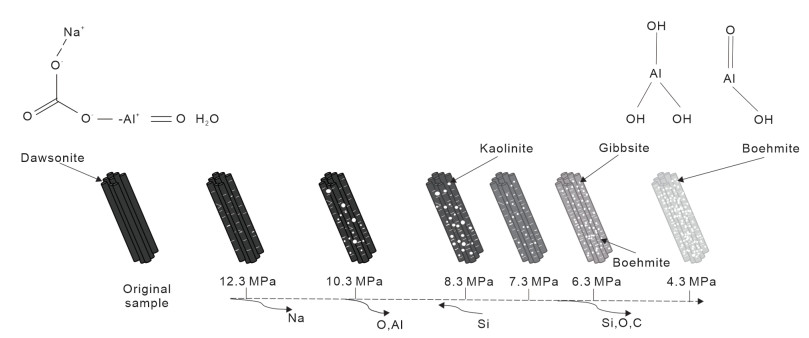
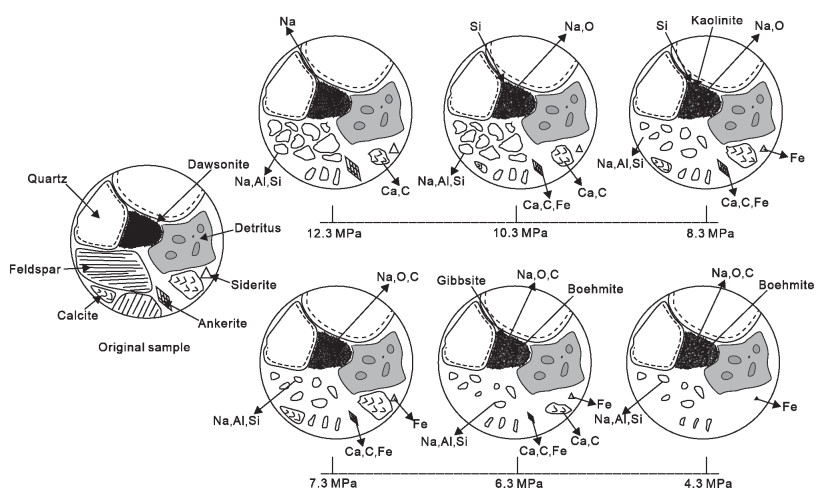
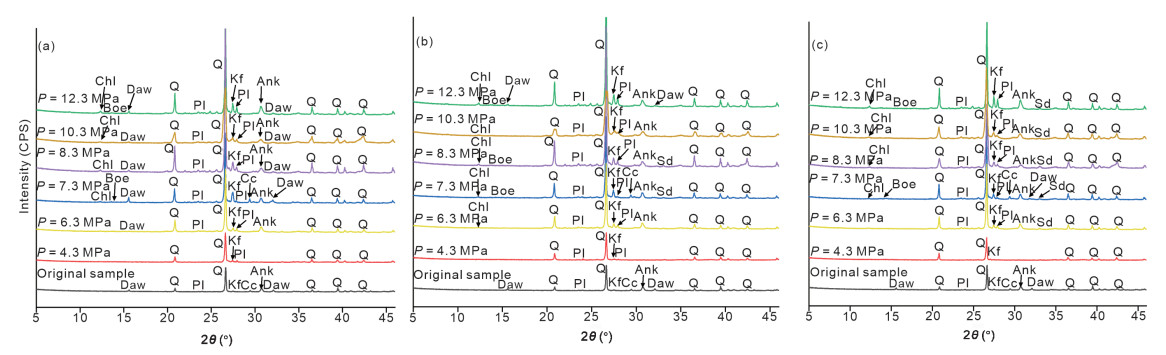
Effective CO2 sequestration is crucial for mitigating climate change, and dawsonite-bearing sandstone reservoirs are considered potential geological storage sites for CO2. In this process, the interactions among CO2, H2O, and rock directly influence the precipitation and dissolution of carbon-bearing minerals within the dawsonite-bearing sandstone, thereby affecting the stability of carbon sequestration. This study focuses on natural dawsonite-bearing sandstone from the Dongying sag. We conduct physical experiments in a high-temperature, high-pressure reactor to investigate the CO2-H2O-dawsonite-bearing sandstone interaction under different temperatures and CO2 pressures. X-ray diffraction, scanning electron microscopy, energy spectrum analysis, and water chemical analysis were employed to systematically investigate the dissolution and precipitation characteristics of the sandstone samples. Additionally, thermodynamic simulations were performed using the PHREEQC numerical simulation software, facilitating an understanding of the stable states of the reaction system under different conditions. The results indicate that the dissolution of dawsonite tablets leads to the formation of gibbsite and boehmite, which can transform into kaolinite under certain conditions. Temperature and CO2 pressure exert significant effects on these processes. Notably, the CO2-H2O-dawsonite-bearing sandstone reaction system remains stable under high CO2 pressure and exhibits strong carbon fixation ability. This research provides valuable insights for assessing the feasibility and safety of CO2 geological sequestration and storage.

| Ajayi, T., Gomes, J. S., Bera, A., 2019. A Review of CO2 Storage in Geological Formations Emphasizing Modeling, Monitoring and Capacity Estimation Approaches. Petroleum Science, 16(5): 1028–1063. https://doi.org/10.1007/s12182-019-0340-8 |
| Aminu, M. D., Ali Nabavi, S., Rochelle, C. A., et al., 2017. A Review of Developments in Carbon Dioxide Storage. Applied Energy, 208: 1389–1419. https://doi.org/10.1016/j.apenergy.2017.09.015 |
| Al-Khdheeawi, E. A., Mahdi, D. S., Yuan, Y. J., et al., 2023. Influence of Clay Content on CO2-Rock Interaction and Mineral-Trapping Capacity of Sandstone Reservoirs. Energies, 16(8): 3489. https://doi.org/10.3390/en16083489 |
| Bakhshi, P., Kharrat, R., Hashemi, A., et al., 2018. Experimental Evaluation of Carbonated Waterflooding: A Practical Process for Enhanced Oil Recovery and Geological CO2 Storage. Greenhouse Gases: Science and Technology, 8(2): 238–256. https://doi.org/10.1002/ghg.1734 |
| Connolly, R., Connolly, M., Carter, R. M., et al., 2020. How Much Human-Caused Global Warming should we Expect with Business-As-Usual (BAU) Climate Policies? A Semi-Empirical Assessment. Energies, 13(6): 1365. https://doi.org/10.3390/en13061365 |
| DePaolo, D. J., Cole, D. R., 2013. Geochemistry of Geologic Carbon Sequestration: An Overview. Reviews in Mineralogy and Geochemistry, 77(1): 1–14. https://doi.org/10.2138/rmg.2013.77.1 |
| Elidemir, S., Güleç, N., 2018. Geochemical Characterization of Geothermal Systems in Western Anatolia (Turkey): Implications for CO2 Trapping Mechanisms in Prospective CO2-EGS Sites. Greenhouse Gases: Science and Technology, 8(1): 63–76. https://doi.org/10.1002/ghg.1747 |
| Frost, R. L., Bouzaid, J. M., 2007. Raman Spectroscopy of Dawsonite NaAl(CO3)(OH)2. Journal of Raman Spectroscopy, 38(7): 873–879. https://doi.org/10.1002/jrs.1733 |
| Gambelli, A. M., 2023. CCUS Strategies as Most Viable Option for Global Warming Mitigation. Energies, 16(10): 4077. https://doi.org/10.3390/en16104077 |
| Gao, Y. Q., Liu, L., 2007. Basic Characteristics and Geological Significance of Dawsonite. Geological Review, 2007(1): 104–111. https://doi.org/10.16509/j.georeview.2007.01.014 (in Chines with English Abstract) |
| Golab, A. N., Carr, P. F., Palamara, D. R., 2006. Influence of Localised Igneous Activity on Cleat Dawsonite Formation in Late Permian Coal Measures, Upper Hunter Valley, Australia. International Journal of Coal Geology, 66(4): 296–304. https://doi.org/10.1016/j.coal.2005.08.001 |
| Grimston, M. C., Karakoussis, V., Fouquet, R., et al., 2001. The European and Global Potential of Carbon Dioxide Sequestration in Tackling Climate Change. Climate Policy, 1(2): 155–171. https://doi.org/10.3763/cpol.2001.0120 |
| Gunnemyr, M., 2019. Causing Global Warming. Ethical Theory and Moral Practice, 22(2): 399–424. https://doi.org/10.1007/s10677-019-09990-w |
| Gysi, A. P., Stefánsson, A., 2008. Numerical Modelling of CO2-Water-Basalt Interaction. Mineralogical Magazine, 72(1): 55–59. https://doi.org/10.1180/minmag.2008.072.1.55 |
| Hellevang, H., Aagaard, P., Oelkers, E. H., et al., 2005. Can Dawsonite Permanently Trap CO2? Environmental Science & Technology, 39(21): 8281–8287. https://doi.org/10.1021/es0504791 |
| Hellevang, H., Declercq, J., Kvamme, B., et al., 2010. The Dissolution Rates of Dawsonite at pH 0.9 to 5 and Temperatures of 22, 60 and 77 ℃. Applied Geochemistry, 25(10): 1575–1586. https://doi.org/10.1016/j.apgeochem.2010.08.007 |
| IPCC, 2014. Climate Change 2014: Synthesis Report. In: Core Writing Team, Pachauri, R. K., Meyer, L. A., eds., Contribution of Working Groups Ⅰ, Ⅱ and Ⅲ to the Fifth Assessment Report of the Intergovernmental Panel on Climate Change. IPCC, Geneva, Switzerland. 151 |
| Jia, Z. Y., Liu, Z., Zhang, L. X., et al., 2022. Development and Prospect of Carbon Capture, Utilization and Storage Technology in China. Chinese Journal of Environmental Management, 14(6): 81–87. https://doi.org/10.16868/j.cnki.1674-6252.2022. 06.081 (in Chinese with English Abstract) doi: 10.16868/j.cnki.1674-6252.2022.06.081 |
| Lechat, K., Lemieux, J. M., Molson, J., et al., 2016. Field Evidence of CO2 Sequestration by Mineral Carbonation in Ultramafic Milling Wastes, Thetford Mines, Canada. International Journal of Greenhouse Gas Control, 47: 110–121. https://doi.org/10.1016/j.ijggc.2016.01.036 |
| Lei, X. J., 2019. Research on Engineering Technology of Atmospheric Carbon Thermal Oxygen Balance System. Energy of China, 41(9): 5–19 (in Chinese with English Abstract) |
| Li, F. L., Cao, Y. C., Li, W. S., et al., 2018. CO2 Mineral Trapping: Hydrothermal Experimental Assessments on the Thermodynamic Stability of Dawsonite at 4.3 Mpa pCO2 and Elevated Temperatures. Greenhouse Gases: Science and Technology, 8(1): 77–92. https://doi.org/10.1002/ghg.1699 |
| Li, F. L., Diao, H., Li, W. S., 2020. Mineral Trapping of CO2: Hydrothermal Experimental System and Thermodynamic Simulation on Interaction between CO2-H2O-Dawsonite Bearing Sandstone with the pH of 4–9, Temperature of 80–140 ℃, and Increasing pCO2. Marine and Petroleum Geology, 111: 588–602. https://doi.org/10.1016/j.marpetgeo.2019.08.029 |
| Li, F. L., Li, W. S., 2017. Petrological Record of CO2 Influx in the Dongying Sag, Bohai Bay Basin, NE China. Applied Geochemistry, 84: 373–386. https://doi.org/10.1016/j.apgeochem.2017.07.015 |
| Li, F. L., Ma, W. K., Zhang, C., et al., 2024. Evolution of Diagenetic Fluid of the Dawsonite-Bearing Sandstone in the Jiyang Depression, Eastern China. Journal of Ocean University of China, 23(1): 80–98. https://doi.org/10.1007/s11802-024-5501-8 |
| Liu, L., Hong, Y., Hocker, J. E., et al., 2012. Analyzing Projected Changes and Trends of Temperature and Precipitation in the Southern USA from 16 Downscaled Global Climate Models. Theoretical and Applied Climatology, 109(3/4): 345–360. https://doi.org/10.1007/s00704-011-0567-9 |
| Maier, U., Tatomir, A., Sauter, U., 2022. Hydrogeochemical Modeling of Mineral Alterations Following CO2 Injection. Applied Geochemistry, 136: 105151. https://doi.org/10.1016/j.apgeochem.2021.105151 |
| Moore, J., Adams, M., Allis, R., et al., 2005. Mineralogical and Geochemical Consequences of the Long-Term Presence of CO2 in Natural Reservoirs: An Example from the Springerville–St. Johns Field, Arizona, and New Mexico, U. S. A. Chemical Geology, 217(3/4): 365–385. https://doi.org/10.1016/j.chemgeo.2004.12.019 |
| Oelkers, E. H., Cole, D. R., 2008. Carbon Dioxide Sequestration a Solution to a Global Problem. Elements, 4(5): 305–310. https://doi.org/10.2113/gselements.4.5.305 |
| Oroud, I. M., 2018. Global Warming and Its Implications on Meteorological and Hydrological Drought in the Southeastern Mediterranean. Environmental Processes, 5(2): 329–348. https://doi.org/10.1007/s40710-018-0301-z |
| Raza, A., Gholami, R., Rezaee, R., et al., 2018. Suitability of Depleted Gas Reservoirs for Geological CO2 Storage: A Simulation Study. Greenhouse Gases: Science and Technology, 8(5): 876–897. https://doi.org/10.1002/ghg.1802 |
| Steefel, C. I., Lasaga, A. C., 1994. A Coupled Model for Transport of Multiple Chemical Species and Kinetic Precipitation/Dissolution Reactions with Application to Reactive Flow in Single Phase Hydrothermal Systems. American Journal of Science, 294(5): 529–592. https://doi.org/10.2475/ajs.294.5.529 |
| Worden, R. H., 2006. Dawsonite Cement in the Triassic Lam Formation, Shabwa Basin, Yemen: A Natural Analogue for a Potential Mineral Product of Subsurface CO2 Storage for Greenhouse Gas Reduction. Marine and Petroleum Geology, 23(1): 61–77. https://doi.org/10.1016/j.marpetgeo.2005.07.001 |
| Wu, J. J., Zhang, H. J., Zong, T., et al., 2023. Analysis on the Challenges and Path Measures of Realizing the "Double Carbon" Goal in Our Country. Low Carbon World, 13(11): 31–33. https://doi.org/10.16844/j.cnki.cn10-1007/tk.2023.11.050 (in Chinese with English Abstract) |
| Xu, T. F., Apps, J. A., Pruess, K., 2005. Mineral Sequestration of Carbon Dioxide in a Sandstone-Shale System. Chemical Geology, 217(3/4): 295–318. https://doi.org/10.1016/j.chemgeo.2004.12.015 |
| Xu, T. F., Apps, J. A., Pruess, K., 2004. Numerical Simulation of CO2 Disposal by Mineral Trapping in Deep Aquifers. Applied Geochemistry, 19(6): 917–936. https://doi.org/10.1016/j.apgeochem.2003.11.003 |
| Yu, M., Liu, L., Yang, S. Y., et al., 2016. Experimental Identification of CO2-Oil-Brine-Rock Interactions: Implications for CO2 Sequestration after Termination of a CO2-EOR Project. Applied Geochemistry, 75: 137–151. https://doi.org/10.1016/j.apgeochem.2016.10.018 |
| Yu, Z. C., Yang, S. Y., Liu, K. Y., et al., 2019. An Experimental and Numerical Study of CO2-Brine-Synthetic Sandstone Interactions under High-Pressure (P)-Temperature (T) Reservoir Conditions. Applied Sciences, 9(16): 3354. https://doi.org/10.3390/app9163354 |
| Yuan, G. H., Cao, Y. C., Zan, N. M., et al., 2019. Coupled Mineral Alteration and Oil Degradation in Thermal Oil-Water-Feldspar Systems and Implications for Organic-Inorganic Interactions in Hydrocarbon Reservoirs. Geochimica et Cosmochimica Acta, 248: 61–87. https://doi.org/10.1016/j.gca.2019.01.001 |
| Zerai, B., Saylor, B. Z., Matisoff, G., 2006. Computer Simulation of CO2 Trapped through Mineral Precipitation in the Rose Run Sandstone, Ohio. Applied Geochemistry, 21(2): 223–240. https://doi.org/10.1016/j.apgeochem.2005.11.002 |
| Zhang, Y. X., Hu, W. X., Yao, S. P., et al., 2018. Reconstruction and Significance of CO2-Rich Fluid on Sandstone Reservoir of Permian Longtan Formation in Huangqiao Area, Subei Basin. Geological Bulletin of China, 37(10): 1944–1955. https://doi.org/10.12097/gbc.dztb-37-10-1944 (in Chinese with English Abstract) |
| Zheng, H., Feng, X. T., Li, S. J., et al., 2019. Coupled Chemo-Mechanical Behavior of CO2 Mineral Trapping in the Reservoir Sandstones during CO2-EWR. Environmental Earth Sciences, 78(15): 481. https://doi.org/10.1007/s12665-019-8416-8 |
| Zhou, B., Liu, L., Zhao, S., et al., 2014. Dawsonite Formation in the Beier Sag, Hailar Basin, NE China Tuff: A Natural Analog for Mineral Carbon Storage. Applied Geochemistry, 48: 155–167. https://doi.org/10.1016/j.apgeochem.2014.07.015 |
Figures(7) / Tables(2)
Copyright © 2013-2020 Journal of Earth Science 鄂ICP备15021562号-2
Tel: +86-27-67885075 Fax: +86-27-67885075 E-mail: xbb@cug.edu.cn
Address: Editorial Office of Journal, China University of Geosciences, Yujiashan, Wuhan, Hubei 430074, P. R. China
Supported by:
Beijing Renhe Information Technology Co. Ltd
E-mail:
info@rhhz.net


 DownLoad: