| Citation: | Tao Hong, Chu Wu, Zhaoxia Liao, Xingwang Xu, Xiao Zheng, Chengxi Wang, Jun Gao. Sulfide-Rich Miarolitic Cavities: Unveiling the Genesis of Ore Formation in the Magmatic to Hydrothermal Stages in Porphyry Deposits. Journal of Earth Science, 2026, 37(1): 60-80. doi: 10.1007/s12583-024-0117-x

|
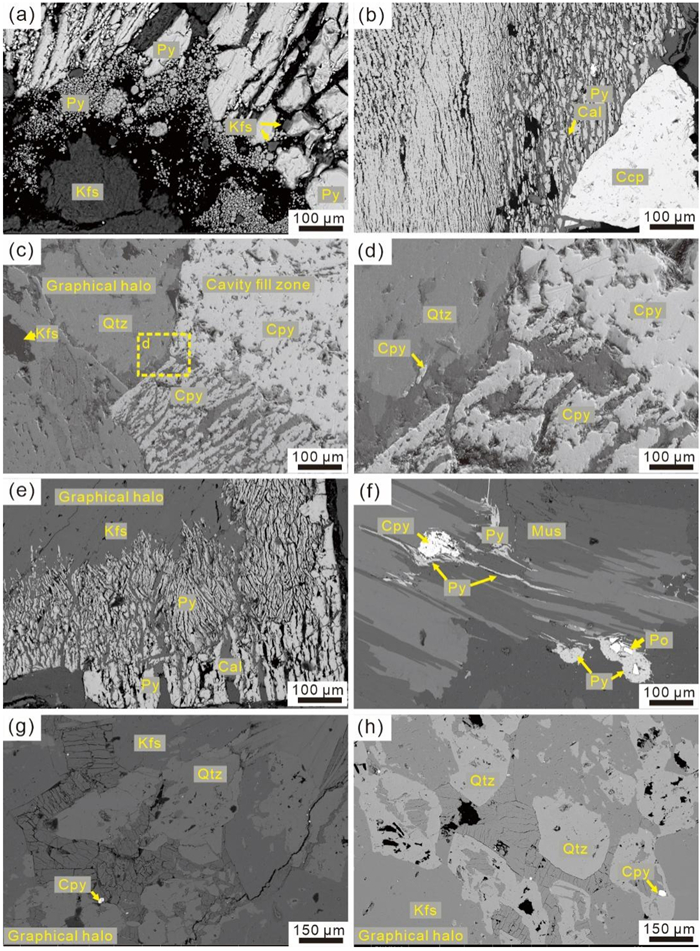
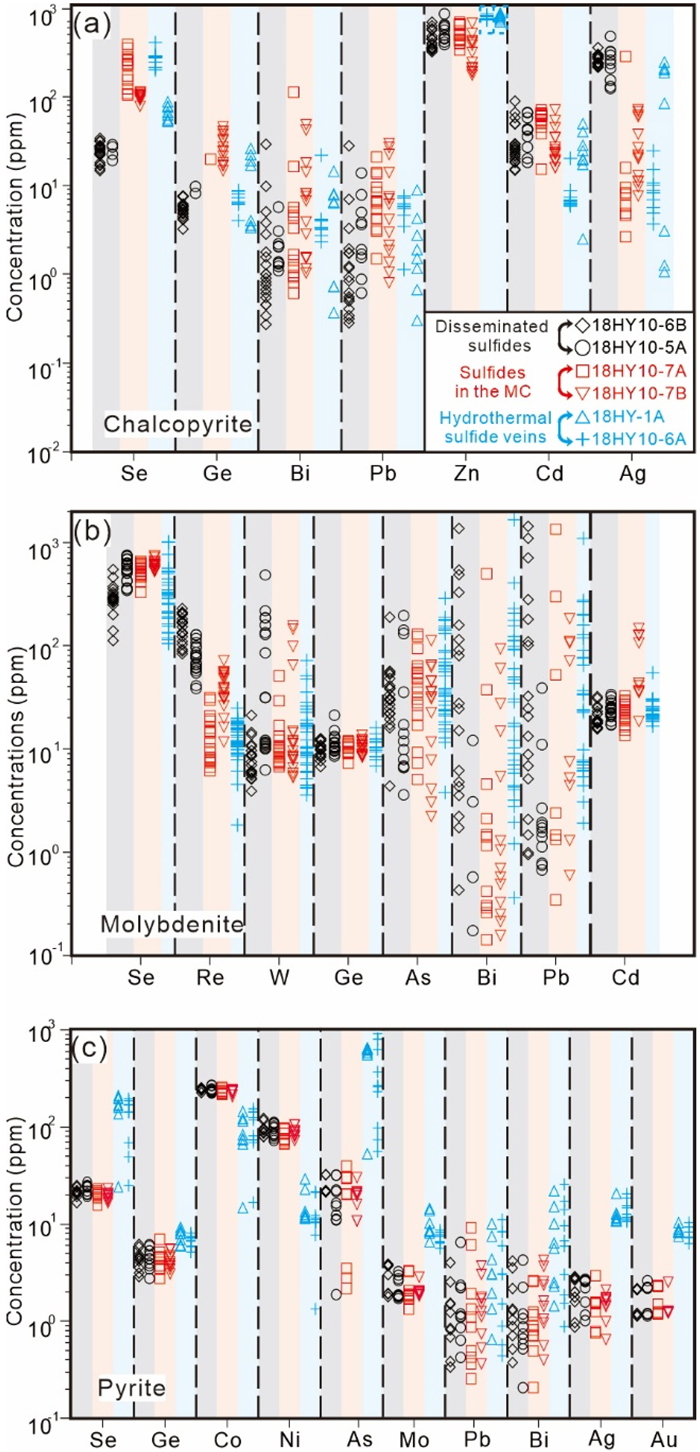
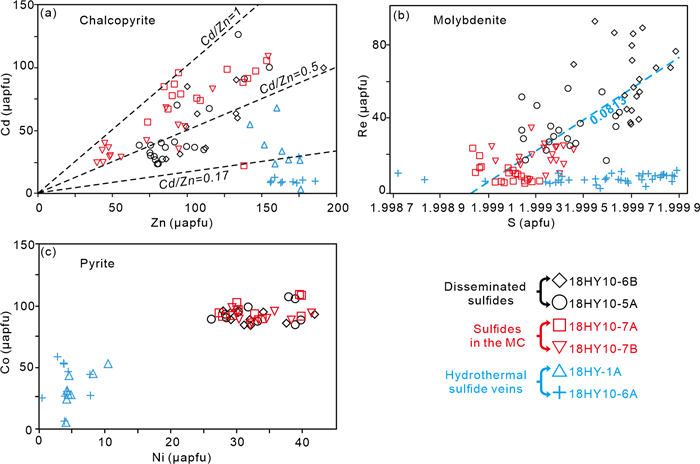
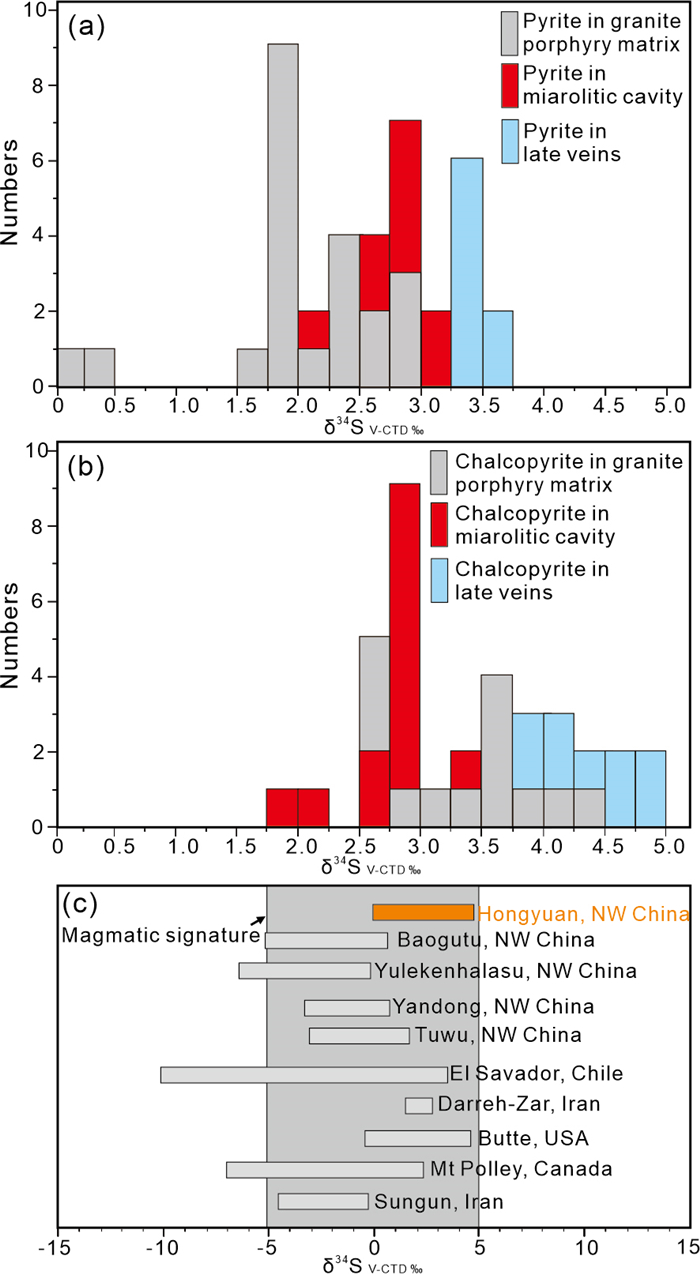
The role of ore metals in magmatic fluids during the magmatic-hydrothermal transition in porphyry systems remains unclear, and their contributions to porphyry ore genesis are unclear. This study offers fresh perspectives on the ore-forming process during this critical transition, focusing on the Hongyuan porphyry Mo (Cu) deposit (PMCD) in West Junggar, China. We find that sulfide-quartz-rich miarolitic cavities (MCs), characterized by micrographic quartz and feldspar, indicate the formation of initial mineralizing fluids from magmatic fluids. This conclusion is supported by three key observations: the simultaneous formation of feldspar and sulfides in the micrographic zones of MCs, the high formation temperatures (approaching 750 ℃) suggested by the sector-zoned bright CL cores of quartz phenocrysts, and the magmatic sulfur source indicated by the narrow sulfur isotopic composition ranges (+0.18‰ to +4.63‰). LA-ICP-MS analyses reveal distinct trace element distribution patterns between the early magmatic and transition stages and the later hydrothermal stage. Chalcopyrite from the early stages has higher Cd and lower Zn contents, while molybdenite has higher Re contents, and pyrite has higher Co and Ni contents than its counterparts in the hydrothermal stage. The decrease in sulfur concentrations at sulfide saturation from granite porphyry to micrographic quartz-feldspar melts (from 200 ppm to 100 ppm) suggests that nearly half of the sulfur was exsolved during the formation of feldspar and quartz intergrowths from fractionated granitic magma. These findings indicate that the initial mineralizing fluids of the porphyry deposit were high-temperature, melt-bearing, and ore-rich and originated from magma. The transition from initial melt-bearing, metal-rich fluids to hydrothermal ore-forming fluids is marked by decreasing temperatures and log

| An, F., Zhu, Y. F., 2009. SHRIMP U-Pb Zircon Ages of Tuff in Baogutu Formation and Their Geological Significances. Acta Petrologica Sinica, 25(6): 1437–1445 (in Chinese with English Abstract) |
| Audétat, A., 2019. The Metal Content of Magmatic-Hydrothermal Fluids and Its Relationship to Mineralization Potential. Economic Geology, 114(6): 1033–1056. https://doi.org/10.5382/econgeo.4673 |
| Audétat, A., Li, W. T., 2017. The Genesis of Climax-Type Porphyry Mo Deposits: Insights from Fluid Inclusions and Melt Inclusions. Ore Geology Reviews, 88: 436–460. https://doi.org/10.1016/j.oregeorev.2017.05.018 |
| Campos, E., Touret, J. L. R., Nikogosian, I., et al., 2002. Overheated, Cu-Bearing Magmas in the Zaldı́var Porphyry-Cu Deposit, Northern Chile. Geodynamic Consequences. Tectonophysics, 345(1/2/3/4): 229–251. https://doi.org/10.1016/S0040-1951(01)00215-3 |
| Candela, P. A., 1997. A Review of Shallow, Ore-Related Granites: Textures, Volatiles, and Ore Metals. Journal of Petrology, 38(12): 1619–1633. https://doi.org/10.1093/petroj/38.12.1619 |
| Candela, P. A., Blevin, P. L., 1995. Do Some Miarolitic Granites Preserve Evidence of Magmatic Volatile Phase Permeability? Economic Geology, 90(8): 2310–2316. https://doi.org/10.2113/gsecongeo.90.8.2310 |
| Cao, M. J., Qin, K. Z., Li, G. M., et al., 2014a. Baogutu: An Example of Reduced Porphyry Cu Deposit in Western Junggar. Ore Geology Reviews, 56: 159–180. https://doi.org/10.1016/j.oregeorev.2013.08.014 |
| Cao, M. J., Qin, K. Z., Li, G. M., et al., 2014b. Abiogenic Fischer-Tropsch Synthesis of Methane at the Baogutu Reduced Porphyry Copper Deposit, Western Junggar, NW-China. Geochimica et Cosmochimica Acta, 141: 179–198. https://doi.org/10.1016/j.gca.2014.06.018 |
| Cao, M. J., Qin, K. Z., Li, G. M., et al., 2014c. Magmatic Process Recorded in Plagioclase at the Baogutu Reduced Porphyry Cu Deposit, Western Junggar, NW-China. Journal of Asian Earth Sciences, 82: 136–150. https://doi.org/10.1016/j.jseaes.2013.12.019 |
| Cao, M. J., Qin, K. Z., Li, G. M., et al., 2015. In Situ LA-(MC)-ICP-MS Trace Element and Nd Isotopic Compositions and Genesis of Polygenetic Titanite from the Baogutu Reduced Porphyry Cu Deposit, Western Junggar, NW China. Ore Geology Reviews, 65: 940–954. https://doi.org/10.1016/j.oregeorev.2014.07.014 |
| Cao, M. J., Qin, K. Z., Li, G. M., et al., 2016. Genesis of Ilmenite-Series I-Type Granitoids at the Baogutu Reduced Porphyry Cu Deposit, Western Junggar, NW-China. Lithos, 246/247: 13–30. https://doi.org/10.1016/j.lithos.2015.12.019 |
| Carstens, H., 1983. Simultaneous Crystallization of Quartz-Feldspar Intergrowths from Granitic Magmas. Geology, 11(6): 339–341. https://doi.org/10.1130/0091-7613(1983)11<339:scoqif>2.0.co;2 doi: 10.1130/0091-7613(1983)11<339:scoqif>2.0.co;2 |
| Carter, L. C., Williamson, B. J., Tapster, S. R., et al., 2021. Crystal Mush Dykes as Conduits for Mineralising Fluids in the Yerington Porphyry Copper District, Nevada. Communications Earth & Environment, 2: 59. https://doi.org/10.1038/s43247-021-00128-4 |
| Cernuschi, F., Dilles, J. H., Grocke, S. B., et al., 2018. Rapid Formation of Porphyry Copper Deposits Evidenced by Diffusion of Oxygen and Titanium in Quartz. Geology, 46(7): 611–614. https://doi.org/10.1130/g40262.1 |
| Černý, P., 1971. Graphic Intergrowths of Feldspars and Quartz in Some Czechoslovak Pegmatites. Contributions to Mineralogy and Petrology, 30(4): 343–355. https://doi.org/10.1007/BF00404729 |
| Chen, B., Jahn, B. M., 2004. Genesis of Post-Collisional Granitoids and Basement Nature of the Junggar Terrane, NW China: Nd-Sr Isotope and Trace Element Evidence. Journal of Asian Earth Sciences, 23(5): 691–703. https://doi.org/10.1016/S1367-9120(03)00118-4 |
| Cloos, M., 2001. Bubbling Magma Chambers, Cupolas, and Porphyry Copper Deposits. International Geology Review, 43(4): 285–311. https://doi.org/10.1080/00206810109465015 |
| Cooke, D. R., Deyell, C. L., Waters, P. J., et al., 2011. Evidence for Magmatic-Hydrothermal Fluids and Ore-Forming Processes in Epithermal and Porphyry Deposits of the Baguio District, Philippines. Economic Geology, 106(8): 1399–1424. https://doi.org/10.2113/econgeo.106.8.1399 |
| Core, D. P., Kesler, S. E., Essene, E. J., 2006. Unusually Cu-Rich Magmas Associated with Giant Porphyry Copper Deposits: Evidence from Bingham, Utah. Geology, 34(1): 41. https://doi.org/10.1130/g21813.1 |
| Dai, H. W., Shen, P., Shen, Y. C., et al., 2010. Mineralogy of Ore Bearing. Porphyries in the Baogutu Copper-Gold Belt of West Junggar and Its Geological Significance. Xinjiang Geology, 28(4): 440–447 (in Chinese with English Abstract) |
| Deditius, A. P., Utsunomiya, S., Reich, M., et al., 2011. Trace Metal Nanoparticles in Pyrite. Ore Geology Reviews, 42(1): 32–46. https://doi.org/10.1016/j.oregeorev.2011.03.003 |
| Duran, C. J., Dubé-Loubert, H., Pagé, P., et al., 2019. Applications of Trace Element Chemistry of Pyrite and Chalcopyrite in Glacial Sediments to Mineral Exploration Targeting: Example from the Churchill Province, Northern Quebec, Canada. Journal of Geochemical Exploration, 196: 105–130. https://doi.org/10.1016/j.gexplo.2018.10.006 |
|
Einaudi, M. T., Hedenquist, J. W., Inan, E. E., 2005. Sulfidation State of Fluids in Active and Extinct Hydrothermal Systems: Transitions from Porphyry to Epithermal Environments. In: Simmons, S. F., Graham, I., eds., Volcanic, Geothermal, and Ore-Forming Fluids: Rulers and Witnesses of Processes within the Earth. Society of Economic Geologists. 285–313. |
| Fenn, P. M., 1986. On the Origin of Graphic Granite. American Mineralogist, 71(3/4): 325–330 |
| Fontboté, L., Kouzmanov, K., Chiaradia, M., et al., 2017. Sulfide Minerals in Hydrothermal Deposits. Elements, 13(2): 97–103. https://doi.org/10.2113/gselements.13.2.97 |
| Fu, J. L., Hu, Z. C., Zhang, W., et al., 2016. In situ Sulfur Isotopes (δ34S and δ33S) Analyses in Sulfides and Elemental Sulfur Using High Sensitivity Cones Combined with the Addition of Nitrogen by Laser Ablation MC-ICP-MS. Analytica Chimica Acta, 911: 14–26. https://doi.org/10.1016/j.aca.2016.01.026 |
| Gammel, E. M., Nabelek, P. I., 2016. Fluid Inclusion Examination of the Transition from Magmatic to Hydrothermal Conditions in Pegmatites from San Diego County, California. American Mineralogist, 101(8): 1906–1915. https://doi.org/10.2138/am-2016-5559 |
| Genna, D., Gaboury, D., 2015. Deciphering the Hydrothermal Evolution of a VMS System by LA-ICP-MS Using Trace Elements in Pyrite: An Example from the Bracemac-McLeod Deposits, Abitibi, Canada, and Implications for Exploration. Economic Geology, 110(8): 2087–2108. https://doi.org/10.2113/econgeo.110.8.2087 |
| George, L. L., Cook, N. J., Crowe, B. B. P., et al., 2018. Trace Elements in Hydrothermal Chalcopyrite. Mineralogical Magazine, 82(1): 59–88. https://doi.org/10.1180/minmag.2017.081.021 |
| Grosse, P., Toselli, A. J., Rossi, J. N., 2010. Petrology and Geochemistry of the Orbicular Granitoid of Sierra de Velasco (NW Argentina) and Implications for the Origin of Orbicular Rocks. Geological Magazine, 147(3): 451–468. https://doi.org/10.1017/s0016756809990707 |
|
Guillong, M., Meier, D. L., Allan, M. M., et al., 2008. Appendix A6: SILLS: A MATLAB-Based Program for the Reduction of Laser Ablation ICP-MS Data of Homogeneous Materials and Inclusions. In: Sylvester, P., ed., Laser Ablation ICP-MS in the Earth Sciences: Current Practices and Outstanding Issues. Mineralogical Association of Canada, 40: 328–333. |
| Guo, L. S., Liu, Y. L., Wang, Z. H., et al., 2010. The Zircon U-Pb LA-ICP-MS Geochronology of Volcanic Rocks in Baogutu Areas, Western Junggar. Acta Petrologica Sinica, 26(2): 471–477 (in Chinese with English Abstract) |
| Halter, W. E., Webster, J. D., 2004. The Magmatic to Hydrothermal Transition and Its Bearing on Ore-Forming Systems. Chemical Geology, 210(1/2/3/4): 1–6. https://doi.org/10.1016/j.chemgeo.2004.06.001 |
| Han, Y. G., Zhao, G. C., 2018. Final Amalgamation of the Tianshan and Junggar Orogenic Collage in the Southwestern Central Asian Orogenic Belt: Constraints on the Closure of the Paleo-Asian Ocean. Earth-Science Reviews, 186: 129–152. https://doi.org/10.1016/j.earscirev.2017.09.012 |
| Hanley, J. J., MacKenzie, M. K., Warren, M. R., et al., 2010. Distribution and Origin of Platinum-Group Elements in Alkalic Porphyry Cu-Au and Low Sulfidation Epithermal Au Deposits in the Canadian Cordillera. In; Guillong, M., ed., 11th International Platinum Symposium, Ontario Geological Survey Sudbury. 21–24 |
| Harris, A. C., Kamenetsky, V. S., White, N. C., et al., 2004. Volatile Phase Separation in Silicic Magmas at Bajo de la Alumbrera Porphyry Cu-Au Deposit, NW Argentina. Resource Geology, 54(3): 341–356. https://doi.org/10.1111/j.1751-3928.2004.tb00210.x |
| Hedenquist, J. W., Lowenstern, J. B., 1994. The Role of Magmas in the Formation of Hydrothermal Ore Deposits. Nature, 370(6490): 519–527. https://doi.org/10.1038/370519a0 |
| Heithersay, P. S., Walshe, J. L., 1995. Endeavour 26 North: A Porphyry Copper-Gold Deposit in the Late Ordovician, Shoshonitic Goonumbla Volcanic Complex, New South Wales, Australia. Economic Geology, 90(6): 1506–1532. https://doi.org/10.2113/gsecongeo.90.6.1506 |
| Hong, W., Cooke, D. R., Zhang, L. J., et al., 2019. Cathodoluminescence Features, Trace Elements, and Oxygen Isotopes of Quartz in Unidirectional Solidification Textures from the Sn-Mineralized Heemskirk Granite, Western Tasmania. American Mineralogist, 104(1): 100–117. https://doi.org/10.2138/am-2019-6534 |
| Hou, Z. Q., Yang, Z. M., Lu, Y. J., et al., 2015. A Genetic Linkage between Subduction- and Collision-Related Porphyry Cu Deposits in Continental Collision Zones. Geology, 43(3): 247–250. https://doi.org/10.1130/g36362.1 |
| Huston, D. L., Sie, S. H., Suter, G. F., et al., 1995. Trace Elements in Sulfide Minerals from Eastern Australian Volcanic-Hosted Massive Sulfide Deposits; Part Ⅰ, Proton Microprobe Analyses of Pyrite, Chalcopyrite, and Sphalerite, and Part Ⅱ, Selenium Levels in Pyrite; Comparison with δ34S Values and Implications for the Source of Sulfur in Volcanogenic Hydrothermal Systems. Economic Geology, 90(5): 1167–1196. https://doi.org/10.2113/gsecongeo.90.5.1167 |
| Jahns, R. H., Burnham, C. W., 1969. Experimental Studies of Pegmatite Genesis; l, A Model for the Derivation and Crystallization of Granitic Pegmatites. Economic Geology, 64(8): 843–864. https://doi.org/10.2113/gsecongeo.64.8.843 |
| Jochum, K. P., Weis, U., Stoll, B., et al., 2011. Determination of Reference Values for NIST SRM 610–617 Glasses Following ISO Guidelines. Geostandards and Geoanalytical Research, 35(4): 397–429. https://doi.org/10.1111/j.1751-908X.2011.00120.x |
|
Johannes, W., Holtz, F., 1996. Effects of Additional Aluminum and Minor Components in the System Qz-Ab-Or. In: Johannes, W., Holtz, F., eds., Petrogenesis and Experimental Petrology of Granitic Rocks. Springer, Berlin, Heidelberg. 127–187. |
| Kirkham, R. V., Sinclair, W. D., 1988. Comb Quartz Layers in Felsic Intrusions and Their Relationship to Porphyry Deposits. In: Sinclair, W. D., Taylor, R. P., Strong, D. F., eds., Recent Advances in the Geology of Granite-Related Mineral Deposits, Canadian Institute of Mining and Metallurgy, Canada. 39: 50–71 |
| Kretschmar, U., Scott, S. D., 1976. Phase Relations Involving Arsenopyrite in the System Fe-As-S and Their Application. The Canadian Mineralogist, 14(3): 364–386. https://pubs.geoscienceworld.org/mac/canmin/article/14/3/364/11122/ https://pubs.geoscienceworld.org/mac/canmin/article/14/3/364/11122/ |
| Launay, G., Sizaret, S., Guillou-Frottier, L., et al., 2018. Deciphering Fluid Flow at the Magmatic-Hydrothermal Transition: A Case Study from the World-Class Panasqueira W-Sn-(Cu) Ore Deposit (Portugal). Earth and Planetary Science Letters, 499: 1–12. https://doi.org/10.1016/j.epsl.2018.07.012 |
| Lentz, R., Fowler, A. D., 1992. A dynamic Model for Quartz-Feldspar Graphic Intergrowths from Granitic Pegmatites in the Southwestern Grenville Province. The Canadian Mineralogist, 30(3): 571–585 |
| Lerchbaumer, L., Audétat, A., 2013. The Metal Content of Silicate Melts and Aqueous Fluids in Subeconomically Mo Mineralized Granites: Implications for Porphyry Mo Genesis. Economic Geology, 108(5): 987–1013. https://doi.org/10.2113/econgeo.108.5.987 |
| Li, W. K., Yang, Z. M., Chiaradia, M., et al., 2020. Redox State of Southern Tibetan Upper Mantle and Ultrapotassic Magmas. Geology, 48(7): 733–736. https://doi.org/10.1130/g47411.1 |
| Li, Y. J., Wang, R., Li, W. D., et al., 2012. Discovery of the Porphyry Copper-Molybdenum Deposits and Prospecting Reflections in Southern Darbut Teoctonic Magmatic Belts, West Junggar, China. Acta Petrologica Sinica, 28(7): 2009–2014 (in Chinese with English Abstract) |
| Li, Y., Selby, D., Condon, D., et al., 2017. Cyclic Magmatic-Hydrothermal Evolution in Porphyry Systems: High-Precision U-Pb and Re-Os Geochronology Constraints on the Tibetan Qulong Porphyry Cu-Mo Deposit. Economic Geology, 112(6): 1419–1440. https://doi.org/10.5382/econgeo.2017.4515 |
| Liu, Y. N., Samaha, N. T., Baker, D. R., 2007. Sulfur Concentration at Sulfide Saturation (SCSS) in Magmatic Silicate Melts. Geochimica et Cosmochimica Acta, 71(7): 1783–1799. https://doi.org/10.1016/j.gca.2007.01.004 |
| London, D., 2009. The Origin of Primary Textures in Granitic Pegmatites. The Canadian Mineralogist, 47(4): 697–724. https://doi.org/10.3749/canmin.47.4.697 |
| London, D., 2014. A Petrologic Assessment of Internal Zonation in Granitic Pegmatites. Lithos, 184/185/186/187: 74–104. https://doi.org/10.1016/j.lithos.2013.10.025 |
| London, D., 2018. Ore-Forming Processes within Granitic Pegmatites. Ore Geology Reviews, 101: 349–383. https://doi.org/10.1016/j.oregeorev.2018.04.020 |
| London, D., Morgan, G. B., 2012. The Pegmatite Puzzle. Elements, 8(4): 263–268. https://doi.org/10.2113/gselements.8.4.263 |
| Mernagh, T. P., Mavrogenes, J., 2019. Significance of High Temperature Fluids and Melts in the Grasberg Porphyry Copper-Gold Deposit. Chemical Geology, 508: 210–224. https://doi.org/10.1016/j.chemgeo.2018.09.040 |
| Müller, A., Seltmann, R., Behr, H. J., 2000. Application of Cathodoluminescence to Magmatic Quartz in a Tin Granite – Case Study from the Schellerhau Granite Complex, Eastern Erzgebirge, Germany. Mineralium Deposita, 35(2): 169–189. https://doi.org/10.1007/s001260050014 |
| Niu, P. P., Jiang, S. Y., 2023. Geochronology and Geochemistry of Wangjiadashan Quartz Syenite Porphyry in Suizao Area of Hubei Province in the Tongbai-Dabie Orogenic Belt. Journal of Earth Science, 34(3): 790–805. https://doi.org/10.1007/s12583-020-1383-x |
| Ohmoto, H., 1972. Systematics of Sulfur and Carbon Isotopes in Hydrothermal Ore Deposits. Economic Geology, 67(5): 551–578. https://doi.org/10.2113/gsecongeo.67.5.551 |
| Pandur, K., Ansdell, K. M., Kontak, D. J., 2015. Graphic-Textured Inclusions in Apatite: Evidence for Pegmatitic Growth in a REE-Enriched Carbonatitic System. Geology, 43(6): 547–550. https://doi.org/10.1130/g36613.1 |
| Peterková, T., Dolejš, D., 2019. Magmatic-Hydrothermal Transition of Mo-W-Mineralized Granite-Pegmatite-Greisen System Recorded by Trace Elements in Quartz: Krupka District, Eastern Krušné Hory/Erzgebirge. Chemical Geology, 523: 179–202. https://doi.org/10.1016/j.chemgeo.2019.04.009 |
| Pettke, T., Oberli, F., Audétat, A., et al., 2012. Recent Developments in Element Concentration and Isotope Ratio Analysis of Individual Fluid Inclusions by Laser Ablation Single and Multiple Collector ICP-MS. Ore Geology Reviews, 44: 10–38. https://doi.org/10.1016/j.oregeorev.2011.11.001 |
| Pistone, M., Baumgartner, L. P., Bégué, F., et al., 2020. Felsic Melt and Gas Mobilization during Magma Solidification: An Experimental Study at 1.1 Kbar. Frontiers in Earth Science, 8: 175. https://doi.org/10.3389/feart.2020.00175 |
| Reich, M., Deditius, A., Chryssoulis, S., et al., 2013. Pyrite as a Record of Hydrothermal Fluid Evolution in a Porphyry Copper System: A SIMS/EMPA Trace Element Study. Geochimica et Cosmochimica Acta, 104: 42–62. https://doi.org/10.1016/j.gca.2012.11.006 |
| Richards, J. P., 2003. Tectono-Magmatic Precursors for Porphyry Cu-(Mo-Au) Deposit Formation. Economic Geology, 98(8): 1515–1533. https://doi.org/10.2113/gsecongeo.98.8.1515 |
| Richards, J. P., 2011. High Sr/Y Arc Magmas and Porphyry Cu ± Mo ± Au Deposits: Just Add Water. Economic Geology, 106(7): 1075–1081. https://doi.org/10.2113/econgeo.106.7.1075 |
| Richards, J. P., Mumin, A. H., 2013. Magmatic-Hydrothermal Processes within an Evolving Earth: Iron Oxide-Copper-Gold and Porphyry Cu ± Mo ± Au Deposits. Geology, 41(7): 767–770. https://doi.org/10.1130/g34275.1 |
| Rottier, B., Kouzmanov, K., Bouvier, A. S., et al., 2016. Heterogeneous Melt and Hypersaline Liquid Inclusions in Shallow Porphyry Type Mineralization as Markers of the Magmatic-Hydrothermal Transition (Cerro de Pasco District, Peru). Chemical Geology, 447: 93–116. https://doi.org/10.1016/j.chemgeo.2016.10.032 |
| Santosh, M., Groves, D. I., 2022. Global Metallogeny in Relation to Secular Evolution of the Earth and Supercontinent Cycles. Gondwana Research, 107: 395–422. https://doi.org/10.1016/j.gr.2022.04.007 |
| Shannon, R. D., 1976. Revised Effective Ionic Radii and Systematic Studies of Interatomic Distances in Halides and Chalcogenides. Acta Crystallographica Section A, 32(5): 751–767. https://doi.org/10.1107/S0567739476001551 |
| Shen, P., Pan, H. D., Shen, Y. C., et al., 2015. Main Deposit Styles and Associated Tectonics of the West Junggar Region, NW China. Geoscience Frontiers, 6(2): 175–190. https://doi.org/10.1016/j.gsf.2014.05.001 |
| Shen, P., Shen, Y. C., Liu, T. B., et al., 2009. Geochemical Signature of Porphyries in the Baogutu Porphyry Copper Belt, Western Junggar, NW China. Gondwana Research, 16(2): 227–242. https://doi.org/10.1016/j.gr.2009.04.004 |
| Shen, P., Shen, Y. C., Pan, H. D., et al., 2010. Baogutu Porphyry Cu-Mo-Au Deposit, West Junggar, Northwest China: Petrology, Alteration, and Mineralization. Economic Geology, 105(5): 947–970. https://doi.org/10.2113/econgeo.105.5.947 |
| Shu, L., Shen, K., Yang, R. C., et al., 2020. SEM-CL Study of Quartz Containing Fluid Inclusions in Wangjiazhuang Porphyry Copper (-Molybdenum) Deposit, Western Shandong, China. Journal of Earth Science, 31(2): 330–341. https://doi.org/10.1007/s12583-019-1025-3 |
| Sillitoe, R. H., 2010. Porphyry Copper Systems. Economic Geology, 105(1): 3–41. https://doi.org/10.2113/gsecongeo.105.1.3 |
| Simmons, W. B., Pezzotta, F., Shigley, J. E., et al., 2012. Granitic Pegmatites as Sources of Colored Gemstones. Elements, 8(4): 281–287. https://doi.org/10.2113/gselements.8.4.281 |
| Su, Y. P., Tang, H. F., Hou, G. S., et al., 2006. Geochemistry of Aluminous A-Type Granites along Darabut Tectonic Belt in West Junggar, Xinjiang. Geochimica, 35(1): 55–67. https://doi.org/10.19700/j.0379-1726.2006.01.007 (in Chinese with English Abstract) |
| Tanner, D., Henley, R. W., Mavrogenes, J. A., et al., 2016. Sulfur Isotope and Trace Element Systematics of Zoned Pyrite Crystals from the El Indio Au-Cu-Ag Deposit, Chile. Contributions to Mineralogy and Petrology, 171(4): 33. https://doi.org/10.1007/s00410-016-1248-6 |
| Thomas, R., Davidson, P., 2016. Revisiting Complete Miscibility between Silicate Melts and Hydrous Fluids, and the Extreme Enrichment of Some Elements in the Supercritical State—Consequences for the Formation of Pegmatites and Ore Deposits. Ore Geology Reviews, 72: 1088–1101. https://doi.org/10.1016/j.oregeorev.2015.10.004 |
| Toulmin, P., Barton, P. B., 1964. A Thermodynamic Study of Pyrite and Pyrrhotite. Geochimica et Cosmochimica Acta, 28(5): 641–671. https://doi.org/10.1016/0016-7037(64)90083-3 |
| Wang, D. Z., Liu, J. J., Carranza, E. J. M., et al., 2019b. Formation and Evolution of Snowball Quartz Phenocrysts in the Dongping Porphyritic Granite, Hebei Province, China: Insights from Fluid Inclusions, Cathodoluminescence, Trace Elements, and Crystal Size Distribution Study. Lithos, 340/341: 239–254. https://doi.org/10.1016/j.lithos.2019.05.018 |
|
Wang, R., Luo, C. H., Xia, W. J., et al., 2021. Role of Alkaline Magmatism in Formation of Porphyry Deposits in Nonarc Settings: Gangdese and Sanjiang Metallogenic Belts. In: Sholeh, A., Wang, R., eds., Tectonomagmatic Influences on Metallogeny and Hydrothermal Ore Deposits: A Tribute to Jeremy P. Richards (Volume Ⅱ). Society of Economic Geologists. 205–229. |
| Wang, Y. F., Chen, H. Y., Baker, M. J., et al., 2019a. Multiple Mineralization Events of the Paleozoic Tuwu Porphyry Copper Deposit, Eastern Tianshan: Evidence from Geology, Fluid Inclusions, Sulfur Isotopes, and Geochronology. Mineralium Deposita, 54(7): 1053–1076. https://doi.org/10.1007/s00126-018-0859-4 |
| Whitney, J. A., 1975. Vapor Generation on a Quartz Monzonite Magma; A Synthetic Model with Application to Porphyry Copper Deposits. Economic Geology, 70(2): 346–358. https://doi.org/10.2113/gsecongeo.70.2.346 |
| Wilson, H. D. B., 1953. Geology and Geochemistry of Base Metal Deposits. Economic Geology, 48(5): 370–407. https://doi.org/10.2113/gsecongeo.48.5.370 |
| Windley, B. F., Alexeiev, D., Xiao, W. J., et al., 2007. Tectonic Models for Accretion of the Central Asian Orogenic Belt. Journal of the Geological Society, 164(1): 31–47. https://doi.org/10.1144/0016-76492006-022 |
| Wu, C., 2017. Tectonic Setting and Formation Mechanism of Reduced Porphyry Copper-Molybdenum Deposit, Southern West Junggar: [Dissertation]. China University of Geosciences, Beijing. 237 (in Chinese with English Abstract) |
| Wu, C., Hong, T., Xu, X. W., et al., 2018. Tectonic Evolution of the Paleozoic Barluk Continental Arc, West Junggar, NW China. Journal of Asian Earth Sciences, 160: 48–66. https://doi.org/10.1016/j.jseaes.2018.04.008 |
| Wu, C., Hong, T., Xu, X. W., et al., 2019. Constraints on the Formation of the Baogutu Reduced Porphyry Copper Deposit (West Junggar, NW China): Assessing the Role of Mafic Magmas in Mineralization. Lithos, 336/337: 112–124. https://doi.org/10.1016/j.lithos.2019.03.034 |
| Wu, C., Hong, T., Zhang, H. J., et al., 2023. Ore-Forming Process within the Hongyuan Reduced Porphyry Mo-Cu Deposit, West Junggar, NW China. Geological Journal, 58(10): 3840–3865. https://doi.org/10.1002/gj.4813 |
| Xiao, W. J., Han, C. M., Yuan, C., et al., 2008. Middle Cambrian to Permian Subduction-Related Accretionary Orogenesis of Northern Xinjiang, NW China: Implications for the Tectonic Evolution of Central Asia. Journal of Asian Earth Sciences, 32(2/3/4): 102–117. https://doi.org/10.1016/j.jseaes.2007.10.008 |
| Xu, X. W., Li, H., Peters, S. G., et al., 2017. Cu-Rich Porphyry Magmas Produced by Fractional Crystallization of Oxidized Fertile Basaltic Magmas (Sangnan, East Junggar, PR China). Ore Geology Reviews, 91: 296–315. https://doi.org/10.1016/j.oregeorev.2017.09.020 |
| Xu, X. W., Mao, Q., Li, X. H., et al., 2014. Copper-Zinc Albite Porphyry in the Hersai Porphyry Copper Deposit, East Junggar, China: A Transition between Late Magmatic and Hydrothermal Porphyry Copper Deposit. Ore Geology Reviews, 61: 141–156. https://doi.org/10.1016/j.oregeorev.2014.01.009 |
| Xu, X. W., Peters, S. G., Liang, G. H., et al., 2016. Elastic Stress Transmission and Transformation (ESTT) by Confined Liquid: A New Mechanics for Fracture in Elastic Lithosphere of the Earth. Tectonophysics, 672/673: 129–138. https://doi.org/10.1016/j.tecto.2016.02.004 |
| Yang, Z. M., Hou, Z. Q., Zhou, L. M., et al., 2020. Critical Elements in Porphyry Copper Deposits of China. Chinese Science Bulletin, 65(33): 3653–3664. https://doi.org/10.1360/TB-2020-0246 (in Chinese with English Abstract) |
| Yao, X. F., Cheng, Z. Z., Du, Z. Z., et al., 2021. Petrology, Geochemistry, and Sr-Nd-S Isotopic Compositions of the Ore-Hosting Biotite Monzodiorite in the Luanjiahe Gold Deposit, Jiaodong Peninsula, China. Journal of Earth Science, 32(1): 51–67. https://doi.org/10.1007/s12583-020-1386-7 |
| Yin, J. Y., Long, X. P., Yuan, C., et al., 2013. A Late Carboniferous–Early Permian Slab Window in the West Junggar of NW China: Geochronological and Geochemical Evidence from Mafic to Intermediate Dikes. Lithos, 175/176: 146–162. https://doi.org/10.1016/j.lithos.2013.04.005 |
| Yoder, Jr., H. S., 1950. High-Low Quartz Inversion up to 10000 bars. Eos, Transactions American Geophysical Union, 31(6): 827–835. https://doi.org/10.1029/TR031i006p00827 |
| Zarasvandi, A., Rezaei, M., Raith, J. G., et al., 2018. Metal Endowment Reflected in Chemical Composition of Silicates and Sulfides of Mineralized Porphyry Copper Systems, Urumieh-Dokhtar Magmatic Arc, Iran. Geochimica et Cosmochimica Acta, 223: 36–59. https://doi.org/10.1016/j.gca.2017.11.012 |
| Zheng, Y.-C., Liu, S.-A., Wu, C.-D., et al., 2019. Cu Isotopes Reveal Initial Cu Enrichment in Sources of Giant Porphyry Deposits in a Collisional Setting. Geology, 47(2): 135–138. https://doi.org/10.1130/g45362.1 |
| Zhou, T. F., Yuan, F., Fan, Y., et al., 2008. Granites in the Sawuer Region of the West Junggar, Xinjiang Province, China: Geochronological and Geochemical Characteristics and Their Geodynamic Significance. Lithos, 106(3/4): 191–206. https://doi.org/10.1016/j.lithos.2008.06.014 |
Figures(12)
Copyright © 2013-2020 Journal of Earth Science 鄂ICP备15021562号-2
Tel: +86-27-67885075 Fax: +86-27-67885075 E-mail: xbb@cug.edu.cn
Address: Editorial Office of Journal, China University of Geosciences, Yujiashan, Wuhan, Hubei 430074, P. R. China
Supported by:
Beijing Renhe Information Technology Co. Ltd
E-mail:
info@rhhz.net


 DownLoad: