| Citation: | Zhiping Zhang, Shengqian Chen, Jie Chen, Lingxin Huang, Zhongwei Shen, Aifeng Zhou, Jianbao Liu, Fahu Chen. Perpetuation of the "Evaporation Paradox" in the Arid and Semi-Arid Regions of Northern China since the Last Deglaciation. Journal of Earth Science, 2026, 37(2): 775-786. doi: 10.1007/s12583-024-0129-6

|
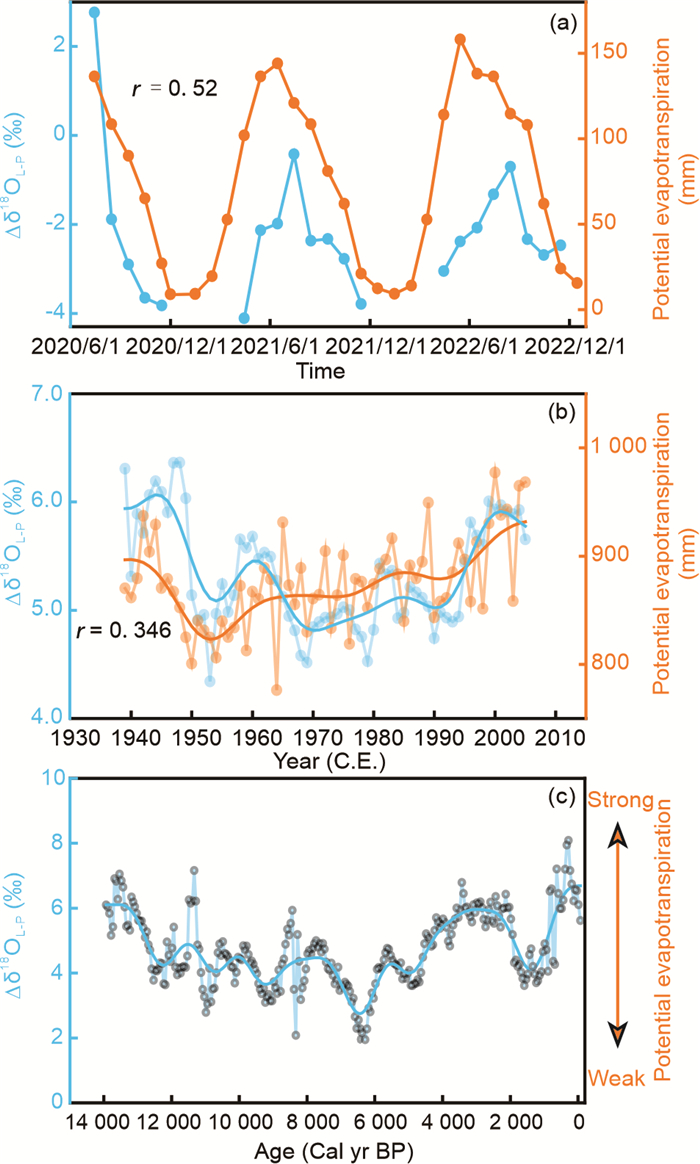
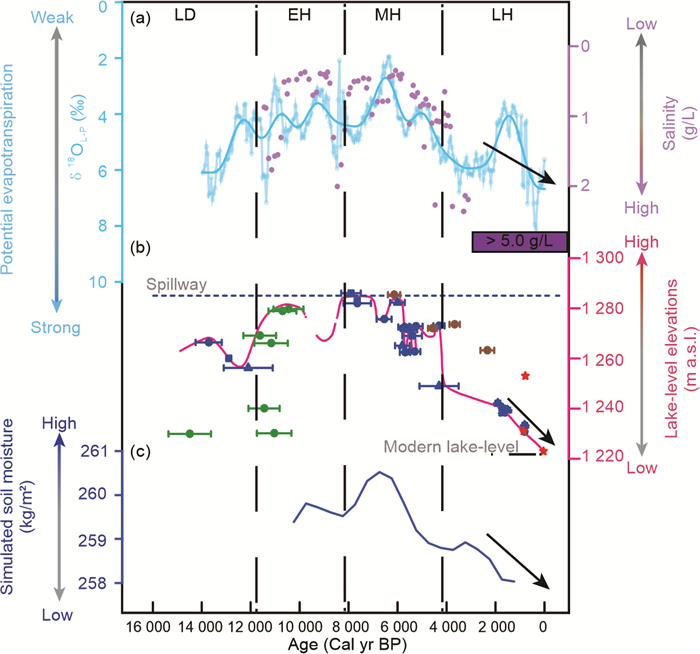
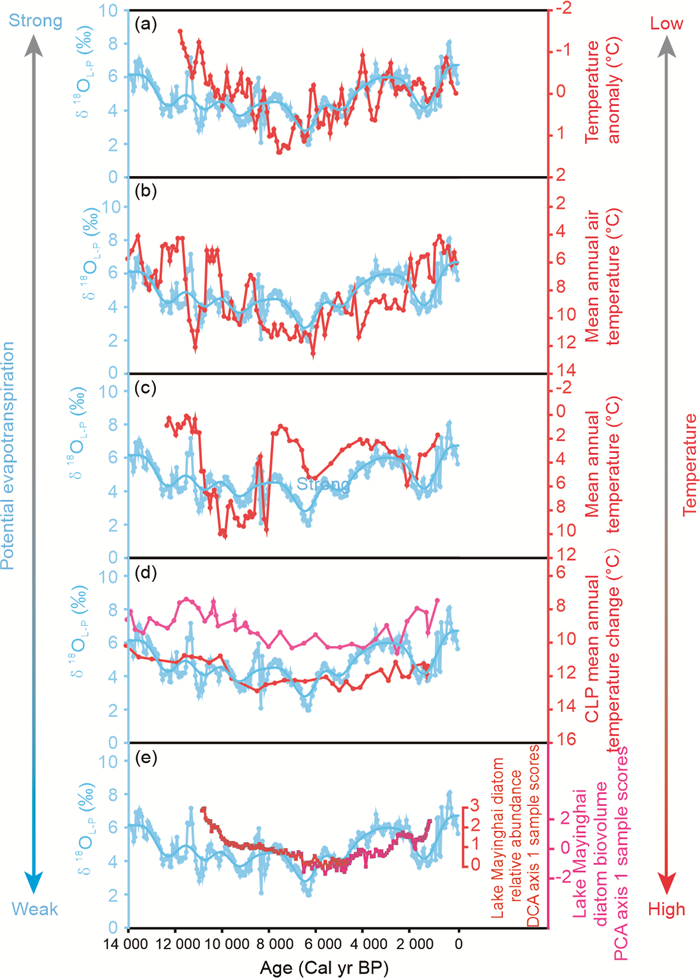
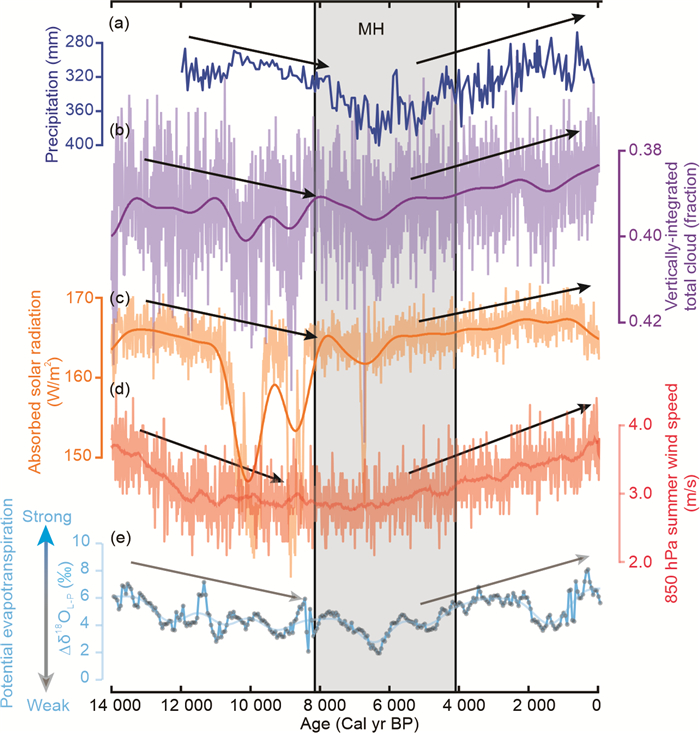
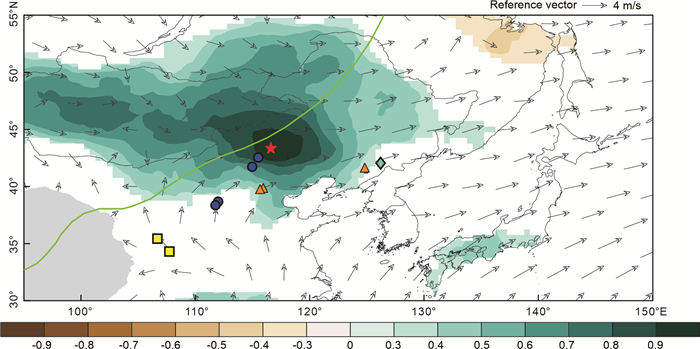
Variations in potential evapotranspiration (PET) are closely linked to regional water equilibria and agricultural productivity. Amid the backdrop of ongoing global warming, PET within the arid and semi-arid regions of northern China (ASARNC), notable for its fragile ecological conditions, exhibits non-monotonic fluctuations. In this study, we selected Dali Lake, a hydrologically closed-lake situated in the ASARNC, as the research object. We calculated ∆δ18OL-P based on δ18OCarb records (indicative of δ18OL) and stalagmite δ18O records (as a proxy for δ18OP) to reconstruct PET changes since the last deglaciation. The findings indicate a gradual decline in PET from ~14 000 cal yr before the present (BP), with PET reaching its minimum around 6 000 cal yr BP. Subsequently, PET exhibited a gradual increase. Moreover, we unveiled an inverse relationship between PET and temperature fluctuations in the ASARNC, suggesting the perpetuation of the evaporation paradox in the region since the last deglaciation. On a millennial timescale, variations in solar radiation (or global dimming) due to changes in cloud or aerosols concentrations, along with shifts in summer wind speed and humidity, rather than surface temperature fluctuations, may primarily drive changes in PET.

| Aouissi, J., Benabdallah, S., Lili Chabaâne, Z., et al., 2016. Evaluation of Potential Evapotranspiration Assessment Methods for Hydrological Modelling with SWAT—Application in Data-Scarce Rural Tunisia. Agricultural Water Management, 174: 39–51. https://doi.org/10.1016/j.agwat.2016.03.004 |
| Bowen, G. J., Wilkinson, B., 2002. Spatial Distribution of δ18O in Meteoric Precipitation. Geology, 30(4): 315. https://doi.org/10.1130/0091-7613(2002)0300315:sdooim>2.0.co;2 doi: 10.1130/0091-7613(2002)0300315:sdooim>2.0.co;2 |
| Brutsaert, W., Parlange, M. B., 1998. Hydrologic Cycle Explains the Evaporation Paradox. Nature, 396(6706): 30. https://doi.org/10.1038/23845 |
| Cao, H. C., Yan, D. D., Ju, Y. L., 2021. Drought and Flood Characteristics in the Farming-Pastoral Ecotone of Northern China Based on the Standardized Precipitation Index. Journal of Arid Land, 13(12): 1244–1259. https://doi.org/10.1007/s40333-021-0111-4 |
| Cao, S. X., Chen, L., Shankman, D., et al., 2011. Excessive Reliance on Afforestation in China's Arid and Semi-Arid Regions: Lessons in Ecological Restoration. Earth-Science Reviews, 104(4): 240–245. https://doi.org/10.1016/j.earscirev.2010.11.002 |
| Chen, F. H., Duan, Y. W., Hao, S., et al., 2023. Holocene Thermal Maximum Mode versus the Continuous Warming Mode: Problems of Data-Model Comparisons and Future Research Prospects. Science China Earth Sciences, 66(8): 1683–1701. https://doi.org/10.1007/s11430-022-1113-x |
| Chen, F. H., Wu, D., Chen, J. H., et al., 2016. Holocene Moisture and East Asian Summer Monsoon Evolution in the Northeastern Tibetan Plateau Recorded by Lake Qinghai and Its Environs: A Review of Conflicting Proxies. Quaternary Science Reviews, 154: 111–129. https://doi.org/10.1016/j.quascirev.2016.10.021 |
| Chen, F. H., Xu, Q. H., Chen, J. H., et al., 2015. East Asian Summer Monsoon Precipitation Variability since the Last Deglaciation. Scientific Reports, 5: 11186. https://doi.org/10.1038/srep11186 |
| Chen, F. H., Yu, Z. C., Yang, M. L., et al., 2008. Holocene Moisture Evolution in Arid Central Asia and Its Out-of-Phase Relationship with Asian Monsoon History. Quaternary Science Reviews, 27(3/4): 351–364. https://doi.org/10.1016/j.quascirev.2007.10.017 |
| Chen, J., Huang, W., Zhang, Q., et al., 2020. Origin of the Spatial Consistency of Summer Precipitation Variability between the Mongolian Plateau and the Mid-Latitude East Asian Summer Monsoon Region. Science China Earth Sciences, 63(8): 1199–1208. https://doi.org/10.1007/s11430-019-9593-2 |
| Chen, J., Zhang, Q., Lu, Z. Y., et al., 2024. Reconciling East Asia's Mid-Holocene Temperature Discrepancy through Vegetation-Climate Feedback. Science Bulletin, 69(15): 2420–2429. https://doi.org/10.1016/j.scib.2024.04.012 |
| Cheng, Y. N., Zhang, C., Li, Y. L., et al., 2023. Increasing Lake Evaporation over the Holocene Revealed by Oxygen Stable Isotope in Indian-Monsoon Dominated Southwestern China. Global and Planetary Change, 228: 104217. https://doi.org/10.1016/j.gloplacha.2023.104217 |
| Cong, Z. T., Yang, D. W., Ni, G. H., 2009. Does Evaporation Paradox Exist in China? Hydrology and Earth System Sciences, 13(3): 357–366. https://doi.org/10.5194/hess-13-357-2009 |
| Cronin, T. M., Dwyer, G. S., Kamiya, T., et al., 2003. Medieval Warm Period, Little Ice Age and 20th Century Temperature Variability from Chesapeake Bay. Global and Planetary Change, 36(1/2): 17–29. https://doi.org/10.1016/s0921-8181(02)00161-3 |
| Dansgaard, W., 1964. Stable Isotopes in Precipitation. Tellus, 16(4): 436–468. https://doi.org/10.3402/tellusa.v16i4.8993 |
| Ding, Y. X., Peng, S. Z., 2021. Spatiotemporal Change and Attribution of Potential Evapotranspiration over China from 1901 to 2100. Theoretical and Applied Climatology, 145(1): 79–94. https://doi.org/10.1007/s00704-021-03625-w |
| Ding, Z. L., Ren, J. Z., Yang, S. L., et al., 1999. Climate Instability during the Penultimate Glaciation: Evidence from Two High-Resolution Loess Records, China. Journal of Geophysical Research: Solid Earth, 104(B9): 20123–20132. https://doi.org/10.1029/1999jb900183 doi: 10.1029/1999JB900183 |
| Dong, Y. J., Wu, N. Q., Li, F. J., et al., 2022. The Holocene Temperature Conundrum Answered by Mollusk Records from East Asia. Nature Communications, 13: 5153. https://doi.org/10.1038/s41467-022-32506-7 |
| Dong, J., 2012. Summer Monsoon Precipitation Variations and Abrupt Climate Events during the 3000 Years: Records from Stalagmites in China. J. Arid Land Resour. Environ. , 26: 36-41 (in Chinese with English Abstract) |
| Evans, N. P., Bauska, T. K., Gázquez-Sánchez, F., et al., 2018. Quantification of Drought during the Collapse of the Classic Maya Civilization. Science, 361(6401): 498–501. https://doi.org/10.1126/science.aas9871 |
| Fan, J. W., Xiao, J. L., Wen, R. L., et al., 2016. Droughts in the East Asian Summer Monsoon Margin during the Last 6 kyrs: Link to the North Atlantic Cooling Events. Quaternary Science Reviews, 151: 88–99. https://doi.org/10.1016/j.quascirev.2016.09.001 |
| Fan, J. W., Xiao, J. L., Wen, R. L., et al., 2019. Mineralogy and Carbonate Geochemistry of the Dali Lake Sediments: Implications for Paleohydrological Changes in the East Asian Summer Monsoon Margin during the Holocene. Quaternary International, 527: 103–112. https://doi.org/10.1016/j.quaint.2018.03.019 |
| Fang, X. Q., Hou, G. L., 2011. Synthetically Reconstructed Holocene Temperature Change in China. Scientia Geographica Sinica, 31(4): 385–393 (in Chinese with English Abstract) |
| Gao, G., Chen, D. L., Ren, G. Y., et al., 2006a. Spatial and Temporal Variations and Controlling Factors of Potential Evapotranspiration in China: 1956–2000. Journal of Geographical Sciences, 16(1): 3–12. https://doi.org/10.1007/s11442-006-0101-7 |
| Gao, G., Chen, D. L., Ren, G. Y., et al., 2006b. Trend of Potential Evapotranspiration over China during 1956 to 2000. Geographical Research, 25(3): 378–387 (in Chinese with English Abstract) |
| Gat, J. R., Matsui, E., 1991. Atmospheric Water Balance in the Amazon basin: An Isotopic Evapotranspiration Model. Journal of Geophysical Research: Atmospheres, 96(D7): 13179–13188. https://doi.org/10.1029/91jd00054 |
| Ge, Q. S., Zheng, J. Y., Man, Z. M., et al., 2004. Key Points on Temperature Change of the Past 2000 Years in China. Progress in Natural Science, 14(8): 730–737. https://doi.org/10.1080/10020070412331344241 |
| Hamed, M. M., Iqbal, Z., Nashwan, M. S., et al., 2023. Diminishing Evapotranspiration Paradox and Its Cause in the Middle East and North Africa. Atmospheric Research, 289: 106760. https://doi.org/10.1016/j.atmosres.2023.106760 |
| Han, L., Li, Y. M., Zou, Y. F., et al., 2022. Relationship between Lake Salinity and the Climatic Gradient in Northeastern China and Its Implications for Studying Climate Change. Science of the Total Environment, 805: 150403. https://doi.org/10.1016/j.scitotenv.2021.150403 |
| Hargreaves, G. H., Samani, Z. A., 1982. Estimating Potential Evapotranspiration. Journal of the Irrigation and Drainage Division, 108(3): 225–230. https://doi.org/10.1061/jrcea4.0001390 |
| Harris, I., Osborn, T. J., Jones, P., et al., 2020. Version 4 of the CRU TS Monthly High-Resolution Gridded Multivariate Climate Dataset. Scientific Data, 7: 109. https://doi.org/10.1038/s41597-020-0453-3 |
| Hersbach, H., Bell, B., Berrisford, P., et al., 2020. The ERA5 Global Reanalysis. Quarterly Journal of the Royal Meteorological Society, 146(730): 1999–2049 doi: 10.1002/qj.3803 |
| Hillman, A. L., Abbott, M. B., Finkenbinder, M. S., et al., 2017. An 8600 Year Lacustrine Record of Summer Monsoon Variability from Yunnan, China. Quaternary Science Reviews, 174: 120–132. https://doi.org/10.1016/j.quascirev.2017.09.005 |
| Hou, J. Z., Tan, M., Cheng, H., et al., 2003. Stable Isotope Records of Plant Cover Change and Monsoon Variation in the Past 2200 Years: Evidence from Laminated Stalagmites in Beijing, China. Boreas, 32(2): 304–313. https://doi.org/10.1111/j.1502-3885.2003.tb01085.x |
| Hu, J. F., Zhao, G. J., Li, P. F., et al., 2022. Variations of Pan Evaporation and Its Attribution from 1961 to 2015 on the Loess Plateau, China. Natural Hazards, 111(2): 1199–1217. https://doi.org/10.1007/s11069-021-05091-z |
| Huntington, T. G., 2006. Evidence for Intensification of the Global Water Cycle: Review and Synthesis. Journal of Hydrology, 319(1/2/3/4): 83–95. https://doi.org/10.1016/j.jhydrol.2005.07.003 |
| International Atomic Energy Agency (IAEA), 2007. Introduction to Water Sampling and Analysis for Isotope Hydrology, Non-Serial Publications, Vienna |
| IPCC, 2021. Summary for Policymakers. In: Masson-Delmotte, V., Zhai, P., Pirani, A., et al., eds., Climate Change 2021: The Physical Science Basis. Contribution of Working Group I to the Sixth Assessment Report of the Intergovernmental Panel on Climate Change. Cambridge University Press, Cambridge |
| Jiang, C., Wang, F., Liu, S. J., et al., 2013. Evaporation Paradox in the Northern and Southern Regions of the Qinling Mountains. Acta Ecologica Sinica, 33(3): 844–855. https://doi.org/10.5846/stxb201207271069 |
| Jiang, W. Y., Guiot, J., Chu, G. Q., et al., 2010. An Improved Methodology of the Modern Analogues Technique for Palaeoclimate Reconstruction in Arid and Semi-Arid Regions. Boreas, 39(1): 145–153. https://doi.org/10.1111/j.1502-3885.2009.00115.x |
| Leng, M. J., Marshall, J. D., 2004. Palaeoclimate Interpretation of Stable Isotope Data from Lake Sediment Archives. Quaternary Science Reviews, 23(7–8): 811–831 doi: 10.1016/j.quascirev.2003.06.012 |
| Lerman, A., 1978. Lakes: Chemistry, Geology, Physics. Springer, 363 |
| Li, H. C., Gu, D. L., Ku, T., et al., 1998. Applications of Interannual-Resolution Stable Isotope Records of Speleothem: Climatic Changes in Beijing and Tianjin, China during the Past 500 Years—The δ18O Record. Science in China Series D: Earth Sciences, 41(4): 362–368. https://doi.org/10.1007/bf02932686 |
| Li, H. C., Gu, D. L., Zhao, S. S., et al., 1996. Isotope Studies of Shihua Cave-I: δD, δ18O and Tritium Activity of Shihua Cave, Beijing, Seismology and Geology, 18(4): 325–328 (in Chinese with English Abstract) |
| Li, M. M., Yan, J. P., 2013. The Evaporation Paradox in the Farming-Pastoral Ecotone of Northern China. Resources Science, 35(11): 2298–2307 (in Chinese with English Abstract) |
| Li, X. L., Cheng, H., Tan, L. C., et al., 2017. The East Asian Summer Monsoon Variability over the Last 145 Years Inferred from the Shihua Cave Record, North China. Scientific Reports, 7(1): 7078. https://doi.org/10.1038/s41598-017-07251-3 |
|
Li, Z., Su, B., Gao, M., et al., 2023. Will the "Evapotranspiration Paradox" Phenomenon Exist Across China in the Future?. Available at SSRN: |
| Liang, X. G., Song, C. Q., Liu, K., et al., 2023. Reconstructing Centennial-Scale Water Level of Large Pan-Arctic Lakes Using Machine Learning Methods. Journal of Earth Science, 34(4): 1218–1230. https://doi.org/10.1007/s12583-022-1739-5 |
| Liu, J. B., Chen, J. H., Zhang, X. J., et al., 2015. Holocene East Asian Summer Monsoon Records in Northern China and Their Inconsistency with Chinese Stalagmite δ18O Records. Earth-Science Reviews, 148: 194–208. https://doi.org/10.1016/j.earscirev.2015.06.004 |
| Liu, J. R., Song, X. F., Yuan, G. F., et al., 2014. Stable Isotopic Compositions of Precipitation in China. Tellus B: Chemical and Physical Meteorology, 66(1): 22567. https://doi.org/10.3402/tellusb.v66.22567 |
| Liu, J. Y., Zhang, J. W., Kong, D. D., et al., 2021. Contributions of Anthropogenic Forcings to Evapotranspiration Changes over 1980–2020 Using GLEAM and CMIP6 Simulations. Journal of Geophysical Research: Atmospheres, 126(22): e2021JD035367. https://doi.org/10.1029/2021jd035367 |
| Liu, W. G., Zhang, P. J., Zhao, C., et al., 2018. Reevaluation of Carbonate Concentration and Oxygen Isotope Records from Lake Qinghai, the Northeastern Tibetan Plateau. Quaternary International, 482: 122–130. https://doi.org/10.1016/j.quaint.2018.03.038 |
| Liu, X. K., Liu, J. B., Chen, S. Q., et al., 2020. New Insights on Chinese Cave δ18O Records and Their Paleoclimatic Significance. Earth-Science Reviews, 207: 103216. https://doi.org/10.1016/j.earscirev.2020.103216 |
| Liu, X. M., Luo, Y. Z., Zhang, D., et al., 2011. Recent Changes in Pan-Evaporation Dynamics in China. Geophysical Research Letters, 38(13): L13404. https://doi.org/10.1029/2011gl047929 |
| Liu, Y., Fang, C. X., Li, Q., et al., 2019. Tree-Ring δ18O Based PDSI Reconstruction in the Mt. Tianmu Region since 1618 AD and Its Connection to the East Asian Summer Monsoon. Ecological Indicators, 104: 636–647. https://doi.org/10.1016/j.ecolind.2019.05.043 |
| Liu, Z., Otto-Bliesner, B. L., He, F., et al., 2009. Transient Simulation of Last Deglaciation with a New Mechanism for Bolling-Allerod Warming. Science, 325(5938): 310–314. https://doi.org/10.1126/science.1171041 |
| Ma, N., Szilagyi, J., Zhang, Y. S., et al., 2019. Complementary-Relationship-Based Modeling of Terrestrial Evapotranspiration across China during 1982–2012: Validations and Spatiotemporal Analyses. Journal of Geophysical Research: Atmospheres, 124(8): 4326–4351. https://doi.org/10.1029/2018jd029850 |
| Ma, T. J., Chen, W., 2023. Recent Progress in Understanding the Interaction between ENSO and the East Asian Winter Monsoon: A Review. Frontiers in Earth Science, 11: 1098517. https://doi.org/10.3389/feart.2023.1098517 |
| Ma, Z. B., Cheng, H., Tan, M., et al., 2012. Timing and Structure of the Younger Dryas Event in Northern China. Quaternary Science Reviews, 41: 83–93. https://doi.org/10.1016/j.quascirev.2012.03.006 |
| Management Office of the Dalinuoer National Nature Reserve in the Inner Mongolia, 2015. Comprehensive Report of Scientific Exploration to the Dalinuoer National Nature Reserve in the Inner Mongolia. China Forestry Press, Beijing |
| Mann, M. E., Jones, P. D., 2003. Global Surface Temperatures over the Past Two Millennia. Geophysical Research Letters, 30(15): 1820. https://doi.org/10.1029/2003gl017814 |
| Masson-Delmotte, V. P., Zhai, P., Pirani, S. L., et al., 2021. IPCC, 2021: Summary for Policymakers. In: Climate Change 2021: The Physical Science Basis. Contribution of Working Group I to the Sixth Assessment Report of the Intergovernmental Panel on Climate Change |
| McVicar, T. R., Roderick, M. L., Donohue, R. J., et al., 2012. Global Review and Synthesis of Trends in Observed Terrestrial Near-Surface Wind Speeds: Implications for Evaporation. Journal of Hydrology, 416: 182–205. https://doi.org/10.1016/j.jhydrol.2011.10.024 |
| Milly, P. C. D., 1992. Potential Evaporation and Soil Moisture in General Circulation Models. Journal of Climate, 5(3): 209–226. https://doi.org/10.1175/1520-0442(1992)0050209:peasmi>2.0.co;2 doi: 10.1175/1520-0442(1992)0050209:peasmi>2.0.co;2 |
| Milly, P. C. D., Dunne, K. A., 2016. Potential Evapotranspiration and Continental Drying. Nature Climate Change, 6(10): 946–949. https://doi.org/10.1038/nclimate3046 |
| Nasrollahi, M., Zolfaghari, A. A., Yazdani, M. R., 2021. Investigation of Pan Evaporation Paradox and Climatic Parameters Affecting It in the West and Center of Iran. Journal of Water and Soil Resources Conservation, 11(1): 61–76 |
| Nie, T. Z., Yuan, R., Liao, S. H., et al., 2022. Characteristics of Potential Evapotranspiration Changes and Its Climatic Causes in Heilongjiang Province from 1960 to 2019. Agriculture, 12(12): 2017. https://doi.org/10.3390/agriculture12122017 |
| Patterson, W. P., Dietrich, K. A., Holmden, C., et al., 2010. Two Millennia of North Atlantic Seasonality and Implications for Norse Colonies. Proceedings of the National Academy of Sciences of the United States of America, 107(12): 5306–5310. https://doi.org/10.1073/pnas.0902522107 |
| Peterson, T. C., Golubev, V. S., Groisman, P. Y., 1995. Evaporation Losing Its Strength. Nature, 377(6551): 687–688. https://doi.org/10.1038/377687b0 |
| Poage, M. A., Chamberlain, C. P., 2001. Empirical Relationships between Elevation and the Stable Isotope Composition of Precipitation and Surface Waters: Considerations for Studies of Paleoelevation Change. American Journal of Science, 301(1): 1–15. https://doi.org/10.2475/ajs.301.1.1 |
| Porter, S. C., An, Z. S., 1995. Correlation between Climate Events in the North Atlantic and China during the Last Glaciation. Nature, 375(6529): 305–308. https://doi.org/10.1038/375305a0 |
| Rind, D., Goldberg, R., Hansen, J., et al., 1990. Potential Evapotranspiration and the Likelihood of Future Drought. Journal of Geophysical Research: Atmospheres, 95(D7): 9983–10004. https://doi.org/10.1029/jd095id07p09983 |
| Roderick, M. L., Farquhar, G. D., 2002. The Cause of Decreased Pan Evaporation over the Past 50 Years. Science, 298(5597): 1410–1411. https://doi.org/10.1126/science.1075390 |
| Shen, Y. J., Shen, Y. J., Guo, Y., et al., 2020. Review of Historical and Projected Future Climatic and Hydrological Changes in Mountainous Semiarid Xinjiang (Northwestern China), Central Asia. CATENA, 187: 104343. https://doi.org/10.1016/j.catena.2019.104343 |
| Shi, X. R., She, D. X., Xia, J., 2022. Variation and Attribution of Potential Evapotran Spiration in the Three-Northern Regions, China during 1960–2019. Engineering Journal of Wuhan University, 55(10): 973–984 (in Chinese with English Abstract) |
| Sun, Q. L., 2023. How Does Global Warming Influence Seafloor Stability? Journal of Earth Science, 34(5): 1624–1625. https://doi.org/10.1007/s12583-023-1877-4 |
| Sun, Q., Chu, G. Q., Xie, M. M., et al., 2018. An Oxygen Isotope Record from Lake Xiarinur in Inner Mongolia since the last Deglaciation and Its Implication for Tropical Monsoon Change. Global and Planetary Change, 163: 109–117. https://doi.org/10.1016/j.gloplacha.2018.01.017 |
| Tang, W., Yin, J. J., Lan, G. Y., et al., 2023. The Difference in Time Delay of δ18O, δ13C DIC and Mg/Ca to the Hydroclimate Change Monitored in a Subtropical Cave, South China. Applied Geochemistry, 156: 105745. https://doi.org/10.1016/j.apgeochem.2023.105745 |
| Tang, Y. Z., Huo, J. J., Zhu, D. J., et al., 2022. Spatio-Temporal Variation of Precipitation and Evaporation on the Tibetan Plateau and Their Influence on Regional Drought. Atmosphere, 13(8): 1323. https://doi.org/10.3390/atmos13081323 |
| Thompson, L. G., Yao, T., Mosley-Thompson, E., et al., 2000. A High-Resolution Millennial Record of the South Asian Monsoon from Himalayan Ice Cores. Science, 289(5486): 1916–1920. https://doi.org/10.1126/science.289.5486.1916 |
| Tian, F., Chen, M. J., Xu, Q. H., et al., 2023. A Cool-Arid Climate with Large Temperature Seasonality Implied by Arboreal Pollen in the Early Holocene, North-Central China. Journal of Earth Science, 34(5): 1629–1631. https://doi.org/10.1007/s12583-023-1920-3 |
| Vystavna, Y., Harjung, A., Monteiro, L. R., et al., 2021. Stable Isotopes in Global Lakes Integrate Catchment and Climatic Controls on Evaporation. Nature Communications, 12: 7224. https://doi.org/10.1038/s41467-021-27569-x |
| Wang, S. J., Lei, S. J., Zhang, M. J., et al., 2022. Spatial and Seasonal Isotope Variability in Precipitation across China: Monthly Isoscapes Based on Regionalized Fuzzy Clustering. Journal of Climate, 35(11): 3411–3425. https://doi.org/10.1175/jcli-d-21-0451.1 |
| Wang, X. M., Ge, Q. S., Geng, X., et al., 2023. Unintended Consequences of Combating Desertification in China. Nature Communications, 14: 1139. https://doi.org/10.1038/s41467-023-36835-z |
| Wu, D., Chen, X. M., Lyu, F. Y., et al., 2018. Decoupled Early Holocene Summer Temperature and Monsoon Precipitation in Southwest China. Quaternary Science Reviews, 193: 54–67. https://doi.org/10.1016/j.quascirev.2018.05.038 |
| Wu, J. Y., Wang, Y. J., Dong, J. G., 2011. Changes In East Asian Summer Monsoon during the Holocene Recorded by Stalagmite δ18O Records from Liaoning Province. Quaternary Sciences, 31(6): 990–998 (in Chinese with English Abstract) |
| Wu, Y., Warken, S., Frank, N., et al., 2023. Northern Hemisphere Summer Insolation and Ice Volume Driven Variations in Hydrological Environment in Southwest China. Geophysical Research Letters, 50(23): e2023GL105664. https://doi.org/10.1029/2023gl105664 |
| Yang, H. B., Yang, D. W., 2012. Climatic Factors Influencing Changing Pan Evaporation across China from 1961 to 2001. Journal of Hydrology, 414: 184–193. https://doi.org/10.1016/j.jhydrol.2011.10.043 |
| Yang, J. P., Ding, Y. J., Chen, R. S., et al., 2005. Fluctuations of the Semi-Arid Zone in China, and Consequences for Society. Climatic Change, 72(1): 171–188. https://doi.org/10.1007/s10584-005-6858-3 |
| Yang, S. L., Ding, Z. L., 2008. Advance-Retreat History of the East-Asian Summer Monsoon Rainfall Belt over Northern China during the Last Two Glacial-Interglacial Cycles. Earth and Planetary Science Letters, 274(3/4): 499–510. https://doi.org/10.1016/j.epsl.2008.08.001 |
| Yang, Z. S., Zhang, Q., Yang, Y., et al., 2016. Evaluation of Evapotranspiration Models over Semi-Arid and Semi-Humid Areas of China. Hydrological Processes, 30(23): 4292–4313. https://doi.org/10.1002/hyp.10824 |
| Yao, T. C., Lu, H. W., Feng, W., et al., 2019. Evaporation Abrupt Changes in the Qinghai-Tibet Plateau during the Last Half-Century. Scientific Reports, 9: 20181. https://doi.org/10.1038/s41598-019-56464-1 |
| Yin, Y. H., Wu, S. H., Chen, G., et al., 2010. Attribution Analyses of Potential Evapotranspiration Changes in China since the 1960s. Theoretical and Applied Climatology, 101(1): 19–28. https://doi.org/10.1007/s00704-009-0197-7 |
| Zhang, C. X., Wang, X. M., Li, J. C., et al., 2020. Identifying the Effect of Climate Change on Desertification in Northern China via Trend Analysis of Potential Evapotranspiration and Precipitation. Ecological Indicators, 112: 106141. https://doi.org/10.1016/j.ecolind.2020.106141 |
| Zhang, J. W., Chen, F. H., Holmes, J. A., et al., 2011. Holocene Monsoon Climate Documented by Oxygen and Carbon Isotopes from Lake Sediments and Peat Bogs in China: A Review and Synthesis. Quaternary Science Reviews, 30(15/16): 1973–1987. https://doi.org/10.1016/j.quascirev.2011.04.023 |
| Zhang, H. W., Ait Brahim, Y., Li, H. Y., et al., 2019. The Asian Summer Monsoon: Teleconnections and Forcing Mechanisms—A Review from Chinese Speleothem δ18O Records. Quaternary, 2(3): 26. https://doi.org/10.3390/quat2030026 |
| Zhang, R. H., Sumi, A., Kimoto, M., 1996. Impact of El Niño on the East Asian Monsoon: A Diagnostic Study of the '86/87 and '91/92 Events. Journal of the Meteorological Society of Japan Ser II, 74(1): 49–62. https://doi.org/10.2151/jmsj1965.74.1_49 |
| Zhang, X. J., Jin, L. Y., Chen, J., et al., 2017. Detecting the Relationship between Moisture Changes in Arid Central Asia and East Asia during the Holocene by Model-Proxy Comparison. Quaternary Science Reviews, 176: 36–50. https://doi.org/10.1016/j.quascirev.2017.09.012 |
| Zhang, X. S., Liu, J. B., Rühland, K. M., et al., 2023. Concurrent Mid-Holocene East Asian Temperature and Summer Monsoon Maxima Forced by High- and Low-Latitude Interplay. Global and Planetary Change, 220: 104008. https://doi.org/10.1016/j.gloplacha.2022.104008 |
| Zhang, Z. P., Liu, J. B., Chen, S. Q., et al., 2022. Anthropogenic Origin of a Change in the Fire-Climate Relationship in Northern China after ∼2000 Yr BP: Evidence from a 15 500-Year Black Carbon Record from Dali Lake. Journal of Geographical Sciences, 32(6): 1136–1156. https://doi.org/10.1007/s11442-022-1989-2 |
| Zhang, Z. P., Liu, J. B., Liu, X. K., et al., 2020. Seasonal Variations in the Lake-Water Oxygen Isotope Composition of Four Lakes in the East Asian Summer Monsoon Region: Implications for the Interpretation of Paleo-Isotope Records. Progress in Physical Geography: Earth and Environment, 44(4): 572–588. https://doi.org/10.1177/0309133319896338 |
| Zhang, Z. P., Shen, Z. W., Zhang, S. J., et al., 2023. Lake Level Evidence for a Mid-Holocene East Asian Summer Monsoon Maximum and the Impact of an Abrupt Late-Holocene Drought Event on Prehistoric Cultures in North-Central China. The Holocene, 33(4): 382–399. https://doi.org/10.1177/09596836221145362 |
| Zhao, J. J., Liu, J. B., Liu, J. Z., et al., 2023. Coupling of the Ecosystems in North China with the East Asian Summer Monsoon Rainfall during the Holocene. Quaternary Science Reviews, 300: 107885. https://doi.org/10.1016/j.quascirev.2022.107885 |
| Zheng, Y. H., Pancost, R. D., Liu, X. D., et al., 2017. Atmospheric Connections with the North Atlantic Enhanced the Deglacial Warming in Northeast China. Geology, 45(11): 1031–1034. https://doi.org/10.1130/g39401.1 |
| Zhou, Z. H., Han, N., Liu, J. J., et al., 2020. Glacier Variations and Their Response to Climate Change in an Arid Inland River Basin of Northwest China. Journal of Arid Land, 12(3): 357–373. https://doi.org/10.1007/s40333-020-0061-2 |
| Zhu, X. W., Kong, Z. Y., Cao, J., et al., 2024. Attributing the Decline of Evapotranspiration over the Asian Monsoon Region during the Period 1950–2014 in CMIP6 Models. Remote Sensing, 16(11): 2027. https://doi.org/10.3390/rs16112027 |
Figures(5)
Copyright © 2013-2020 Journal of Earth Science 鄂ICP备15021562号-2
Tel: +86-27-67885075 Fax: +86-27-67885075 E-mail: xbb@cug.edu.cn
Address: Editorial Office of Journal, China University of Geosciences, Yujiashan, Wuhan, Hubei 430074, P. R. China
Supported by:
Beijing Renhe Information Technology Co. Ltd
E-mail:
info@rhhz.net


 DownLoad: