| Citation: | Zheng Wang, Ke Xu, Dianjun Tong, Yong Tang, Chen Hu, Jianye Ren. Growth History of Complex Fault System and Syn- to Post-Rift Transition in the Wushi East Subsag, Beibuwan Basin. Journal of Earth Science, 2026, 37(2): 608-624. doi: 10.1007/s12583-024-1987-7

|
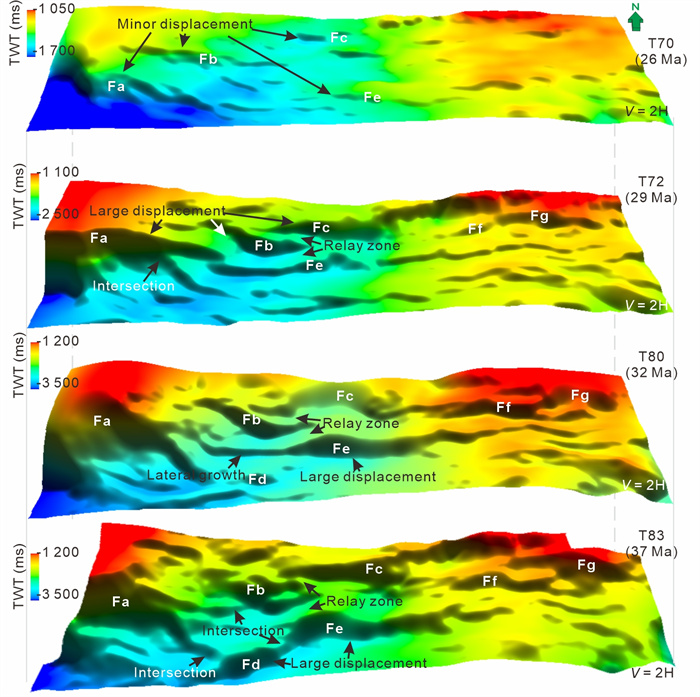
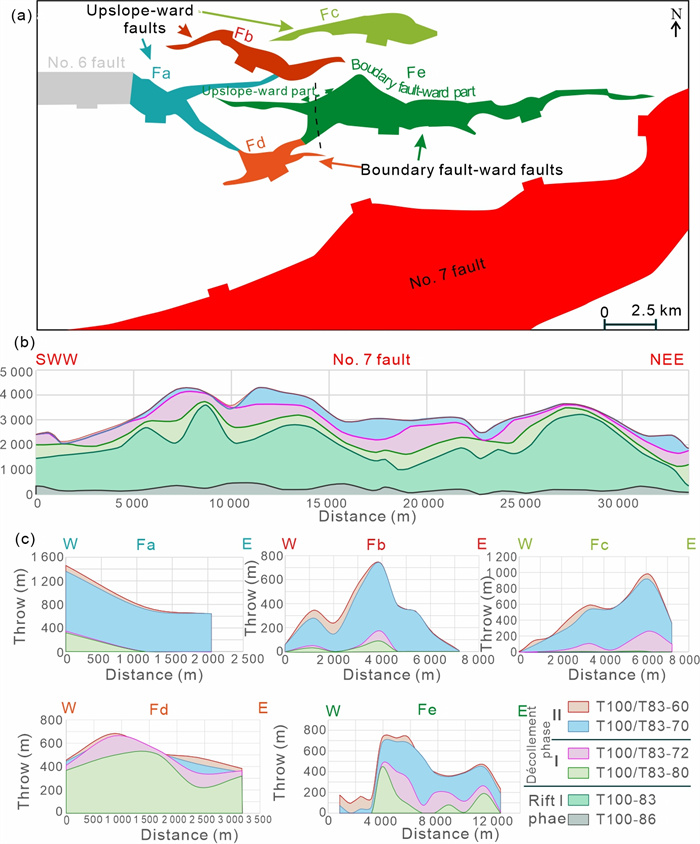
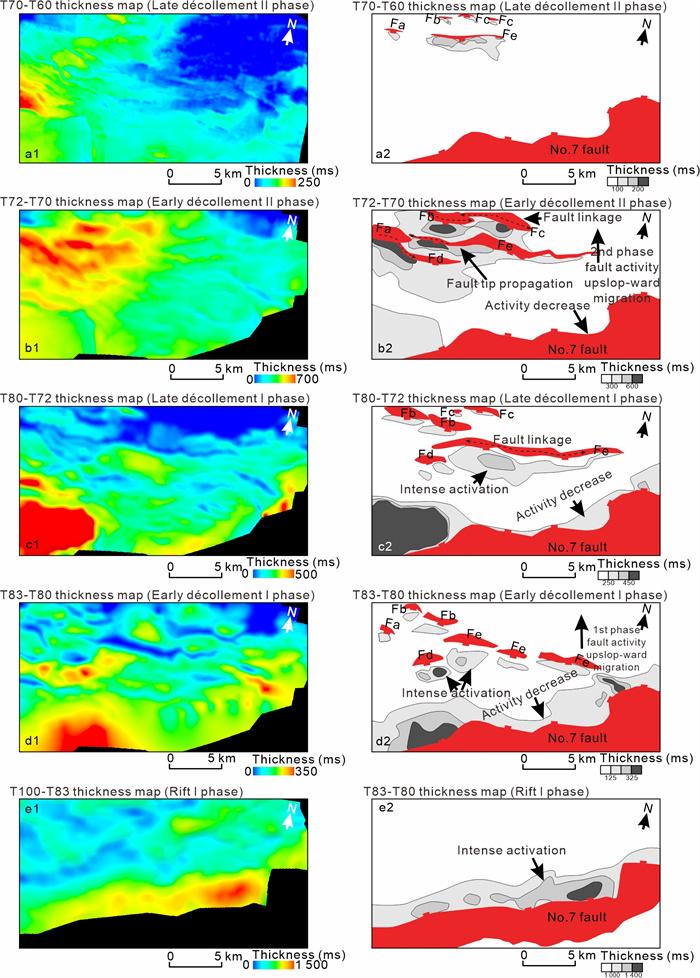
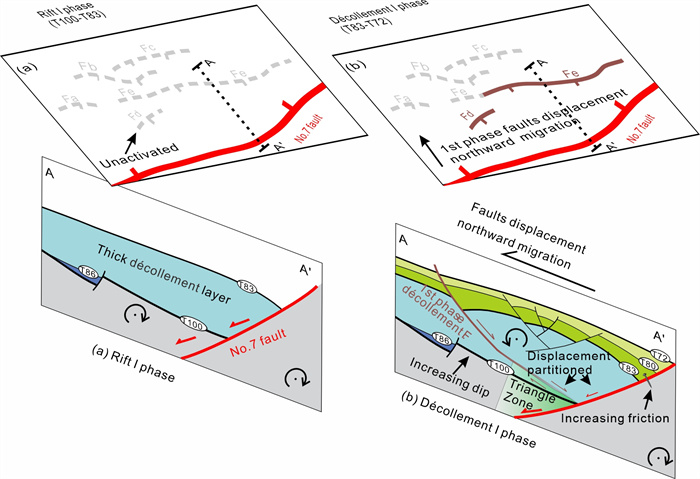
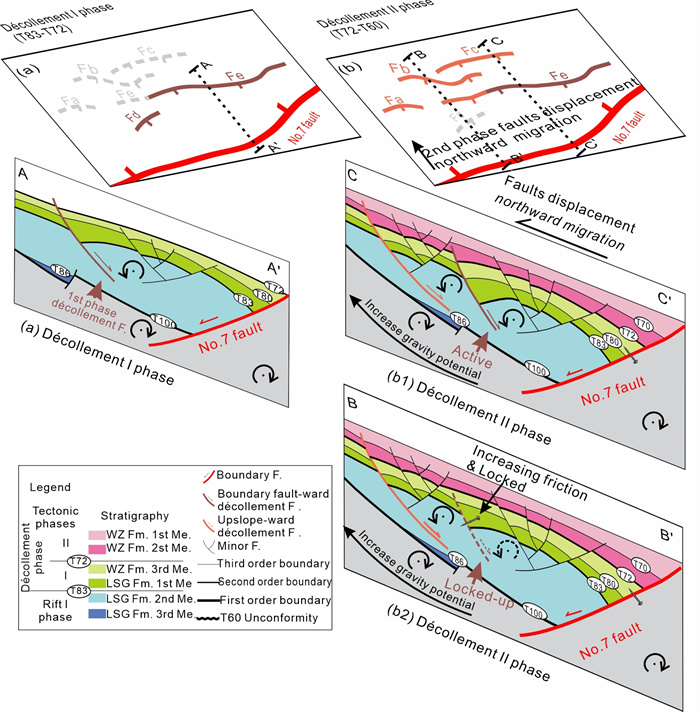
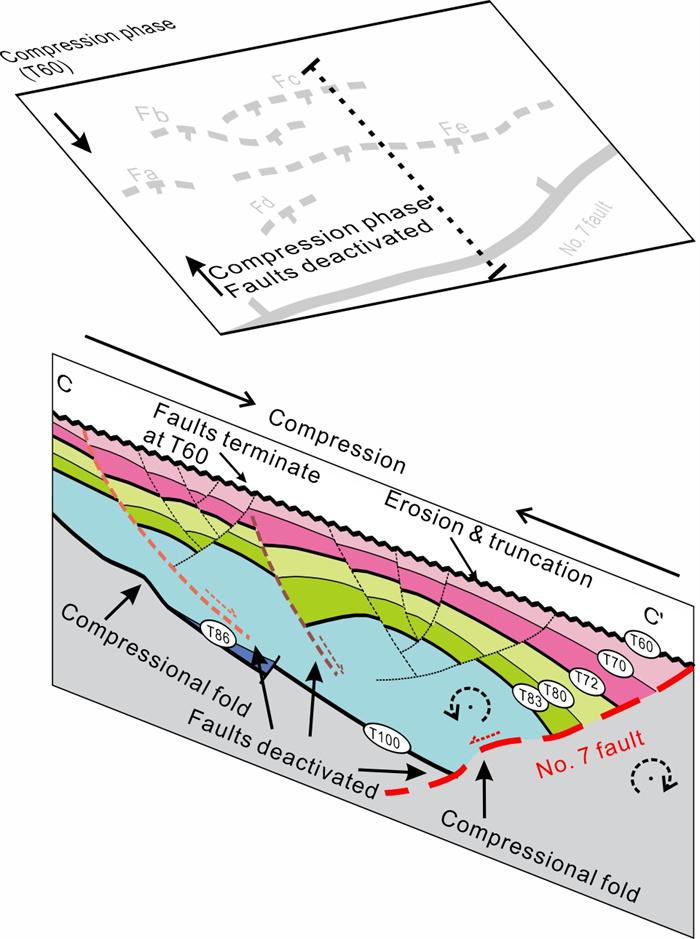
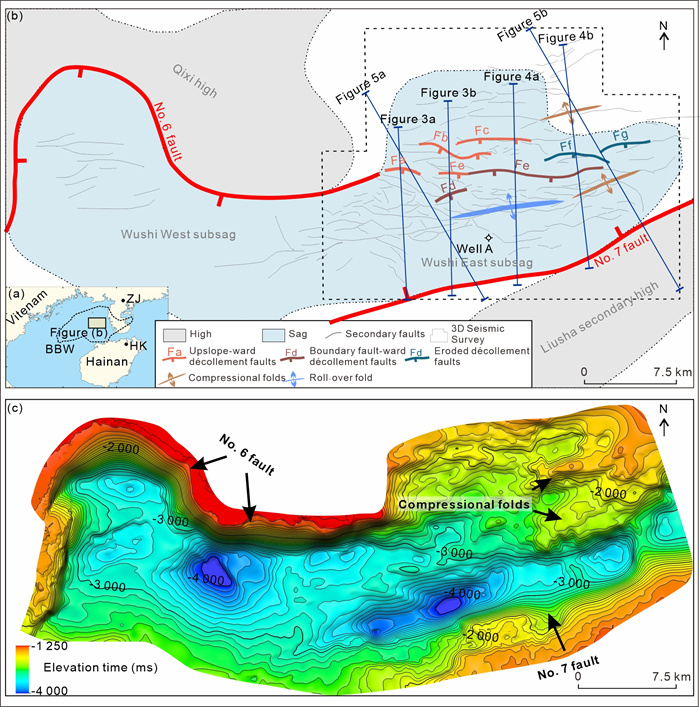
The Wushi sag is located in the central part of the Beibuwan Basin, northern South China Sea. Above the thick oily shale unit in the Wushi East subsag, a suite of terrace-like extensional décollement fault systems exists, which, in conjunction with the No. 7 boundary fault, control a complex fault system. This study integrates the high-resolution 3D seismic data and quantitative analysis of fault displacement to analyze the growth history of the complex fault system and to establish a model of fault system evolution in the Wushi East subsag. The findings reveal two phases of fault growth northward migration during the rifting process. The first phase occurred between the rift Ⅰ phase and the décollement Ⅰ phase, witnessing fault activity migrating northward from the No. 7 boundary fault to the décollement faults (Fd and Fe) in the hangingwall. The second phase occurred between the décollement Ⅰ phase and the décollement Ⅱ phase, with fault activity migrating further northward from Fd and Fe to Fa, Fb and Fd. By the end of the Oligocene, basin inversion controlled the syn- to post-rift transition of the Wushi East subsag. This study bears significant implications for hydrocarbon exploration and for understanding the mechanism underlying the syn- to post-rift process in the north continental marginal basins of the South China Sea.

| Ai, N., Ren, J., Qi, P., et al., 2009. The Redefinition and Geological Siginificance of Extensional Decollement Structure Systems the Qikou Depression. Geotectonica et Metallogenia, 33(3): 343–351 (in Chinese with English Abstract) |
| Allen, P. A., Allen, J. R., 2013. Basin Analysis: Principles and Application to Petroleum Play Assessment Depositional Systems in Multiphase Rifts: Seismic Case Study from the Lofoten Margin, Norway. Basin Research, 29(4): 447–469 |
| Álvaro, J. J., Vizcaïno, D., 2018. The Furongian Break-up (Rift/Drift) Unconformity in the Central Anti-Atlas, Morocco. Journal of Iberian Geology, 44(4): 567–587. https://doi.org/10.1007/s41513-018-0066-2 |
| Back, S., Strozyk, F., Kukla, P. A., et al., 2008. Three-Dimensional Restoration of Original Sedimentary Geometries in Deformed Basin Fill, Onshore Brunei Darussalam, NW Borneo. Basin Research, 20(1): 99–117. https://doi.org/10.1111/j.1365-2117.2007.00343.x |
| Bai, B., Kang, H., Cheng, T., et al., 2016. Gravity Décollement Structural System in Offshore Basins of Northeast Brazil. Marine Geology Frontiers, 32(4): 31–36 (in Chinese with English Abstract) |
| Barnes, P. M., Nicol, A., 2004. Formation of an Active Thrust Triangle Zone Associated with Structural Inversion in a Subduction Setting, Eastern New Zealand. Tectonics, 23(1): 2002TC001449. https://doi.org/10.1029/2002tc001449 |
| Braun, J., Beaumont, C., 1989. A Physical Explanation of the Relation between Flank Uplifts and the Breakup Unconformity at Rifted Continental Margins. Geology, 17(8): 760. https://doi.org/10.1130/0091-7613(1989)017<0760:apeotr>2.3.co;2 doi: 10.1130/0091-7613(1989)017<0760:apeotr>2.3.co;2 |
| Cheng, Y. J., Wu, Z. P., Zhang, J., et al., 2022. Cenozoic Rifting and Inversion of Beibuwan Basin and Its Linkage with the Strike-Slip Movement along the Ailao Shan-Red River Shear Zone. International Geology Review, 64(20): 2966–2983. https://doi.org/10.1080/00206814.2021.2010132 |
| Couzens, T. J., 1992. The Rift to Drift Transition and Sequence Stratigraphy at Passive Continental Margins: [Dissertation]. University of Liverpool, Liverpool |
| Damuth, J. E., 1994. Neogene Gravity Tectonics and Depositional Processes on the Deep Niger Delta Continental Margin. Marine and Petroleum Geology, 11(3): 320–346. https://doi.org/10.1016/0264-8172(94)90053-1 |
| De Matteo, A., Corti, G., van Wyk de Vries, B., et al., 2018. Fault-Volcano Interactions with Broadly Distributed Stretching in Rifts. Journal of Volcanology and Geothermal Research, 362: 64–75. https://doi.org/10.1016/j.jvolgeores.2018.08.008 |
| Deng, H. D., McClay, K., 2021. Three-Dimensional Geometry and Growth of a Basement-Involved Fault Network Developed during Multiphase Extension, Enderby Terrace, North West Shelf of Australia. GSA Bulletin, 133(9/10): 2051–2078. https://doi.org/10.1130/b35779.1 |
| Deng, H. D., McClay, K., Bilal, A., 2021. Multiphase Activation of the Boundary Fault System of the Eastern Dampier Subbasin, Northwest Shelf of Australia. AAPG Bulletin, 105(1): 157–188. https://doi.org/10.1306/03022019160 |
| Embry, A. F., Dixon, J., 1990. The Breakup Unconformity of the Amerasia Basin, Arctic Ocean: Evidence from Arctic Canada. Geological Society of America Bulletin, 102(11): 1526–1534. https://doi.org/10.1130/0016-7606(1990)102<1526:tbuota>2.3.co;2 doi: 10.1130/0016-7606(1990)102<1526:tbuota>2.3.co;2 |
| Erslev, E. A., 1991. Trishear Fault-Propagation Folding. Geology, 19(6): 617. https://doi.org/10.1130/0091-7613(1991)019<0617:tfpf>2.3.co;2 doi: 10.1130/0091-7613(1991)019<0617:tfpf>2.3.co;2 |
| Falvey, D. A., 1974. The Development of Continental Margins in Plate Tectonic Theory. The APPEA Journal, 14(1): 95–106 |
| Fazlikhani, H., Back, S., 2015. The Influence of Differential Sedimentary Loading and Compaction on the Development of a Deltaic Rollover. Marine and Petroleum Geology, 59: 136–149. https://doi.org/10.1016/j.marpetgeo.2014.08.005 |
| Fazlikhani, H., Back, S., Kukla, P. A., et al., 2017. Interaction between Gravity-Driven Listric Normal Fault Linkage and Their Hanging-Wall Rollover Development: A Case Study from the Western Niger Delta, Nigeria. Geological Society, London, Special Publications, 439(1): 169–186. https://doi.org/10.1144/sp439.20 |
| Ferrer, O., Jackson, M. P. A., Roca, E., et al., 2012. Evolution of Salt Structures during Extension and Inversion of the Offshore Parentis Basin (Eastern Bay of Biscay). Geological Society, London, Special Publications, 363(1): 361–380. https://doi.org/10.1144/sp363.16 |
| Franke, D., 2013. Rifting, Lithosphere Breakup and Volcanism: Comparison of Magma-Poor and Volcanic Rifted Margins. Marine and Petroleum Geology, 43: 63–87. https://doi.org/10.1016/j.marpetgeo.2012.11.003 |
| Frankowicz, E., McClay, K. R., 2010. Extensional Fault Segmentation and Linkages, Bonaparte Basin, Outer North West Shelf, Australia. AAPG Bulletin, 94(7): 977–1010 doi: 10.1306/01051009120 |
| Fyhn, M. B. W., Cuong, T. D., Hoang, B. H., et al., 2018. Linking Paleogene Rifting and Inversion in the Northern Song Hong and Beibuwan Basins, Vietnam, with Left-Lateral Motion on the Ailao Shan-Red River Shear Zone. Tectonics, 37(8): 2559–2585. https://doi.org/10.1029/2018tc005090 |
| Gartrell, A., Bailey, W. R., Brincat, M., 2006. A New Model for Assessing Trap Integrity and Oil Preservation Risks Associated with Postrift Fault Reactivation in the Timor Sea. AAPG Bulletin, 90(12): 1921–1944. https://doi.org/10.1306/06200605195 |
| Hardy, S., Finch, E., 2007. Mechanical Stratigraphy and the Transition from Trishear to Kink-Band Fault-Propagation Fold Forms above Blind Basement Thrust Faults: A Discrete-Element Study. Marine and Petroleum Geology, 24(2): 75–90. https://doi.org/10.1016/j.marpetgeo.2006.09.001 |
| Henstra, G. A., Gawthorpe, R. L., Helland-Hansen, W., et al., 2017. Depositional Systems in Multiphase Rifts: Seismic Case Study from the Lofoten Margin, Norway. Basin Research, 29(4): 447–469. https://doi.org/10.1111/bre.12183 |
| Hoang, B. H., Fyhn, M. B. W., Cuong, T. D., et al., 2020. Paleogene Structural Development of the Northern Song Hong Basin and Adjacent Areas: Implications for the Role of Extrusion Tectonics in Basin Formation in the Gulf of Tonkin. Tectonophysics, 789: 228522. https://doi.org/10.1016/j.tecto.2020.228522 |
| Hou, G., Liu, H., Zuo, S., 2005. A Study of Distribution Characteristics of Petroleum in Niger Delta Basin and THEIR Controling Factors. Oil & Gas Geology, 26(3): 374–378 (in Chinese with English Abstract) |
| Hu, D., Deng, Y., Zhang, J., et al., 2016. Palaeogene Fault System and Hydrocarbon Accumulation in East Wushi Sag. Journal of Southwest Petroleum University (Science & Technology Edition), 38(4): 27–36 (in Chinese with English Abstract) |
| Hu, L., Li, C., Jin, Q. Y., et al., 2021. Experimental Analysis on Influence of Plastic Formation on Characteristics of Fault Development under Extensional Stress. Earth Science, 46(5): 1749–1757 (in Chinese with English Abstract) |
| Huang, B., Huang, H., Wu, G., et al., 2012. Geochemical Characteristics and Formation Mechanism of Eocene lacustrine Organic-Rich Shales in the Beibuwan Basin. Acta Petrolei Sinica, 33(1): 25–31 (in Chinese with English Abstract) |
| Hughes, A. N., Shaw, J. H., 2014. Fault Displacement-Distance Relationships as Indicators of Contractional Fault-Related Folding Style. AAPG Bulletin, 98(2): 227–251. https://doi.org/10.1306/05311312006 |
| Jackson, C. A. L., Larsen, E., 2009. Temporal and Spatial Development of a Gravity-Driven Normal Fault Array: Middle–Upper Jurassic, South Viking Graben, Northern North Sea. Journal of Structural Geology, 31(4): 388–402. https://doi.org/10.1016/j.jsg.2009.01.007 |
| Jarvis, G. T., McKenzie, D. P., 1980. Sedimentary Basin Formation with Finite Extension Rates. Earth and Planetary Science Letters, 48(1): 42–52. https://doi.org/10.1016/0012-821x(80)90168-5 |
| Jin, G. H., Groshong, R. H., 2006. Trishear Kinematic Modeling of Extensional Fault-Propagation Folding. Journal of Structural Geology, 28(1): 170–183. https://doi.org/10.1016/j.jsg.2005.09.003 |
| Kairanov, B., Marín, D., Escalona, A., et al., 2019. Growth and Linkage of a Basin-Bounding Fault System: Insights from the Early Cretaceous Evolution of the Northern Polhem Subplatform, SW Barents Sea. Journal of Structural Geology, 124: 182–196. https://doi.org/10.1016/j.jsg.2019.04.014 |
| Lei, B. H., 2012. Review of Methods with Quantitative Studies of Activity Intensity of the Growth Fault. Advances in Earth Science, 27(9): 947–956 (in Chinese with English Abstract) |
| Li, C., Zhang, G., Liang, J., et al., 2012. Characteristics of Fault Structure and Its Conotrol on Hydrocarbons in the Beibuwan Basin. Acta Petrolei Sinica, 33(2): 195–203 (in Chinese with English Abstract) |
| Liu, X., Dong, Y., Wang, H., 2010. Antiformal Negative Flower Structure in Nanpu Sag, Bohai Bay Basin. Earth Science, 35(6): 1029–1034 (in Chinese with English Abstract) |
| Man, X., Hu, D., Fan, C., et al., 2021. Study on the Origin of "Antiform Negative Flower Structure" and the Difference of Oil and Gas Enrichment Law in Wushi Sag. China Offshore Oil and Gas, 33(5): 32–39 (in Chinese with English Abstract) |
| McKenzie, D., 1978. Some Remarks on the Development of Sedimentary Basins. Earth and Planetary Science Letters, 40(1): 25–32. https://doi.org/10.1016/0012-821x(78)90071-7 |
| Morley, C. K., 2016. Major Unconformities/Termination of Extension Events and Associated Surfaces in the South China Seas: Review and Implications for Tectonic Development. Journal of Asian Earth Sciences, 120: 62–86. https://doi.org/10.1016/j.jseaes.2016.01.013 |
| Morley, C., 2002. Evolution of Large Normal Faults: Evidence from Seismic Reflection Data. AAPG Bulletin, 86(6): 961–9786. https://doi.org/10.1306/61eedbfc-173e-11d7-8645000102c1865d |
| Muirhead, J. D., Kattenhorn, S. A., 2018. Activation of Preexisting Transverse Structures in an Evolving Magmatic Rift in East Africa. Journal of Structural Geology, 106: 1–18 |
| Plotek, B., Guzmán, C., Cristallini, E., et al., 2021. Analysis of Fault Bend Folding Kinematic Models and Comparison with an Analog Experiment. Journal of Structural Geology, 146: 104316. https://doi.org/10.1016/j.jsg.2021.104316 |
| Ren, J. Y., Luo, P., Gao, Y. Y., et al., 2022. Structural, Sedimentary and Magmatic Records during Continental Breakup at Southwest Sub-Basin of South China Sea. Earth Science, 47(7): 2287–2302 (in Chinese with English Abstract) |
| Ren, J. Y., Pang, X., Yu, P., et al., 2018. Characteristics and Formation Mechanism of Deepwater and Ultra-Deepwater Basins in the Northern Continental Margin of the South China Sea. Chinese Journal of Geophysics, 61(12): 4901–4920. https://doi.org/10.6038/cjg2018L0558 |
| Richard, J. H., 1988. Age and Significance of Sequence Boundaries on Jurassic and Early Cretaceous Rifted Continental Margins. AAPG Bulletin, 72(1): 49–72. https://doi.org/10.1306/703c81c8-1707-11d7-8645000102c1865d |
| Rotevatn, A., Jackson, C. A. L., Tvedt, A. B. M., et al., 2019. How Do Normal Faults Grow? Journal of Structural Geology, 125: 174–184. https://doi.org/10.1016/j.jsg.2018.08.005 |
| Soares, D. M., Alves, T. M., Terrinha, P., 2012. The Breakup Sequence and Associated Lithospheric Breakup Surface: Their Significance in the Context of Rifted Continental Margins (West Iberia and Newfoundland Margins, North Atlantic). Earth and Planetary Science Letters, 355/356: 311–326. https://doi.org/10.1016/j.epsl.2012.08.036 |
| Soares, D. M., Alves, T. M., Terrinha, P., 2014. Contourite Drifts on Early Passive Margins as an Indicator of Established Lithospheric Breakup. Earth and Planetary Science Letters, 401: 116–131. https://doi.org/10.1016/j.epsl.2014.06.001 |
| Song, Y., Ren, J. Y., Liu, K. Y., et al., 2022. Syn-Rift to Post-Rift Tectonic Transition and Drainage Reorganization in Continental Rifting Basins: Detrital Zircon Analysis from the Songliao Basin, NE China. Geoscience Frontiers, 13(3): 101377. https://doi.org/10.1016/j.gsf.2022.101377 |
| Stewart, S. A., 2014. Detachment-Controlled Triangle Zones in Extension and Inversion Tectonics. Interpretation, 2(4): SM29–SM38. https://doi.org/10.1190/int-2014-0026.1 |
| Umhoefer, P. J., Plattner, C., Malservisi, R., 2020. Quantifying Rates of "Rifting while Drifting" in the Southern Gulf of California: The Role of the Southern Baja California Microplate and Its Eastern Boundary Zone. Lithosphere, 12(1): 122–132. https://doi.org/10.1130/l1132.124-42 |
| von Hagke, C., Malz, A., 2018. Triangle Zones–Geometry, Kinematics, Mechanics, and the Need for Appreciation of Uncertainties. Earth-Science Reviews, 177: 24–42. https://doi.org/10.1016/j.earscirev.2017.11.003 |
| Wang, H. R., Fu, G., Su, B. L., et al., 2018. A Method to Determine Preferential Pathways for Hydrocarbon Migration in "Lower Source Rock and Upper Reservoir" Combination and Its Application. Oil & Gas Geology, 39(6): 1237–1245 (in Chinese with English Abstract) |
| Wang, J., Luan, X., He, B., et al., 2021. Characteristics and Genesis of Faults in Southwestern Pearl River Mouth Basin, Northern South China Sea. Earth Science, 46(3): 916–928 (in Chinese with English Abstract) |
| Wang, P. X., Huang, C. Y., Lin, J., et al., 2019. The South China Sea Is Not a Mini-Atlantic: Plate-Edge Riftingvsintra-Plate Rifting. National Science Review, 6(5): 902–913. https://doi.org/10.1093/nsr/nwz135 |
| Wang, Z., Tong, D., Gao, M., et al., 2022. Development of Extensional Decollement Faults and Its Petroleum Implications in Wushi East Subsag, Beibuwan Basin. Earth Science, 47(7): 2509–2520 (in Chinese with English Abstract) |
| Xu, C., Fan, C., 2021. New Exploration Progress and Thinking of Offshore Large-Medium-Sized Oil and Gas Fields in the Western South China Sea. China Offshore Oil and Gas, 33(2): 13–25 (in Chinese with English Abstract) |
| Yang, X., Chen, Z., Man, Y., et al., 2017. Sand Distribution Mechanisam of Liushagang Formation in Eastern Wushi Area. Fault-Block Oil & Gas Field, 24(3): 342–345 (in Chinese with English Abstract) |
| Yielding, G., Freeman, B., 2016.3-D Seismic-Structural Workflows – Examples Using the Hat Creek Fault System. 3-D Structural Interpretation. American Association of Petroleum Geologists, Tulsa. https://doi.org/10.1306/13561991m1111540 |
| Yue, P., 2012. Research of Petroleum Geology and Petroleum Resource Potential in Niger Delta Basin: [Dissertation]. Chang'an University, Xi'an (in Chinese with English Abstract) |
| Zehnder, A. T., Allmendinger, R. W., 2000. Velocity Field for the Trishear Model. Journal of Structural Geology, 22(8): 1009–1014. https://doi.org/10.1016/s0191-8141(00)00037-7 |
| Zhang, C., 2010. Tectono-sedimentary analysis of Nanpu sag in the Bohaiwan Basin: [Dissertation]. China University of Geosciences (Wuhan), Wuhan |
| Zhang, D., Liu, C., Huang, Y., 2013. Detachment Structure in Qikou Sag and Its Significance to Oil and Gas Geology. Chinese Journal of Geology, 48(1): 263–274 (in Chinese with English Abstract) |
| Zhang, J. L., Meng, Q. A., Zhang, C. H., et al., 2009. A Quantitative Study on the Growth of Boundary Faults of the Xujiaweizi Faulting Depression in the Songliao Basin. Earth Science Frontiers, 16(4): 87–96 (in Chinese with English Abstract) |
Figures(11) / Tables(1)
Copyright © 2013-2020 Journal of Earth Science 鄂ICP备15021562号-2
Tel: +86-27-67885075 Fax: +86-27-67885075 E-mail: xbb@cug.edu.cn
Address: Editorial Office of Journal, China University of Geosciences, Yujiashan, Wuhan, Hubei 430074, P. R. China
Supported by:
Beijing Renhe Information Technology Co. Ltd
E-mail:
info@rhhz.net


 DownLoad: