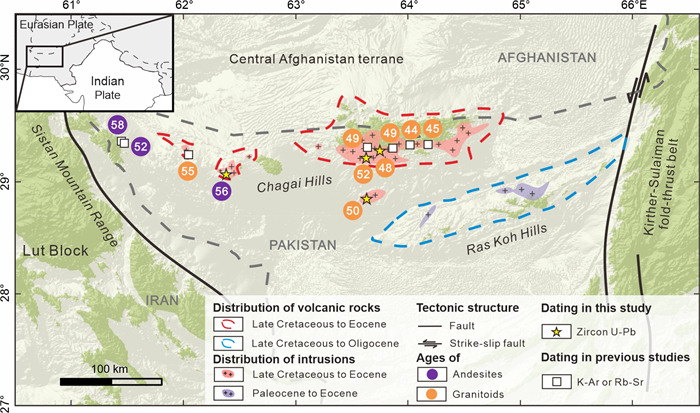
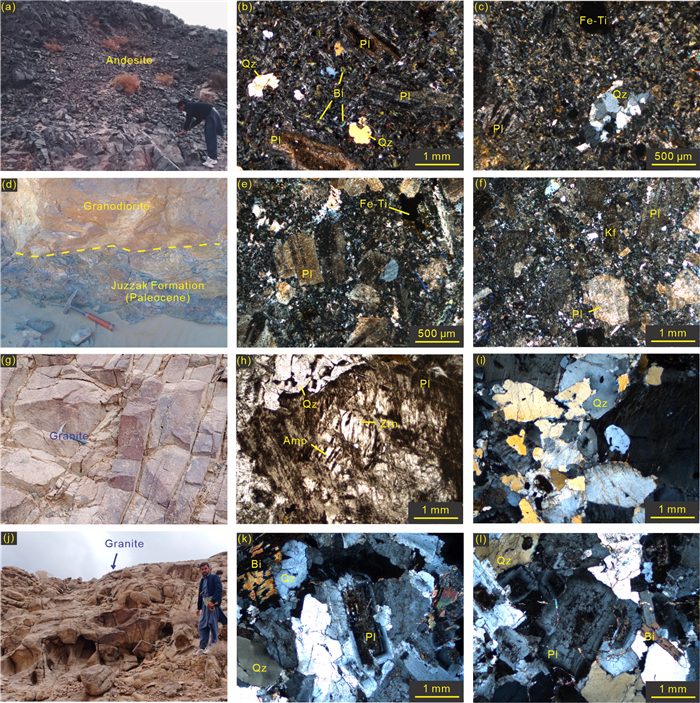
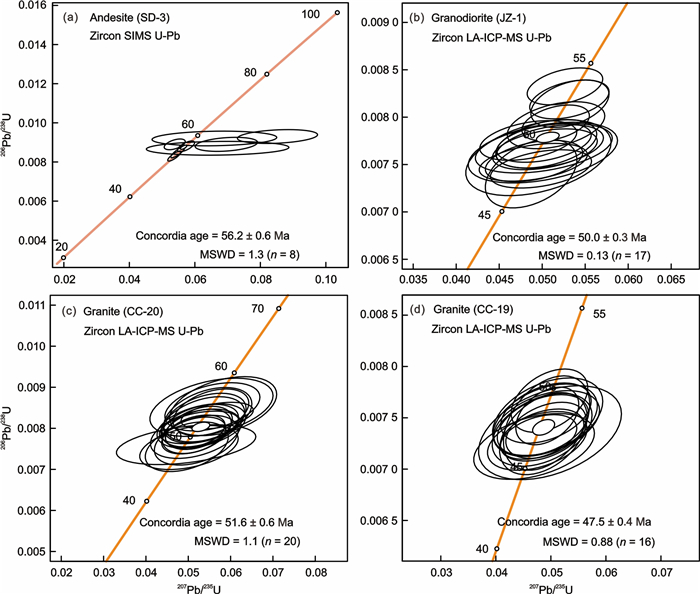
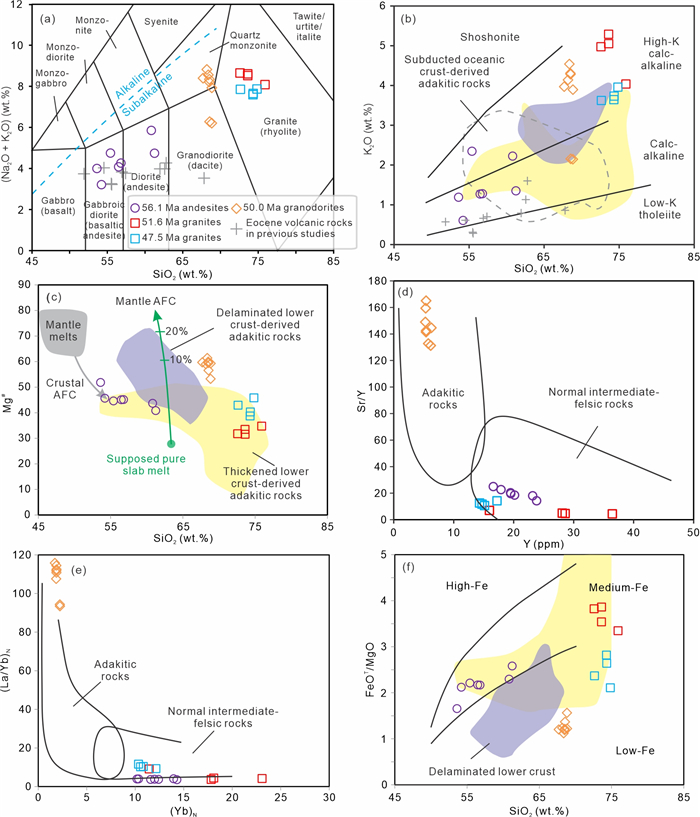
| Citation: | Guangping Zeng, Yunying Zhang, Zhen Sun, Mubashir Mehmood, Syed Ahsan Hussain Gardezi, Xiuquan Miao, Liheng Sun, Xuqing Li. Unraveling the India-Eurasia Collision Pattern: Insights from Subduction to Collision-Related Magmatism in the Chagai Hills. Journal of Earth Science, 2026, 37(3): 1055-1069. doi: 10.1007/s12583-025-0244-z

|
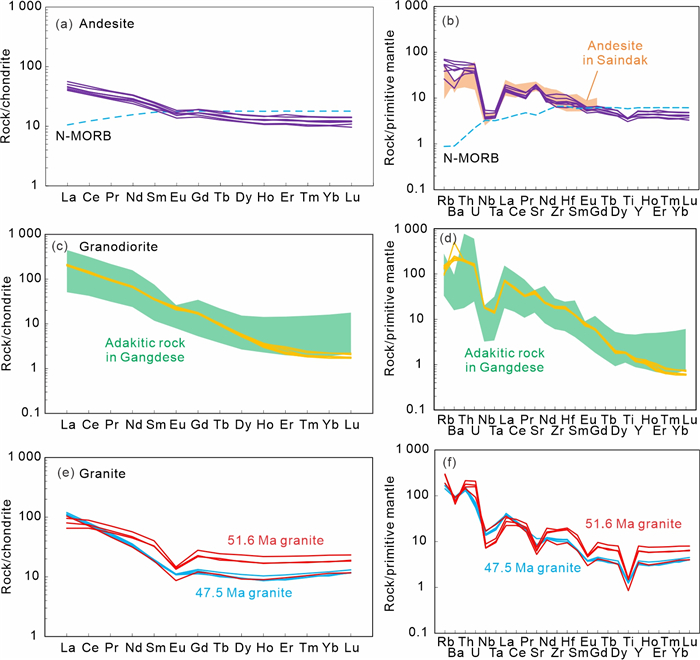
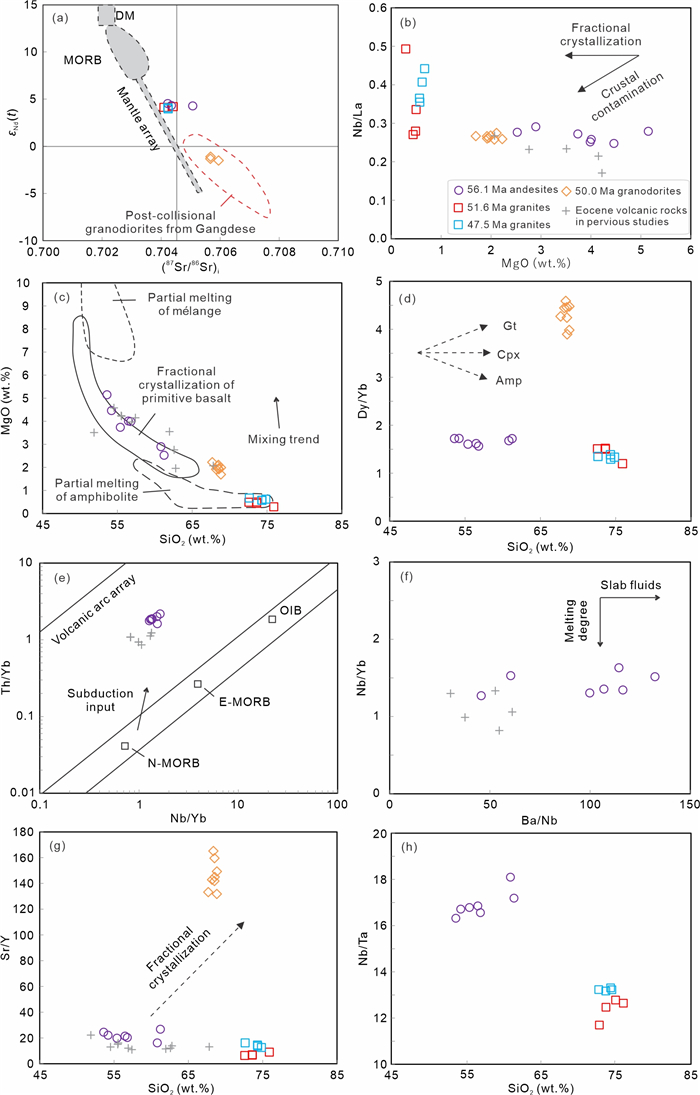
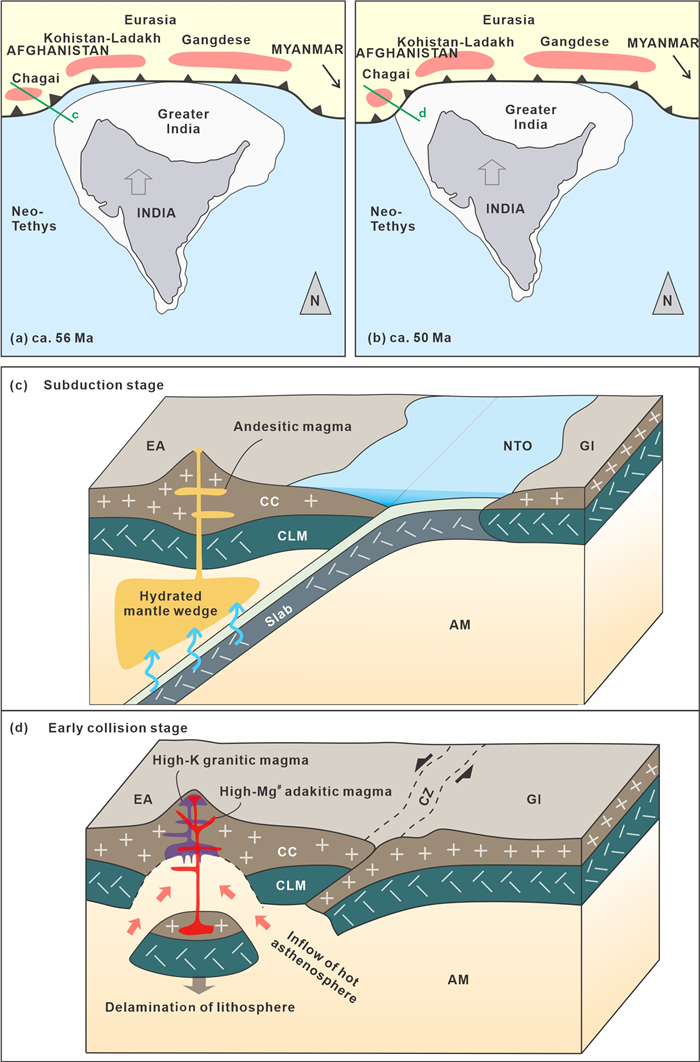
The pattern of India-Eurasia collision is critical for understanding plateau uplift and Cenozoic global climate change. However, the initial collisional timing and location remain debated. This study investigates magmatic rocks from the Chagai Hills in the western India-Eurasia collision zone, integrating petrological, geochronological and geochemical analyses of andesites (56.2 Ma), granodiorites (50.0 Ma) and granites (51.6–47.5 Ma). The arc-like andesites with depleted Nb-Ta-Ti, low 87Sr/86Sr of 0.704 2–0.705 1 and high

| An, Z. S., Kutzbach, J. E., Prell, W. L., et al., 2001. Evolution of Asian Monsoons and Phased Uplift of the Himalaya-Tibetan Plateau since Late Miocene Times. Nature, 411(6833): 62–66. https://doi.org/10.1038/35075035 |
| Angiboust, S., Agard, P., De Hoog, J. C. M., et al., 2013. Insights on Deep, Accretionary Subduction Processes from the Sistan Ophiolitic "Mélange" (Eastern Iran). Lithos, 156–159: 139–158. https://doi.org/10.1016/j.lithos.2012.11.007 |
| Annen, C., Blundy, J. D., Sparks, R. S. J., 2006. The Genesis of Intermediate and Silicic Magmas in Deep Crustal Hot Zones. Journal of Petrology, 47(3): 505–539. https://doi.org/10.1093/petrology/egi084 |
| Arjmandzadeh, R., Karimpour, M. H., Mazaheri, S. A., et al., 2011. Sr-Nd Isotope Geochemistry and Petrogenesis of the Chah-Shaljami Granitoids (Lut Block, Eastern Iran). Journal of Asian Earth Sciences, 41(3): 283–296. https://doi.org/10.1016/j.jseaes.2011.02.014 |
| Arthurton, R. S., Farah, A., Ahmed, W., 1982. The Late Cretaceous-Cenozoic History of Western Baluchistan Pakistan: The Northern Margin of the Makran Subduction Complex. Geological Society, London, Special Publications, 10(1): 373–385. https://doi.org/10.1144/gsl.sp.1982.010.01.25 |
| Blatter, D. L., Sisson, T. W., Ben Hankins, W., 2013. Crystallization of Oxidized, Moderately Hydrous Arc Basalt at Mid- to Lower-Crustal Pressures: Implications for Andesite Genesis. Contributions to Mineralogy and Petrology, 166(3): 861–886. https://doi.org/10.1007/s00410-013-0920-3 |
| Bouilhol, P., Jagoutz, O., Hanchar, J. M., et al., 2013. Dating the India-Eurasia Collision through Arc Magmatic Records. Earth and Planetary Science Letters, 366: 163–175. https://doi.org/10.1016/j.epsl.2013.01.023 |
| Breitzman, L. L., Birnie, R. W., Johnson, G. D., 1983. Fission-Track Ages of the Chagai Intrusives, Baluchistan, Pakistan. Geological Society of America Bulletin, 94(2): 253. https://doi.org/10.1130/0016-7606(1983)94253:faotci>2.0.co;2 doi: 10.1130/0016-7606(1983)94253:faotci>2.0.co;2 |
| Bröcker, M., Fotoohi Rad, G., Burgess, R., et al., 2013. New Age Constraints for the Geodynamic Evolution of the Sistan Suture Zone, Eastern Iran. Lithos, 170/171: 17–34. https://doi.org/10.1016/j.lithos.2013.02.012 |
| Castillo, P. R., 2006. An Overview of Adakite Petrogenesis. Chinese Science Bulletin, 51(3): 257–268. https://doi.org/10.1007/s11434-006-0257-7 |
| Castillo, P. R., Janney, P. E., Solidum, R. U., 1999. Petrology and Geochemistry of Camiguin Island, Southern Philippines: Insights to the Source of Adakites and Other Lavas in a Complex Arc Setting. Contributions to Mineralogy and Petrology, 134(1): 33–51. https://doi.org/10.1007/s004100050467 |
| Chappell, B. W., White, A. J. R., 2001. Two Contrasting Granite Types: 25 Years Later. Australian Journal of Earth Sciences, 48(4): 489–499. https://doi.org/10.1046/j.1440-0952.2001.00882.x |
| Chappell, B. W., White, A. J. R., 1992. I- and S-Type Granites in the Lachlan Fold Belt. Earth and Environmental Science Transactions of the Royal Society of Edinburgh, 83(1/2): 1–26. https://doi.org/10.1017/s0263593300007720 |
| Chung, S. L., Liu, D. Y., Ji, J. Q., et al., 2003. Adakites from Continental Collision Zones: Melting of Thickened Lower Crust beneath Southern Tibet. Geology, 31(11): 1021. https://doi.org/10.1130/g19796.1 |
| Chung, S. L., Chu, M. F., Zhang, Y. Q., et al., 2005. Tibetan Tectonic Evolution Inferred from Spatial and Temporal Variations in Post-Collisional Magmatism. Earth-Science Reviews, 68(3/4): 173–196. https://doi.org/10.1016/j.earscirev.2004.05.001 |
| Cruz-Uribe, A. M., Marschall, H. R., Gaetani, G. A., et al., 2018. Generation of Alkaline Magmas in Subduction Zones by Partial Melting of Mélange Diapirs: An Experimental Study. Geology, 46(4): 343–346. https://doi.org/10.1130/g39956.1 |
| DeCelles, P. G., Kapp, P., Gehrels, G. E., et al., 2014. Paleocene-Eocene Foreland Basin Evolution in the Himalaya of Southern Tibet and Nepal: Implications for the Age of Initial India-Asia Collision. Tectonics, 33(5): 824–849. https://doi.org/10.1002/2014TC003522 |
| Defant, M. J., Drummond, M. S., 1990. Derivation of Some Modern Arc Magmas by Melting of Young Subducted Lithosphere. Nature, 347(6294): 662–665. https://doi.org/10.1038/347662a0 |
| DePaolo, D. J., 1981. Trace Element and Isotopic Effects of Combined Wallrock Assimilation and Fractional Crystallization. Earth and Planetary Science Letters, 53(2): 189–202. https://doi.org/10.1016/0012-821X(81)90153-9 |
| Ding, L., Kapp, P., Cai, F. L., et al., 2022. Timing and Mechanisms of Tibetan Plateau Uplift. Nature Reviews Earth & Environment, 3(10): 652–667. https://doi.org/10.1038/s43017-022-00318-4 |
| Elliott, T., Plank, T., Zindler, A., et al., 1997. Element Transport from Slab to Volcanic Front at the Mariana Arc. Journal of Geophysical Research: Solid Earth, 102(B7): 14991–15019. https://doi.org/10.1029/97JB00788 |
| Gromet, P., Silver, L. T., 1987. REE Variations across the Peninsular Ranges Batholith: Implications for Batholithic Petrogenesis and Crustal Growth in Magmatic Arcs. Journal of Petrology, 28(1): 75–125. https://doi.org/10.1093/petrology/28.1.75 |
|
Guillot, S., Cosca, M., Allemand, P., et al., 1999. Contrasting Metamorphic and Geochronologic Evolution along the Himalayan Belt. In: Macfarlane, A., Sorkhabi, R. B., Quade, J., eds., Himalaya and Tibet: Mountain Roots to Mountain Tops. Geological Society of America, |
| Guo, Z. F., Wilson, M., Dingwell, D. B., et al., 2021. India-Asia Collision as a Driver of Atmospheric CO2 in the Cenozoic. Nature Communications, 12: 3891. https://doi.org/10.1038/s41467-021-23772-y |
| Han, B. F., Wang, S. G., Jahn, B. M., et al., 1997. Depleted-Mantle Source for the Ulungur River A-Type Granites from North Xinjiang, China: Geochemistry and Nd-Sr Isotopic Evidence, and Implications for Phanerozoic Crustal Growth. Chemical Geology, 138(3/4): 135–159. https://doi.org/10.1016/S0009-2541(97)00003-X |
| Hofmann, A. W., 1997. Mantle Geochemistry: The Message from Oceanic Volcanism. Nature, 385(6613): 219–229. https://doi.org/10.1038/385219a0 |
| Hofmann, A. W., White, W. M., 1982. Mantle Plumes from Ancient Oceanic Crust. Earth and Planetary Science Letters, 57(2): 421–436. https://doi.org/10.1016/0012-821X(82)90161-3 |
| Hu, X. M., Garzanti, E., Moore, T., et al., 2015. Direct Stratigraphic Dating of India-Asia Collision Onset at the Selandian (Middle Paleocene, 59 ± 1 Ma). Geology, 43(10): 859–862. https://doi.org/10.1130/g36872.1 |
| Hu, X. M., Garzanti, E., Wang, J. G., et al., 2016. The Timing of India-Asia Collision Onset: Facts, Theories, Controversies. Earth-Science Reviews, 160: 264–299. https://doi.org/10.1016/j.earscirev.2016.07.014 |
| Ingalls, M., Rowley, D. B., Currie, B., et al., 2016. Large-Scale Subduction of Continental Crust Implied by India-Asia Mass-Balance Calculation. Nature Geoscience, 9(11): 848–853. https://doi.org/10.1038/ngeo2806 |
| Jahn, B. M., Wu, F. Y., Lo, C. H., et al., 1999. Crust-Mantle Interaction Induced by Deep Subduction of the Continental Crust: Geochemical and Sr-Nd Isotopic Evidence from Post-Collisional Mafic-Ultramafic Intrusions of the Northern Dabie Complex, Central China. Chemical Geology, 157(1/2): 119–146. https://doi.org/10.1016/S0009-2541(98)00197-1 |
| Jentzer, M., Agard, P., Bonnet, G., et al., 2022. The North Sistan Orogen (Eastern Iran): Tectono-Metamorphic Evolution and Significance within the Tethyan Realm. Gondwana Research, 109: 460–492. https://doi.org/10.1016/j.gr.2022.04.004 |
| Kay, R. W., Kay, S. M., 1993. Delamination and Delamination Magmatism. Tectonophysics, 219(1/2/3): 177–189. https://doi.org/10.1016/0040-1951(93)90295-u |
| Kent, D. V., Muttoni, G., 2008. Equatorial Convergence of India and Early Cenozoic Climate Trends. Proceedings of the National Academy of Sciences of the United States of America, 105(42): 16065–16070. https://doi.org/10.1073/pnas.0805382105 |
| Li, X. H., Tang, G. Q., Gong, B., et al., 2013. Qinghu Zircon: A Working Reference for Microbeam Analysis of U-Pb Age and Hf and O Isotopes. Chinese Science Bulletin, 58(36): 4647–4654. https://doi.org/10.1007/s11434-013-5932-x |
| Liu, Y. S., Gao, S., Hu, Z. C., et al., 2010. Continental and Oceanic Crust Recycling-Induced Melt-Peridotite Interactions in the Trans-North China Orogen: U-Pb Dating, Hf Isotopes and Trace Elements in Zircons from Mantle Xenoliths. Journal of Petrology, 51(1/2): 537–571. https://doi.org/10.1093/petrology/egp082 |
| Liu, Y. S., Zong, K. Q., Kelemen, P. B., et al., 2008. Geochemistry and Magmatic History of Eclogites and Ultramafic Rocks from the Chinese Continental Scientific Drill Hole: Subduction and Ultrahigh-Pressure Metamorphism of Lower Crustal Cumulates. Chemical Geology, 247(1/2): 133–153. https://doi.org/10.1016/j.chemgeo.2007.10.016 |
| Ludwig, K., 2003. User's Manual for Isoplot 3.00: A Geochronological Toolkit for Microsoft Excel. Berkeley Geochronology Center Special Publication, Berkeley |
| Luo, C. H., Wang, R., Weinberg, R. F., et al., 2022. Isotopic Spatial-Temporal Evolution of Magmatic Rocks in the Gangdese Belt: Implications for the Origin of Miocene Post-Collisional Giant Porphyry Deposits in Southern Tibet. GSA Bulletin, 134(1/2): 316–324. https://doi.org/10.1130/b36018.1 |
| MacPherson, C. G., Dreher, S. T., Thirlwall, M. F., 2006. Adakites without Slab Melting: High Pressure Differentiation of Island Arc Magma, Mindanao, the Philippines. Earth and Planetary Science Letters, 243(3/4): 581–593. https://doi.org/10.1016/j.epsl.2005.12.034 |
| Malkani, M. S., 2020. Revised Stratigraphy and Mineral Resources of Balochistan Basin, Pakistan: An Update. Open Journal of Geology, 10(7): 784–828. https://doi.org/10.4236/ojg.2020.107036 |
| Martin, C. R., Jagoutz, O., Upadhyay, R., et al., 2020. Paleocene Latitude of the Kohistan-Ladakh Arc Indicates Multistage India-Eurasia Collision. Proceedings of the National Academy of Sciences of the United States of America, 117(47): 29487–29494. https://doi.org/10.1073/pnas.2009039117 |
| Martin, H., Smithies, R. H., Rapp, R., et al., 2005. An Overview of Adakite, Tonalite-Trondhjemite-Granodiorite (TTG), and Sanukitoid: Rela-tionships and Some Implications for Crustal Evolution. Lithos, 79(1/2): 1–24. https://doi.org/10.1016/j.lithos.2004.04.048 |
| Meng, J., Gilder, S. A., Tan, X. D., et al., 2023. Strengthening the Argument for a Large Greater India. Proceedings of the National Academy of Sciences of the United States of America, 120(33): e2305928120. https://doi.org/10.1073/pnas.2305928120 |
| Mohammadi, A., Burg, J. P., Winkler, W., et al., 2016. Detrital Zircon and Provenance Analysis of Late Cretaceous–Miocene Onshore Iranian Makran Strata: Implications for the Tectonic Setting. Geological Society of America Bulletin, 128(9/10): 1481–1499. https://doi.org/10.1130/b31361.1 |
| Molnar, P., Tapponnier, P., 1975. Cenozoic Tectonics of Asia: Effects of a Continental Collision. Science, 189(4201): 419–426 doi: 10.1126/science.189.4201.419 |
| Moyen, J. F., 2009. High Sr/Y and La/Yb Ratios: The Meaning of the "Adakitic Signature". Lithos, 112(3/4): 556–574. https://doi.org/10.1016/j.lithos.2009.04.001 |
| Nicholson, K. N., Khan, M., Mahmood, K., 2010. Geochemistry of the Chagai-Raskoh Arc, Pakistan: Complex Arc Dynamics Spanning the Cretaceous to the Quaternary. Lithos, 118(3/4): 338–348. https://doi.org/10.1016/j.lithos.2010.05.008 |
| Pang, K. N., Chung, S. L., Zarrinkoub, M. H., et al., 2013. Eocene–Oligocene Post-Collisional Magmatism in the Lut-Sistan Region, Eastern Iran: Magma Genesis and Tectonic Implications. Lithos, 180: 234–251. https://doi.org/10.1016/j.lithos.2013.05.009 |
| Patriat, P., Achache, J., 1984. India-Eurasia Collision Chronology Has Implications for Crustal Shortening and Driving Mechanism of Plates. Nature, 311(5987): 615–621. https://doi.org/10.1038/311615a0 |
| Pearce, J. A., 2008. Geochemical Fingerprinting of Oceanic Basalts with Applications to Ophiolite Classification and the Search for Archean Oceanic Crust. Lithos, 100(1/2/3/4): 14–48. https://doi.org/10.1016/j.lithos.2007.06.016 |
| Perelló, J., Razique, A., Schloderer, J., et al., 2008. The Chagai Porphyry Copper Belt, Baluchistan Province, Pakistan. Economic Geology, 103(8): 1583–1612. https://doi.org/10.2113/gsecongeo.103.8.1583 |
| Qian, Q., Hermann, J., 2013. Partial Melting of Lower Crust at 10–15 kbar: Constraints on Adakite and TTG Formation. Contributions to Mineralogy and Petrology, 165(6): 1195–1224. https://doi.org/10.1007/s00410-013-0854-9 |
| Rad, G. R. F., Droop, G. T. R., Burgess, R., 2009. Early Cretaceous Exhumation of High-Pressure Metamorphic Rocks of the Sistan Suture Zone, Eastern Iran. Geological Journal, 44(1): 104–116. https://doi.org/10.1002/gj.1135 |
| Rapp, R. P., Shimizu, N., Norman, M. D., et al., 1999. Reaction between Slab-Derived Melts and Peridotite in the Mantle Wedge: Experimental Constraints at 3.8 GPa. Chemical Geology, 160(4): 335–356. https://doi.org/10.1016/S0009-2541(99)00106-0 |
| Rapp, R. P., Watson, E. B., 1995. Dehydration Melting of Metabasalt at 8–32 kbar: Implications for Continental Growth and Crust-Mantle Recycling. Journal of Petrology, 36(4): 891–931. https://doi.org/10.1093/petrology/36.4.891 |
| Rapp, R. P., Watson, E. B., Miller, C. F., 1991. Partial Melting of Amphibolite/Eclogite and the Origin of Archean Trondhjemites and Tonalites. Precambrian Research, 51(1/2/3/4): 1–25. https://doi.org/10.1016/0301-9268(91)90092-o |
| Raymo, M. E., Ruddiman, W. F., 1992. Tectonic Forcing of Late Cenozoic Climate. Nature, 359(6391): 117–122. https://doi.org/10.1038/359117a0 |
| Richards, J. P., 2015. Tectonic, Magmatic, and Metallogenic Evolution of the Tethyan Orogen: From Subduction to Collision. Ore Geology Reviews, 70: 323–345. https://doi.org/10.1016/j.oregeorev.2014.11.009 |
| Richards, J. P., Spell, T., Rameh, E., et al., 2012. High Sr/Y Magmas Reflect Arc Maturity, High Magmatic Water Content, and Porphyry Cu ± Mo ± Au Potential: Examples from the Tethyan Arcs of Central and Eastern Iran and Western Pakistan. Economic Geology, 107(2): 295–332. https://doi.org/10.2113/econgeo.107.2.295 |
| Rogers, G., Hawkesworth, C. J., 1989. A Geochemical Traverse across the North Chilean Andes: Evidence for Crust Generation from the Mantle Wedge. Earth and Planetary Science Letters, 91(3/4): 271–285. https://doi.org/10.1016/0012-821X(89)90003-4 |
| Rowley, D. B., 1996. Age of Initiation of Collision between India and Asia: A Review of Stratigraphic Data. Earth and Planetary Science Letters, 145(1/2/3/4): 1–13. https://doi.org/10.1016/S0012-821X(96)00201-4 |
| Ruddiman, W. F., Kutzbach, J. E., 1989. Forcing of Late Cenozoic Northern Hemisphere Climate by Plateau Uplift in Southern Asia and the American West. Journal of Geophysical Research: Atmospheres, 94(D15): 18409–18427. https://doi.org/10.1029/JD094iD15p18409 |
|
Rudnick, R. L., Gao, S., 2003. Composition of the Continental Crust. Treatise on Geochemistry. Elsevier, Amsterdam. 1–64. |
| Siddiqui, R. H., Jan, M. Q., Khan, M. A., et al., 2017. Petrogenesis of the Late Cretaceous Tholeiitic Volcanism and Oceanic Island Arc Affinity of the Chagai Arc, Western Pakistan. Acta Geologica Sinica (English Edition), 91(4): 1248–1263. https://doi.org/10.1111/1755-6724.13358 |
| Siddiqui, R. H., Khan, M. A., Jan, M. Q., et al., 2010. Paleocene Tholeiitic Volcanism and Oceanic Island Arc Affinities of the Chagai Arc, Balochistan, Pakistan. Sindh University Research Journal, 42(1): 83–98 |
| Siddiqui, R. H., Khan, M. A., Jan, M. Q., 2005. Petrogenesis of Eocene Lava Flows from the Chagai Arc, Balochistan, Pakistan and Its Tectonic Implications. Journal of Himalayan Earth Sciences, 38(1): 163–187 |
| Sillitoe, R. H., 1978. Metallogenic Evolution of a Collisional Mountain Belt in Pakistan: A Preliminary Analysis. Journal of the Geological Society, 135(4): 377–387. https://doi.org/10.1144/gsjgs.135.4.0377 |
| Sun, S. S., McDonough, W. F., 1989. Chemical and Isotopic Systematics of Oceanic Basalts: Implications for Mantle Composition and Processes. Geological Society, London, Special Publications, 42: 313–345. https://doi.org/10.1144/GSL.SP.1989.042.01.19 |
| Tirrul, R., Bell, I. R., Griffis, R. J., et al., 1983. The Sistan Suture Zone of Eastern Iran. Geological Society of America Bulletin, 94(1): 134. https://doi.org/10.1130/0016-7606(1983)94134:tsszoe>2.0.co;2 doi: 10.1130/0016-7606(1983)94134:tsszoe>2.0.co;2 |
| Ullah, I., Xue, C. D., Yang, T. N., et al., 2023. Double Arc-Continent Collision Record in the Latest Mesozoic–Cenozoic Tectonic History of the Himalayan-Tibetan Orogenic Belt in Western Pakistan. Journal of the Geological Society, 180(6): jgs2023–jgs2076. https://doi.org/10.1144/jgs2023-076 |
| Wang, Q., Wyman, D. A., Xu, J. F., et al., 2008. Triassic Nb-Enriched Basalts, Magnesian Andesites, and Adakites of the Qiangtang Terrane (Central Tibet): Evidence for Metasomatism by Slab-Derived Melts in the Mantle Wedge. Contributions to Mineralogy and Petrology, 155(4): 473–490. https://doi.org/10.1007/s00410-007-0253-1 |
| Wang, Q., Xu, J. F., Jian, P., et al., 2006. Petrogenesis of Adakitic Porphyries in an Extensional Tectonic Setting, Dexing, South China: Implications for the Genesis of Porphyry Copper Mineralization. Journal of Petrology, 47(1): 119–144. https://doi.org/10.1093/petrology/egi070 |
| Wei, G. J., Liang, X. R., Li, X. H., Liu, Y., 2002. Precise Measurement of Sr Isotopic Composition of Liquid and Solid Base Using (LP)MC-ICPMS. Geochimica, 31: 295–299 (in Chinese with English Abstract) |
| Wiedenbeck, M., Allé, P., Corfu, F., et al., 1995. Three Natural Zircon Standards for U-Th-Pb, Lu-Hf, Trace Element and REE Analyses. Geostandards Newsletter, 19(1): 1–23. https://doi.org/10.1111/j.1751-908x.1995.tb00147.x |
| Wilson, M., 1989. Geochemical Characteristics of Igneous Rocks as Petrogenetic Indicators. In: Wilson, M., ed., Igneous Petrogenesis. Springer Netherlands, Dordrecht. 13–35 |
| Wu, F. Y., Ji, W. Q., Wang, J. G., et al., 2014. Zircon U-Pb and Hf Isotopic Constraints on the Onset Time of India-Asia Collision. American Journal of Science, 314(2): 548–579. https://doi.org/10.2475/02.2014.04 |
| Wu, X. Y., Hu, J. S., Chen, L., et al., 2023. Paleogene India-Eurasia Collision Constrained by Observed Plate Rotation. Nature Communications, 14: 7272. https://doi.org/10.1038/s41467-023-42920-0 |
| Xu, J. F., Shinjo, R., Defant, M. J., et al., 2002. Origin of Mesozoic Adakitic Intrusive Rocks in the Ningzhen Area of East China: Partial Melting of Delaminated Lower Continental Crust. Geology, 30(12): 1111. https://doi.org/10.1130/0091-7613(2002)0301111:oomair>2.0.co;2 doi: 10.1130/0091-7613(2002)0301111:oomair>2.0.co;2 |
| Zandt, G., Gilbert, H., Owens, T. J., et al., 2004. Active Foundering of a Continental Arc Root beneath the Southern Sierra Nevada in California. Nature, 431: 41–46. https://doi.org/10.1038/nature02847 |
| Zarrinkoub, M. H., Pang, K. N., Chung, S. L., et al., 2012. Zircon U-Pb Age and Geochemical Constraints on the Origin of the Birjand Ophiolite, Sistan Suture Zone, Eastern Iran. Lithos, 154: 392–405. https://doi.org/10.1016/j.lithos.2012.08.007 |
| Zeng, Y. C., Ducea, M. N., Xu, J. F., et al., 2021. Negligible Surface Uplift Following Foundering of Thickened Central Tibetan Lower Crust. Geology, 49(1): 45–50. https://doi.org/10.1130/g48142.1 |
| Zhang, Y. Y., Sun, M., Yuan, C., et al., 2018. Alternating Trench Advance and Retreat: Insights from Paleozoic Magmatism in the Eastern Tianshan, Central Asian Orogenic Belt. Tectonics, 37(7): 2142–2164. https://doi.org/10.1029/2018TC005051 |
| Zhang, Y. Y., Yuan, C., Sun, M., et al., 2017. Arc Magmatism Associated with Steep Subduction: Insights from Trace Element and Sr-Nd-Hf-B Isotope Systematics. Journal of Geophysical Research: Solid Earth, 122(3): 1816–1834. https://doi.org/10.1002/2016JB013289 |
| Zhang, Y. Y., Yuan, C., Sun, M., et al., 2015. Permian Doleritic Dikes in the Beishan Orogenic Belt, NW China: Asthenosphere-Lithosphere Interaction in Response to Slab Break-off. Lithos, 233: 174–192. https://doi.org/10.1016/j.lithos.2015.04.001 |
| Zhang, Y. Y., Yuan, C., Sun, M., et al., 2020. Two Late Carboniferous Belts of Nb-Enriched Mafic Magmatism in the Eastern Tianshan: Heterogeneous Mantle Sources and Geodynamic Implications. GSA Bulletin, 132(9/10): 1863–1880. https://doi.org/10.1130/b35366.1 |
| Zhou, J. X., Su, H., 2019. Site and Timing of Substantial India-Asia Collision Inferred from Crustal Volume Budget. Tectonics, 38(7): 2275–2290. https://doi.org/10.1029/2018TC005412 |
| Zhu, B. Q., Zhang, J. L., Tu, X. L., et al., 2001. Pb, Sr, and Nd Isotopic Features in Organic Matter from China and Their Implications for Petroleum Generation and Migration. Geochimica et Cosmochimica Acta, 65(15): 2555–2570. https://doi.org/10.1016/S0016-7037(01)00608-1 |
| Zhu, D. C., Wang, Q., Weinberg, R. F., et al., 2022. Interplay between Oceanic Subduction and Continental Collision in Building Continental Crust. Nature Communications, 13: 7141. https://doi.org/10.1038/s41467-022-34826-0 |
| Zhu, D. C., Wang, Q., Weinberg, R. F., et al., 2023. Continental Crustal Growth Processes Recorded in the Gangdese Batholith, Southern Tibet. Annual Review of Earth and Planetary Sciences, 51: 155–188. https://doi.org/10.1146/annurev-earth-032320-110452 |
| Zong, K. Q., Klemd, R., Yuan, Y., et al., 2017. The Assembly of Rodinia: The Correlation of Early Neoproterozoic (ca. 900 Ma) High-Grade Metamorphism and Continental Arc Formation in the Southern Beishan Orogen, Southern Central Asian Orogenic Belt (CAOB). Precambrian Research, 290: 32–48. https://doi.org/10.1016/j.precamres.2016.12.010 |
Figures(8)
Copyright © 2013-2020 Journal of Earth Science 鄂ICP备15021562号-2
Tel: +86-27-67885075 Fax: +86-27-67885075 E-mail: xbb@cug.edu.cn
Address: Editorial Office of Journal, China University of Geosciences, Yujiashan, Wuhan, Hubei 430074, P. R. China
Supported by:
Beijing Renhe Information Technology Co. Ltd
E-mail:
info@rhhz.net


 DownLoad: