| Citation: | Xiang Chen, Duanyang Zhuang, Liangtong Zhan, Wenjie Xu, Jinlong Li, Linbo Wu, Haibin Yang, Jisen Shi, Zizhuang Yan, Yunmin Chen. Study on the Role of Weak Lower Crust in Cenozoic Tectonic Deformation of Qinghai-Tibet Plateau by an Integrated Centrifugal Analog Modeling and Numerical Simulation Approach. Journal of Earth Science, 2026, 37(1): 137-154. doi: 10.1007/s12583-025-0284-4

|
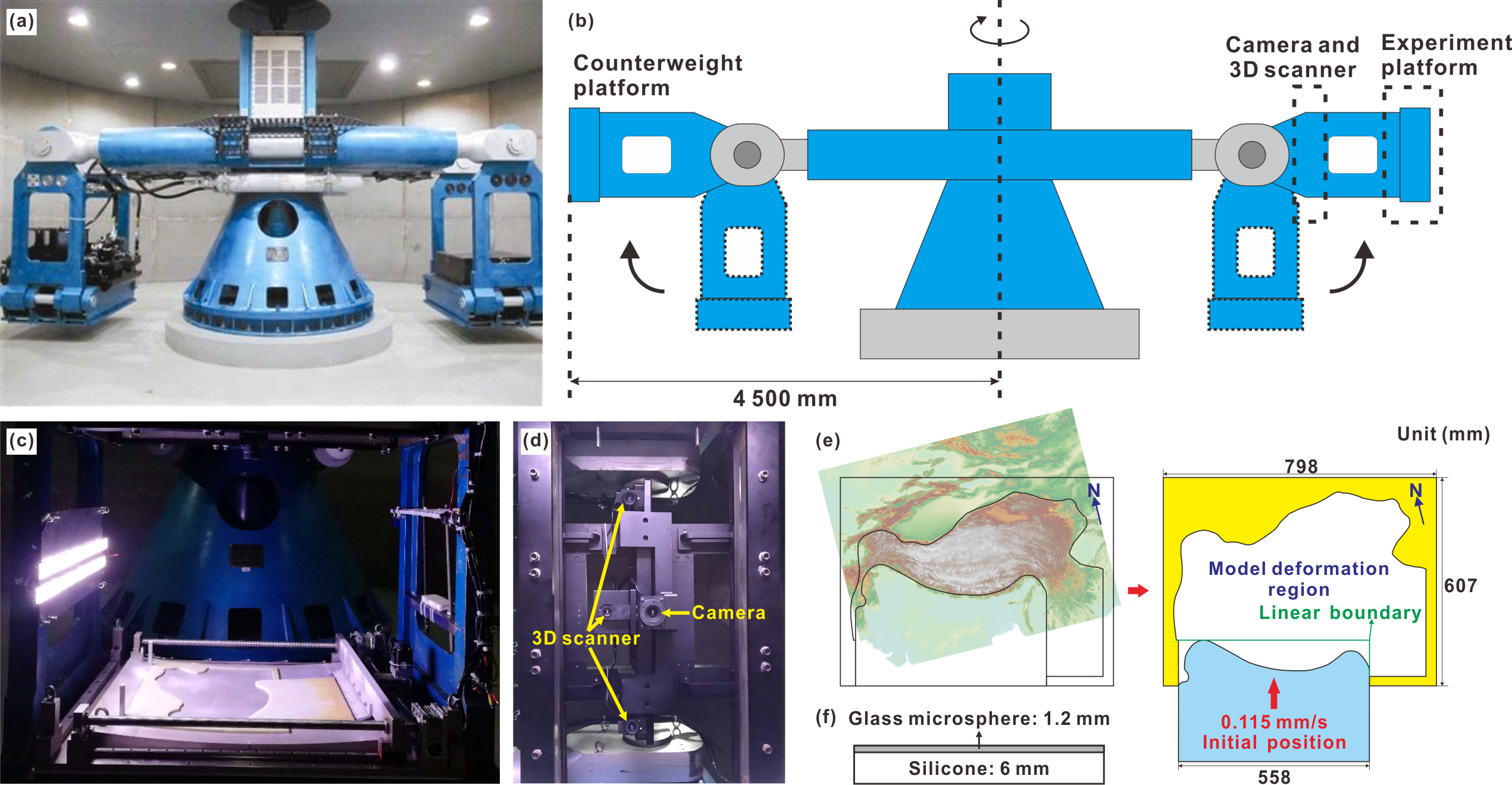
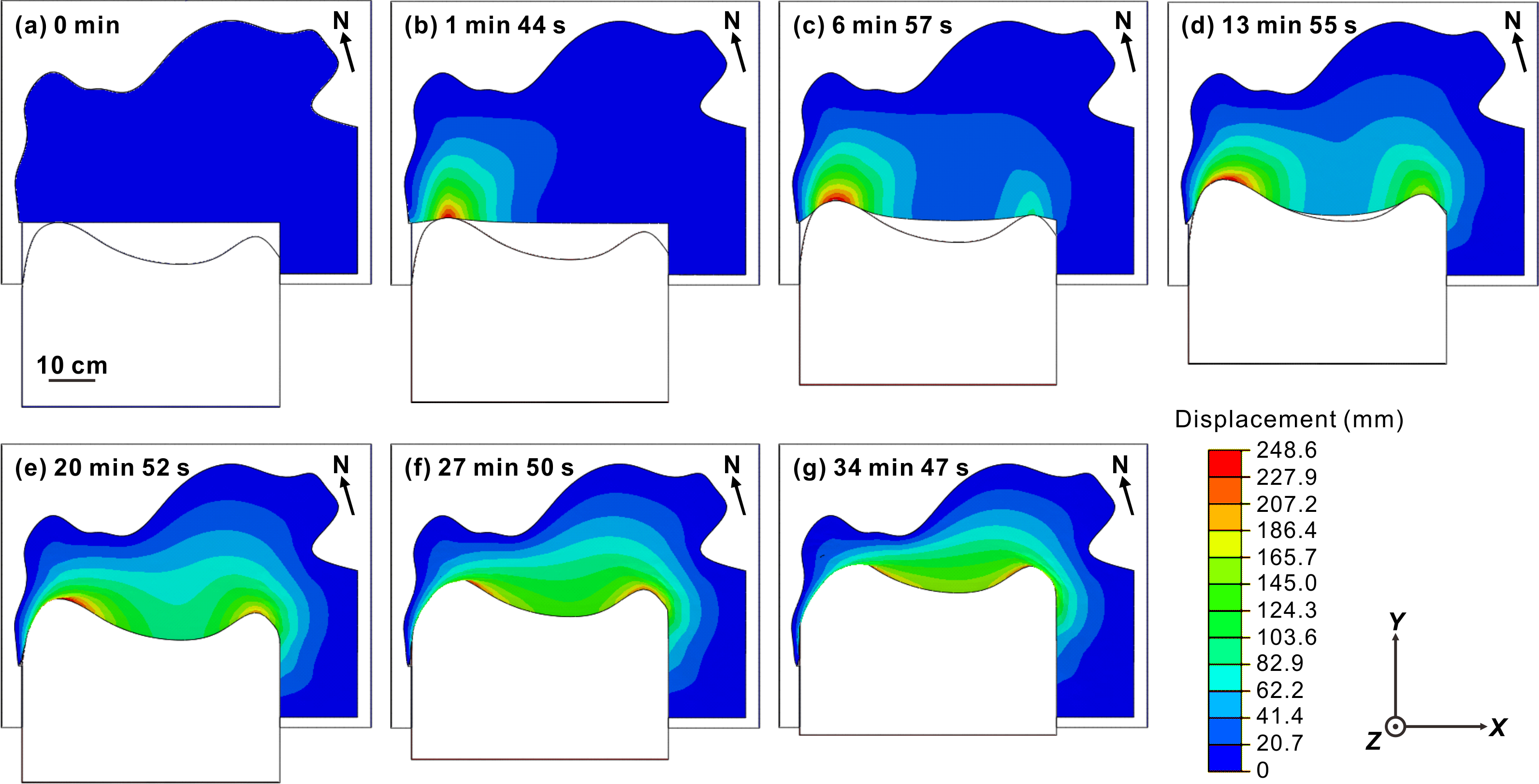
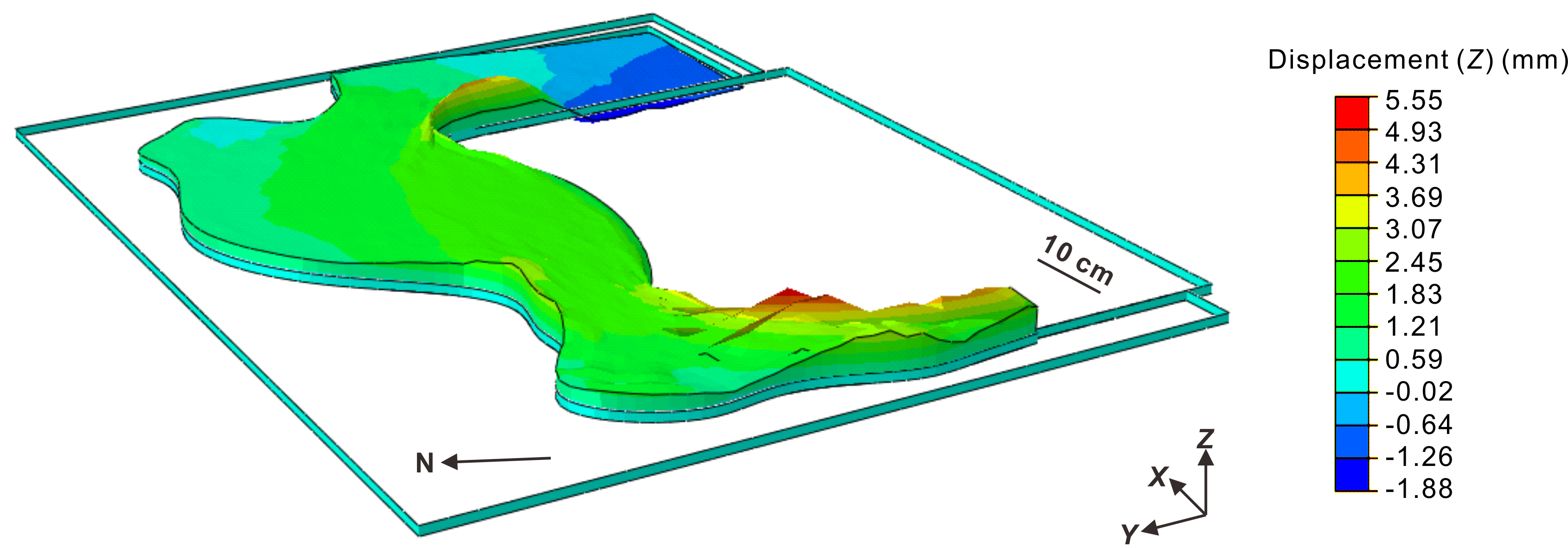
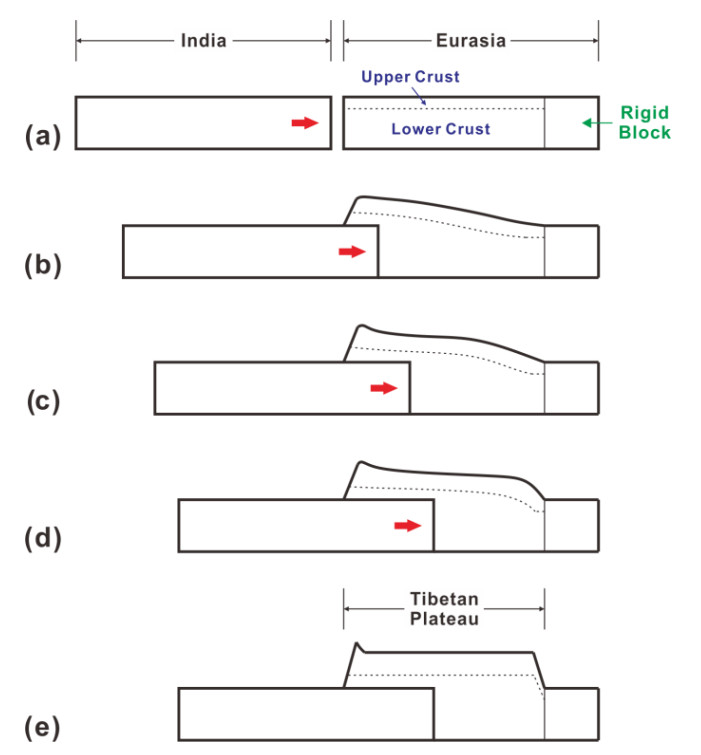
The India-Asia collision resulted in the formation of Qinghai-Tibet Plateau. Lower crustal flow model was proposed to explain the mechanism of Cenozoic tectonic deformation of Qinghai-Tibet Plateau. In this study, we propose a new approach by combining centrifugal analog modeling with numerical simulation to simulate the tectonic uplift history of the plateau based on the lower crustal flow model, and to investigate the material migration characteristics and the influence of crustal motion velocity and ductile layer viscosity on the plateau tectonic geomorphology. The models reproduce steep-sided flat-topped geomorphic features and clockwise rotation of the material at eastern Himalayan Syntaxis, verifying the rationality of the models. The results show that the greater the crustal motion velocity and the greater the ductile layer viscosity, the steeper the terrain change; and conversely, the smaller the crustal motion velocity and the smaller the ductile layer viscosity, the gentler the terrain change. This study further indicates that the weak lower crust plays an important role in the formation of geomorphic features and material migration characteristics of Qinghai-Tibet Plateau, and provides a new insight for the study of the uplift mechanism of the Tibetan Plateau.

| Allemand, P., Dromart, G., Garcia, J. P., et al., 2004. One My Scale Subsidence of Carbonate Sedimentary Bodies and the Viscosity of the Lower Crust. Journal of Geodynamics, 37(1): 103–124. https://doi.org/10.1016/j.jog.2003.09.001 |
|
Argand, E., 1924. La Tectonique de l’Asie. In: Proceedings of the 13th International Geological Congress, Brussels, 1922. 171–372. |
| Bahroudi, A., Koyi, H., 2003. Effect of Spatial Distribution of Hormuz Salt on Deformation Style in the Zagros Fold and Thrust Belt: An Analogue Modelling Approach. Journal of the Geological Society, 160(5): 719–733. https://doi.org/10.1144/0016-764902-135 |
| Bai, D. H., Unsworth, M. J., Meju, M. A., et al., 2010. Crustal Deformation of the Eastern Tibetan Plateau Revealed by Magnetotelluric Imaging. Nature Geoscience, 3(5): 358–362. https://doi.org/10.1038/ngeo830 |
| Barazangi, M., Ni, J., 1982. Velocities and Propagation Characteristics of Pn and Sn beneath the Himalayan Arc and Tibetan Plateau: Possible Evidence for Underthrusting of Indian Continental Lithosphere beneath Tibet. Geology, 10(4): 179–185. https://doi.org/10.1130/0091-7613(1982)10<179:vapcop>2.0.co;2 doi: 10.1130/0091-7613(1982)10<179:vapcop>2.0.co;2 |
| Bonini, M., Sokoutis, D., Mulugeta, G., et al., 2001. Dynamics of Magma Emplacement in Centrifuge Models of Continental Extension with Implications for Flank Volcanism. Tectonics, 20(6): 1053–1065. https://doi.org/10.1029/2001TC900017 |
| Cadell, H. M., 1889. Ⅶ.—Experimental Researches in Mountain Building. Transactions of the Royal Society of Edinburgh, 35(1): 337–357. https://doi.org/10.1017/s0080456800017658 |
| Cao, J. L., Shi, Y. L., Zhang, H., et al., 2009. Numerical Simulation of GPS Observed Clockwise Rotation around the Eastern Himalayan Syntax in the Tibetan Plateau. Chinese Science Bulletin, 54(8): 1398–1410. https://doi.org/10.1007/s11434-008-0588-7 |
| Chen, Y. M., Tang, Y., Ling, D. S., et al., 2022. Hypergravity Experiments on Multiphase Media Evolution. Science China Technological Sciences, 65(12): 2791–2808. https://doi.org/10.1007/s11431-022-2125-x |
| Clark, M. K., Royden, L. H., 2000. Topographic Ooze: Building the Eastern Margin of Tibet by Lower Crustal Flow. Geology, 28(8): 703–706. https://doi.org/10.1130/0091-7613(2000)28<703:tobtem>2.0.co;2 doi: 10.1130/0091-7613(2000)28<703:tobtem>2.0.co;2 |
| Copley, A., McKenzie, D., 2007. Models of Crustal Flow in the India-Asia Collision Zone. Geophysical Journal International, 169(2): 683–698. https://doi.org/10.1111/j.1365-246X.2007.03343.x |
| Corti, G., 2008. Control of Rift Obliquity on the Evolution and Segmentation of the Main Ethiopian Rift. Nature Geoscience, 1(4): 258–262. https://doi.org/10.1038/ngeo160 |
| Corti, G., Dooley, T. P., 2015. Lithospheric-Scale Centrifuge Models of Pull-Apart Basins. Tectonophysics, 664: 154–163. https://doi.org/10.1016/j.tecto.2015.09.004 |
| Costa, E., Vendeville, B. C., 2002. Experimental Insights on the Geometry and Kinematics of Fold-and-Thrust Belts above Weak, Viscous Evaporitic Décollement. Journal of Structural Geology, 24(11): 1729–1739. https://doi.org/10.1016/S0191-8141(01)00169-9 |
| Costa, E., Vendeville, B., 2004. Experimental Insights on the Geometry and Kinematics of Fold-and-Thrust Belts above Weak, Viscous Evaporitic Décollement: Reply to Comments by Hemin Koyi and James Cotton. Journal of Structural Geology, 26(11): 2141–2143. https://doi.org/10.1016/j.jsg.2004.04.002 |
| Cotton, J. T., Koyi, H. A., 2000. Modeling of Thrust Fronts above Ductile and Frictional Detachments: Application to Structures in the Salt Range and Potwar Plateau, Pakistan. Geological Society of America Bulletin, 112(3): 351–363. https://doi.org/10.1130/0016-7606(2000)112<351:motfad>2.0.co;2 doi: 10.1130/0016-7606(2000)112<351:motfad>2.0.co;2 |
| Cui, J. W., Zhang, X. W., Tang, Z. M., 2006. Tectonic Divisions of Qinghai-Tibet Plateau and Structural Characteristics of Deformation on Their Boundaries. Geology in China, 33(2): 256–267. https://doi.org/10.3969/j.issn.1000-3657.2006.02.003 (in Chinese with English Abstract) |
| Dewey, J. F., Shackleton, R. M., Chang, C. F., et al., 1988. The Tectonic Evolution of the Tibetan Plateau. Philosophical Transactions of the Royal Society of London, 327: 379–413. https://doi.org/10.1098/rsta.1988.0135 |
| Dong, Z. B., Yan, D. P., Zhang, Z. L., et al., 2014. Research on Methods of Sandbox Modeling and Case Study Based on Particle Image Velocimetry (PIV). GeoScience, 28(2): 321–330. https://doi.org/10.3969/j.issn.1000-8527.2014.02.010 (in Chinese with English Abstract) |
| England, P. C., Houseman, G. A., 1986. Finite Strain Calculations of Continental Deformation: 2. Comparison with the India-Asia Collision Zone. Journal of Geophysical Research: Solid Earth, 91(B3): 3664–3676. https://doi.org/10.1029/JB091iB03p03664 |
| England, P. C., Houseman, G. A., 1988. The Mechanics of the Tibetan Plateau. Philosophical Transactions of the Royal Society of London, 326: 301–320. https://doi.org/10.1098/rsta.1988.0089 |
| Faisal, S., Dixon, J. M., 2015. Physical Analog (Centrifuge) Model Investigation of Contrasting Structural Styles in the Salt Range and Potwar Plateau, Northern Pakistan. Journal of Structural Geology, 77: 277–292. https://doi.org/10.1016/j.jsg.2014.10.009 |
| Fielding, E., Isacks, B., Barazangi, M., et al., 1994. How Flat Is Tibet? Geology, 22(2): 163–167. https://doi.org/10.1130/0091-7613(1994)022<0163:hfit>2.3.co;2 doi: 10.1130/0091-7613(1994)022<0163:hfit>2.3.co;2 |
| Gan, W. J., Zhang, P. Z., Shen, Z. K., et al., 2007. Present-Day Crustal Motion within the Tibetan Plateau Inferred from GPS Measurements. Journal of Geophysical Research: Solid Earth, 112(8): B08416. https://doi.org/10.1029/2005JB004120 |
| Gao, R., Lu, Z. W., Klemperer, S. L., et al., 2016. Crustal-Scale Duplexing beneath the Yarlung Zangbo Suture in the Western Himalaya. Nature Geoscience, 9(7): 555–560. https://doi.org/10.1038/ngeo2730 |
| Graveleau, F., Malavieille, J., Dominguez, S., 2012. Experimental Modelling of Orogenic Wedges: A Review. Tectonophysics, 538/539/540: 1–66. https://doi.org/10.1016/j.tecto.2012.01.027 |
| Hu, X. M., Wang, J. G., An, W., et al., 2017. Constraining the Timing of the India-Asia Continental Collision by the Sedimentary Record. Science China (Earth Sciences), 60(4): 603–625 (in Chinese with English Abstract) doi: 10.1007/s11430-016-9003-6 |
| Hubbert, M. K., 1937. Theory of Scale Models as Applied to the Study of Geologic Structures. Geological Society of America Bulletin, 48(10): 1459–1520. https://doi.org/10.1130/gsab-48-1459 |
| Jin, Y., McNutt, M. K., Zhu, Y. S., 1994. Evidence from Gravity and Topography Data for Folding of Tibet. Nature, 371(6499): 669–674. https://doi.org/10.1038/371669a0 |
| Koyi, H., 1988. Experimental Modeling of Role of Gravity and Lateral Shortening in Zagros Mountain Belt. AAPG Bulletin,, 72(11): 1381–1394. https://doi.org/10.1306/703c99ab-1707-11d7-8645000102c1865d |
| Koyi, H., 1997. Analogue Modelling: From a Qualitative to a Quantitative Technique—A Historical Outline. Journal of Petroleum Geology, 20(2): 223–238. https://doi.org/10.1111/j.1747-5457.1997.tb00774.x |
| Koyi, H., Talbot, C. J., Torudbakken, B. O., 1995. Analogue Models of Salt Diapirs and Seismic Interpretation in the Nordkapp Basin, Norway. Petroleum Geoscience, 1(2): 185–192. https://doi.org/10.1144/petgeo.1.2.185 |
| Kusznir, N. J., Park, R. G., 1984. The Strength of Intraplate Lithosphere. Physics of the Earth and Planetary Interiors, 36(3/4): 224–235. https://doi.org/10.1016/0031-9201(84)90048-7 |
| Li, Y. L., Wang, C. S., Dai, J. G., et al., 2015. Propagation of the Deformation and Growth of the Tibetan-Himalayan Orogen: A Review. Earth-Science Reviews, 143: 36–61. https://doi.org/10.1016/j.earscirev.2015.01.001 |
| Liang, X. F., Chen, Y., Tian, X. B., et al., 2016.3D Imaging of Subducting and Fragmenting Indian Continental Lithosphere beneath Southern and Central Tibet Using Body-Wave Finite-Frequency Tomography. Earth and Planetary Science Letters, 443: 162–175. https://doi.org/10.1016/j.epsl.2016.03.029 |
| Lu, S. J., He, J. K., 2013. Three-Dimensional Mechanical Modeling of Intracontinental Deformation around the Tibetan Plateau and Tienshan Regions. Progress in Geophysics, 28(2): 624–632 (in Chinese with English Abstract) |
| Masek, J. G., Isacks, B. L., Fielding, E. J., et al., 1994. Rift Flank Uplift in Tibet: Evidence for a Viscous Lower Crust. Tectonics, 13(3): 659–667. https://doi.org/10.1029/94TC00452 |
| Mattauer, M., 1986. Intracontinental Subduction, Crust-Mantle Décollement and Crustal-Stacking Wedge in the Himalayas and Other Collision Belts. Geological Society, London, Special Publications, 19(1): 37–50. https://doi.org/10.1144/gsl.sp.1986.019.01.02 |
| Matte, P., Mattauer, M., Olivet, J. M., et al., 1997. Continental Subductions beneath Tibet and the Himalayan Orogeny: a Review. Terra Nova, 9(5/6): 264–270. https://doi.org/10.1111/j.1365-3121.1997.tb00026.x |
| Molnar, P., England, P., Martinod, J., 1993. Mantle Dynamics, Uplift of the Tibetan Plateau, and the Indian Monsoon. Reviews of Geophysics, 31(4): 357–396. https://doi.org/10.1029/93RG02030 |
| Molnar, P., Tapponnier, P., 1975. Cenozoic Tectonics of Asia: Effects of a Continental Collision: Features of Recent Continental Tectonics in Asia Can Be Interpreted as Results of the India-Eurasia Collision. Science, 189(4201): 419–426. https://doi.org/10.1126/science.189.4201.419 |
| Mulugeta, G., 1988. Squeeze Box in a Centrifuge. Tectonophysics, 148(3/4): 323–335. https://doi.org/10.1016/0040-1951(88)90139-4 |
| Nettleton, L. L., Elkins, T. A., 1947. Geologic Models Made from Granular Materials. Eos, Transactions American Geophysical Union, 28(3): 451–466. https://doi.org/10.1029/TR028i003p00451 |
| Nikkilä, K., Korja, A., Koyi, H., et al., 2015. Analog Modeling of One-Way Gravitational Spreading of Hot Orogens: A Case Study from the Svecofennian Orogen, Fennoscandian Shield. Precambrian Research, 268: 135–152. https://doi.org/10.1016/j.precamres.2015.07.011 |
| Niu, Z. J., Wang, M., Sun, H. R., et al., 2005. Contemporary Velocity Field of Crustal Movement of Chinese Mainland from Global Positioning System Measurements. Chinese Science Bulletin, 50(9): 939–941. https://doi.org/10.1007/BF02897392 |
| Noble, T. E., Dixon, J. M., 2011. Structural Evolution of Fold-Thrust Structures in Analog Models Deformed in a Large Geotechnical Centrifuge. Journal of Structural Geology, 33(2): 62–77. https://doi.org/10.1016/j.jsg.2010.12.007 |
| Pan, Y. J., Shen, W. B., Shum, C. K., et al., 2018. Spatially Varying Surface Seasonal Oscillations and 3-D Crustal Deformation of the Tibetan Plateau Derived from GPS and GRACE Data. Earth and Planetary Science Letters, 502: 12–22. https://doi.org/10.1016/j.epsl.2018.08.037 |
| Powell, C. McA., 1986. Continental Underplating Model for the Rise of the Tibetan Plateau. Earth and Planetary Science Letters, 81(1): 79–94. https://doi.org/10.1016/0012-821X(86)90102-0 |
| Powell, C. McA., Conaghan, P. J., 1973. Plate Tectonics and the Himalayas. Earth and Planetary Science Letters, 20(1): 1–12. https://doi.org/10.1016/0012-821X(73)90134-9 |
| Powell, C. McA., Conaghan, P. J., 1975. Tectonic Models of the Tibetan Plateau. Geology, 3(12): 727–732. https://doi.org/10.1130/0091-7613(1975)3<727:tmottp>2.0.co;2 doi: 10.1130/0091-7613(1975)3<727:tmottp>2.0.co;2 |
| Ramberg, H., 1967. Gravity, Deformation and the Earth’s Crust; as Studied by Centrifuged Models. Academic Press, London. 43–52, 81–122. https://lccn.loc.gov/66030128 https://lccn.loc.gov/66030128 |
| Ramberg, H., 1981. Gravity, Deformation and the Earth’s Crust: in Theory, Experiments, and Geological Application. Academic Press, London. 1–19, 227–245. https://lccn.loc.gov/80041317 https://lccn.loc.gov/80041317 |
| Royden, L. H., 1996. Coupling and Decoupling of Crust and Mantle in Convergent Orogens: Implications for Strain Partitioning in the Crust. Journal of Geophysical Research: Solid Earth, 101(B8): 17679–17705. https://doi.org/10.1029/96JB00951 |
| Royden, L. H., Burchfiel, B. C., King, R. W., et al., 1997. Surface Deformation and Lower Crustal Flow in Eastern Tibet. Science, 276(5313): 788–790. https://doi.org/10.1126/science.276.5313.788 |
| Shen, Z. K., Lü, J. N., Wang, M., et al., 2005. Contemporary Crustal Deformation around the Southeast Borderland of the Tibetan Plateau. Journal of Geophysical Research: Solid Earth, 110(11): 1–17. https://doi.org/10.1029/2004JB003421 |
| Shi, Y. L., Cao, J. L., 2008. Effective Viscosity of China Continental Lithosphere. Earth Science Frontiers, 15(3): 82–95 (in Chinese with English Abstract) doi: 10.1016/S1872-5791(08)60064-0 |
| Sonder, L. J., England, P., 1986. Vertical Averages of Rheology of the Continental Lithosphere: Relation to Thin Sheet Parameters. Earth and Planetary Science Letters, 77(1): 81–90. https://doi.org/10.1016/0012-821X(86)90134-2 |
| Tapponnier, P., Peltzer, G., Le Dain, A. Y., et al., 1982. Propagating Extrusion Tectonics in Asia: New Insights from Simple Experiments with Plasticine. Geology, 10(12): 611–616. https://doi.org/10.1130/0091-7613(1982)10<611:petian>2.0.co;2 doi: 10.1130/0091-7613(1982)10<611:petian>2.0.co;2 |
| Tapponnier, P., Xu, Z. Q., Roger, F., et al., 2001. Oblique Stepwise Rise and Growth of the Tibet Plateau. Science, 294(5547): 1671–1677. https://doi.org/10.1126/science.105978 |
| Wang, C. Y., Han, W. B., Wu, J. P., et al., 2007. Crustal Structure beneath the Eastern Margin of the Tibetan Plateau and Its Tectonic Implications. Journal of Geophysical Research: Solid Earth, 112(7): B07307. https://doi.org/10.1029/2005JB003873 |
| Wang, Q., Zhang, P. Z., Freymueller, J. T., et al., 2001. Present-Day Crustal Deformation in China Constrained by Global Positioning System Measurements. Science, 294(5542): 574–577. https://doi.org/10.1126/science.1063647 |
| Wang, Y. R., 2023. Prediction and Characteristic Analysis of Terrestrial Heat Flow in the Chinese Continent Area: [Dissertation]. China University of Petroleum, Beijing. https://doi.org/10.27643/d.cnki.gsybu.2023.001325 (in Chinese) |
| Weijermars, R., Schmeling, H., 1986. Scaling of Newtonian and Non-Newtonian Fluid Dynamics without Inertia for Quantitative Modelling of Rock Flow Due to Gravity (Including the Concept of Rheological Similarity). Physics of the Earth and Planetary Interiors, 43(4): 316–330. https://doi.org/10.1016/0031-9201(86)90021-X |
| Wittlinger, G., Masson, F., Poupinet, G., et al., 1996. Seismic Tomography of Northern Tibet and Kunlun: Evidence for Crustal Blocks and Mantle Velocity Contrasts. Earth and Planetary Science Letters, 139(1/2): 263–279. https://doi.org/10.1016/0012-821X(95)00235-5 |
| Wittlinger, G., Tapponnier, P., Poupinet, G., et al., 1998. Tomographic Evidence for Localized Lithospheric Shear along the Altyn Tagh Fault. Science, 282(5386): 74–76. https://doi.org/10.1126/science.282.5386.74 |
| Xu, Z. Q., Jiang, M., Yang, J. S., et al., 2004. Mantle structure of Qinghai-Tibet Plateau: Mantle Plume, Mantle Shear Zone and Delamination of Lithospheric Slab. Earth Science Frontiers, 11(4): 329–343. https://doi.org/10.3321/j.issn:1005-2321.2004.04.001 (in Chinese with English Abstract) |
| Xu, Z. Q., Yang, J. S., Hou, Z. Q., et al., 2016. The Progress in the Study of Continental Dynamics of the Tibetan Plateau. Geology in China, 43(1): 1–42 (in Chinese with English Abstract) |
| Xu, Z. Q., Yang, J. S., Jiang, M., et al., 1999. Continental Subduction and Uplifting of the Orogenic Belts at the Margin of the Qinghai-Tibet Plateau. Earth Science Frontiers, 6(3): 139–151. https://doi.org/10.3321/j.issn:1005-2321.1999.03.014 (in Chinese with English Abstract) |
| Yang, W. C., Qu, C., Hou, Z. Z., et al., 2017. Crustal Density Structures of Craton Terrains in Continent of China. Geological Review, 63(4): 843–853. https://doi.org/10.16509/j.georeview.2017.04.001 (in Chinese with English Abstract) |
| Yin, A., Harrison, T. M., 2000. Geologic Evolution of the Himalayan-Tibetan Orogen. Annual Review of Earth and Planetary Sciences, 28: 211–280. https://doi.org/10.1146/annurev.earth.28.1.211 |
| Zhang, P. -Z., Shen, Z. K., Wang, M., et al., 2004. Continuous Deformation of the Tibetan Plateau from Global Positioning System Data. Geology, 32(9): 809–812. https://doi.org/10.1130/g20554.1 |
| Zhang, Z. J., Deng, Y. F., Teng, J. W., et al., 2011. An Overview of the Crustal Structure of the Tibetan Plateau after 35 Years of Deep Seismic Soundings. Journal of Asian Earth Sciences, 40(4): 977–989. https://doi.org/10.1016/j.jseaes.2010.03.010 |
| Zhao, W. L., Morgan, W. J., 1985. Uplift of Tibetan Plateau. Tectonics, 4(4): 359–369. https://doi.org/10.1029/TC004i004p00359 |
| Zhao, W. L., Morgan, W. J., 1987. Injection of Indian Crust into Tibetan Lower Crust: a Two-Dimensional Finite Element Model Study. Tectonics, 6(4): 489–504. https://doi.org/10.1029/TC006i004p00489 |
| Zhou, J. X., Su, H., 2019. Site and Timing of Substantial India-Asia Collision Inferred from Crustal Volume Budget. Tectonics, 38(7): 2275–2290. https://doi.org/10.1029/2018TC005412 |
| Zhu, S. B., Cai, Y. E., Shi, Y. L., 2005. Computation of the Present-Day Strain Rate Field of the Qinghai-Tibetan Plateau and Its Geodynamic Implications. Chinese Journal of Geophysics, 48(5): 1053–1061. https://doi.org/10.3321/j.issn:0001-5733.2005.05.011 (in Chinese with English Abstract) |

Figures(17) / Tables(4)
Copyright © 2013-2020 Journal of Earth Science 鄂ICP备15021562号-2
Tel: +86-27-67885075 Fax: +86-27-67885075 E-mail: xbb@cug.edu.cn
Address: Editorial Office of Journal, China University of Geosciences, Yujiashan, Wuhan, Hubei 430074, P. R. China
Supported by:
Beijing Renhe Information Technology Co. Ltd
E-mail:
info@rhhz.net


 DownLoad: