| Citation: | Zhao Li, Kehao Yu, Kunpeng Shi, Justyna Śliwińska-Bronowicz, Xiaoya Wang, Jian Wang, Kai Liu, Zhou Wu, Weiping Jiang. A New Short-Term Polar Motion Prediction Method Based on Combination of LS Model with Time-Varying Characteristics and Arima Model. Journal of Earth Science, 2026, 37(2): 870-881. doi: 10.1007/s12583-025-0319-x

|
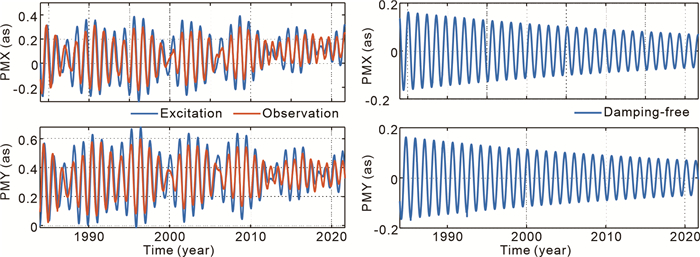
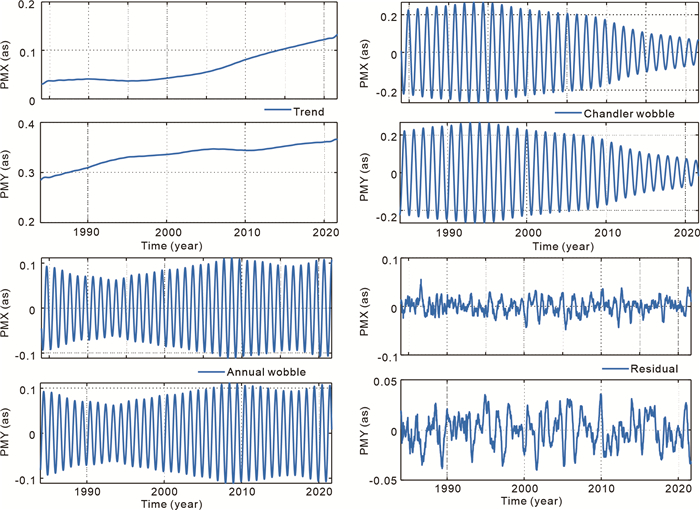
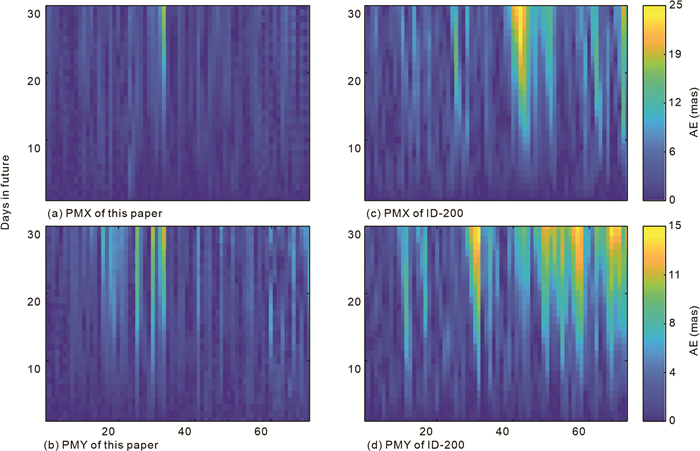
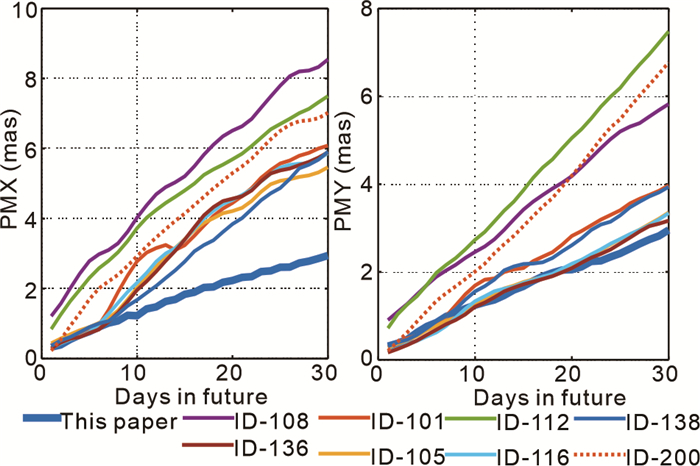
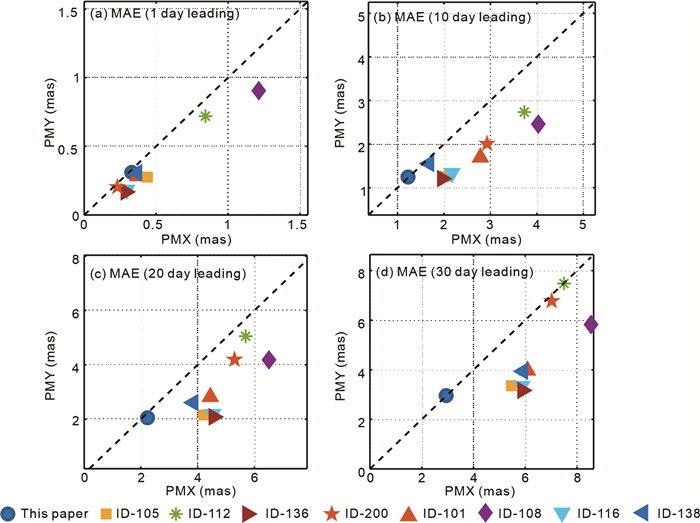
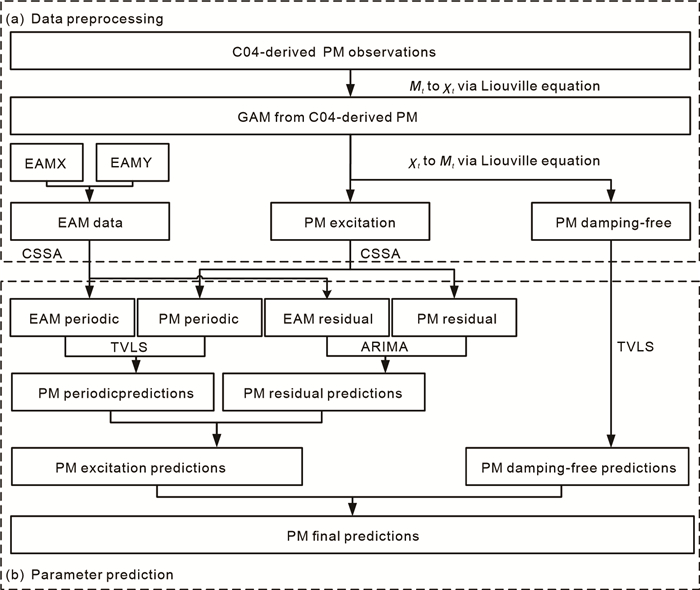
Accurate and rapid short-term (up to 30 days in advance) polar motion (PM) predictions are critical for real-time applications like earthquake monitoring and early warning, global navigation satellite system (GNSS) meteorology, etc. Traditional prediction models, such as the least squares (LS) model, primarily rely on empirical periodic signals with constant amplitude and phase for extrapolation. However, due to complicated internal and external geophysical processes, these signals exhibit irregular variations rather than remaining constant, making it challenging for traditional methods to resolve them autonomously, especially in short-term predictions. To address this issue, we propose a method that combines the LS model with time-varying PM characteristics (TVLS) using the Prony method and the autoregressive integrated moving average (ARIMA) model, along with the effective angular momentum (EAM) data, to enhance the accuracy of short-term PM prediction. Compared with the official predictions disseminated by the International Earth Rotation and Reference Systems Service (IERS), the proposed method improves the prediction accuracy of PMX and PMY by up to 60.84% and 56.70%, respectively. Our method also outperforms the LS + AR + EAM forecast models from the Second Earth Orientation Parameters Prediction Comparison Campaign (2nd EOP PCC), ranking first for forecast horizons beyond 7 days for our predicted PMX and 12 days for PMY. The improvement can be attributed to the core feature of the TVLS model, which constructs a model for the main components of the PM periodic signal based on the Prony method, effectively capturing the non-stationary characteristics by addressing amplitude and phase variations. Therefore, we conclude that the proposed method could significantly enhance short-term PM prediction accuracy and has potential applications in the fields such as real-time satellite orbit determination, precise positioning and navigation.

| Chen, W., Chen, Y. F., Ray, J., et al., 2023. Free Decay and Excitation of the Chandler Wobble: Self-Consistent Estimates of the Period and Quality Factor. Journal of Geodesy, 97(4): 36. https://doi.org/10.1007/s00190-023-01727-z |
|
Dick, W., Thaller, D., 2023. IERS Annual Report 2019. Federal Agency for Cartography and Geodesy. |
| Dill, R., Dobslaw, H., 2010. Short-Term Polar Motion Forecasts from Earth System Modeling Data. Journal of Geodesy, 84(9): 529–536. https://doi.org/10.1007/s00190-010-0391-5 |
| Dill, R., Dobslaw, H., Thomas, M., 2019. Improved 90-Day Earth Orientation Predictions from Angular Momentum Forecasts of Atmosphere, Ocean, and Terrestrial Hydrosphere. Journal of Geodesy, 93(3): 287–295. https://doi.org/10.1007/s00190-018-1158-7 |
| Fomel, S., 2013. Seismic Data Decomposition into Spectral Components Using Regularized Nonstationary Autoregression. Geophysics, 78(6): O69–O76. https://doi.org/10.1190/geo2013-0221.1 |
|
Georgescu, V., Delureanu, S. M., 2015. Fuzzy-Valued and Complex-Valued Time Series Analysis Using Multivariate and Complex Extensions to Singular Spectrum Analysis. 2015 IEEE International Conference on Fuzzy Systems (FUZZ-IEEE). August 2–5, 2015, Istanbul. |
| Guessoum, S., Belda, S., Modiri, S., et al., 2025. Joint Short-Term Prediction of Polar Motion and Length of Day with Multi-Task Deep Learning Methods. Earth, Planets and Space, 77(1): 25. https://doi.org/10.1186/s40623-025-02150-8 |
| Jin, X., Liu, X., Guo, J. Y., et al., 2021. Analysis and Prediction of Polar Motion Using MSSA Method. Earth, Planets and Space, 73(1): 147. https://doi.org/10.1186/s40623-021-01477-2 |
| Kehm, A., Hellmers, H., Bloßfeld, M., et al., 2023. Combination Strategy for Consistent Final, Rapid and Predicted Earth Rotation Parameters. Journal of Geodesy, 97(1): 3. https://doi.org/10.1007/s00190-022-01695-w |
| Kong, Q. L., Han, J. W., Wu, Y. W., et al., 2023. High-Precision Polar Motion Prediction Using EOP20-C04 and EAM Based on CSLS+AR and CSLS + LSTM Methods. Geophysical Journal International, 235(2): 1658–1670.https://doi.org/10.1093/gji/gga d317 doi: 10.1093/gji/ggad317 |
| Kosek, W., 2002. Autocovariance Prediction of Complex-Valued Polar Motion Time Series. Advances in Space Research, 30(2): 375–380. https://doi.org/10.1016/s0273-1177(02)00310-1 |
| Kosek, W., McCarthy, D. D., Luzum, B. J., 1998. Possible Improvement of Earth Orientation Forecast Using Autocovariance Prediction Procedures. Journal of Geodesy, 72(4): 189–199. https://doi.org/10.1007/s001900050160 |
| Kur, T., Dobslaw, H., Śliwińska, J., et al., 2022. Evaluation of Selected Short-Term Predictions of UT1-UTC and LOD Collected in the Second Earth Orientation Parameters Prediction Comparison Campaign. Earth, Planets and Space, 74(1): 191. https://doi.org/10.1186/s40623-022-01753-9 |
| Kur, T., Śliwińska-Bronowicz, J., Wińska, M., et al., 2024. Prospects of Predicting the Polar Motion Based on the Results of the Second Earth Orientation Parameters Prediction Comparison Campaign. Earth and Space Science, 11(11): e2023EA003278. https://doi.org/10.1029/2023ea003278 |
| Modiri, S., Belda, S., Heinkelmann, R., et al., 2018. Polar Motion Prediction Using the Combination of SSA and Copula-Based Analysis. Earth, Planets and Space, 70(1): 115. https://doi.org/10.1186/s40623-018-0888-3 |
| Niedzielski, T., Kosek, W., 2008. Prediction of UT1-UTC, LOD and AAM Χ3 by Combination of Least-Squares and Multivariate Stochastic Methods. Journal of Geodesy, 82(2): 83–92. https://doi.org/10.1007/s00190-007-0158-9 |
| Petit, G., Luzum, B., 2010. IERS Conventions 2010. Verlag des Bundesamtes für Kartographie und Geodäsie, Frankfurt am Main |
| Schuh, H., Ulrich, M., Egger, D., et al., 2002. Prediction of Earth Orientation Parameters by Artificial Neural Networks. Journal of Geodesy, 76(5): 247–258. https://doi.org/10.1007/s00190-001-0242-5 |
| Seitz, F., Schuh, H., 2010. Earth Rotation. In: Xu, G. C., ed., Sciences of Geodesy-I: Advances and Future Directions. Springer Berlin Heidelberg, Berlin, Heidelberg |
| Shen, Y., Guo, J. Y., Liu, X., et al., 2018. Long-Term Prediction of Polar Motion Using a Combined SSA and ARMA Model. Journal of Geodesy, 92(3): 333–343. https://doi.org/10.1007/s00190-017-1065-3 |
| Shen, Y., Guo, J. Y., Liu, X., et al., 2017. One Hybrid Model Combining Singular Spectrum Analysis and LS+ARMA for Polar Motion Prediction. Advances in Space Research, 59(2): 513–523. https://doi.org/10.1016/j.asr.2016.10.023 |
| Shi, K. P., Ding, H., 2023. Hankel Spectrum Analysis: A Decomposition Method for Quasi-Periodic Signals and Its Geophysical Applications. Journal of Geophysical Research: Solid Earth, 128(3): e2023JB026438.https://doi.org/10.1029/20 23jb026438 doi: 10.1029/2023jb026438 |
| Śliwińska-Bronowicz, J., Kur, T., Wińska, M., et al., 2024. Assessment of Length-of-Day and Universal Time Predictions Based on the Results of the Second Earth Orientation Parameters Prediction Comparison Campaign. Journal of Geodesy, 98(3): 22. https://doi.org/10.1007/s00190-024-01824-7 |
| Śliwińska-Bronowicz, J., Kur, T., Wińska, M., et al., 2022. Second Earth Orientation Parameters Prediction Comparison Campaign (2nd EOP PCC): Overview. Artificial Satellites, 57(s1): 237–253. https://doi.org/10.2478/arsa-2022-0021 |
|
Śliwińska-Bronowicz, J., Nastula, J., Kur, T., et al., 2025. Second Earth Orientation Parameters Prediction Comparison Campaign. IERS Technical Note No. 42. Verlag des Bundesamts für Kartographie und Geodäsie 152. Frankfurt am Main. |
| Su, X. Q., Liu, L. T., Houtse, H., et al., 2014. Long-Term Polar Motion Prediction Using Normal Time-Frequency Transform. Journal of Geodesy, 88(2): 145–155. https://doi.org/10.1007/s00190-013-0675-7 |
| Trudnowski, D. J., Johnson, J. M., Hauer, J. F., 1999. Making Prony Analysis More Accurate Using Multiple Signals. IEEE Transactions on Power Systems, 14(1): 226–231.https://ieeexplore.ieee.org/document/744537 https://ieeexplore.ieee.org/document/744537 |
| Wang, L., Miao, W., Wu, F., 2023a. A New Medium-Long Term Polar Motion Prediction Method Based on Sliding Average within Difference Series. Measurement Science and Technology, 34(10): 105023.https://iopscience.iop.org/article/10.1088/1361-6501/ace5c1 doi: 10.1088/1361-6501/ace5c1 |
| Wang, L. Y., Miao, W., Wu, F., et al., 2023b. Medium-Short-Term Prediction of Polar Motion Combining the Differencing between Series with the Differencing within Series Free. Geophysical Journal International, 235(1): 109–118. https://doi.org/10.1093/gji/ggad213 |
| Wang, L., Que, H., Wu, F., 2025. The CNN-LSTM-Attention Model for Short Term Prediction of the Polar Motion. Measurement Science and Technology, 36(1): 016323. https://iopscience.iop.org/article/10.1088/1361-6501/ad8be5 doi: 10.1088/1361-6501/ad8be5 |
| Wilson, C. R., 1985. Discrete Polar Motion Equations. Geophysical Journal of the Royal Astronomical Society, 80(2): 551–554. https://doi.org/10.1111/j.1365-246x.1985.tb05109.x |
| Wilson, C. R., Haubrich, R. A., 1976. Meteorological Excitation of the Earth’s Wobble Free. Geophysical Journal International, 46(3): 707–743. https://doi.org/10.1111/j.1365-246x.1976.tb01254.x |
| Wu, F., Chang, G. B., Deng, K. Z., et al., 2019. Selecting Data for Autoregressive Modeling in Polar Motion Prediction. Acta Geodaetica et Geophysica, 54(4): 557–566.https://doi.org/10.1 007/s40328-019-00271-7 doi: 10.1007/s40328-019-00271-7 |
| Wu, Y. W., Zhao, X., Yang, X. Y., 2022. Improved Prediction of Polar Motions by Piecewise Parameterization. Artificial Satellites, 57(s1): 290–299. https://doi.org/10.2478/arsa-2022-0025 |
| Xu, C. C., Huang, C. L., Zhou, Y. H., et al., 2024. A New Approach to Improve the Earth’s Polar Motion Prediction: On the Deconvolution and Convolution Methods. Journal of Geodesy, 98(11): 92. https://doi.org/10.1007/s00190-024-01890-x |
| Xu, X. Q., Zhou, Y. H., Liao, X. H., 2012. Short-Term Earth Orientation Parameters Predictions by Combination of the Least-Squares, AR Model and Kalman Filter. Journal of Geodynamics, 62: 83–86. https://doi.org/10.1016/j.jog.2011.12.001 |
| Xu, X. Q., Zhou, Y. H., Xu, C. C., 2022. Earth Rotation Parameters Prediction and Climate Change Indicators in It. Artificial Satellites, 57(s1): 262–273. https://doi.org/10.2478/arsa-2022-0023 |
| Yu, K. H., Shi, H. W., Sun, M. Q., et al., 2024. Combined BiLSTM and ARIMA Models in Middle- and Long-Term Polar Motion Prediction. Studia Geophysica et Geodaetica, 68(1): 25–40. https://doi.org/10.1007/s11200-023-0134-y |
| Yu, K. H., Wang, X. Y., Li, Z., et al., 2025. Near Real-Time LOD Prediction Using ConvLSTM Model through Integrating IGS Rapid LOD and Effective Angular Momentum. Geo-spatial Information Science, 1–15.https://doi.org/10.1080/10095020.20 25.2471432 doi: 10.1080/10095020.2025.2471432 |
| Yu, K. H., Yang, K., Shen, T. H., et al., 2023. Estimation of Earth Rotation Parameters and Prediction of Polar Motion Using Hybrid CNN-LSTM Model. Remote Sensing, 15(2): 427. https://doi.org/10.3390/rs15020427 |
| Zajdel, R., Sośnica, K., Bury, G., et al., 2020. Sub-Daily Polar Motion from GPS, GLONASS, and Galileo. Journal of Geodesy, 95(1): 3. https://doi.org/10.1007/s00190-020-01453-w |
| Zhao, D. N., Lei, Y., 2019. Possible Enhancement of Earth’s Polar Motion Predictions Using a Wavelet-Based Preprocessing Procedure. Studia Geophysica et Geodaetica, 63(1): 83–94. https://doi.org/10.1007/s11200-018-1026-1 |
| Zygarlicki, J., Mroczka, J., 2012. Variable-Frequency Prony Method in the Analysis of Electrical Power Quality. Metrology and Measurement Systems, 19(1): 39–48.https://doi.org/10.2478/v1 0178-012-0003-1 doi: 10.2478/v10178-012-0003-1 |
Figures(6) / Tables(2)
Copyright © 2013-2020 Journal of Earth Science 鄂ICP备15021562号-2
Tel: +86-27-67885075 Fax: +86-27-67885075 E-mail: xbb@cug.edu.cn
Address: Editorial Office of Journal, China University of Geosciences, Yujiashan, Wuhan, Hubei 430074, P. R. China
Supported by:
Beijing Renhe Information Technology Co. Ltd
E-mail:
info@rhhz.net



 DownLoad: