| Citation: | Chengxin Jiang, Caixiang Zhang, Fenfei Gao, Mingang Zhu. Environmental Geochemistry of Electrolytic Manganese Slag Ponds in Karst Regions. Journal of Earth Science, 2026, 37(1): 229-240. doi: 10.1007/s12583-026-0503-7

|
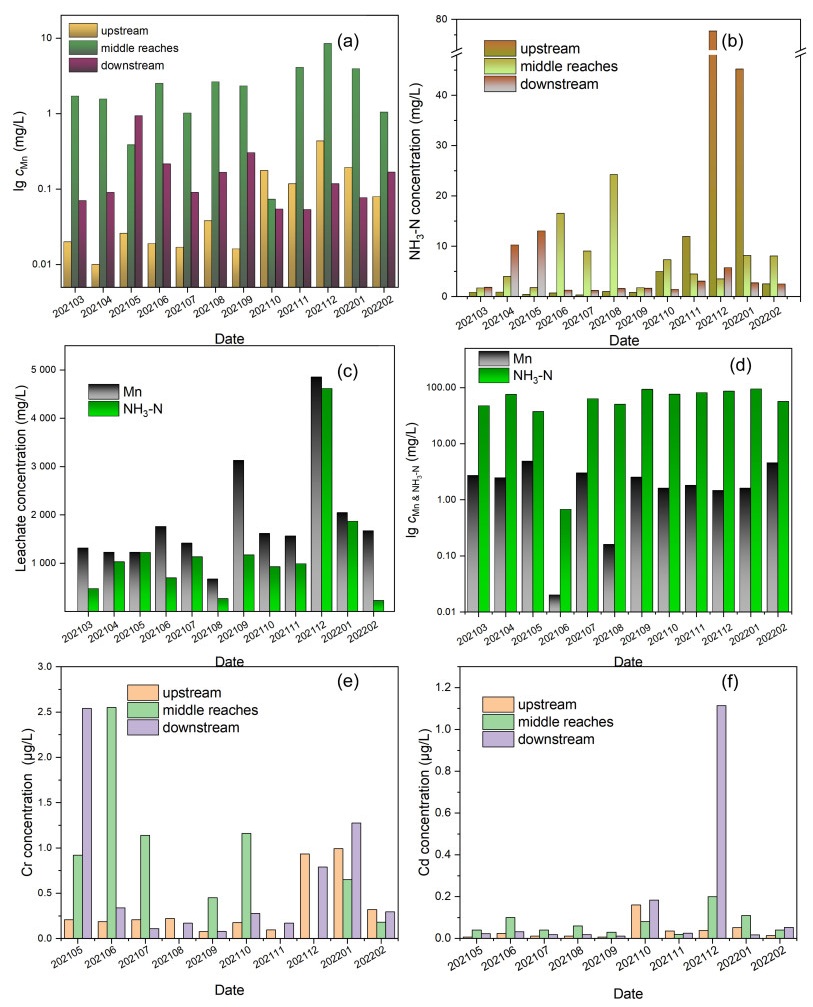
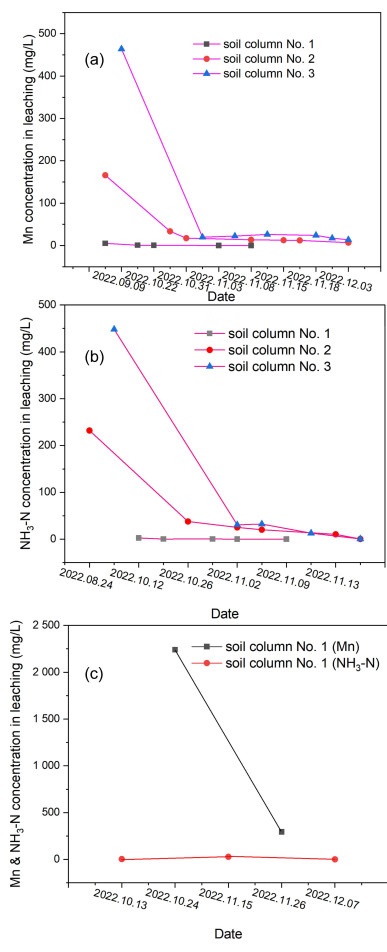
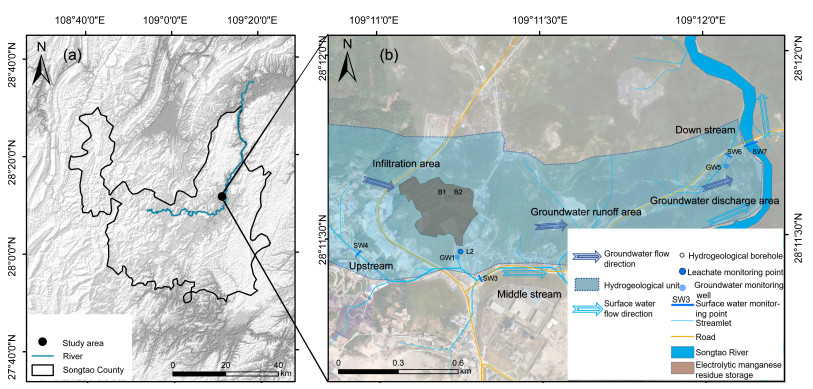
Leakage of electrolytic manganese slag (EMS) ponds is a long-lasting and serious threat to environmental health worldwide, particularly in karst areas where the ecosystems are highly sensitive to geochemical perturbations. However, the mechanisms of Mn mobilization and migration are insufficiently known. In this study, we combine systematic field investigations, laboratory column experiments and geochemical analyses to clarify the environmental geochemistry and controlling factors of leaching of Mn in the karst areas of southwestern China. While the Mn slag ponds as a whole had shown a low permeability, release of free Mn2+ and NH3-N is significantly facilitated by the synergies of seepage infiltration, microbial activities and environmental acidification. With the increase of depth, the mineralogical composition of the slag undergoes significant alteration, and redox conditions change from acidic-oxidizing to acidic-reducing environments, which will accelerate the mobilization of Mn further and increase the risk of groundwater contamination. In addition, the presence of clay mineral colloids in Mn slag changes the migration properties of Mn, which introduces complexity in the geochemical behavior of Mn. Our findings highlight that Mn transformation and migration are controlled by dynamic, depth-dependent geochemical processes and the interplay of both internal and external factors. This research consolidates mechanistic foundation of deciphering Mn environmental behaviors in karst regions, reinforcing the urgency of preventing and rehabilitating electrolytic Mn slag leakage.

| An, R., Liu, J. T., Gao, Z. J., et al., 2024. Hydrochemical Characterization, Controlling Factors and Water Quality of Surface Water in Shandong Province, North China. Journal of Earth Science, 35(1): 155–166. https://doi.org/10.1007/s12583-021-1441-z |
| Bai, J., Yuan, Z. J., Su, X. S., 2024. Spatiotemporal Distribution Patterns of Iron, Manganese, and Arsenic within the River Infiltration Zone and the Potential Geochemical Activity at Key Interfaces. Applied Geochemistry, 172: 106123. https://doi.org/10.1016/j.apgeochem.2024.106123 |
| Bhoja, S. K., Tripathy, S. K., Murthy, Y. R., et al., 2021. Influence of Mineralogy on the Dry Magnetic Separation of Ferruginous Manganese Ore—A Comparative Study. Minerals, 11(2): 150–170. https://doi.org/10.3390/min11020150 |
| Cao, J. B., Li, X. M., Ouyang, Y. Z., et al., 2012. Manganese-Electrolysed Slag Treatment: Bioleaching of Manganese by Fusarium Sp. Environmental Technology, 33(11): 1307–1312. https://doi.org/10.1080/09593330.2011.624125 |
| Chen, H. L., Long, Q., Zhang, Y. T., et al., 2019. Simultaneous Immobilization of NH4+ and Mn2+ from Electrolytic Manganese Residue Using Phosphate and Magnesium Sources. RSC Advances, 9(8): 4583–4590. https://doi.org/10.1039/C8RA09615E |
| Chen, Y. X., Long, J. Y., Chen, S. H., et al., 2022. Multi-Step Purification of Electrolytic Manganese Residue Leachate Using Hydroxide Sedimentation, Struvite Precipitation, Chlorination and Coagulation: Advanced Removal of Manganese, Ammonium, and Phosphate. Science of the Total Environment, 805: 150237. https://doi.org/10.1016/j.scitotenv.2021.150237 |
| Dan, Z. G., Zhang, Y. T., Cai, J. H., et al., 2016. Reductive Leaching of Manganese from Manganese Dioxide Ores by Bacterial-Catalyzed Two-Ores Method. International Journal of Mineral Processing, 150: 24–31. https://doi.org/10.1016/j.minpro.2016.03.007 |
| Fu, X. X., Xiao, X., Tan, D. Y., et al., 2024. Heavy Metal Pollution of Soils around an Electrolytic Manganese Waste Residue Storage: Characteristics and Evaluation. Environmental Science & Technology, 47(3): 179–191. https://doi.org/10.19672/j.cnki.1003-6504.2268.23.338 (in Chinese with English Abstract) |
| Gavrilescu, M., 2022. Enhancing Phytoremediation of Soils Polluted with Heavy Metals. Current Opinion in Biotechnology, 74: 21–31. https://doi.org/10.1016/j.copbio.2021.10.024 |
| Han, F. L., Wu, L. E., 2019. Resource Utilization of Electrolytic Manganese Residues. Industrial Solid Waste Recycling in Western China. Springer Singapore, Singapore. 127–164. https://doi.org/10.1007/978-981-13-8086-0_3 |
| He, D. J., Shu, J. C., Wang, R., et al., 2021. A Critical Review on Approaches for Electrolytic Manganese Residue Treatment and Disposal Technology: Reduction, Pretreatment, and Reuse. Journal of Hazardous Materials, 418: 126235. https://doi.org/10.1016/j.jhazmat.2021.126235 |
| He, D. J., Shu, J. C., Zeng, X. F., et al., 2022. Synergistic Solidification/Stabilization of Electrolytic Manganese Residue and Carbide Slag. Science of the Total Environment, 810: 152175. https://doi.org/10.1016/j.scitotenv.2021.152175 |
| Huang, Z. N., Tang, Y. K., Zhang, K. X., et al., 2016. Environmental Risk Assessment of Manganese and Its Associated Heavy Metals in a Stream Impacted by Manganese Mining in South China. Human and Ecological Risk Assessment: An International Journal, 22(6): 1341–1358. https://doi.org/10.1080/10807039.2016.1169915 |
| Jiang, L., Tang, Y. K., Lu, Y. Y., et al., 2024. In situ Phytoextraction of Mn and NH4+-N from Aqueous Electrolytic Manganese Residue Solution by Pistia Stratiotes: Effects of Fe/Co Presence and Rhizospheric Microbe Synergistic Involvement. Environmental Pollution, 355: 124177. https://doi.org/10.1016/j.envpol.2024.124177 |
| Johnson, D. B., 2013. Development and Application of Biotechnologies in the Metal Mining Industry. Environmental Science and Pollution Research, 20(11): 7768–7776. https://doi.org/10.1007/s11356-013-1482-7 |
| Lan, J. R., Dong, Y. Q., Xiang, Y. W., et al., 2021a. Selective Recovery of Manganese from Electrolytic Manganese Residue by Using Water as Extractant under Mechanochemical Ball Grinding: Mechanism and Kinetics. Journal of Hazardous Materials, 415: 125556. https://doi.org/10.1016/j.jhazmat.2021.125556 |
| Lan, J. R., Sun, Y., Chen, X. H., et al., 2021b. Bio-Leaching of Manganese from Electrolytic Manganese Slag by Microbacterium trichothecenolyticum Y1: Mechanism and Characteristics of Microbial Metabolites. Bioresource Technology, 319: 124056. https://doi.org/10.1016/j.biortech.2020.124056 |
| Lan, J. R., Sun, Y., Guo, L., et al., 2019. Highly Efficient Removal of As(Ⅴ) with Modified Electrolytic Manganese Residues (M-EMRs) as a Novel Adsorbent. Journal of Alloys and Compounds, 811: 151973. https://doi.org/10.1016/j.jallcom.2019.151973 |
| Li, C. X., Zhong, H., Wang, S., et al., 2014. Leaching Behavior and Risk Assessment of Heavy Metals in a Landfill of Electrolytic Manganese Residue in Western Hunan, China. Human and Ecological Risk Assessment: An International Journal, 20(5): 1249–1263. https://doi.org/10.1080/10807039.2013.849482 |
| Liu, K. H., Zhang, H. C., Liu, Y. F., et al., 2020. Investigation of Plant Species and Their Heavy Metal Accumulation in Manganese Mine Tailings in Pingle Mn Mine, China. Environmental Science and Pollution Research, 27(16): 19933–19945. https://doi.org/10.1007/s11356-020-08514-9 |
| Lu, R. J., Fu, J., Wang, C. C., et al., 2023. Research Progress on the Characteristics of Heavy Metal Transfer and Transformation in Municipal Sludge Mreatment. Journal of Environmental Engineering Technology, 13(1): 318–324. https://doi.org/10.12153/j.issn.1674-991X.20210762 (in Chinese with English Abstract) |
| Luo, M. M., Chen, Z. H., Yin, D. C., et al., 2016. Surface Flood and Underground Flood in Xiangxi River Karst Basin: Characteristics, Models, and Comparisons. Journal of Earth Science, 27(1): 15–21. https://doi.org/10.1007/s12583-016-0624-5 |
| Ning, D., Dan, Z. G., Wang, F., et al., 2011. Electrolytic Manganese Metal Industry Experience Based China's New Model for Cleaner Production Promotion. Journal of Cleaner Production, 19(17/18): 2082–2087. https://doi.org/10.1016/j.jclepro.2011.06.024 |
| Ning, D., Wang, F., Zhou, C. B., et al., 2010. Analysis of Pollution Materials Generated from Electrolytic Manganese Industries in China. Resources, Conservation and Recycling, 54(8): 506–511. https://doi.org/10.1016/j.resconrec.2009.10.007 |
| Nong, H. J., Liu, J., Chen, J. Z., et al., 2023. Woody Plants Have the Advantages in the Phytoremediation Process of Manganese Ore with the Help of Microorganisms. Science of the Total Environment, 863: 160995. https://doi.org/10.1016/j.scitotenv.2022.160995 |
| Peng, T. F., Xu, L. J., Chen, H. C., 2010. Preparation and Characterization of High Specific Surface Area Mn3O4 from Electrolytic Manganese Residue. Central European Journal of Chemistry, 8(5): 1059–1068. https://doi.org/10.2478/s11532-010-0081-4 |
| Rao, D. D., Sun, B., Qiao, J. L., et al., 2017. The Properties, Generation and Environmental Significance of Mn(Ⅲ). Progress in Chemistry, 29(9): 1142–1153. https://doi.org/10.7536/PC170437 (in Chinese with English Abstract) |
| Ribeiro, R. A., Giannini, T. C., Gastauer, M., et al., 2018. Topsoil Application during the Rehabilitation of a Manganese Tailing Dam Increases Plant Taxonomic, Phylogenetic and Functional Diversity. Journal of Environmental Management, 227: 386–394. https://doi.org/10.1016/j.jenvman.2018.08.060 |
| Rosado, D., Usero, J., Morillo, J., 2016. Ability of 3 Extraction Methods (BCR, Tessier and Protease K) to Estimate Bioavailable Metals in Sediments from Huelva Estuary (Southwestern Spain). Marine Pollution Bulletin, 102(1): 65–71. https://doi.org/10.1016/j.marpolbul.2015.11.057 |
| Shi, Y. Y., Long, G. C., Wang, F., et al., 2023. Innovative Co-Treatment Technology for Effective Disposal of Electrolytic Manganese Residue. Environmental Pollution, 335: 122234. https://doi.org/10.1016/j.envpol.2023.122234 |
| Shu, J. C., Zeng, X. F., Sun, D. Y., et al., 2022. Enhanced Mn2+ Solidification and NH4+-N Removal from Electrolytic Manganese Metal Residue via Surfactants. Chinese Journal of Chemical Engineering, 49: 205–212. https://doi.org/10.1016/j.cjche.2021.08.003 |
| Sorensen, B., Gaal, S., Ringdalen, E., et al., 2010. Phase Compositions of Manganese Ores and Their Change in the Process of Calcination. International Journal of Mineral Processing, 94(3/4): 101–110. https://doi.org/10.1016/j.minpro.2010.01.001 |
| Tao, C. Y., Li, M. Y., Liu, Z. H., et al., 2009. Composition and Recovery Method for Electrolytic Manganese Residue. Journal of Central South University of Technology (English Edition), 16(s1): 309–312 |
| Velusamy, K., Periyasamy, S., Kumar, P. S., et al., 2021. Advanced Techniques to Remove Phosphates and Nitrates from Waters: A Review. Environmental Chemistry Letters, 19(4): 3165–3180. https://doi.org/10.1007/s10311-021-01239-2 |
| Veress, M., 2020. Karst Types and Their Karstification. Journal of Earth Science, 31(3): 621–634. https://doi.org/10.1007/s12583-020-1306-x |
| Wang, F., Long, G. C., Bai, M., et al., 2022. Application of Electrolytic Manganese Residues in Cement Products through Pozzolanic Activity Motivation and Calcination. Journal of Cleaner Production, 338: 130629. https://doi.org/10.1016/j.jclepro.2022.130629 |
| Wang, F., Long, G. C., Ma, K. L., et al., 2023. Recyling Manganese-Rich Electrolytic Residues: A Review. Environmental Chemistry Letters, 21(4): 2251–2284. https://doi.org/10.1007/s10311-023-01595-1 |
| Wang, J., Cheng, Q. Y., Xue, S. G., et al., 2018. Pollution Characteristics of Surface Runoff under Different Restoration Types in Manganese Tailing Wasteland. Environmental Science and Pollution Research, 25(10): 9998–10005. https://doi.org/10.1007/s11356-018-1338-2 |
| Wang, R. F., Yuan, S., Liu, Y. Z., et al., 2023. Present Situation of Global Manganese Ore Resources and Progress of Beneficiation Technology. Conservation Utilization of Mineral Resources, 43: 14–23. https://doi.org/10.13779/j.cnki.issn1001-0076.2023.01.001 (in Chinese with English Abstract) |
| Wang, W. J., Chu, J. L., Cui, H., et al., 2023. Groundwater Environmental Pollution Characteristics and Pollution Control of Electrolytic Manganese Slag Storage in Karst Mountainous Areas. Mining & Metallurgy, 32(4): 110–118. https://doi.org/10.9369/j.issn.1005-7854.2023.04.017 (in Chinese with English Abstract) |
| Xiu, W., Lloyd, J., Guo, H. M., et al., 2020. Linking Microbial Community Composition to Hydrogeochemistry in the Western Hetao Basin: Potential Importance of Ammonium as an Electron Donor during Arsenic Mobilization. Environment International, 136: 105489. https://doi.org/10.1016/j.envint.2020.105489 |
| Zhang, W. S., Jiao, Y. Y., Zhang, G. H., et al., 2022. Analysis of the Mechanism of Water Inrush Geohazards in Deep-Buried Tunnels under the Complex Geological Environment of Karst Cave-Fractured Zone. Journal of Earth Science, 33(5): 1204–1218. https://doi.org/10.1007/s12583-022-1619-z |
| Zhang, Y. T., Dan, Z. G., He, X. Y., et al., 2017. Mn Bio-Dissolution from Low-Grade MnO2 Ore and Simultaneous Fe Precipitation in Presence of Waste Electrolytic Manganese Anolyte as Nitrogen Source and Iron Scavenger. Journal of Cleaner Production, 158: 182–191. https://doi.org/10.1016/j.jclepro.2017.04.129 |
| Zheng, F., Zhu, H., Luo, T., et al., 2020. Pure Water Leaching Soluble Manganese from Electrolytic Manganese Residue: Leaching Kinetics Model Analysis and Characterization. Journal of Environmental Chemical Engineering, 8(4): 103916. https://doi.org/10.1016/j.jece.2020.103916 |
| Zhu, E. Y., Geng, Y., Xiao, S. J., et al., 2024. Mapping the Evolution of Manganese Flows and Stocks in China from 2000 to 2021. Resources, Environment and Sustainability, 16: 100152.https://doi.org/10.1016/j.resenv.2024.100152 |
| Zhu, Y. G., Zhai, Y. Z., Teng, Y. G., et al., 2020. Water Supply Safety of Riverbank Filtration Wells under the Impact of Surface Water-Groundwater Interaction: Evidence from Long-Term Field Pumping Tests. Science of the Total Environment, 711: 135141. https://doi.org/10.1016/j.scitotenv.2019.135141 |
| Zhu, Z., Wang, J. X., Hu, M. G., et al., 2019. Geographical Detection of Groundwater Pollution Vulnerability and Hazard in Karst Areas of Guangxi Province, China. Environmental Pollution, 245: 627–633. https://doi.org/10.1016/j.envpol.2018.10.017 |
Figures(3) / Tables(1)
Copyright © 2013-2020 Journal of Earth Science 鄂ICP备15021562号-2
Tel: +86-27-67885075 Fax: +86-27-67885075 E-mail: xbb@cug.edu.cn
Address: Editorial Office of Journal, China University of Geosciences, Yujiashan, Wuhan, Hubei 430074, P. R. China
Supported by:
Beijing Renhe Information Technology Co. Ltd
E-mail:
info@rhhz.net


 DownLoad: