| Citation: | Ke Zhang, Haikuan Nie, Songhang Zhang, Tianwu Xu, Zhujiang Liu, Chuanxiang Sun, Chengxiang Wan, Wei Dang, Pei Li, Jia Rong, Shuheng Tang. Differential Enrichment of Deep Shale Gas in Southeastern Sichuan Basin: Dynamic Evolution and Preservation Mechanisms. Journal of Earth Science, 2026, 37(4): 1676-1695. doi: 10.1007/s12583-026-0505-5

|
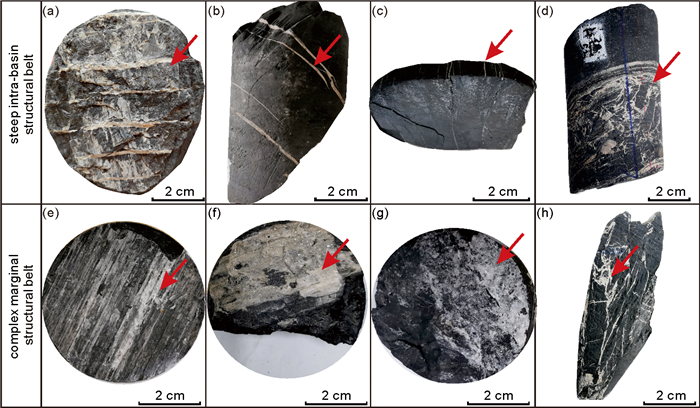
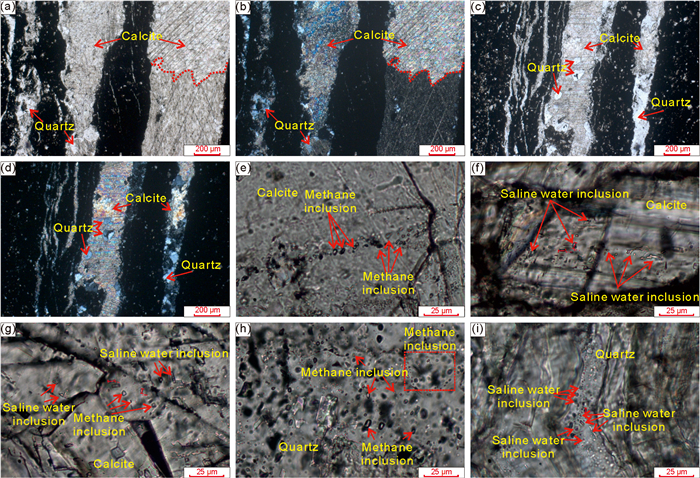
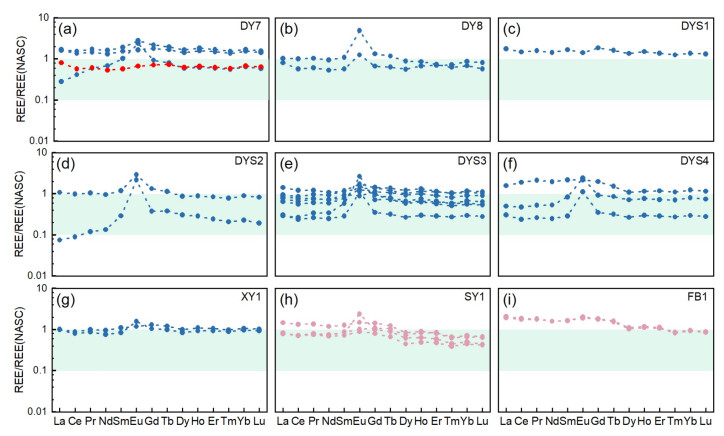
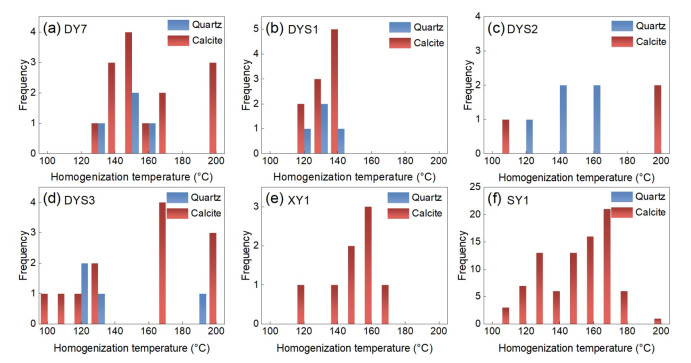
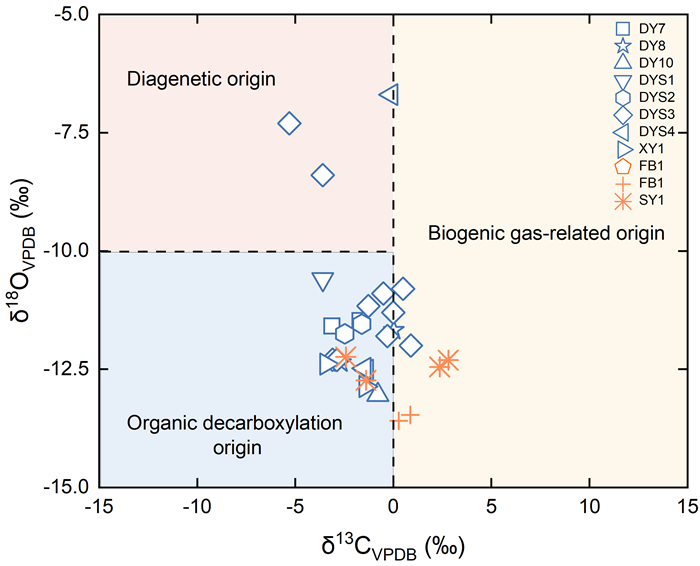
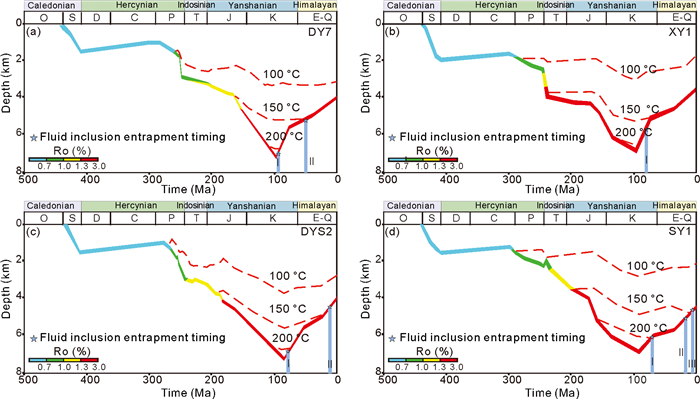
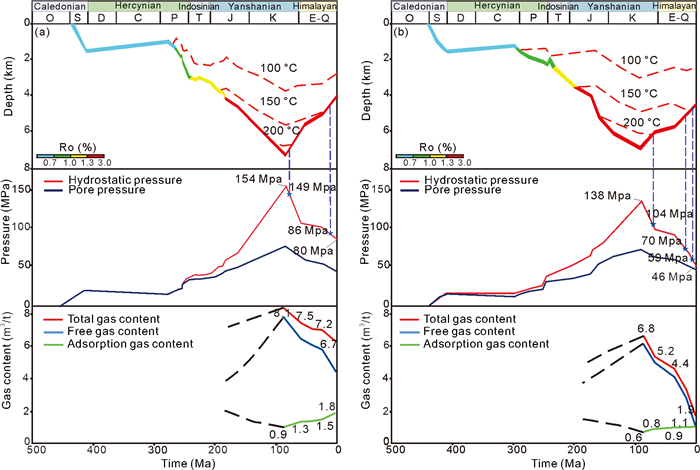
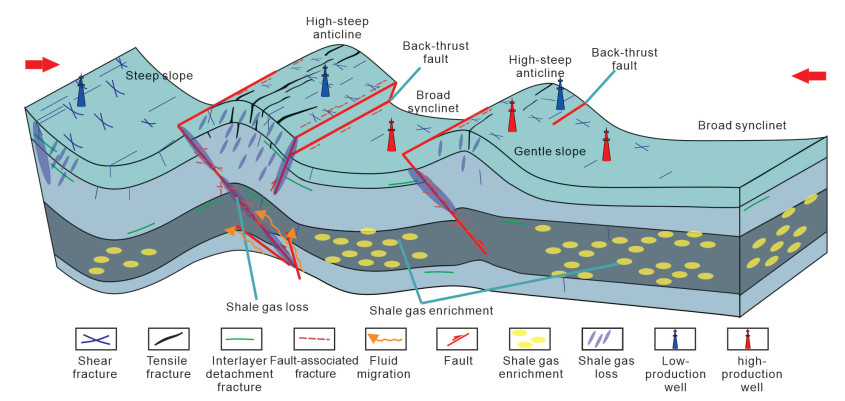
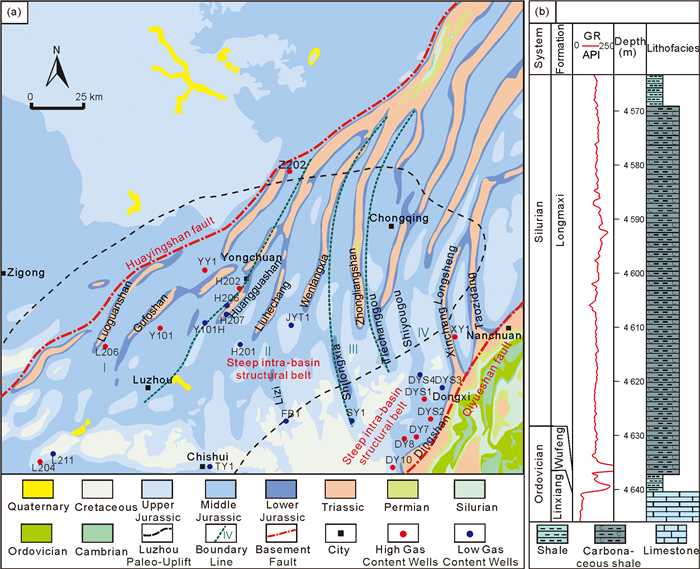
Significant heterogeneity in deep shale gas enrichment is observed within the Wufeng-Longmaxi formations in southeastern Sichuan, yet the dynamic evolution processes and mechanisms driving differential enrichment remain unclear. This study focuses on the complex marginal structural belt (Dongxi, Dingshan, Xinchang) and the steep intra-basin structural belt (Shilongxia, Lizi), and investigates the mechanisms of deep shale gas enrichment based on analyses of vein types, carbon and oxygen isotopes, rare earth elements, and fluid inclusion homogenization temperatures, integrated with basin modeling. The results show that: (1) Vein characteristics reflect differences in gas preservation conditions. Fracture-filling veins are mainly composed of calcite and quartz, formed during the Late Cretaceous to Miocene (10–95 Ma). In the intra-basin high-steep anticlines, veins are associated with hydrothermal and meteoric water origins, and exhibit wide homogenization temperature ranges and three phases of fluid activity, indicating poor gas preservation. In contrast, the marginal zones are dominated by veins derived from in situ formation fluids, show narrower homogenization temperature ranges, and experienced fewer fluid events (1–2 phases), suggesting favorable preservation conditions. (2) Fracture-fluid interactions dominate reservoir evolution. At maximum burial depth, deep shale reservoirs in the Wufeng-Longmaxi formations were strongly overpressured (pressure coefficient > 2.0) and had high gas contents (> 6 m3/t). In the intra-basin high-steep structures, repeated opening and closure of high-angle fractures during the Yanshanian–Himalayan uplift led to rapid gas loss from the Late Cretaceous to Oligocene, resulting in present-day gas content below 2 m3/t, whereas marginal fault-bend anticlines with weak high-angle fracture development retained overpressure (pressure coefficient > 1.8), and current gas contents remain above 6 m3/t. (3) Structural style controls differential enrichment. In areas of structural superposition between the Luzhou paleo-uplift and the southern Sichuan finger-like structures (Lizi, Shilongxia), significant stratigraphic shortening and the development of back-thrust and strike-slip faults led to severe reservoir damage. In contrast, marginal fault-bend anticlines experienced less shortening and weaker deformation; regions without back-thrust faults retained higher gas contents. Favorable enrichment zones are identified in fault-bend anticlines without back-thrusts and in slope or syncline areas far from high-steep or strike-slip fault zones. These findings provide theoretical support for targeted exploration and efficient development of deep shale gas resources in the Sichuan Basin.

| Bau, M., 1991. Rare-Earth Element Mobility during Hydrothermal and Metamorphic Fluid-Rock Interaction and the Significance of the Oxidation State of Europium. Chemical Geology, 93(3/4): 219–230. https://doi.org/10.1016/0009-2541(91)90115-8 |
| Bodnar, R. J., 1993. Revised Equation and Table for Determining the Freezing Point Depression of H2O-NaCl Solutions. Geochimica et Cosmochimica Acta, 57(3): 683–684. https://doi.org/10.1016/0016-7037(93)90378-a |
| Cao, Y., Xu, Q., Zheng, J. F., et al., 2023. Two Stages of Late Cretaceous to Neogene Deformation of the Huayingshan Tectonic Belt, Eastern Sichuan Basin, SW China. Journal of Asian Earth Sciences, 255: 105779. https://doi.org/10.1016/j.jseaes.2023.105779 |
| Cui, Y., Li, X. Z., Guo, W., et al., 2023. Enlightenment of Calcite Veins in Deep Ordovician Wufeng-Silurian Longmaxi Shales Fractures to Migration and Enrichment of Shale Gas in Southern Sichuan Basin, SW China. Petroleum Exploration and Development, 50(6): 1374–1385. https://doi.org/10.1016/s1876-3804(24)60473-8 |
| Dang, W., Zhang, J. C., Nie, H. K., et al., 2020. Isotherms, Thermodynamics and Kinetics of Methane-Shale Adsorption Pair under Supercritical Condition: Implications for Understanding the Nature of Shale Gas Adsorption Process. Chemical Engineering Journal, 383: 123191. https://doi.org/10.1016/j.cej.2019.123191 |
| Du, X., Jin, Z., Zeng, L., et al., 2024. Development Model of Natural Fractures in Continental Shale of the Pingdiquan Formation in the Shuangjingzi Area, Eastern Junggar Basin. Earth Science, 49(9): 3264–3275 (in Chinese with English Abstract) |
| Duan, Z. H., Møller, N., Weare, J. H., 1992. An Equation of State for the CH4-CO2-H2O System: Ⅱ. Mixtures from 50 to 1 000 ℃ and 0 to 1 000 bar. Geochimica et Cosmochimica Acta, 56(7): 2619–2631. https://doi.org/10.1016/0016-7037(92)90348-m |
| Fan, C. H., Nie, S., Li, H., et al., 2024. Quantitative Prediction and Spatial Analysis of Structural Fractures in Deep Shale Gas Reservoirs within Complex Structural Zones: A Case Study of the Longmaxi Formation in the Luzhou Area, Southern Sichuan Basin, China. Journal of Asian Earth Sciences, 263: 106025. https://doi.org/10.1016/j.jseaes.2024.106025 |
| Fan, Q. Q., Liu, D. D., Du, W., et al., 2024a. In situ U-Pb Dating of Carbonate Veins in Cambrian Shales Constrains Fluid Flow and Hydrocarbon Evolution at the Southeastern Margin of the Upper Yangtze Platform, Southwestern China. Geological Society of America Bulletin, 136(7/8): 2875–2890. https://doi.org/10.1130/b36893.1 |
| Fan, Q. Q., Liu, D. D., Xu, M. Y., et al., 2024b. Origin of Calcite Cements in the Permian Lucaogou Formation Tight Reservoirs, Jimsar Sag, Junggar Basin, NW China: Constraints from Geochemistry. Marine and Petroleum Geology, 161: 106675. https://doi.org/10.1016/j.marpetgeo.2023.106675 |
| Gao, J., He, S., Zhao, J. X., et al., 2017. Geothermometry and Geobarometry of Overpressured Lower Paleozoic Gas Shales in the Jiaoshiba Field, Central China: Insight from Fluid Inclusions in Fracture Cements. Marine and Petroleum Geology, 83: 124–139. https://doi.org/10.1016/j.marpetgeo.2017.02.018 |
| Gao, J., He, S., Zhao, J. X., et al., 2020. Sm-Nd Isochron Dating and Geochemical (Rare Earth Elements, 87Sr/86Sr, δ18O, δ13C) Characterization of Calcite Veins in the Jiaoshiba Shale Gas Field, China: Implications for the Mechanisms of Vein Formation in Shale Gas Systems. GSA Bulletin, 132(7/8): 1722–1740. https://doi.org/10.1130/b32015.1 |
| Gao, J., He, S., Yi, J. Z., 2015. Discovery of High Density Methane Inclusions in Jiaoshiba Shale Gas Field and Its Significance. Oil & Gas Geology, 36(3): 472–480 (in Chinese with English Abstract) |
| Gu, Z. D., Wang, X., Nunns, A., et al., 2021. Structural Styles and Evolution of a Thin-Skinned Fold-and-Thrust Belt with Multiple Detachments in the Eastern Sichuan Basin, South China. Journal of Structural Geology, 142: 104191. https://doi.org/10.1016/j.jsg.2020.104191 |
| Guo, X. S., Hu, D. F., Li, Y. P., et al., 2017. Geological Factors Controlling Shale Gas Enrichment and High Production in Fuling Shale Gas Field. Petroleum Exploration and Development, 44(4): 513–523. https://doi.org/10.1016/s1876-3804(17)30060-5 |
| Guo, X. S., Hu, Z. Q., Li, S. J., et al., 2023. Progress and Prospect of Natural Gas Exploration and Research in Deep and Ultra-Deep Strata. Petroleum Science Bulletin, 8(4): 461–474. https://doi.org/10.3969/j.issn.2096-1693.2023.04.035 (in Chinese with English Abstract) |
| Guo, T. L., Xiong, L., Lei, W., et al., 2022. Deep Shale Gas Exploration and Development in the Weirong and Yongchuan Areas, South Sichuan Basin: Progress, Challenges and Prospect. Natural Gas Industry, 42(8): 45–59. https://doi.org/10.3787/j.issn.1000-0976.2022.08.005 (in Chinese with English Abstract) |
| Hansen, S. B., Berg, R. W., 2009. Raman Spectroscopic Studies of Methane Gas Hydrates. Applied Spectroscopy Reviews, 44(2): 168–179. https://doi.org/10.1080/05704920802352614 |
| He, Z. L., Nie, H. K., Zhang, Y. Y., 2016. The Main Factors of Shale Gas Enrichment of Ordovician Wufeng Formation: Silurian Longmaxi in Sichuan Basin and Its Adjacent Areas. Earth Science Frontiers, 23: 8–17 (in Chinese with English Abstract) |
| Huang, H. Y., He, D. F., Li, Y. Q., et al., 2019. Determination and Formation Mechanism of the Luzhou Paleo-Uplift in the Southeastern Sichuan Basin. Earth Science Frontiers, 26(1): 102–120. https://doi.org/10.13745/j.esf.sf.2019.1.9 (in Chinese with English Abstract) |
| Jia, X., 2016. Structural Geometry and Kinematics of Southeast Sichuan Basin: Insights into Tectonic Relationship with the Western Segment of Xue Feng Mountain Orogenic Belt: [Dissertation]. China University of Geosciences (Beijing), Beijing |
| Jin, Z. J., Nie, H. K., 2022. Evolution History of Overpressured and Normally Pressured Shale Gas Reservoirs in Wufeng Formation-Longmaxi Formation, Sichuan Basin, China: An Analysis from the Perspective of Source and Seal Coupling Mechanism. Energy & Fuels, 36(18): 10870–10885. https://doi.org/10.1021/acs.energyfuels.2c01925 |
| Jin, Z. J., Nie, H. K., Liu, Q. Y., et al., 2018. Source and Seal Coupling Mechanism for Shale Gas Enrichment in Upper Ordovician Wufeng Formation-Lower Silurian Longmaxi Forma-tion in Sichuan Basin and Its Periphery. Marine and Petroleum Geology, 97: 78–93. https://doi.org/10.1016/j.marpetgeo.2018.06.009 |
| Lewis, R., Ingraham, D., Pearcy, M., et al., 2004. New Evaluation Techniques for Gas Shale Reservoirs. In: Proceedings of the 2004 Schlumberger Reservoir Symposium. Schlumberger, Oklahoma |
| Li, J. H., Dong, S. W., Cawood, P. A., et al., 2018. An Andean-Type Retro-Arc Foreland System beneath Northwest South China Revealed by SINOPROBE Profiling. Earth and Planetary Science Letters, 490: 170–179. https://doi.org/10.1016/j.epsl.2018.03.008 |
| Li, J., Li, H., Yang, C., et al., 2022. Geological Characteristics and Controlling Factors of Deep Shale Gas Enrichment of the Wufeng-Longmaxi Formation in the Southern Sichuan Basin, China. Lithosphere, 2022(Special 12): 4737801. https://doi.org/10.2113/2022/4737801 |
| Li, S. J., Li, Y. Q., He, Z. L., et al., 2020. Differential Deformation on Two Sides of Qiyueshan Fault along the Eastern Margin of Sichuan Basin, China, and Its Influence on Shale Gas Preservation. Marine and Petroleum Geology, 121: 104602. https://doi.org/10.1016/j.marpetgeo.2020.104602 |
| Li, S. Z., Zhou, Z., Nie, H. K., et al., 2023. Organic Matter Accumulation Mechanisms in the Wufeng-Longmaxi Shales in Western Hubei Province, China and Paleogeographic Implications for the Uplift of the Hunan-Hubei Submarine High. International Journal of Coal Geology, 270: 104223. https://doi.org/10.1016/j.coal.2023.104223 |
| Liu, S. G., Deng, B., Jansa, L., et al., 2018. Multi-Stage Basin Development and Hydrocarbon Accumulations: A Review of the Sichuan Basin at Eastern Margin of the Tibetan Plateau. Journal of Earth Science, 29(2): 307–325. https://doi.org/10.1007/s12583-017-0904-8 |
| Liu, S. G., Qin, C., Jansa, L., et al., 2011. Transformation of Oil Pools into Gas Pools as Results of Multiple Tectonic Events in Upper Sinian (Upper Neoproterozoic), Deep Part of Sichuan Basin, China. Energy Exploration & Exploitation, 29(6): 679–698. https://doi.org/10.1260/0144-5987.29.6.679 |
| Liu, S. G., Yang, Y., Deng, B., et al., 2021. Tectonic Evolution of the Sichuan Basin, Southwest China. Earth-Science Reviews, 213: 103470. https://doi.org/10.1016/j.earscirev.2020.103470 |
| Lu, W. J., Chou, I. M., Burruss, R. C., et al., 2007. A Unified Equation for Calculating Methane Vapor Pressures in the CH4-H2O System with Measured Raman Shifts. Geochimica et Cosmochimica Acta, 71(16): 3969–3978. https://doi.org/10.1016/j.gca.2007.06.004 |
| Ma, X. H., Xie, J., Yong, R., et al., 2020. Geological Characteristics and High Production Control Factors of Shale Gas Reservoirs in Silurian Longmaxi Formation, Southern Sichuan Basin, SW China. Petroleum Exploration and Development, 47(5): 901–915. https://doi.org/10.1016/s1876-3804(20)60105-7 |
| Nie, H. K., He, Z. L., Wang, R. Y., et al., 2020. Temperature and Origin of Fluid Inclusions in Shale Veins of Wufeng-Longmaxi Formations, Sichuan Basin, South China: Implications for Shale Gas Preservation and Enrichment. Journal of Petroleum Science and Engineering, 193: 107329. https://doi.org/10.1016/j.petrol.2020.107329 |
| Nie, H. K., Li, P., Chen, Q., et al., 2024a. A World-Class Source Rock in Southern China Formed during the Periods from Katian to Rhuddanian: Biostratigraphic Distribution, Depositional Model and Shale Gas Potential. Gondwana Research, 126: 267–288. https://doi.org/10.1016/j.gr.2023.10.007 |
| Nie, H. K., Dang, W., Zhang, K., et al., 2024b. Two Decades of Shale Gas Research & Development in China: Review and Prospects. Natural Gas Industry, 44(3): 20–52. https://doi.org/10.3787/j.issn.1000-0976.2024.03.003 (in Chinese with English Abstract) |
| Nie, H. K., Dang, W., Zhang, Q., et al., 2024c. Evaluation of Gas Content in Organic-Rich Shale: A Review of the History, Current Status, and Future Directions. Geoscience Frontiers, 15(6): 101921. https://doi.org/10.1016/j.gsf.2024.101921 |
| Nie, H. K., Jin, Z. J., Li, P., et al., 2023. Deep Shale Gas in the Ordovician–Silurian Wufeng-Longmaxi Formations of the Sichuan Basin, SW China: Insights from Reservoir Characteristics, Preservation Conditions and Development Strategies. Journal of Asian Earth Sciences, 244: 105521. https://doi.org/10.1016/j.jseaes.2022.105521 |
| Nie, H. K., Liu, Q. Y., Li, P., et al., 2025. Quartz Types, Formation Mechanism, and Its Effect on Shale Oil and Gas Enrichment: a Review. Earth-Science Reviews, 261: 105011. https://doi.org/10.1016/j.earscirev.2024.105011 |
| Qiao, J. Q., Li, H., Luo, Q. Y., et al., 2025. Development Conditions and Factors Controlling the Formation of the Permian Pingdiquan Source Rocks in the Wucaiwan Sag, Junggar Basin, China: A Comprehensively Elemental, Biomarker and Isotopic Perspective. Journal of Earth Science, 36(2): 627–643. https://doi.org/10.1007/s12583-022-1804-0 |
| Shalaby, M. R., Hakimi, M. H., Abdullah, W. H., 2011. Geochemical Characteristics and Hydrocarbon Generation Modeling of the Jurassic Source Rocks in the Shoushan Basin, North Western Desert, Egypt. Marine and Petroleum Geology, 28(9): 1611–1624. https://doi.org/10.1016/j.marpetgeo.2011.07.003 |
| Su, H. K., Zhang, K., Nie, H. K., et al., 2025. High-Quality Reservoir Space Types and Controlling Factors of Deep Shale Gas Reservoirs in the Wufeng-Longmaxi Formation, Sichuan Basin. Energy & Fuels, 39(2): 1106–1125. https://doi.org/10.1021/acs.energyfuels.4c04401 |
| Sun, C. X., Nie, H. K., Dang, W., et al., 2021. Shale Gas Exploration and Development in China: Current Status, Geological Challenges, and Future Directions. Energy & Fuels, 35(8): 6359–6379. https://doi.org/10.1021/acs.energyfuels.0c04131 |
| Sun, C. X., Nie, H. K., Su, H. K., et al., 2023. Porosity, Permeability and Rock Mechanics of Lower Silurian Longmaxi Formation Deep Shale under Temperature-Pressure Coupling in the Sichuan Basin, SW China. Petroleum Exploration and Development, 50(1): 85–98. https://doi.org/10.1016/s1876-3804(22)60371-9 |
| Tang, L., Wang, P. F., Zhao, Z. G., et al., 2024. Overpressure Origin and Evolution during Burial in the Shale Gas Plays of the Wufeng-Longmaxi Formations of Southern Sichuan Basin. Geoenergy Science and Engineering, 236: 212729. https://doi.org/10.1016/j.geoen.2024.212729 |
| Wang, H. Y., Shi, Z. S., Sun, S. S., 2021. Biostratigraphy and Reservoir Characteristics of the Ordovician Wufeng Formation—Silurian Longmaxi Formation Shale in the Sichuan Basin and Its Surrounding Areas, China. Petroleum Exploration and Development, 48(5): 1019–1032. https://doi.org/10.1016/s1876-3804(21)60088-5 |
| Wang, E. Z., Guo, T. L., Li, M. W., et al., 2022. Exploration Potential of Different Lithofacies of Deep Marine Shale Gas Systems: Insight into Organic Matter Accumulation and Pore Formation Mechanisms. Journal of Natural Gas Science and Engineering, 102: 104563. https://doi.org/10.1016/j.jngse.2022.104563 |
| Wang, Y. Q., Cao, J., Hu, W. X., et al., 2023. Fluid Inclusion Evidence for Overpressure-Induced Shale Oil Accumulation. Geology, 51(1): 115–120. https://doi.org/10.1130/g50668.1 |
| Wei, S. L., He, S., Pan, Z. J., et al., 2019. Models of Shale Gas Storage Capacity during Burial and Uplift: Application to Wufeng-Longmaxi Shales in the Fuling Shale Gas Field. Marine and Petroleum Geology, 109: 233–244. https://doi.org/10.1016/j.marpetgeo.2019.06.012 |
| Wu, A. B., Luo, Q., Dai, B., et al., 2022. Genetic Mechanism and Indicative Significance of Fracture Calcite Veins in Marine High-Evolution Shale. Journal of China University of Petroleum (Edition of Natural Science), 46(3): 25–35. https://doi.org/10.3969/j.issn.1673-5005.2022.03.003 (in Chinese with English Abstract) |
| Xu, W. Q., Yin, H. W., Zhao, S. X., et al., 2024. Influence of Multiple Detachments on Structural Vergence and Evolution of the Thin-Skinned Fold-and-Thrust Belt in the Eastern Sichuan Basin: Insights from Numerical Modeling. Journal of Structural Geology, 180: 105068. https://doi.org/10.1016/j.jsg.2024.105068 |
| Yan, D. P., Zhou, M. F., Song, H. L., et al., 2003. Origin and Tectonic Significance of a Mesozoic Multi-Layer Over-Thrust System within the Yangtze Block (South China). Tectonophysics, 361(3/4): 239–254. https://doi.org/10.1016/s0040-1951(02)00646-7 |
| Yang, R., He, Z., Dong, T., et al., 2025. What are the Key Factors Controlling the Occurrence and Enrichment of Deep Marine Shale Gas in the Middle-Upper Yangtze Region? Earth Science, 50(12): 5012–5019 (in Chinese with English Abstract) |
| Yang, X. X., Tang, S. H., Xi, Z. D., et al., 2025. Dynamic Evolution and Differential Enrichment of Deep Coalbed Methane: A Case Study in Qinshui Basin. International Journal of Coal Geology, 299: 104696. https://doi.org/10.1016/j.coal.2025.104696 |
| Yu, L. J., Fan, M., Tenger, et al., 2016. Shale Gas Occurrence under Burial Conditions. Petroleum Geology & Experiment, 38(4): 438–44, 52 (in Chinese with English Abstract) |
| Zhang, C., Wen, H. G., Wang, X., et al., 2024. Formational Stages of Natural Fractures Revealed by U-Pb Dating and C-O-Sr-Nd Isotopes of Dolomites in the Ediacaran Dengying Formation, Sichuan Basin, Southwest China. Geological Society of America Bulletin, 136(11/12): 4671–4688. https://doi.org/10.1130/b37360.1 |
| Zheng, Y. J., Liao, Y. H., Wang, J., et al., 2024. Factors Controlling the Heterogeneity of Shale Pore Structure and Shale Gas Production of the Wufeng-Longmaxi Shales in the Dingshan Plunging Anticline of the Sichuan Basin, China. International Journal of Coal Geology, 282: 104434. https://doi.org/10.1016/j.coal.2023.104434 |
Figures(13) / Tables(5)
Copyright © 2013-2020 Journal of Earth Science 鄂ICP备15021562号-2
Tel: +86-27-67885075 Fax: +86-27-67885075 E-mail: xbb@cug.edu.cn
Address: Editorial Office of Journal, China University of Geosciences, Yujiashan, Wuhan, Hubei 430074, P. R. China
Supported by:
Beijing Renhe Information Technology Co. Ltd
E-mail:
info@rhhz.net


 DownLoad: