| Citation: | Shenghua Cui, Yufei Liang, Xiangjun Pei, Roberto Tomás, Tao Jiang, Mengjie Yang, Chun Zhu, Huilin Le, Ling Zhu. Decoding the Initiation of an Earthquake-Induced Mega-Landslide: Role of Rock Bridge Failures in the Daguangbao Landslide. Journal of Earth Science, 2026, 37(4): 1863-1884. doi: 10.1007/s12583-026-0508-2

|
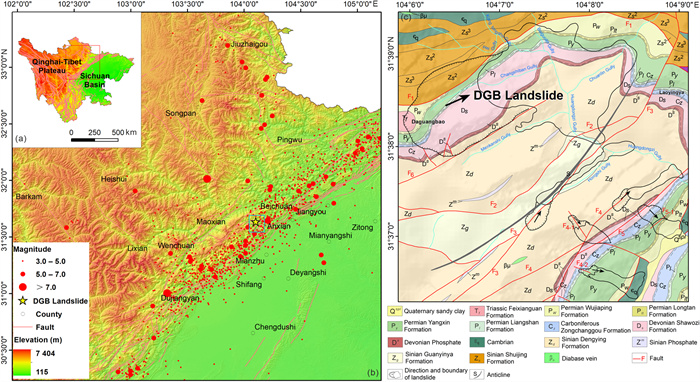
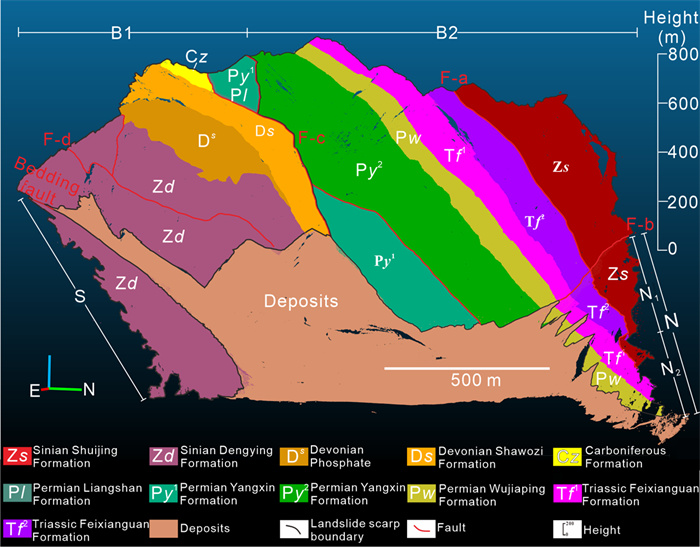
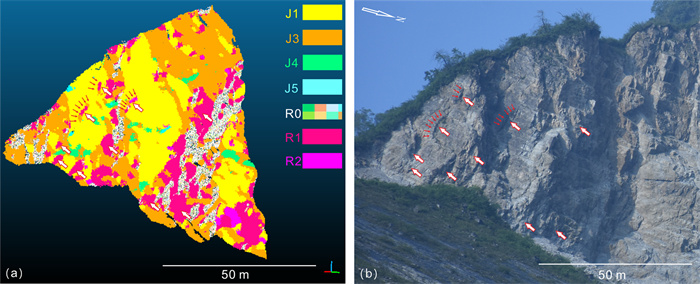
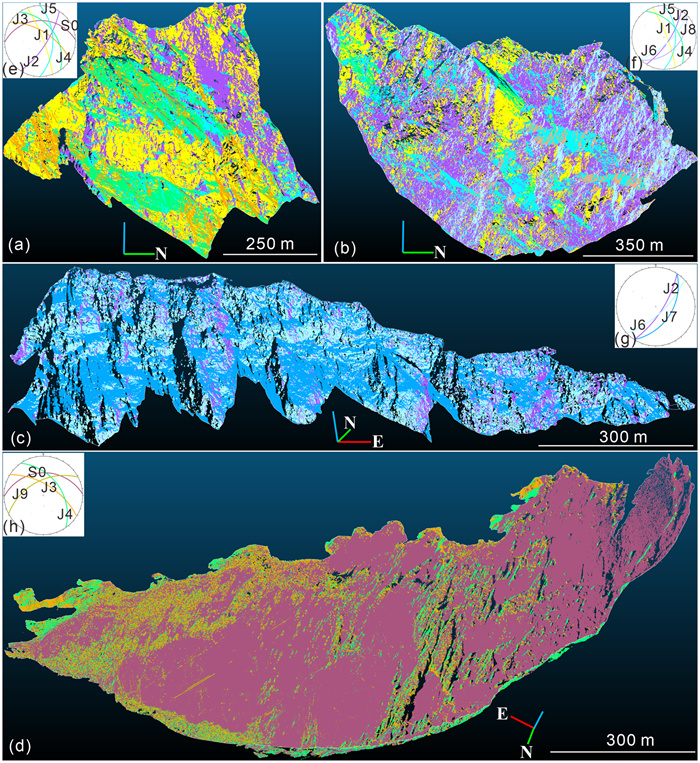
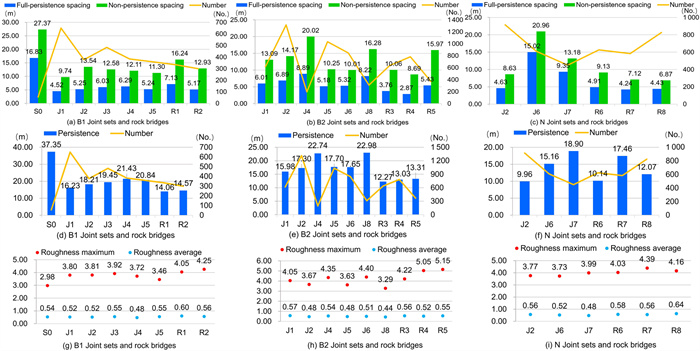
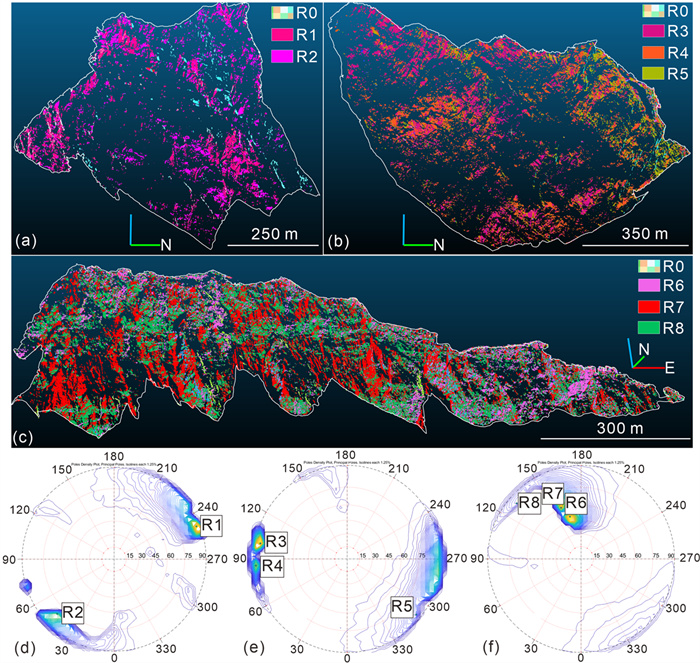
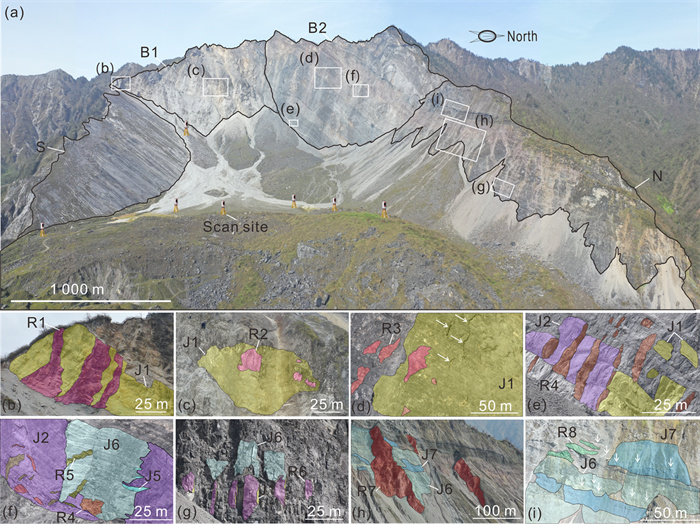
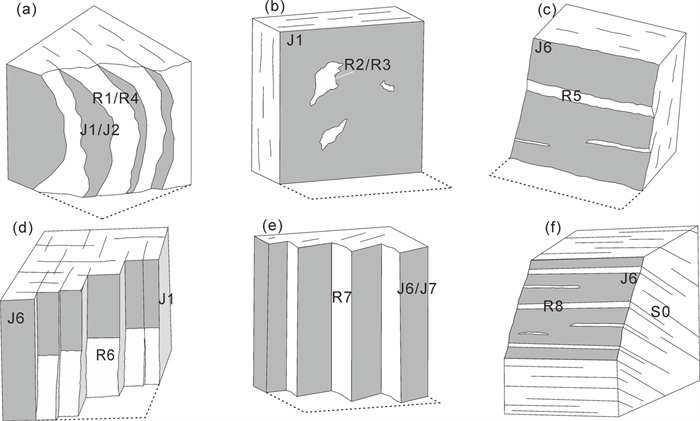
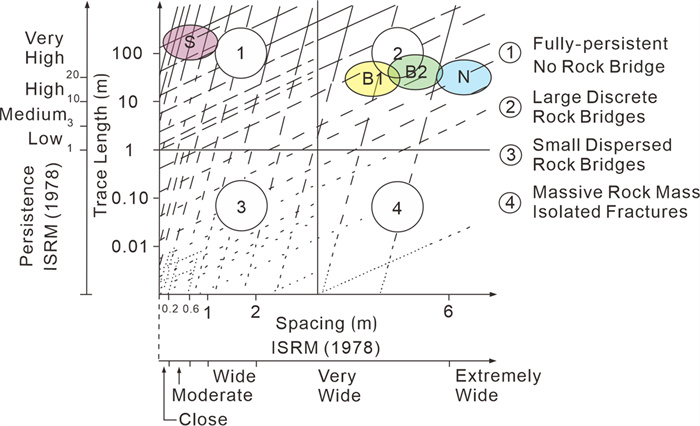
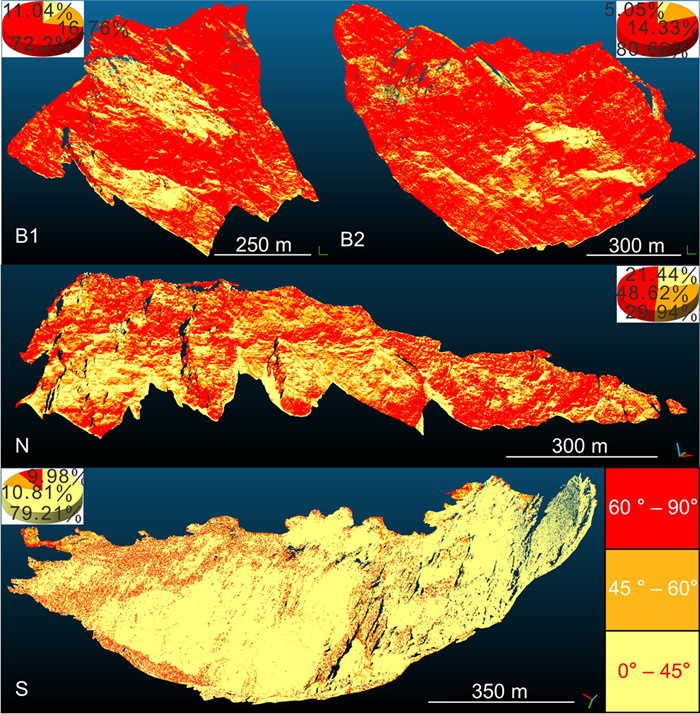
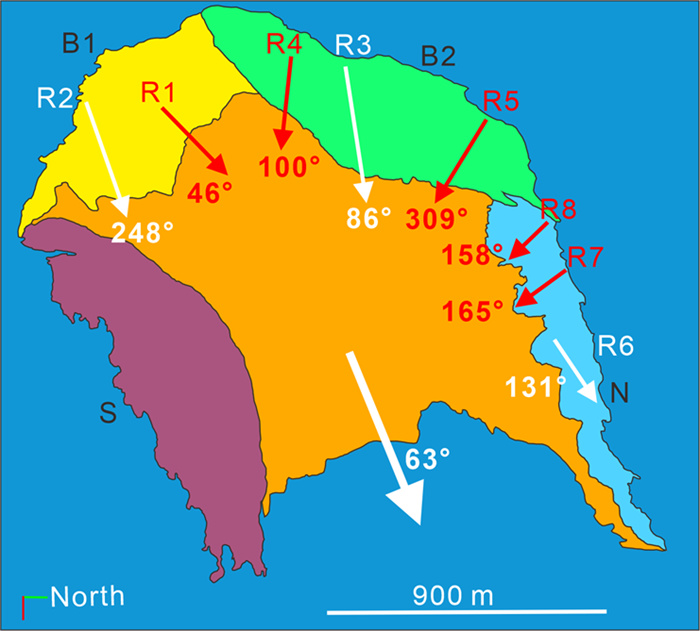
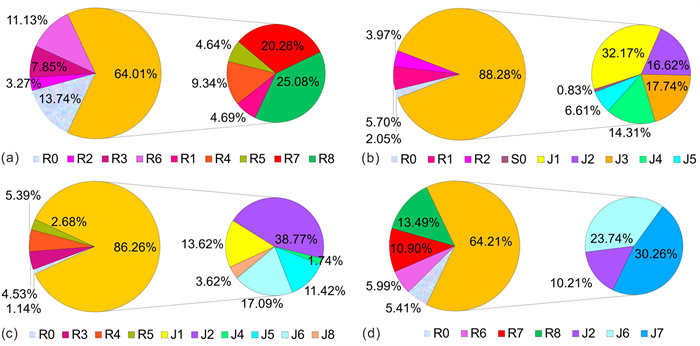
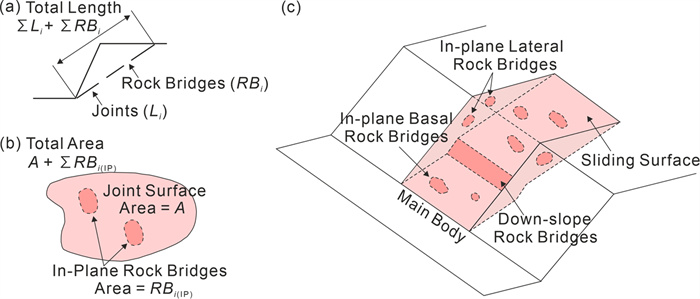
The Daguangbao (DGB) mega-landslide is the largest-scale landslide triggered by the 2008 Wenchuan Earthquake. The slope failure involved approximately 1.2 × 10⁹ m3, exposing a head scarp with a projected area of 1.85 km2 and a maximum height of 800 m. However, the initiation mechanisms remain inadequately understood due to a lack of detailed structural data on the failure boundaries. This study employs 3D laser scanning to analyze rock bridge distribution and fracture patterns on the earthquake landslide scarp. Results indicate that rock bridge failures constitute 22.49% of the total rupture area. The main scarp is characterized by tensile failure involving in-plane basal and downslope rock bridges linked with steep discontinuities, while the northern boundary exhibits combined tensile and shear failure through the linkage of in-plane lateral rock bridges with discontinuities of varying dips. The distribution and morphology of rock bridges indicate that the northern boundary experienced tensile failure under SN-oriented horizontal seismic loading, while the main scarp underwent tensile cracking parallel to the sliding direction due to EW-directed seismic forces. These processes led to the destabilization of a wedge-shaped block bounded by the southern and northern margins together with the main scarp, which subsequently slid along the basal bedding plane. Prior to the landslide's detachment from the source area, seismic activity had already caused 64.01% of the total rock bridge failures. During downslope movement, landslide traction further caused tensile failure of the remaining rock bridges on the main scarp and shear failure of those along the northern boundary. This study demonstrates that rock bridge analysis provides crucial insights into boundary fracture development during the rapid initiation of large earthquake-induced landslides.

| Abellán, A., Vilaplana, J. M., Martínez, J., 2006. Application of a Long-Range Terrestrial Laser Scanner to a Detailed Rockfall Study at Vall de Núria (Eastern Pyrenees, Spain). Engineering Geology, 88(3/4): 136–148. https://doi.org/10.1016/j.enggeo. 2006.09.012 doi: 10.1016/j.enggeo.2006.09.012 |
| Albano, M., Saroli, M., Beccaro, L., et al., 2023. Multi-Source Data Analysis to Assess the Past and Present Kinematics of the Pisciotta Deep-Seated Gravitational Slope Deformation (Southern Italy). Remote Sensing of Environment, 296: 113751. https://doi.org/10.1016/j.rse.2023.113751 |
| Barton, N., Choubey, V., 1977. The Shear Strength of Rock Joints in Theory and Practice. Rock Mechanics, 10(1/2): 1–54. https://doi.org/10.1007/bf01261801 |
| Bitenc, M., Kieffer, D. S., Khoshelham, K., 2019. Range versus Surface Denoising of Terrestrial Laser Scanning Data for Rock Discontinuity Roughness Estimation. Rock Mechanics and Rock Engineering, 52(9): 3103–3117. https://doi.org/10.1007/s00603-019-01755-2 |
| Bolla, A., Paronuzzi, P., 2020. Geomechanical Field Survey to Identify an Unstable Rock Slope: The Passo Della Morte Case History (NE Italy). Rock Mechanics and Rock Engineering, 53(4): 1521–1544. https://doi.org/10.1007/s00603-019-01963-w |
| Chen, N., Cai, X. M., Li, S., et al., 2021. Automatic Extraction of Rock Mass Discontinuity Based on 3D Laser Scanning. Quarterly Journal of Engineering Geology and Hydrogeology, 54(1): qjegh2020-054. https://doi.org/10.1144/qjegh2020-054 |
| Chen, Q., Cheng, H. Q., Yang, Y. H., et al., 2014. Quantification of Mass Wasting Volume Associated with the Giant Landslide Daguangbao Induced by the 2008 Wenchuan Earthquake from Persistent Scatterer InSAR. Remote Sensing of Environment, 152: 125–135. https://doi.org/10.1016/j.rse.2014.06.002 |
| Chen, R. F., Chang, K. J., Angelier, J., et al., 2006. Topographical Changes Revealed by High-Resolution Airborne LiDAR Data: The 1999 Tsaoling Landslide Induced by the Chi-Chi Earthquake. Engineering Geology, 88(3/4): 160–172. https://doi.org/10.1016/j.enggeo.2006.09.008 |
| Cui, S. H., Pei, X. J., Huang, R. Q., 2018. Effects of Geological and Tectonic Characteristics on the Earthquake-Triggered Daguangbao Landslide, China. Landslides, 15(4): 649–667. https://doi.org/10.1007/s10346-017-0899-3 |
| Cui, S. H., Pei, X. J., Jiang, Y., et al., 2021. Liquefaction within a Bedding Fault: Understanding the Initiation and Movement of the Daguangbao Landslide Triggered by the 2008 Wenchuan Earthquake (Ms = 8.0). Engineering Geology, 295: 106455. https://doi.org/10.1016/j.enggeo.2021.106455 |
| Cui, S. H., Pei, X. J., Huang, R. Q., et al., 2024. The Analysis of Seismic Induced Progressive Instability and Failure Mechanisms: A Case Study. International Journal of Rock Mechanics and Mining Sciences, 174: 105646. https://doi.org/10.1016/j.ijrmms.2024.105646 |
| Cui, S. H., Yang, Q. W., Pei, X. J., et al., 2020. Geological and Morphological Study of the Daguangbao Landslide Triggered by the ms. 8.0 Wenchuan Earthquake, China. Geomorphology, 370: 107394. https://doi.org/10.1016/j.geomorph.2020.107394 |
| de Vilder, S. J., Rosser, N. J., Brain, M. J., 2017. Forensic Analysis of Rockfall Scars. Geomorphology, 295: 202–214. https://doi.org/10.1016/j.geomorph.2017.07.005 |
| Dai, K. R., Li, Z. H., Tomás, R., et al., 2016. Monitoring Activity at the Daguangbao Mega-Landslide (China) Using Sentinel-1 TOPS Time Series Interferometry. Remote Sensing of Environment, 186: 501–513. https://doi.org/10.1016/j.rse.2016.09.009 |
| Deng, J. L., Kameya, H., Miyashita, Y., et al., 2011. Study on Dip Slope Failure at Higashi Takezawa Induced by 2004 Niigata-Ken Chuetsu Earthquake. Soils and Foundations, 51(5): 929–943. https://doi.org/10.3208/sandf.51.929 |
| Donati, D., Stead, D., Borgatti, L., 2023. The Importance of Rock Mass Damage in the Kinematics of Landslides. Geosciences, 13(2): 52. https://doi.org/10.3390/geosciences13020052 |
| Dong, X. J., Xu, Q., Huang, R. Q., et al., 2020. Reconstruction of Surficial Rock Blocks by Means of Rock Structure Modelling of 3D TLS Point Clouds: The 2013 Long-Chang Rockfall. Rock Mechanics and Rock Engineering, 53(2): 671–689. https://doi.org/10.1007/s00603-019-01935-0 |
| Dunning, S. A., Mitchell, W. A., Rosser, N. J., et al., 2007. The Hattian Bala Rock Avalanche and Associated Landslides Triggered by the Kashmir Earthquake of 8 October 2005. Engineering Geology, 93(3/4): 130–144. https://doi.org/10.1016/j.enggeo.2007.07.003 |
| Einstein, H. H., Veneziano, D., Baecher, G. B., et al., 1983. The Effect of Discontinuity Persistence on Rock Slope Stability. International Journal of Rock Mechanics and Mining Sciences & Geomechanics Abstracts, 20(5): 227–236. https://doi.org/10.1016/0148-9062(83)90003-7 |
| Elmo, D., Donati, D., Stead, D., 2018. Challenges in the Characterisation of Intact Rock Bridges in Rock Slopes. Engineering Geology, 245: 81–96. https://doi.org/10.1016/j.enggeo.2018.06.014 |
| Elmo, D., Stead, D., Yang, B., et al., 2022. A New Approach to Characterise the Impact of Rock Bridges in Stability Analysis. Rock Mechanics and Rock Engineering, 55(5): 2551–2569. https://doi.org/10.1007/s00603-021-02488-x |
| Ester, M., Kriegel, H. P., Sander, J., et al., 1996. A Density-Based Algorithm for Discovering Clusters in Large Spatial Databases with Noise. KDD, 96(34): 226–231 |
| Frayssines, M., Hantz, D., 2006. Failure Mechanisms and Triggering Factors in Calcareous Cliffs of the Subalpine Ranges (French Alps). Engineering Geology, 86(4): 256–270. https://doi.org/10. 1016/j.enggeo.2006.05.009 doi: 10.1016/j.enggeo.2006.05.009 |
| Ge, Y. F., Liu, C. Y., Tang, H. M., et al., 2025a. Landslide Monitoring from Point Cloud Sequence Using Stereo Feature Matching. Earth Surface Processes and Landforms, 50(6): e70073. https://doi.org/10.1002/esp.70073 |
| Ge, Y. F., Liu, G., Wang, H. Y., et al., 2025b. Rock Joint Detection from Borehole Imaging Logs Using a Convolutional Neural Networks Model. Journal of Earth Science, 36(4): 1700–1716. https://doi.org/10.1007/s12583-024-1989-5 |
| Gerstner, R., Fey, C., Kuschel, E., et al., 2023. Polyphase Rock Slope Failure Controlled by Pre-Existing Geological Structures and Rock Bridges. Bulletin of Engineering Geology and the Environment, 82(9): 363. https://doi.org/10.1007/s10064-023-03382-2 |
| Gigli, G., Casagli, N., 2011. Semi-Automatic Extraction of Rock Mass Structural Data from High Resolution LIDAR Point Clouds. International Journal of Rock Mechanics and Mining Sciences, 48(2): 187–198. https://doi.org/10.1016/j.ijrmms.2010.11.009 |
| Gigli, G., Lombardi, L., Carlà, T., et al., 2022. A Method for Full Three-Dimensional Kinematic Analysis of Steep Rock Walls Based on High-Resolution Point Cloud Data. International Journal of Rock Mechanics and Mining Sciences, 157: 105178. https://doi.org/10.1016/j.ijrmms.2022.105178 |
|
Glueer, F., Loew, S., 2015. Rock Bridge Failure Caused by the Aysèn 2007 Earthquake (Patagonia, Chile). In: Lollino. G., ed., Engineering Geology for Society and Territory. Springer Interna Publishing, Cham. 2: 775–780. |
| Gschwind, S., Loew, S., Wolter, A., 2019. Multi-Stage Structural and Kinematic Analysis of a Retrogressive Rock Slope Instability Complex (Preonzo, Switzerland). Engineering Geology, 252: 27–42. https://doi.org/10.1016/j.enggeo.2019.02.018 |
| He, M. C., Ribeiro, E. L., Müller, A., et al., 2019. Numerical and Safety Considerations about the Daguangbao Landslide Induced by the 2008 Wenchuan Earthquake. Journal of Rock Mechanics and Geotechnical Engineering, 11(5): 1019–1035. https://doi.org/10.1016/j.jrmge.2019.05.004 |
| Huang, R. Q., Pei, X. J., Fan, X. M., et al., 2012. The Characteristics and Failure Mechanism of the Largest Landslide Triggered by the Wenchuan Earthquake, May 12, 2008, China. Landslides, 9(1): 131–142. https://doi.org/10.1007/s10346-011-0276-6 |
| ISRM., 1978. Suggested Methods for the Quantitative Description of Discontinuities in Rock Masses. International Journal of Rock Mechanics and Mining Sciences & Geomechanics Abstracts, 15(6): 319–368 |
| Jaboyedoff, M., Couture, R., Locat, P., 2009. Structural Analysis of Turtle Mountain (Alberta) Using Digital Elevation Model: Toward a Progressive Failure. Geomorphology, 103(1): 5–16. https://doi.org/10.1016/j.geomorph.2008.04.012 |
| Jennings, J. E., 1970. A mathematical Theory for the Calculation of the Stability of Slopes in Open Cast Mines. Plann. Open Pit. Mines Proc. Johannesburg, 21(2): 87–102 |
| Karamitros, I., Ganas, A., Chatzipetros, A., et al., 2020. Non-Planarity, Scale-Dependent Roughness and Kinematic Properties of the Pidima Active Normal Fault Scarp (Messinia, Greece) Using High-Resolution Terrestrial LiDAR Data. Journal of Structural Geology, 136: 104065. https://doi.org/10.1016/j.jsg. 2020.104065 doi: 10.1016/j.jsg.2020.104065 |
| Li, H. B., Li, X. W., Ning, Y., et al., 2019. Dynamical Process of the Hongshiyan Landslide Induced by the 2014 Ludian Earthquake and Stability Evaluation of the back Scarp of the Remnant Slope. Bulletin of Engineering Geology and the Environment, 78(3): 2081–2092. https://doi.org/10.1007/s10064-018-1233-6 |
| Martin, C. D., 1978. The Influence of Fabric Geometry and Fabric History on the Stability of Rock Slopes: [Dissertation]. Imperial College, London. 99 |
| Oppikofer, T., Jaboyedoff, M., Pedrazzini, A., et al., 2011. Detailed DEM Analysis of a Rockslide Scar to Characterize the Basal Sliding Surface of Active Rockslides. Journal of Geophysical Research: Earth Surface, 116(F2): 2010JF001807. https://doi.org/10.1029/2010jf001807 |
| Paronuzzi, P., Bolla, A., Rigo, E., 2016. 3D Stress-Strain Analysis of a Failed Limestone Wedge Influenced by an Intact Rock Bridge. Rock Mechanics and Rock Engineering, 49(8): 3223–3242. https://doi.org/10.1007/s00603-016-0963-7 |
| Paronuzzi, P., Serafini, W., 2009. Stress State Analysis of a Collapsed Overhanging Rock Slab: A Case Study. Engineering Geology, 108(1/2): 65–75. https://doi.org/10.1016/j.enggeo. 2009. 06.019 doi: 10.1016/j.enggeo.2009.06.019 |
| Priest, S. D., 1993. Discontinuity Analysis for Rock Engineering. Springer Netherlands, Dordrecht. https://doi.org/10.1007/978-94-011-1498-1 |
| Priest, S. D., Hudson, J. A., 1976. Discontinuity Spacings in Rock. International Journal of Rock Mechanics and Mining Sciences & Geomechanics Abstracts, 13(5): 135–148. https://doi.org/10. 1016/0148-9062(76)90818-4 doi: 10.1016/0148-9062(76)90818-4 |
| Riquelme, A. J., Abellán, A., Tomás, R., et al., 2014. A New Approach for Semi-Automatic Rock Mass Joints Recognition from 3D Point Clouds. Computers & Geosciences, 68: 38–52. https://doi.org/10.1016/j.cageo.2014.03.014 |
| Riquelme, A., Tomás, R., Cano, M., et al., 2018. Automatic Mapping of Discontinuity Persistence on Rock Masses Using 3D Point Clouds. Rock Mechanics and Rock Engineering, 51(10): 3005–3028. https://doi.org/10.1007/s00603-018-1519-9 |
| Rocscience, 2015. Dips V. 6-Graphical and Statistical Analysis of Orientation Data. Rocscience Inc., Toronto |
| Singeisen, C., Massey, C., Wolter, A., et al., 2022. Mechanisms of Rock Slope Failures Triggered by the 2016 Mw 7.8 Kaikōura Earthquake and Implications for Landslide Susceptibility. Geo-morphology, 415: 108386. https://doi.org/10.1016/j.geomorph. 2022.108386 doi: 10.1016/j.geomorph.2022.108386 |
| Spreafico, M. C., Franci, F., Bitelli, G., et al., 2017. Intact Rock Bridge Breakage and Rock Mass Fragmentation Upon Failure: Quantification Using Remote Sensing Techniques. The Photogrammetric Record, 32(160): 513–536. https://doi.org/10. 1111/phor.12225 doi: 10.1111/phor.12225 |
| Sturzenegger, M., Stead, D., 2012. The Palliser Rockslide, Canadian Rocky Mountains: Characterization and Modeling of a Stepped Failure Surface. Geomorphology, 138(1): 145–161. https://doi.org/10.1016/j.geomorph.2011.09.001 |
| Thapa, B. B., Hughett, P., Karasaki, K., 1997. Semi-Automatic Analysis of Rock Fracture Orientations from Borehole Wall Images. Geophysics, 62(1): 129–137. https://doi.org/10.1190/1. 1444112 doi: 10.1190/1.1444112 |
| Truttmann, S., Herwegh, M., Schreurs, G., et al., 2021. The Effect of Pre-Existing Structures on the Moosfluh Landslide and Its Lateral Propagation (Great Aletsch Glacier, Switzerland). Geo-morphology, 377: 107530. https://doi.org/10.1016/j.geomorph. 2020.107530 doi: 10.1016/j.geomorph.2020.107530 |
| Tuckey, Z., Stead, D., 2016. Improvements to Field and Remote Sensing Methods for Mapping Discontinuity Persistence and Intact Rock Bridges in Rock Slopes. Engineering Geology, 208: 136–153. https://doi.org/10.1016/j.enggeo.2016.05.001 |
| Vöge, M., Lato, M. J., Diederichs, M. S., 2013. Automated Rockmass Discontinuity Mapping from 3-Dimensional Surface Data. Engineering Geology, 164: 155–162. https://doi.org/10.1016/j.enggeo.2013.07.008 |
| Wang, C. Y., Zou, X. J., Han, Z. Q., et al., 2016. An Automatic Recognition and Parameter Extraction Method for Structural Planes in Borehole Image. Journal of Applied Geophysics, 135: 135–143. https://doi.org/10.1016/j.jappgeo.2016.10.005 |
| Wang, G. H., Furuya, G., Zhang, F. Y., et al., 2016. Layered Internal Structure and Breaching Risk Assessment of the Higashi-Takezawa Landslide Dam in Niigata, Japan. Geomorphology, 267: 48–58. https://doi.org/10.1016/j.geomorph.2016.05.021 |
| Wang, X., Zou, L. J., Shen, X. H., et al., 2017. A Region-Growing Approach for Automatic Outcrop Fracture Extraction from a Three-Dimensional Point Cloud. Computers & Geosciences, 99: 100–106. https://doi.org/10.1016/j.cageo.2016.11.002 |
| Wichmann, V., Strauhal, T., Fey, C., et al., 2019. Derivation of Space-Resolved Normal Joint Spacing and in Situ Block Size Distribution Data from Terrestrial LIDAR Point Clouds in a Rugged Alpine Relief (Kühtai, Austria). Bulletin of Engineering Geology and the Environment, 78(6): 4465–4478. https://doi.org/10.1007/s10064-018-1374-7 |
| Wickens, E. H., Barton, N. R., 1971. The Application of Photogrammetry to the Stability of Excavated Rock Slopes. The Photogrammetric Record, 7(37): 46–54. https://doi.org/10.1111/j.1477-9730.1971.tb01127.x |
| Wolter, A., Stead, D., Clague, J. J., 2014. A Morphologic Characterisation of the 1963 Vajont Slide, Italy, Using Long-Range Terrestrial Photogrammetry. Geomorphology, 206: 147–164. https://doi.org/10.1016/j.geomorph.2013.10.006 |
| Wu, J. H., Wang, W. N., Chang, C. S., et al., 2005. Effects of Strength Properties of Discontinuities on the Unstable Lower Slope in the Chiu-Fen-Erh-Shan Landslide, Taiwan. Engineering Geology, 78(3/4): 173–186. https://doi.org/10.1016/j.enggeo. 2004.12.005 doi: 10.1016/j.enggeo.2004.12.005 |
| Wyllie, D. C., Mah, C., 2004. Rock Slope Engineering: 4th Ed. Spon Press, London |
| Xu, Q., Pei, X. J., Huang, R. Q., 2010. Large-Scale Landslides Induced by the Wenchuan Earthquake. Science Press, Beijing (in Chinese) |
| Yin, Y. P., Wang, M., Li, B., et al., 2012. Dynamic Response Characteristics of Daguangbao Landslide Triggered by Wenchuan Earthquake. Chinese Journal of Rock Mechanics and Engineering, 31(10): 1969–1982 (in Chinese with English Abstract) |
| Zhao, X. H., Zhang, W., Chen, J. Q., et al., 2025. Integrating UAV Photogrammetry and Thermal Infrared Entropy in Evaluating Rock Mass Characteristics. Journal of Earth Science, 36(4): 1853–1866. https://doi.org/10.1007/s12583-025-0192-7 |
| Zhang, Y. B., Chen, G. Q., Zheng, L., et al., 2013. Effects of Near-Fault Seismic Loadings on Run-out of Large-Scale Landslide: A Case Study. Engineering Geology, 166: 216–236. https://doi.org/10.1016/j.enggeo.2013.08.002 |
Figures(23) / Tables(1)
Copyright © 2013-2020 Journal of Earth Science 鄂ICP备15021562号-2
Tel: +86-27-67885075 Fax: +86-27-67885075 E-mail: xbb@cug.edu.cn
Address: Editorial Office of Journal, China University of Geosciences, Yujiashan, Wuhan, Hubei 430074, P. R. China
Supported by:
Beijing Renhe Information Technology Co. Ltd
E-mail:
info@rhhz.net



 DownLoad: